Wednesday, August 28, 2019
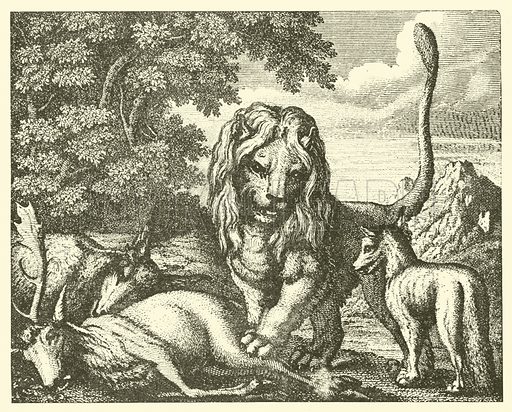
Aesop's Fable: The Ass, the Fox and the Lion
The Ass and the Fox, having entered into a partnership together, went out into the forest to hunt.
They had not proceeded far, when they met a Lion.
The Fox approached the Lion and promised to contrive for him the capture of the Ass, if he would pledge his word that his own life should be spared.
On his assuring him that he would not injure him, the Fox led the Ass to a deep pit, and contrived that he should fall into it.
The Lion, seeing that the Ass was secured, immediately clutched the Fox, and then attacked the Ass at his leisure.
Moral: "Traitors must expect treachery."
Tuesday, August 27, 2019
Quote for the Day
"Sometimes the Bible in the hand of one man is worse than a whisky bottle in the hand of (another)"
—Harper Lee, To Kill a Mockingbird
Poem Spot
The Little Boy And Old Man
By Shel Silverstein
Said the little boy, sometimes I drop my spoon.
Said the little old man, I do that too.
The little boy whispered, I wet my pants.
I do too, laughed the old man.
Said the little boy, I often cry.
The old man nodded. So do I.
But worst of all, said the boy,
it seems grown-ups don’t pay attention to me.
And he felt the warmth of a wrinkled old hand.
I know what you mean, said the little old man.
Monday, August 26, 2019
Why no Bytes yesterday
My apologies for the lack of Bytes posts yesterday, a computer glitch prevented me from posting.
😟
Readers Write
-----oOo-----
Steve M sent me an email on the post about the Enola Gay, the name of the plane that nuked Hiroshima, named by its captain, Paul Tibbets, after his mother Enola Gay Tibbets. It is the first in a proposed series of people who Hve given their names to events and inventions for which they may not have wanted to be so remembered.
Enjoyed the Enola Gay Bytes today Otto. Most informative. Thank you.
Steve M
Thanks, Steve.
By the way:
As noted in the post, the plane which dropped the atomic bomb (code named Little Boy) on Hiroshima was Enola Gay, accompanied by The Great Artiste and Necessary Evil.
The plane which dropped the atomic bomb (code named Fat Man) on Nagasaki was named Bockscar, a play on the name of its command pilot captain Frederick C Bock. Bockstar was accompanied by planes Up An’ Atom and Laggin Dragon.
When the atomic bomb was being developed, there were 2 designs worked on, a gun-type design in which two sub-critical masses would be brought together by firing a "bullet" into a "target", and a plutonium fission through implosion design. The gun-type and implosion-type designs were codenamed "Thin Man" and "Fat Man" respectively. These code names were created by Robert Serber, a former student of Oppenheimer's who worked on the Manhattan Project. He chose them based on their design shapes; the Thin Man was a very long device, and the name came from the Dashiell Hammett detective novel The Thin Man and series of movies. The Fat Man was round and fat and was named after Sydney Greenstreet's character in The Maltese Falcon. Little Boy came last as a variation of Thin Man.
Some pics:
A mockup of the Fat Man nuclear device.
Captain Tibbets and Enola Gay
The Great Artiste
Necessary Evil
Bockscar
Laggin Dragon
Up An' Atom
-----oOo-----
Byter David C B also sent me an email:
Your joke about the German guy and his martini reminds me of the German riddle
What comes between fear and sex?
The answer: Funf.!
And that joke about the electrician takes me back to my apprentice days when this extract from Hillaire Bellocs "Newdiaate Poem" was our safety warning:
A random touch — a hand's imprudent slip —
The Terminals — a flash — a sound like " Zip! "
A smell of burning fills the started Air —
The Electrician is no longer there!
Thanks David
The first comment in turn reminds me of the Chevy Chase’s European Vacation:
[In Germany, Clark is looking for their relatives house]
Clark Griswold: What are we looking for?
Audrey Griswold: Sechs, Dad.
[Pronounces it as "Sex"]
Clark Griswold: That'll do Audrey.
Rusty Griswold: Dad, that's German for six.
[Unable to find No 6, Clark knocks on a door and seeks directions]
Clark Griswold: Hello, my family and I were looking for sex.
German Resident: Schweinhund!
-----oOo-----
Steve M also sent me his comments on the article that saw the reverence for Woodstock as being overrated and unwarranted:
Good morning Otto,
It’s a shame people don’t get over themselves, and see Woodstock for what it was - a groundbreaking concert over a couple of days with a large audience, mostly hippies, some of whom were off their face with drugs. Perhaps it was a statement by a generation, or maybe it was just a damned good concert with some awesome music?
Steve M
Another interesting Bytes!
Thanks, Steve
Btw:
Classic rock fans in the retirement home
Saturday, August 24, 2019
Quote for the Day
Mario Puzo wrote both screenplays for Godfather 1&2, saying it was a “cinch” as he just followed his book. After, he thought he should learn about screenwriting so bought a book on writing and on the first page it said “Study the Godfather movies as perfect examples of the art”.
- Johnny Geller
Not how they might have wanted to be remembered: Enola Gay
The Enola Gay was the name of the plane that dropped the atomic bomb on Hiroshima and was named after Enola Gay Tibbets, the mother of the pilot, Colonel Paul Tibbets (pictured above).
Some facts:
The bomber was one of the 15 initial examples of B-29s built to the "Silverplate" specification—65 of these eventually being completed during and after World War II—giving them the primary ability to function as nuclear "weapon delivery" aircraft. These modifications included an extensively modified bomb bay with pneumatic doors and British bomb attachment and release systems, reversible pitch propellers that gave more braking power on landing, improved engines with fuel injection and better cooling, and the removal of protective armour and gun turrets.
On 5 August 1945, during preparation for the first atomic mission, Tibbets assumed command of the aircraft and named it after his mother, Enola Gay Tibbets, who, in turn, had been named for the heroine of a novel. When it came to selecting a name for the plane, Tibbets later recalled that:
... my thoughts turned at this point to my courageous red-haired mother, whose quiet confidence had been a source of strength to me since boyhood, and particularly during the soul-searching period when I decided to give up a medical career to become a military pilot. At a time when Dad had thought I had lost my marbles, she had taken my side and said, "I know you will be all right, son."
Enola Gay, piloted by Tibbets, took off from North Field, in the Northern Mariana Islands, about six hours' flight time from Japan, accompanied by two other B-29s, The Great Artiste, carrying instrumentation, and a then-nameless aircraft later called Necessary Evil, commanded by Captain George Marquardt, to take photographs. The director of the Manhattan Project, Major General Leslie R. Groves, Jr., wanted the event recorded for posterity, so the takeoff was illuminated by floodlights. When he wanted to taxi, Tibbets leaned out the window to direct the bystanders out of the way. On request, he gave a friendly wave for the cameras (see photo at top).
On 6 August 1945, the Enola Gay became the first aircraft to drop an atomic bomb. The bomb, code-named "Little Boy", was targeted at the city of Hiroshima, Japan, and caused the near-complete destruction of the city.
Little Boy unit on trailer cradle in pit before being loaded into Enola Gay's bomb bay
At the time this photo was made, smoke billowed 6,000 metres / 20,000 feet above Hiroshima while smoke from the burst of the first atomic bomb had spread over 3,000 metres / 10,000 feet on the target at the base of the rising column.
70,000–80,000 people, 30% of the city's population, were killed by the blast and resultant firestorm and another 70,000 injured. Out of those killed, 20,000 were soldiers.
Enola Gay returned safely to its base, The Great Artiste and Necessary Evil following at short intervals. Several hundred people, including journalists and photographers, had gathered to watch the planes return. Tibbets was the first to disembark, and was presented with the Distinguished Service Cross on the spot.
Enola Gay landing at its base after its bombing of Hiroshima
Enola Gay participated in the second atomic attack as the weather reconnaissance aircraft for the primary target of Kokura. Clouds and drifting smoke resulted in a secondary target, Nagasaki, being bombed instead.
After the war, the Enola Gay returned to the United States, where it was operated from Roswell Army Air Field, New Mexico. In 1946 it was transferred to the Smithsonian Institution, and spent many years parked at air bases exposed to the weather and souvenir hunters, before being disassembled and transported to the Smithsonian's storage facility at Suitland, Maryland, in 1961.
In the 1980s, veterans groups engaged in a call for the Smithsonian to put the aircraft on display, leading to an acrimonious debate about exhibiting the aircraft without a proper historical context. The cockpit and nose section of the aircraft were exhibited at the National Air and Space Museum (NASM) in downtown Washington, D.C., for the bombing's 50th anniversary in 1995, amid controversy. Since 2003, the entire restored B-29 has been on display at NASM's Steven F. Udvar-Hazy Center.
Enola Gay nose, port side, at the Steven F. Udvar-Hazy Center.
The last survivor of its crew, Theodore Van Kirk, died on 28 July 2014 at the age of 93.
"I honestly believe the use of the atomic bomb saved lives in the long run. There were a lot of lives saved. Most of the lives saved were Japanese."
- Theodore Van Kirk
In 2005, Van Kirk came as close as he ever got to regret.
"I pray no man will have to witness that sight again. Such a terrible waste, such a loss of life. We unleashed the first atomic bomb, and I hope there will never be another. I pray that we have learned a lesson for all time. But I'm not sure that we have."
“What do you say to people who maintain that there was no need to drop an Atomic Bomb on Hiroshima? The Japanese were ready to surrender, that was overkill?” Tibbets was asked. “First of all, war stories are told in two phases. One is the fairly tale, ‘Once upon a time … (Revisionist History). But real war stories are not B.S., this is the way it happened,” he explained with steam coming out of his ears.
Tibbets said at least 80,000 people were killed because of the bomb he dropped. “When I got the assignment to drop the bomb on Hiroshima I knew I had to be successful,” he said. “Because if we were successful we could convince the emperor of the futility of continuing the fight. MacArthur’s headquarters in the Pacific estimated that if we had to invade (the Japanese main Islands) we would lose 1 million men killed and wounded. I’ve been to Japan a number of time after the war. The people over there ask me, ‘Why didn’t you drop the bomb earlier and stop the war?'” Tibbets said.
A couple of years ago the Smithsonian Institution in Washington, D.C. had a portion of the “Enola Gay” on display that caused an international flap. He was asked what that was all about. “The Smithsonian had come up with a proposal to display the airplane as an exhibit. It was fraught with errors because revisionist historians had written the whole damn thing,” Tibbets said.
“If you had to drop the Atomic Bomb on Hiroshima again and the conditions were similar, would you?”
“I wouldn’t hesitate a minute,” Tibbets replied.
Name: Paul W. Tibbets
Date of Birth: 23 February 1915
Death: 1 November 2007
Hometown: Columbus, Ohio
Discharged: 1966
Rank: Brigadier General
Unit: 509th Composite Group, 97th Bombardment Group
Commendations: Purple Heart, Distinguished Service Cross, Distinguished Flying Cross, Air Medal, Legion of Merit, European Campaign Medal, Joint Staff Commendation Medal, American Defense Service Medal, World War II Victory Medal, Air Force Outstanding Unit Award, American Campaign Medal
Tibbets died in 2007 at age 92. He had requested cremation and no physical memorial, because it would become a pilgrimage site for nuclear protesters.
Enola Gay Tibbets 1890-1966
How did Enola Gay Tibbetts feel at being so recorded in history? I haven’t been able to find out but it's not something that I would have liked.
Friday, August 23, 2019
Funny Friday
😂😂😂😂😂😂😂
Yes, it's that time again, Friday and time for some fun.
But be warned, there are risque waters ahead so proceed at your own risk.
😂😂😂😂😂😂😂
This week's humour:
----oOo----
Not sure about this dodgy electrician I hired to do some work in my basement.
I came home early and he's down there sleeping on the job, and also now wearing his hair in a full afro.
----oOo----
A man goes to prison, it's his first time doing time. At night when everyone is in their cell he hears someone say "43!" and all the guys in their cells howl with laughter. A little later someone from another cell says "161" and again the cell block has a hearty laugh. The new guy asks his cell mate to explain.
Well, says the cell mate, everyone's been here for some time, and we've only got one joke book in the library, so we have all heard all the jokes. Rather than tell the whole thing now we just rattle off the number.
After another half hour the new guy thinks he's ready to join in, so he shouts "11!" Silence. He looks at his cell mate and says "What gives?" and the celly just groans and says "Aww man, you didn't tell it right."
----oOo----
A woman goes into a pet shop looking for a parrot. The assistant shows her a beautiful African Grey parrot. "What about this one, Madam? A beautiful bird, I'm sure you'll agree, and it's an absolute steal at only $20." "Why is it that cheap?" the woman asks. "Well", replies the assistant, it used to live in a brothel and as a result its language is a touch fruity" "Oh, I don't mind that", said the woman, making her mind up, "I'm broad minded and it'll be a laugh having a profane parrot". So saying, she buys the parrot and takes him home.
Once safely in his new home, the parrot looks around and squawks at the woman "Fuck me, a new brothel and a new madam" "I'm not a madam and this Isn't a brothel" says the woman indignantly. A little later the woman's two teenage daughters arrive home. "A new brothel, a new madam, and now new prostitutes" says the parrot when he sees the daughters. "Mum, tell your parrot to shut-up, we're not prostitutes" complained the girls, but they all see the funny side and have at laugh at their new pet.
A short while later, the woman's husband comes home. "Well, fuck me, a new brothel, a new madam, new girls, but the same old clients. How ya doin', Dave?"
----oOo----
Nurses aren't supposed to laugh.
"Of course I won't laugh, I'm a professional �‚ nurse. In over twenty years I've never laughed at a patient."
"Okay then," Fred said and proceeded to drop his trousers, evealing the tiniest man thingy the nurse had ever seen.
Length and width, it couldn't have been bigger than an AAA battery.
Unable to control herself, the nurse started giggling, then almost fell to the floor laughing.
A few minutes later she was able to regain her composure. "I'm so sorry," said the nurse. "I don't know what came over me. On my honor as a nurse and a lady, I promise it won't happen again. Now tell me, what seems to be the problem?"
"It's swollen," Fred replied.
Things went downhill from there.
----oOo----
A German guy and his beautiful date sit down at a bar.
He asks the bartender for a couple of martinis.
The bartender asks "Dry?"
The German replies, "Nein, zwei."
😂😂😂😂😂😂😂
From the vault:
Dad and Dave went to the Royal Easter Show in Sydney and were very interested in the new tractors that were on display. One salesman demonstrated his machine and then offered them a deal.
'You can have this model for $10,000, and I'll take off 10 per cent for cash.' They went away to discuss the deal.
'What’s he mean by take orf 10 per cent cash?' asked Dad. 'How much would he take orf?'
'Gees, I dunno, Dad,' replied Dave.
'Listen Dave, you're in pretty good with that barmaid at the pub where we're stayin' and she looks like a pretty smart sort of girl. How about you ask her?' So Dave approached the barmaid.
'Tell me, Dulcie, if I gave you $10,000 less 10 per cent, how much would you take orf?'
'Jesus, Dave!' she said, 'If you gave me $10,000 less 10 per cent, I'd take off everything bar me garters and you could use them for stirrups.’
😂😂😂😂😂😂😂
Limerick of the Week:
There once was a sad Maitre d'Hôtel
Who said "They can all go to Hell,
What they do to my wife -
Why, it ruins my life,
And the worst is, they do it so well".
😂😂😂😂😂😂😂
Corn Corner:
----oOo----
Which is heavier: one gallon of water or 10 gallons of butane?
The water.
No matter how much you have, butane will always be a lighter fluid.
----oOo----
I got an e-mail saying “At Google Earth, we can even read maps backwards.”,
I thought “That’s just spam.”
----oOo----
I just got robbed by 6 dwarfs.
Not Happy
----oOo----
I went to visit my old hometown the other day and found the house I grew up in. I knocked on the door and asked the owners if I could have a look around. They said "NO!" and closed the door in my face.
My parents can be such jerks sometimes.
😂😂😂😂😂😂😂
Thursday, August 22, 2019
Woodstock, an alternative view
----oOo----
Son Thomas drew my attention to the article below.
It is true that over time, events and people often achieve an iconic status much greater than when they happened or lived.
Remember the movie “The Man Who Shot Liberty Valance”. There is a scene where the newspaper editor says “When the legend becomes fact, print the legend.”
Nonetheless there are still men and women among us who dare to call out “But the emperor is not wearing any clothes.”
Here is such an example, from the pages of Ther Bulwark at:
----oOo----
Woodstock Actually Accomplished Nothing
And yet here we are, marking its 50th anniversary.
by Christian Schneider August 15, 2019
Musician Brian Eno allegedly once remarked that while not many people purchased the first album by the Velvet Underground, everyone who did buy it ended up starting a band.
It can similarly be said that while a relatively small sliver of America’s hippie population attended Woodstock in the summer of 1969, everyone who did attend has either written a book or produced a documentary about it.
Recently, PBS cranked out another dutiful hagiography in honor of the festival’s 50th anniversary, which starts Friday. The documentary accomplished what all remembrances of Woodstock seek to do – declare victory for the hippie ethos and lionize the attendees who did little more than actually survive the challenges of their own making.
Those who mock millennials for their self-absorption have clearly forgotten the hippies’ bottomless well of unearned self-regard.
Perhaps no one is more responsible for keeping the Woodstock myth alive than organizer Michael Lang, who, in his autobiography, Marching to Woodstock, described Jimi Hendrix’s performance of “The Star Spangled Banner” thusly:
As Jimi builds the song, adding feedback and distortion, I am carried away just as is everyone around me. I realize the national anthem will never been the same. Jimi has plugged into our collective experience: all the emotional turmoil and confusion we have felt as young Americans growing up in the sixties pours from the sound towers. His song takes us to the battlefield, where we feel the rockets and bombs exploding around us; to demonstrations and marches, confronting police and angry citizens. It’s a powerful rebuke of the war, of racial and social inequity, and a wake-up call to fix the things that are broken in our society.
Or, it was a guy playing the guitar early on a Monday morning.
(Of note, Woodstock co-founder Bob Spitz has said Lang left the show after a Sunday night performance by The Band, meaning it’s extremely unlikely Lang was even there for the Hendrix performance. According to most estimates, up to 90 percent of the crowd had left by Monday morning.)
This is the conceit of the hippie generation: that their culture of free love and chemical consciousness actually led America out of the Vietnam War, as if Jimi Hendrix produced the first copy of the Pentagon Papers on stage from his afro.
This is, of course, the history we get when the hippies get to write it; it is just assumed that bohemian values were vindicated at every turn.
But these stories reflect what we can demonstrate actually happened. Less clear is whether we would have been better off had an entire generation not deluded themselves into believing dropping acid somehow effected change in the world.
Presumably, America would have been fine without the hippies – think of all the college degrees that would have been earned and all the brain cells that would have remained alive.
In Jeff Guinn’s book Manson: The Life and Times of Charles Manson,” Guinn details the streets of San Francisco during the 1967 “Summer of Love,” where teenage girls were routinely pumped with LSD and dragged off to communes. Manson himself had trouble keeping some of his “family” members in the fold, as he was constantly competing with other cult leaders for the top recruits. (Imagine a popular figure rising to power by mistreating women and warning of impending racial conflict: inconceivable in 2019, right?)
In the mythology now told by hippie historians, even Woodstock’s massive failures were simply obstacles to be overcome by love and understanding. When hundreds of thousands of people trampled the barely existent gates to gain free entry, it was the public standing up against corporatism. When thousands of people ended up in the medical tents from dehydration, hunger, and bad drugs, the volunteers caring for them demonstrated a triumph of humanity. When the festival ended and the field was saturated with mountains of rain-soaked tents, blankets, and garbage, it was proof of the philanthropy of those who stayed to help clean up.
But some facts about Woodstock are too hard to spin. Three people died during the festival. A Saturday night riot by an anarchist group contending the festival was committing “crimes against the people” for selling hot dogs for 35 cents left 12 of the 16 food stands burned to the ground. The PBS documentary notes that during a rainstorm, an exposed power cable could easily have electrocuted the entire crowd. Love can be a strong force, but it is unlikely to prevent the electrocution of 500,000 people.
In the half-century since America’s most famous music festival, actual drugs have been supplanted by the drug of nostalgia. As we all know, the winners get to write the history – it’s just unclear what the Woodstock attendees actually “won,” other than a few extra shots of penicillin.
Christian Schneider
Christian Schneider is a reporter for The College Fix and author of 1916: The Blog.
Wednesday, August 21, 2019
Various items of art and public installations
By the way, the elderly people on the sides of buildings was
a 2012 installation art project, read about it and see more pics at:
How did the chairs stay put?
How did the old people get up there?
How were they secured and protected?
Beats me.
Subscribe to:
Posts (Atom)