Thursday, January 28, 2021

READERS WEEK: Lismore's Christmas Trees

Brett B sent me an email at Christmas with a link to an item in Atlas Obscura, a site that presents interesting items about places around the world. Brett’s link is to an item about the Australian town of Lismore, which is located very close to the Queensland border. This is a pic of the main street, Molesworth Street: 


Christmas has passed but the article is still of interest. This is the link: 

Thanks, Brett. 

The following text and photographs are from that article . . . 


The Australian Town That Turns Trash Into Christmas Trees 

Vivienne Pearson, December 23 2020 

The traditional public Christmas tree in Lismore, the largest town in the northeast of Australia’s New South Wales, used to be pretty ho-ho-hum. Before 2015, a Cook pine in the middle of a roundabout was dressed up each holiday season as a tannenbaum. But, like all Cook pines, the tree leans toward the equator, so the effect of decorating it was underwhelming. “Everyone said ‘Oh, that’s a bit sad, it can’t even stand straight,’” says Neil Marks, acting mayor of Lismore City Council. 

The Cook pine tree, cheery but crooked. 

Lismore is an inland town sometimes seen as the less-dazzling cousin of celebrity-filled Byron Bay. However, it has a vibrant culture centered on art and environmental awareness. So it was fitting when a member of the town’s council staff came up with the idea of a recycled Christmas tree, to be situated on an otherwise unadorned roundabout down the street from the Cook pine tree (which also still gets the festive treatment). 

The first tree—built under the cover of night out of a pile of bicycles—debuted in 2015 and ushered in a new tradition. In subsequent years, the tree has been made from used tires, old road signs, broken umbrellas, and potted plants combined with solar-powered lighting. Materials are sourced from the town’s junkyard, and various town staff take on design and construction. 

The 2015 bicycle tree—the one that started it all. 

Like most things in this unusual year, the 2020 tree was a little different. It was a group effort, since most staff worked from home due to COVID-19 restrictions. And the tree is an ode to resilience. “This year’s tree is a nod and a tribute to our rural community,” says Marks, who spoke to Atlas Obscura while he waited to see whether flood waters in town would recede and allow him to travel back to his workplace. “They’ve had a tough time. They’ve gone through fires, a drought, and now a little too much rain.” Local farmers have also suffered from indirect effects of COVID-19, including border closures, despite Lismore being one of the many regions of Australia that has had no active cases of the virus. 

This year’s 23-foot tree is made from recycled 6.5-gallon drums that store chemicals for use on farms. The decorations are made from used animal feed bags, piping, and discarded metal. 

The 2020 tree is made from farm castoffs. 

Many in the community love the scrappy, garbage-inspired trees. “I’m very much in the ‘bah-humbug’ community but, despite my general pessimism, I have grown fond of our tree,” says Lismore resident Gray Wilson. Another fan is Jodi Adams, who took a keen interest in the trees after moving to Lismore from Sydney in 2018. An ex-journalist and longtime environmental activist, she can’t believe that more public groups aren’t following the trend, “especially those [in] areas that wear their green credentials proudly,” she says. “I send photos of them to friends in Australia and abroad and they are amazed it is not done elsewhere.” 

In 2019, the tree was comprised of a bunch of tiny plants. 

One year, the whole thing was made of umbrellas. 

Adams has an elaborate vision for a tree-filled future, recreating each past tree every year in addition to adding a new one. “Wouldn’t it be amazing to have one on each street corner?” she says. For (Acting Mayor) Marks, one per year is enough. And this year, it’s very welcome. “It’s something different to make you smile,” he says. “After 2020, we need to smile as much as we can.”

Wednesday, January 27, 2021

Quote for the Day


READERS WEEK: The Miniatures of Jacki Gordon

Continuing Readers Week.

An email from Rob T:
Otto, 

You might like these …. !! 

Best, Rob T 


Thanks Rob. 

The above link is to an article about Glasgow artist Jacki Gordon, who creates and then photographs miniature scenes using everyday foods items. Gordon is a research and evaluation consultant specialising in mental health and wellbeing, her sculptures and photographs being strictly amateur. 

Her favourite photography subjects were found in the outdoors - landscapes and animals – but then came the Covid-19 pandemic with the home isolation, lockdown and travel restrictions. She spent time photographing her dog Ollie and when that was exhausted, turned to macro photography, close up photography of small things. According to her: "Very quickly, I got bored photographing the more obvious subjects, like flowers. So a couple of months ago, I started taking pics of Lego people, but then I wanted pictures that were more lifelike and also more surprising." 

Shei now poses tiny model railway figures and food to create humorous scenes, which she posts to social media for her friends' and family's amusement. 

Some Jacki Gordon comments: 

"My first miniature scene shots were of Nordic walkers scaling frozen peas. I struggled so much with those first shots. My partner Paul and I were eating the defrosted peas for days. However, I was hooked." 

“Setting the figures in place is a labour of love. They stick to my fingers, fall over, and are just generally uncooperative. It can take a couple of hours to get them to behave so that I achieve the right look. I find the whole experience utterly immersive." 

"Generally my ideas are sparked by what I can find in the fridge or the back of the cupboard, often in the middle of the night as I am such a bad sleeper. 

"I set up various shots, look at them, think - that doesn't work, and then have a rummage to see what I can find." 

So far, Jacki has created about 70 of her miniature scenes and she hopes to eventually publish them in a book. 

She said: "Until then, I will continue trying to brighten up these dark days for myself, and for others." 

Gallery:


Tuesday, January 26, 2021

Thought for the Day


READERS WEEK: Parliament House Invasion and Riot, Canberra, Australia

Coincidentally, the next item in the Readers Week queue is about Australia, which is appropriate in that today is Australia Day.

Following the Capital riot in the US, Byter Sue P sent me an email providing a Wikipedia account of the riot in Parliament House, Australia in 1996, plus a link to a video about it. 

I had forgotten about that and am glad Sue’s email reminded me of our own history of a similar event.

Thanks, Sue. 


The video: 

The link sent by Sue: 


The Story: 

The Wikipedia link sent by Sue: 


From that Wikipedia article: 

Overview 
The Australian Council of Trade Unions called the "cavalcade to Canberra" rally to protest against the industrial relations reform agenda of the Liberal-National Coalition Howard Government. The protest began with senior Australian Trade Union officials including ACTU President Jennie George and Assistant Secretary Greg Combet, as well as senior members of the Australian Labor Party rallying demonstrators from a podium. 

According to then President of the Senate, Margaret Reid, the initially peaceful protest deteriorated into violent action when a new group of demonstrators arrived in the early afternoon and, joined by people from the main protest, attacked the entrance to Parliament. Around 90 personnel were injured —including lacerations, sprains, and head and eye injuries. Damage to the forecourt and foyer of Parliament was initially estimated at $75,000 and the Parliamentary shop was looted. Nine rioters were arrested and charged with a variety of offences. 

The day after the riot the President of the Australian Senate outlined to Parliament what had happened: 
[T]his group refused to accept police direction, forced a breach in police lines and ran towards the main front entrance of Parliament House. Unfortunately, it was apparent that some of these demonstrators were affected by alcohol. This group was supported by participants from the more general demonstration who were incited to join those involved in riotous conduct by a speaker from the official platform. 

Police formed a protective line along the perimeter of the Great Verandah which was subsequently forced back to the main doors. The police line was withdrawn from this area due to the level of violence being experienced by officers and was redeployed to an area inside the front doors in support of parliamentary security personnel. This deployment stabilised the situation for a short period. However, demonstrators using increasing force broke through the first line of doors. 

Once inside this area, demonstrators used weapons, including a large hammer, a wheel brace, a steel trolley and a stanchion torn from the external doors to break open the internal doors. Simultaneously, a second group of demonstrators used other weapons to break into the Parliament House shop, but were held at the internal doors. The shop was ransacked by demonstrators and major damage was caused by persons who subsequently occupied the area. After some two hours, the demonstrators were finally repelled from Parliament House and driven back onto the forecourt area and, shortly afterwards, they dispersed. 
In addition to the events which took place at the front entrance to the building, incidents also occurred on the Members Terrace, the roof of the Great Verandah and the Queens Terrace. There were 197 Australian Federal Police on duty at the start of the demonstration, in addition to the Australian Protective Service officers and parliamentary security personnel. A further 60 Australian Federal Police reinforcements were called out under established contingency plans. 
During the course of the riot, unionist Davie Thomason, of the CFMEU, took the podium at the official rally with a bloodied face and spoke while shaking a police riot shield, saying to cheers from other protesters: 
[T]he CFMEU and other organisations from the construction division, 100 of us have got into our House. And look what we got from the coppers. And we have to remember it's going to be a long haul but these people up here will never defeat us, we have to remember that ... Workers, united, will never be defeated. 
Addressing the Senate the following day, Senator Robert Hill, leader of the Government in the Senate, described the event as "very sad day in the history of the Australian political process", and his opposition counterpart Senator John Faulkner condemned the "appalling violence" on behalf of the opposition. Senator Cheryl Kernot for the Australian Democrats said she "condemned" the violence and "I deplore the actions of those who, in my opinion, selfishly and deliberately chose to distract from discussion of the issues". Senator Dee Margetts, speaking for the Greens Western Australia said that "the Greens WA do not associate ourselves with the violent action" but that "there are obviously some in the Greens movement who have differing opinions about that". In the House of Representatives, Opposition Leader Kim Beazley called the rioters "lunatics" and "louts" who had distracted from a "peaceful and lawful" protest, while Prime Minister John Howard described the violence as "thuggery" and said that the ACTU should accept some responsibility for the riot: 
Those who organise demonstrations have a responsibility to stop them getting out of hand, and it is utterly disingenuous of the Australian Council of Trade Unions to pretend that it can accept no responsibility at all for what happened yesterday. 

Gallery: 

The 1996 Parliament House riot turned bloody (above, in the Marble Foyer 

25,000 demonstrators swarmed Parliament House, Canberra, to protest against Prime Minister John Howard's industrial relations laws. It started peacefully but ended with a breakaway group of rioters smashing into the parliamentary gift shop 


Prime Minister Howard inspects the damage caused to the looted gift store in Parliament House.

Bonus items: 

Breakfast host Ben Fordham, then a cub reporter covering the demonstration, has recalled the Australian riot as a comparison to the Capitol riot. You can read his recollections at: 

From that article: 

“It was absolutely chaotic. I can still remember seeing a young female police officer being helped away by a colleague, blood pouring out. Dozens stormed inside and mayhem ensued - with several ransacking the gift shop in the process, pilfering teaspoons and tea towels. I was standing in the gift shop looking at people filling their bags, pockets and bras with whatever they could find. The most remarkable aspect of it was it came from nowhere. When it blew up, it exploded.” 

Last words to Jim Middleton, the ABC chief political reporter at the time, from the same article: 

[The Parliament House riot was] “. . . frightening, confronting, violent and counter-productive. But they weren't trying to overthrow the government, they were simply trying to make a point, and if anything, did harm to their cause, but it's not quite the same as turning up with body armour and flash bombs and Tasers.”

Monday, January 25, 2021

Quote for the Day


READERS WEEK: The Cremation of Sam McGee

 ----------oOo--------


An email from Tim B, another regulator comment provider, in response to my posting of a Robert W Service poem The Spell of the Yukon.  I have previously also posted his poem The Shooting of Sam McGrew. 

Robert William Service (1874 – 1958) was a British-Canadian poet and writer, often called "The Bard of the Yukon".  Partly because of their popularity, and the speed with which he wrote them, his works were dismissed as doggerel by the critics, who were tending to say the same of Kipling, with whom Service was often compared. This did not worry Service, who was happy to classify his work as “verse, not poetry”.


Tim’s email: 


Hi Otto, 

Great Bytes today.  I love the poems of Robert Service, my favorite, which is probably the most read, and famous, is The Cremation of Sam McGee.  I have a book of his poems and it made me dust it off the shelf.  

Thanks and stay safe, 

Tim B. 

p.s. Johnny Cash does a rendition/reading of the poem on YouTube if interested.


Thanks, Tim


About the poem:

"The Cremation of Sam McGee" is among the most famous of Robert W. Service's poems. It was published in 1907 in Songs of a Sourdough. (A "sourdough", in this sense, is a resident of the Yukon.)  It concerns the cremation of a prospector who freezes to death near Lake Laberge (spelled "Lebarge" by Service), Yukon, Canada, as told by the man who cremates him. 

The poem is about a freezing-cold winter trip in the Yukon, back in the days of the Klondike Gold Rush. The poem’s speaker tells us a story about his friend, Sam McGee, who freezes to death on the trail. 

Sam hates the cold and doesn’t want to be buried in the frozen ground. So, as his dying wish, he asks our speaker to cremate him (which is a fancy way of saying "burn his corpse"). The speaker promises he will, but it’s tough to find a way to do it in the dead of winter. He ends up having a lousy trip, carrying Sam’s frozen corpse until he finds a spot to burn Sam’s body. 

He starts to burn Sam, but is pretty grossed out by the whole thing. Then, when he goes to see if Sam is "cooked," he finds his friend alive and well and cozy! Apparently Sam just needed to defrost a little, and the raging fire did the trick. 

Robert Service’s classic poem is generally dismissed as fiction. However, a Sam McGee really did exist and he worked for a transport company in Whitehorse. The boiler of the steamship Alice May, where the fictional Sam McGee was cremated, is based on a derelict steamer named Olive May. Service wrote the poem around a real experience relayed to him by a Dr. Sugden from Whitehorse, who Service lived with at one point. The doctor went out to tend to a sick prospector, but when he arrived at the cabin he found the man dead and frozen stiff. Sugden had no tools to bury the man, so he cremated him in the Olive May’s boiler and brought the remains back to town. 

A success upon its initial publication in 1907, the poem became a staple of traditional campfire storytelling in North America throughout the 20th century and has become widely read in Canadian elementary schools.


The poem:


The Cremation of Sam McGee

There are strange things done in the midnight sun
      By the men who moil for gold;
  The Arctic trails have their secret tales
      That would make your blood run cold;
  The Northern Lights have seen queer sights,
      But the queerest they ever did see
  Was that night on the marge of Lake Lebarge
      I cremated Sam McGee.


Now Sam McGee was from Tennessee, where the cotton blooms and blows.
Why he left his home in the South to roam 'round the Pole, God only knows.
He was always cold, but the land of gold seemed to hold him like a spell;
Though he'd often say in his homely way that 'he'd sooner live in hell'.

On a Christmas Day we were mushing our way over the Dawson trail.
Talk of your cold! through the parka's fold it stabbed like a driven nail.
If our eyes we'd close, then the lashes froze till sometimes we couldn't see;
It wasn't much fun, but the only one to whimper was Sam McGee.

And that very night, as we lay packed tight in our robes beneath the snow,
And the dogs were fed, and the stars o'erhead were dancing heel and toe,
He turned to me, and 'Cap,' says he, 'I'll cash in this trip, I guess;
And if I do, I'm asking that you won't refuse my last request.'

Well, he seemed so low that I couldn't say no; then he says with a sort of moan:
'It's the cursed cold, and it's got right hold till I'm chilled clean through to the bone.
Yet 'taint being dead - it's my awful dread of the icy grave that pains;
So I want you to swear that, foul or fair, you'll cremate my last remains.'

A pal's last need is a thing to heed, so I swore I would not fail;
And we started on at the streak of dawn; but God! he looked ghastly pale.
He crouched on the sleigh, and he raved all day of his home in Tennessee;
And before nightfall a corpse was all that was left of Sam McGee.

There wasn't a breath in that land of death, and I hurried, horror-driven,
With a corpse half hid that I couldn't get rid, because of a promise given;
It was lashed to the sleigh, and it seemed to say: 'You may tax your brawn and brains,
But you promised true, and it's up to you to cremate those last remains.'

Now a promise made is a debt unpaid, and the trail has its own stern code.
In the days to come, though my lips were dumb, in my heart how I cursed that load.
In the long, long night, by the lone firelight, while the huskies, round in a ring,
Howled out their woes to the homeless snows -O God! how I loathed the thing.

And every day that quiet clay seemed to heavy and heavier grow;
And on I went, though the dogs were spent and the grub was getting low;
The trail was bad, and I felt half mad, but I swore I would not give in;
And I'd often sing to the hateful thing, and it hearkened with a grin.

Till I came to the marge of Lake Lebarge, and a derelict there lay;
It was jammed in the ice, but I saw in a trice it was called the 'Alice May.'
And I looked at it, and I thought a bit, and I looked at my frozen chum;
Then 'Here,' said I, with a sudden cry, 'is my cre-ma-tor-eum.'

Some planks I tore from the cabin floor, and I lit the boiler fire;
Some coal I found that was lying around, and I heaped the fuel higher;
The flames just soared, and the furnace roared - such a blaze you seldom see;
And I burrowed a hole in the glowing coal, and I stuffed in Sam McGee.

Then I made a hike, for I didn't like to hear him sizzle so;
And the heavens scowled, and the huskies howled, and the wind began to blow.
It was icy cold, but the hot sweat rolled down my cheeks, and I don't know why;
And the greasy smoke in an inky cloak went streaking down the sky.

I do not know how long in the snow I wrestled with grisly fear;
But the stars came out and they danced about ere again I ventured near;
I was sick with dread, but I bravely said: 'I'll just take a peep inside.
I guess he's cooked, and it's time I looked then the door I opened wide.

And there sat Sam, looking cool and calm, in the heart of the furnace roar;
And he wore a smile you could see a mile, and he said: 'Please close that door.
It's fine in here, but I greatly fear you'll let in the cold and storm -
Since I left Plumtree, down in Tennessee, it's the first time I've been warm.'

There are strange things done in the midnight sun
By the men who moil for gold;
The Arctic trails have their secret tales
That would make your blood run cold;
The Northern Lights have seen queer sights,
But the queerest they ever did see
Was that night on the marge of Lake Lebarge
I cremated Sam McGee.


Johnny Cash’s recording:


The link:

Johnny Cash's reading of the poem was National Public Radio's song of the day on May 9, 2006. Cash's "The Cremation of Sam McGee" was released along with a vast collection of personal archive recordings of Johnny Cash on the two-disc album Personal File. Some believe Cash misreads the occasional word (such as "toil for gold" instead of "moil for gold") and accidentally transposes a few lines, but there are printed versions of the poem with "toil" used in place of "moil".

BTW, “moil” means to work hard, as does “toil”.

 ----------oOo--------

Sunday, January 24, 2021

Quote for the Day


READER WEEK: Tina Krauss

----------oOo-------- 

Byters:

Having looked up the items and material to make up Readers Week, I realise that I have more than just a week’s worth. This week will therefore be Readers Week Part 1, with more Reader Weeks to follow. 

Another point is that they are in the order received, but working backwards. Mots recent first. Some of the later items may have a connection to Christmas or other earlier dates. 
________________ 

Today’s item is the result of an email from Sue P, who regularly sends me suggestions and snippets. Thanks Sue. 

Sue’s email says simply: 

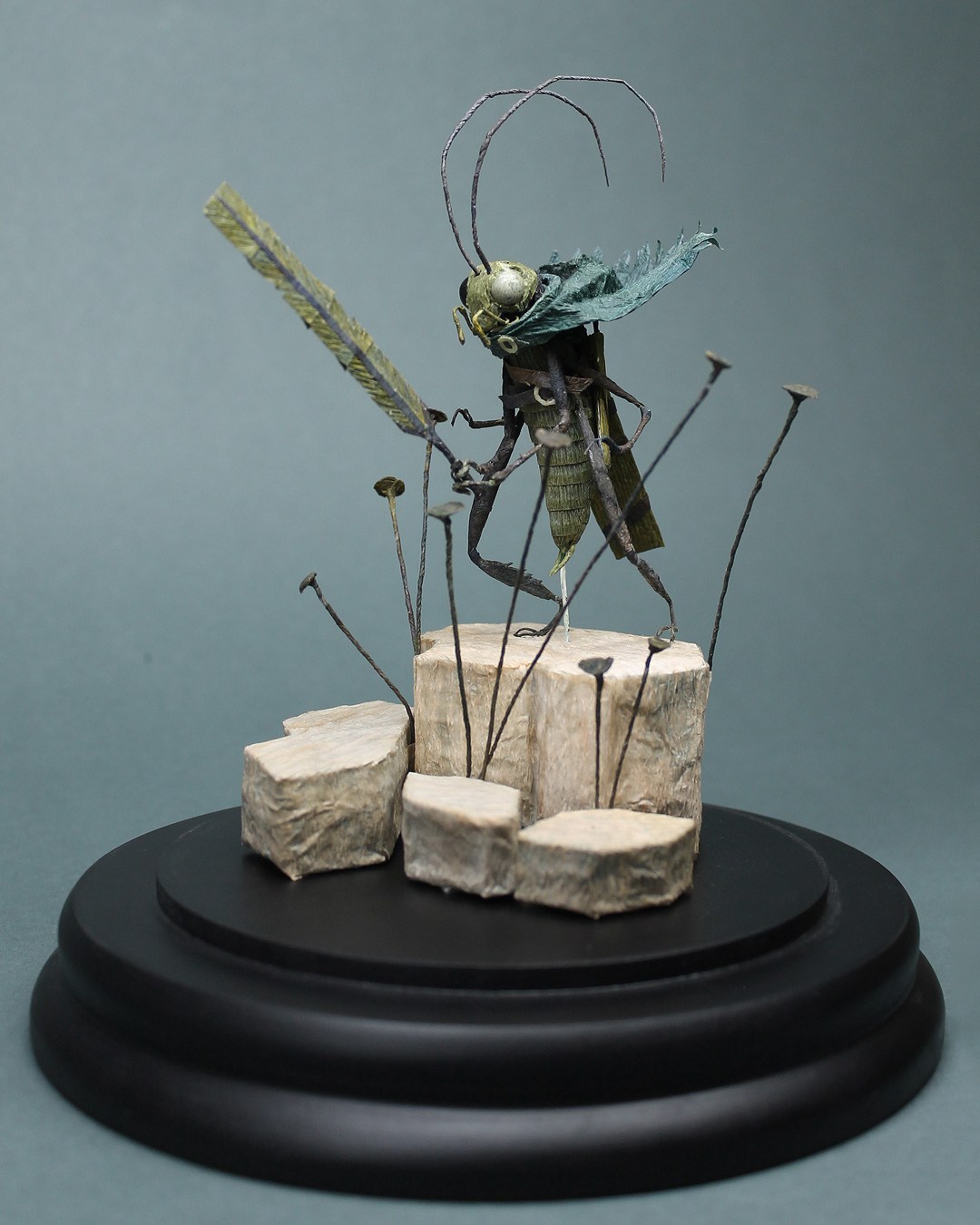
Love the flights of fancy captured with a sharp blade and steady hand 


The above link is to the website of Tina Krauss, which has the following quick bio: 

I’m Tina Kraus, a freelance illustrator and paper artist living in Münster, Germany. 

I specialize in live-like and detailed paper sculptures of animals and plants made out of crepe paper, but also paper engineering for pop-ups and paper toys. 

The work with paper as a medium fascinates me because it is so versatile and easily obtainable. I constantly experiment with it and develop new ways to work with it. 

I studied illustration in Münster, Germany, where I live now. I also lived in Seoul, South Korea for a few months as an exchange student. 

My paper artwork includes pop-up books, paper toys and paper objects and since 2017 lifelike Crepe Paper Sculptures. I also do children’s book, editorial, non-fiction, Pattern and Stationery illustration. 

When I’m not crafting or illustrating, I am either cooking some delicious food or exploring the world on my bicycle. I love bikepacking, vegan mexican and korean food but I hate cucumbers and bell peppers. 

Gallery: 


----------oOo--------