Saturday, September 24, 2022
REMEMBERING HEROES
--------oOo--------
The stories behind the names on the signs at the rest stops on the Remembrance Driveway, which goes from Sydney to Canberra.
The highway commemorates persons awarded the Victoria Cross by naming rest stops after them.
-----oOo-----
The Victoria Cross (VC) is the highest and most prestigious award for gallantry in the face of the enemy that can be awarded to British and Commonwealth forces
The VC was introduced on 29 January 1856 by Queen Victoria to honour acts of valour during the Crimean War. The metal used to make every Victoria Cross medal has been made from cannons captured by the British at the siege of Sevastopol.
--------oOo--------
JACK FRENCH, VC:
John Alexander French, VC (1914 – 1942), one of 20 Australians to receive the award for their actions during the Second World War.
--------oOo--------
Location of rest area:
Hume Highway, NSW, near Goulburn
--------oOo--------
About:
- Jack French was born in Queensland and joined his father's hairdressing business, commencing an apprenticeship.
- After the outbreak of the Second World War, French enlisted in the Second Australian Imperial Force on 22 October 1939.
- He was deployed overseas to the UK part of the Australian contingent to help defend against a possible invasion following the fall of France. When the invasion did not eventuate in late 1940, the Australian Battalion was transferred to the Middle East and became part of the 7th Division.
- Part of the actions in which it took part included joining the garrison at Tobruk as it was surrounded by German forces, taking part in several actions before being withdrawn.
- Sent to Syria, French was promoted to corporal in December.
- In early 1942, in response to the growing threat posed by Japan's entry into the war following the attacks on Pearl Harbour and Malaya, the 2/9th Battalion, along with the rest of the 7th Division, was brought back to fight against the Japanese in New Guinea.
--------oOo--------
Victoria Cross:
- In late August 1942, the 2/9th Battalion was deployed to the Milne Bay area of New Guinea. The Japanese were advancing south along the Kokoda Track and Allied intelligence had predicted an attack around Milne Bay.
- In early September, the battalion took part in heavy fighting after the Japanese landed a force to capture the Allied airfields situated there.
- It was during this fighting that French performed the deeds that led to him being awarded the Victoria Cross. The citation for French's VC award reads as follows:
At Milne Bay New Guinea, on the afternoon of 4 September 1942, a company of Australian Infantry battalion attacked a Japanese position where it encountered terrific rifle and machine-gun fire. The advance of the section, of which Corporal French was in command, was held up by fire from three enemy machine-gun posts, whereupon Corporal French, ordering his section to take cover, advanced and silenced one of the posts with grenades. He returned to his section for more grenades and again advanced and silenced the second post. Armed with a Thompson sub-machine gun, he then attacked the third post, firing from the hip as he went forward.He was seen to be badly wounded by fire from this post, but he continued to advance. Enemy guns then ceased fire and his section pushed on to find that all the members of the three enemy gun crews had been killed, and that Corporal French had died in front of the third gun pit.By his cool courage and disregard of his own personal safety, this non-commissioned officer saved members of his section from heavy casualties and was responsible for the successful conclusion of the attack.
- The fighting around Milne Bay eventually resulted in Japanese withdrawal, and represented the first full-scale defeat of the Japanese on land during the war.
- French is buried at the Bomana War Cemetery at Port Moresby.
John Alexander French's Grave at the Bomana War Cemetery, Port Moresby
The final resting place for Corporal John Alexander French VC, Port Moresby War Cemetery, Papua New Guinea
War-time grave of Corporal John Alexander French VC, 2/9th Infantry Battalion.
- Two of his brothers also served during the war: Eric in the Army and Gordon, who was killed in action in August 1943 in Europe, in the Royal Australian Air Force.
Vc 44
Friday, September 23, 2022
FUNNY FRIDAY
-------☹😊☹-------
Now that the Oz Day of Mourning is done and dusted, it is time for the Day of Laughter, that is, it is Funny Friday time.
A word of caution, however: for some reason, most of the humour that I was able to come up with this time has risqué content and risqué language, so don’t go further if easily offended (although such a caution might make readers more determined to press on).
Enjoy the humour, dear readers, enjoy the Friday and enjoy the weekend, a good end to a week of Royal Family blues.
-------☹😊☹-------
SOME HUMOUR:
What’s the difference between an onion and a bagpipe?
Nobody cries when you cut up a bagpipe.
--------oOo--------
I recall that I may have posted these before . . .
A 10 year old girl asks her mother, “Mummy, how was I born?”
The mother smiled and replied, “Once upon a time your daddy and I decided to plant a little seed. Daddy put it in the earth and I took care of it every single day. After a while the seed started to grow more and more leaves and in a few months, it turned into a beautiful healthy plant. So we took the plant, dried it, smoked it and got so high we fucked without a condom.”
--------oOo--------
Kids in front seats cause accidents. Accidents in back seats cause kids.
--------oOo--------
Johnny brought home his history test result, it was 90.
His father was so happy with it. However, his mother, Karen, just couldn't believe her son got 90 in history.
After taking a closer look at the marks, she found that the handwriting style of the 9 and the 0 are different.
"Johnny, you are so busted. Tell me, did you add the 0 to your marks?"
"No, mum, I didn't."
"I am asking you once more. Did you add that fucking 0 to your marks?"
"Mum, no, I didn't add that 0".
" OK, as you're not telling the truth, you are grounded for 1 month."
"Mum, no, please, no, I really didn't add that 0."
" This is your last chance kid, tell me the truth."
"....... I just added the 9 to it."
-------☹😊☹-------
A man from the city bought himself a farm.
On his first day at the farm he was walking his acres, discovering the creeks, hills and other features when he came upon a large hole in the ground. He looked inside but he could see only blackness. He picked up a small stone and dropped it into the hole, waiting to hear it strike the bottom to ascertain its depth, but he heard nothing.
He then dropped in a larger stone, with his ear held over the hole, but again he heard nothing.
Looking around he noticed a railway sleeper. With some effort he managed to push it into the hole. As he waited to hear the sound of it striking the bottom, a goat ran out from some nearby bushes and charged straight at him. He managed to get out of its way at the last moment but the goat continued straight on, into the hole.
A short while later a man came by and said to him “’Scuse me, mate, but you haven’t seen a goat around here anywhere, have you?”
”Well, as a matter of fact I have,” he replied. “A goat came out of those bushes, charged at me and dived into this hole.”
“That wouldn’t be my goat,” he replied, “mine’s tied to a railway sleeper.”
-------☹😊☹-------
There once was a young man from Yuma,
Who told an elephant joke to a puma.
Now his dry bleached bones lie,
Under hot Asian skies,
'Cause the puma had no sense of huma.
An alternative version of the young man from Yuma . . .
There once was a young man from Yuma
Who attempted sex with a puma
He gave up real quick
Minus nose, toes, and prick
In obvious pain and ill huma.
-------☹😊☹-------
GALLERY:
-------☹😊☹-------
RELIGION SPOT:
I found $10 on the sidewalk and I was going to keep it, but then I thought, "What would Jesus do?"
So I turned it into wine.
-------☹😊☹-------
CORN CORNER:
A shark was swimming around looking for food and he catches a squid.
The squid says: "Don't eat me, I'm really sick!"
The shark says: "Fine, I won't eat you. But I know just what to do with you..."
The shark takes the squid to his barracuda friend and says: "Here's the sick squid I owe you."
(For the benefit of Ron in the US, “quid” is slang for “pound”, the unit of currency in the UK and in Oz before we went decimal in 1966).
--------oOo--------
A Scotsman goes on a skiing holiday to Canada. After a hard day on the slopes, he retires to a bar at the bottom of the mountain. After about five or six whiskeys, he looks up and notices a stuffed animal with antlers on the wall...
He asks the bartender, "What’s that?"
The bartender replies, "It's a moose."
The Scottish chap says "Fuck me! How big are the cats?"
--------oOo--------
My nerdy friend just got a PhD on the history of palindromes.
We now call him Dr. Awkward.
-------☹😊☹-------
Wednesday, September 21, 2022
OF THRONES AND FUNERALS
--------oOo--------
Today is the National Day of Mourning in Australia, in honour of her Maj, a public holiday but is it just JAH? Just another holiday? My view is that it is, we have done our mourning and expressed our feelings, the funeral has been held and Charlie 3 has the royal bottom firmly ensconced on the monarchical throne.
Speaking of which, according to a royal official whilst she was alive, the Queen was not fussy when it came to sitting on the porcelain throne and did not bring her own seat whilst on tour. Tom Bowers' biography of Charles, titled Rebel Prince: The Power, Passion and Defiance of Prince Charles, claimed the prince took luxury toilet paper, his own toilet seat, an orthopaedic mattress, and two paintings of the Scottish Highlands with him when he went on long trips. Chazza was asked about this during his 7 day 2018 tour of Australia when a reporter from Brisbane’s Hit 105 station asked if it was true that he took his own toilet seat with him on trips abroad. The Prince of Wales said, “My own what?! Oh, don’t believe all that crap. The very idea!”
Camilla also hit back when she was asked: “Hi Camilla. So he doesn’t carry his own toilet seat when he travels?” The Duchess of Cornwall replied: “Don’t you believe that.”
--------oOo--------
So what to post on this day off from work?
How about some facts about funerals and burials? . . .
--------oOo--------
The following is from the website of Harry L Marks Memorials, which bills itself as “the number one gravestone makers in Birmingham” (England). It can be accessed by clicking on:
--------oOo--------
INTERESTING FACTS ABOUT THE HISTORY OF FUNERALS
1.Wearing black dates back to Roman times
Unless requested to wear a specific colour, it is usually respectful to wear black or dark shades to funeral services. It is believed that this tradition dates back to the Roman period, where individuals would wear a dark toga (known as a toga pulla) after the passing of a loved one or family member. This tradition persisted throughout British history, with the Victorians in particular favouring black as the colour of mourning.
2.The word funeral was first used in the 1300s
The word ‘funeral’ is believed to have first been used by Geoffrey Chaucer, who is often considered the father of the English language. It appeared in writing in his Middle English work The Knight’s Tale, in which he refers to a ‘funeral servyse’ after a character passes away. It was published in 1386, making it the first written use of the word funeral that we know of.
3.Flowers and candles were first used to mask unpleasant smells
There is a lot of symbolism surrounding the use of flowers at funerals and it is commonplace to include flowers in a service today (with roses, lilies and carnations particularly popular choices). However, it is believed that using flowers became particularly common in the history of funerals as they helped to mask any unpleasant odours.
Technology and mortuary processes have improved, meaning this is no longer an obstacle. However the practice of bringing flowers to a funeral has endured.
4.Burials used to be more common than cremation
Throughout funeral history, there have been many different ways of laying a person to rest. Archaeological evidence has suggested that cremation was a practice used as far back as the Anglo-Saxon period in the United Kingdom.
However, burials became more common as time progressed. This can often be associated with the Christian belief in resurrection, where it was believed that burial would allow the dead to be facing Christ on the day of resurrection.
Today, cremation and burial are often equally popular options.
5. Victorians popularised carved headstones
While grave markers have been used throughout British history (with Stonehenge one of our most famous ancient grave sites), engraved or carved headstones became increasingly popular in the Victorian era. Inscriptions, bible verses and messages about the loved one were often included, as well as artistic decoration. This is something that has endured today, with many choosing a bespoke headstone with beautiful carvings to honour their loved ones.
6.Rosemary was often used in place of flowers
While flowers are common at services throughout the world, rosemary also has a significant place in the history of funerals too. This fragrant herb is rich in symbolism, with its meaning ranging from remembrance to loyalty and friendship. As an evergreen plant, it was often also associated with eternal life.
There may be a practical reason why rosemary was often used at funerals too. Before mortuary science developed, the fragrant herb may have been used to mask unpleasant odours.
7.Professional mourners were often hired for Roman funerals
Much like traditional funeral processions today, the Romans used to hold processions to honour their dead. However, they looked very different to the type of procession you would see in contemporary Britain. The larger and noisier the procession, the wealthier or more important the deceased would be. For this reason, professional mourners were sometimes hired to ensure that the procession was as large and noisy as possible.
8.The first evidence of cremation was 20,000 years ago
Cremation is often a common practice today, with many choosing this option over a burial. For this reason, we may often think that cremation is a relatively new process. While it is certainly true that cremation has gained popularity since the Victorian era, the oldest evidence of cremation in funeral history is believed to be over 20,000 years old.
This archaeological evidence was found in Australia, near Lake Mungo (and is aptly known as the Mungo Lady).
(Yay for Oz).
9.Mourners used to stop the clocks when a loved one passed away
There are many different traditions in the history of funerals that we continue to do today. However, there are some that are less commonly practised too. One of these less commonly used rituals is for mourners to stop the clocks in the room or house where a loved one passed away.
This was a popular ritual during the Victorian period and was originally thought to prevent bad luck, as well as symbolise the loved one’s passage into a new life without time. It was commonly done in conjunction with covering the mirrors, closing the curtains and turning over portraits of the loved one.
(Remember the poem read out at the funeral in Four Weddings and a Funeral? It is called Funeral Blues and is by W H Auden. It begins:
Stop all the clocks, cut off the telephone,
Prevent the dog from barking with a juicy bone,
Silence the pianos and with muffled drum
Bring out the coffin, let the mourners come.
Let aeroplanes circle moaning overhead
Scribbling on the sky the message He Is Dead,
Put crepe bows round the white necks of the public doves,
Let the traffic policemen wear black cotton gloves.
10.Wakes were originally held in case the deceased returned to life
In the history of funerals and wakes, many of the rituals or traditions we have can be traced back to pagan practises. It is thought that the tradition of a wake can be traced back to pre-Christian times, in which family members would keep a constant vigil over their deceased loved one lest they wake. It is also thought that this vigil would help to prevent evil spirits from taking hold. It is typically believed that this type of wake would be held before the funeral or burial.
Today, we tend to hold a wake after the burial or funeral service. Instead of keeping vigil over the body, we use this time to celebrate our loved one’s life and grieve together with friends and family.
11.Celebration of life services were often held in the 1800s
In modern funeral ceremonies, it is becoming increasingly popular to forgo a traditional service in favour of a celebration of life. Instead of a sad occasion, these celebrations are designed to be more upbeat and rejoice in the life and achievements of a loved one.
While this might seem like quite a modern trend, the practice actually dates back to the 1800s. In this funeral history period, celebratory feasts were hosted in the deceased’s honour after the burial.
12.Obituaries for ‘the common man’ became commonplace in the 20th century
Throughout the history of funerals, obituaries or published death announcements have been somewhat commonplace. There is evidence of obituaries from the 1600s, and it was customary in the 1800s for public figures to have their death announced to the community (or the country).
However, it wasn’t until the 20th century that obituaries for non-prolific individuals became common. These were often announced in the local paper, giving the date of death and the details of the funeral. This is something that is still done today, as well as the use of online methods through social media, to publicly announce a death.
--------oOo--------
Tuesday, September 20, 2022
RANDOM PHOTOGRAPHS
--------oOo--------
Making the Titanic's anchor chain at Hingley and Sons
--------oOo--------
Family recreational vehicle, 1924. In the 1920s families who wanted to travel into the wilderness on vacation modified their own automobiles into makeshift campers.
--------oOo--------
Mata Hari, 1906. Born Margaretha Geertruida Zelle (1876 – 1917), she better known by the stage name Mata Hari. A Dutch exotic dancer and courtesan, she was inspired by dances she had seen in the Dutch East Indies, the stage name that she took meaning “eye of the day” or "sun" in Malay. Mata Hari was convicted of being a spy for Germany during World War I although she had been recruited to spy for France in 1916. She maintained that at she was simply romancing the Germans because she wanted to get more information from them. French officials still found her guilty of espionage and executed her by firing squad on October 15, 1917.
--------oOo--------
Marilyn Monroe with her first husband, James Dougherty, c. 1943–44. They married on 19 June, 1942, just after her 16th birthday. Her husband was shipped out to the Pacific in 1944. She became a model, a step opposed by her husband, and they divorced in 1946.
--------oOo--------
7 year-old Dwayne “The Rock” Johnson with his father Rocky Johnson, who was a famous pro wrestler. (1978)
--------oOo--------
Hitler visits Napoleon’s grave, 1940, and pays his respects.
--------oOo--------
George "Professor" Burchett (1872 – 1953), c 1950, English tattoo artist known as the "King of Tattooists". Burchett became the first star tattooist and a favourite among the wealthy upper class and European royalty. Among his customers were King Alfonso XIII of Spain and King Frederick IX of Denmark. It was reputed that he had also tattooed King George V of the United Kingdom.
--------oOo--------
Beijing University students put the finishing touches on the Goddess of Democracy, modelled after the Statue of Liberty, in Tiananmen Square in Beijing, May 30, 1989. the Styrofoam statue stood about 9 metres (30 feet) high. The statue was constructed over four days out of foam and papier-mâché over a metal armature and was destroyed on June 4, 1989, by soldiers clearing the protesters from Tiananmen square. Estimates of death have ranged up to thousands. Reaction to the protests set limits on political expression in China that have lasted up to the present day.
--------oOo--------
Saundra Brown, the first black woman on the Oakland police force, gets instructions on how to shoot a shotgun, 1970. She is currently a federal judge.
--------oOo--------
A soldier rescues a girl named Barbara James from the ruins of her home after a series of bombings, London, 1944.
--------oOo--------
Las Vegas visitors observe mushroom cloud from atomic test just 65 miles away, 1955.
--------oOo--------
A Dutch woman is seen here with her husband, a German soldier that she had married during the German occupation of the Netherlands. Refusing to leave his side, she marched with the German prisoners to the Prisoner of War holding center. Picture taken in Walcheren, Zeeland, the Netherlands. November 1944.
--------oOo--------
Playground, 1912. Some modern researchers question the value of safety-first playgrounds. Even if children do suffer fewer physical injuries — and the evidence for that is debatable — the critics say that these playgrounds may stunt emotional development, leaving children with anxieties and fears that are ultimately worse than a broken bone.
--------oOo--------
A thylacine or ‘Tasmanian tiger’ in captivity, circa 1930. The last thylacine died in captivity in 1936.
--------oOo--------
Picture of a 1st Class stateroom aboard the Titanic, 1912.
--------oOo--------
Monday, September 19, 2022
ON DEATH, PRAYERS AND HONOUR . . .
------------oOo-----------
Some quotes from the 1999 film The 13th Warrior . . .
------------oOo------------
The Viking Prayer:
Lo, there do I see my father.
Lo, there do I see my mother and my sisters and my brothers.
Lo, there do I see the line of my people, back to the beginning.
Lo, they do call to me, they bid me take my place among them, in the halls of Valhalla, where the brave may live forever.
__________
Merciful Father, I have squandered my days with plans of many things. This was not among them. But at this moment, I beg only to live the next few minutes well. For all we ought to have thought, and have not thought; all we ought to have said, and have not said; all we ought to have done, and have not done; I pray thee God for forgiveness.
__________
Buliwyf: I have only these hands. I will die a pauper.
King Hrothgar: You will be buried as a king.
Buliwyf: A man might be thought wealthy if someone were to... draw the story of his deeds. That they may be remembered.
Ahmed Ibn Fahdlan: Such a man might be thought wealthy indeed.
_________
Alternative version the Viking Prayer:
Sunday, September 18, 2022
INTERNATIONAL TALK LIKE A PIRATE DAY
------------oOo------------
Arrr!!! Ahoy, shipmates.
International Talk Like a Pirate Day be a parody holiday created in 1995 by John Baur (Ol' Chumbucket) and Mark Summers (Cap'n Slappy), of Albany, Oregon, who proclaimed September 19 each year as the day when everyone in the world should talk like a pirate.
"Cap'n Slappy" and "Ol' Chumbucket", the founders of Talk Like a Pirate Day.
Here are some origins of pirate words and phrases. (Why are pirates called pirates? Because they just arrrr!!)
------------oOo------------
Modern day pirates now operate largely off the coast of Somalia and in the Gulf of Aden. They are thugs, kidnappers and murderers but then again so were the 18th century pirates, the golden age of piracy being 1650-1720. The olden day pirates have been romanticised by books and films, the image owing much to Robert Louis Stevenson’s Treasure Island and Disney’s 1950 film of the book.
------------oOo------------
The word “pirate” comes originally from the Indo-European “per”, meaning to try, to risk. From there it went into Greek as “pieran”, meaning attempt, attack, and into Latin as “pirata”, meaning attacker, robber. Later it came to mean specifically sea attacker. It then evolved into an attacker/plunderer at sea.
In English, “pirate” appeared in the late 14th century with the meaning of “a person who robs ships at sea”. The use as a robber on land and sea developed about 100 years later.
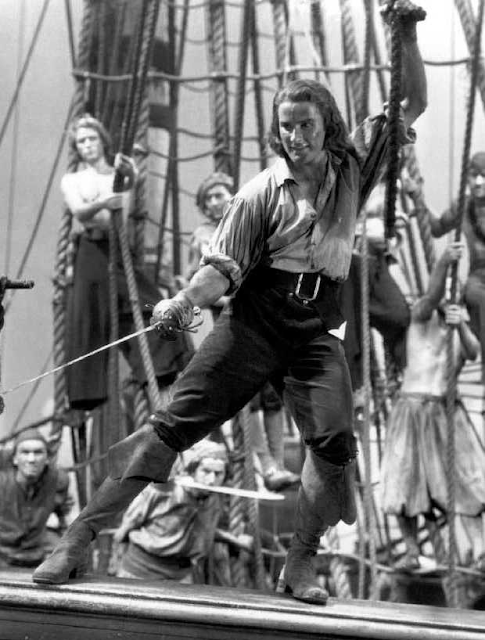
Some other Hollywood pirates . . .
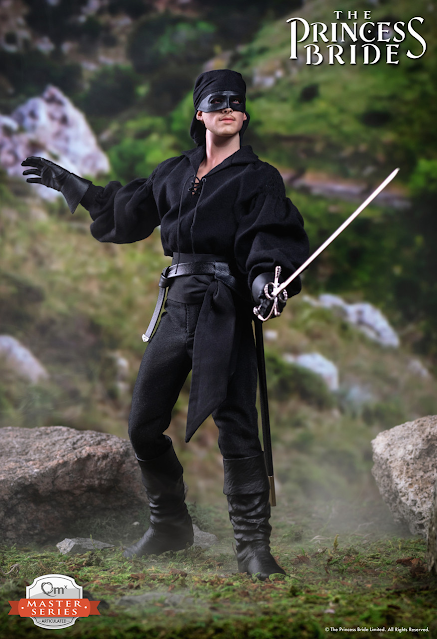
Cary Elwes as Dread Pirate Roberts in The Princess Bride (1987)
(love that movie)
------------oOo------------
In the 1960s in the UK, pirate radio stations were unlicensed and broadcast offshore from anchored ships and marine platforms.
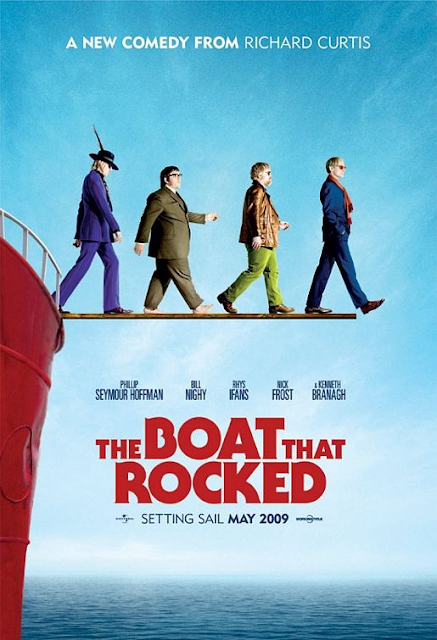
There is a good film set in the 1960’s against a backdrop of the operation of an English offshore pirate radio station. The 2009 flick is called The Boat That Rocked ( Pirate Radio in North America) and it stars Philip Seymour Hoffman, Bill Nighy (one of his best), Rhys Ifans, Nick Frost and Kenneth Branagh.
Arrr, this be well worth watching, maties.
------------oOo------------
How pirates get eye patches . . .
------------oOo------------
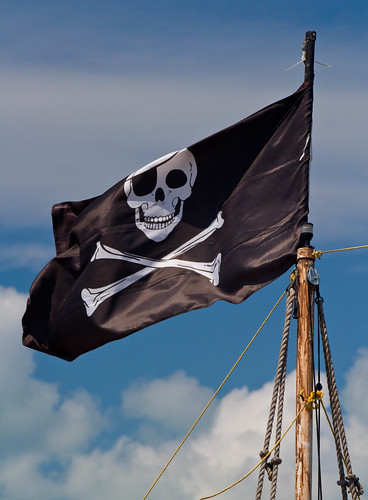
The Jolly Roger is the traditional English name for the flags flown to identify a pirate ship before or during an attack. The flag most commonly identified as the Jolly Roger today is the skull and crossbones symbol on a black flag. This was used during the 1710s by a number of pirate captains and went on to become the most commonly used pirate flag during the 1720s, although other designs were also in use.
The raising of pirate flags, usually only hoisted at the last minute, signalled that the ship under approach should immediately surrender or face not only attack and boarding but the execution of all on board.
The threat that no quarter was to be given was often reinforced by raising an additional flag, an all-red one.
Pirates flew many other types of flags to signal their terrible purpose in approaching a ship, usually with gruesome such as skeletons, swords, and bleeding hearts.
------------oOo------------
Recycled, but a goodie . . .
A pirate captain goes to a bar on returning from sea. in a bar. The barman notes that the pirate has a peg-leg, a hook, and an eye patch. He asks, “So, how did you end up with the peg-leg?”
The pirate replies, “We were in a storm at sea, and I was swept overboard into a school of sharks. Just as my men were pulling me out, a shark bit my leg off.”
“What about your hook?” asks the bartender.
“Well”, replied the pirate, “We were boarding an enemy ship and were battling the other sailors with swords. One of the enemy cut my hand off.”
“Incredible!” says the bartender. “How did you get the eye patch”?
“A seagull shat in my eye,” replied the pirate.
“You lost your eye to a seagull pooping?” the barkeep asked incredulously.
“Well,” said the pirate, “it was my first day with the hook.”
------------oOo------------
Some possible origins of the term Jolly Roger:
- It may derive from the word ‘Roger’ which in that period signified the Devil, a figure often referred to as ‘Old Roger’.
- A group of pirates hanged in Newport, Rhode Island in 1723 had called their flag showing a skeleton holding an hourglass and a bleeding heart as ‘Old Roger’.
- The term ‘roger’ was also applied to wandering beggars or vagrants and privateers were sometimes referred to as ‘Sea Beggars’, particularly in the Netherlands.
- An alternative origin is the French term le jolie rouge (the “pretty red”), which was applied to the red flag commonly flown by privateers for centuries.
- The Welsh pirate Black Bart Roberts (1682-1722) was famous for wearing bright red silks in battle, causing the French to nickname him le jolie rouge. Roberts was known to fly the skull and crossbones flag, amongst others on his fleet of ships and so this flag became the ‘Jolly Roger’ by association.
------------oOo------------
Q: What has 8 legs, 8 arms, and 8 eyes?
A: 8 pirates.
------------oOo------------
A buccaneer is a pirate, but the word derives from a method of barbeque used by the Indigenous people of the Caribbean region. A boucan was a grill used for roasting meat and vegetables, and the term buccaneer was first applied to hunters in Hispaniola who killed and smoked wild cattle on boucans. That was a rough lifestyle, and when the term was borrowed into English, the sense became that of a pirate, either because the hunters of Hispaniola had turned to piracy, or that piracy was a similarly rough profession.
------------oOo------------
Subscribe to:
Posts (Atom)