Showing posts sorted by relevance for query sprig of wattle. Sort by date Show all posts

Tuesday, January 31, 2012

Reader Comments

Some recent reader emails and responses:


Comment:

From Byter Morris, in response to the pic last week showing the graffiti on the side of the house:


What about “I like Tabbouleh but hate Hommos!!!” somewhere in Newtown.

Response:

Morris is referring to a well known bit of 1980’s graffiti that was on the wall of the car park at the corner of Parramatta Road and Missenden Road in Camperdown, Sydney.  That car park now comprises residential units; before it became a carpark it was a derelict warehouse for a number of years.

In the 80’s, as the AIDS epidemic became known, there were proposals that all doctors and hospitals compulsorily report any persons with HIV.  This prompted a large graffiti:

Authoritarianism
Is
Disease, not
Sex.

Note that the initials letters spell AIDS when read downwards.

Someone then came along and painted an arrow on the wall pointing to the above graffiti, with the words, in capitals, “GOD HATES HOMOS”.

To this was added a further graffiti comment” “But does he like tabouleh?”

Unfortunately I have not been able to find a photograph of it.

Friday, January 7, 2011

Cricket


In case anyone has missed it, Australia has been playing cricket against England in a series or matches referred to as “The Ashes”. Cricket is a game that was once described by Robin Williams as being similar to baseball on Valium. Devotees will sit for hours watching it, whether at the ground or in front of a box. Non-devotees (and I confess that I am one) feel that it is only marginally better than watching paint dry.

I am, however, interested in some of the terms and facts associated with the game:

• The game is believed to have developed from a children’s game in Saxon or Norman times, possibly from the use of a matted lump of sheep’s wool (or a stone or a small lump of wood) as the ball; a stick or a crook or another farm tool as the bat, and a stool or a tree stump or a gate (e.g., a wicket gate) as the wicket.

Saturday, November 11, 2023

REMEMBRANCE DAY FACTS

---------oOo---------

  • Remembrance Day marks the anniversary of the end of the First World War, the Armistice, on 11 November, 1918.
  • World War I was originally known as the Great War. It began in August 1914 when Britain and Germany went to war but many countries, such as Australia and New Zealand (who formed the famous ANZACs), immediately declared their allegiance to Britain and joined the war. Many such allergiances were due to the system of treaties and support agreements. This partnership was known as the ‘Allied Forces’.
  • The main nations in the Allied Forces were Britain, France and Russia. Later, they were supported by countries such as Canada and the United States. The Allied Forces fought the Central Powers: Germany, Austria-Hungary, Italy, and the Ottoman Empire (Turkey).
  • During the four years of World War I, Australia was involved in some of history’s most tragic conflicts, such as the famous landing at Gallipoli, horrific battles on the Western Front (France and Belgium) and in the Middle East.
  • In 1918, after suffering a number of defeats and heavy losses, the German forces agreed to an armistice with the Allied troops and this signalled the end of WWI. The treaty was signed at 5am on 11 November 1918, but did not officially come into effect until six hours later at 11am. The armistice was met by celebration around the world.
  • For this reason, Remembrance Day was originally called Armistice Day. In Australia, it was renamed in 1997. The name change broadened the meaning of the day, widening the focus from World War I, to a day which commemorates those who served in any war or conflict.
  • In most countries, Remembrance Day is observed on 11 November to recall the end of First World War hostilities. Hostilities formally ended "at the 11th hour of the 11th day of the 11th month" of 1918, in accordance with the armistice signed by representatives of Germany and the Entente between 5:12 and 5:20 that morning. "At the 11th hour" refers to the passing of the 11th hour, or 11:00 am. The First World War officially ended with the signing of the Treaty of Versailles on 28 June 1919.
  • Every year, nations around the globe fall silent for one minute at 11am on the 11th day of the 11th month to remember those who have served their country during war. This practice stems from King George V’s declaration on 6 November 1919 that people throughout the Commonwealth should suspend their normal activities so that in “perfect stillness the thoughts of everyone may be concentrated on reverent remembrance of the Glorious Dead”.
  • The Flanders poppy was one of the first plants to grow on the blood-soaked battlefields of France and Belgium. In nineteenth century English poetry, poppies often symbolised sleep or oblivion. After WWI, silk poppies were sold on Armistice Day with proceeds going to a charity for French children and to the Returned Soldiers League (RSL).
  • Many people wear a sprig of rosemary on Remembrance Day and on ANZAC Day. Since ancient times this aromatic herb has been recognised as a sign of remembrance and loyalty. For Australians, rosemary is even more significant as this plant grows wild on the Gallipoli peninsula, serving as another reminder of the ANZAC troops who lost their lives there.
  • An old tale describes the Virgin Mary spreading her blue cloak over a flowering rosemary bush. The story says that the white flowers turned blue and from that day on the bush was called the ‘Rose of Mary’.
  • On Remembrance Day, flags are flown at half-mast from 10.30am to 11.03am as a sign of mourning and respect. It is said that this tradition stems from sailing ships that lowered their sails at sea to honour an important person or mark a death.
  • There are a number of rules associated with flying the Australian flag at half-mast. The flag can never be flown at half-mast at night. If in a group of flags, all flags should be lowered to half-mast, however, Australia’s should be lowered last and raised first.
  • The Unknown Soldier is intended to represent all men killed during war, especially those with no known resting place. The original Unknown Soldier was entombed at Westminster Abbey in London on Remembrance Day 1920. On the same day, France entombed an Unknown Soldier below the Arc de Triomphe.
  • It was not until Remembrance Day 1993 that Australia laid to rest an Unknown Soldier in the Hall of Memory at the Australian War Memorial in Canberra. At his side was a bayonet and a golden sprig of wattle. The soldier was buried in a coffin made from Tasmanian Blackwood which was scattered with soil from the French battlefield, Pozières.
  • It is estimated that over 60,000 Australians died in the Great War, many of these have no known graves. This left the Western Front dotted with memorials and cemeteries commemorating the fallen. Many Australians travel to these locations, as well as others in Egypt and Turkey, to pay tribute to the events that occurred and to remember all who served and fell there.
  • In modern times, these pilgrimages have become increasingly popular around Remembrance Day and ANZAC Day. On these days, many locations, such as Gallipoli, Villers-Bretonneux and Bullecourt, hold special commemorative ceremonies. These ceremonies are made up of many traditional elements such as a parade, wreath laying, the Last Post (played on a bugle) and a minute of silence.
  • The word ‘armistice’ means a truce or peace arrangement. It comes from the Latin word ‘arma’, meaning arms and ‘stitium’, meaning ‘a stopping’, giving us the meaning: to put down your arms ie weapons.
  • The famous poem In Flanders Fields that made the red poppy such an iconic symbol, was written by Canadian Lieutenant Colonel John McRae. It is said that it only took him 20 minutes to write buy, dissatisfied with it, McCrae tossed the poem away. A fellow officer retrieved it and sent it to newspapers in England. The Spectator, in London, rejected it, but Punch published it on 8 December 1915. The poem went on to become hugely popular with the public, and has since become an abiding symbol of remembrance worldwide.
  • It was not just men who went to war. In World War I, many Australian women volunteered as cooks, drivers, interpreters and other skilled positions. Female nurses served in countries such as Egypt, France and Greece, often in dangerous conditions, close to the frontline where they were exposed to shelling.
  • World War I was the first armed conflict where aircraft were used. There were around 3000 Australian airmen who served with the Australian Flying Corps.
  • The conditions in WWI trenches were so horrifying that they gave their name to numerous ailments that occurred there. These include: ‘Trench Foot’ (a fungal foot infection), ‘Trench Nephritis’ (an inflammation of the kidneys) and ‘Trench Fever’ (a painful infection caused by lice).
  • It is estimated that the WWI trench system on the Western Front measured approximately 475 miles (764km) in length.
  • Many countries (such as Canada, the United Kingdom, France, Belgium and Poland) also observe Remembrance Day.
  • During the Second World War, many countries changed the name of the holiday. Member states of the Commonwealth of Nations adopted Remembrance Day, while the US chose Veterans Day.


Sunday, January 10, 2016

People on Australian Banknotes, Part 1: $5 and $10


Beginning a new series, a brief look at the people on the Australian banknotes, both the current polymer notes (started in 1992 and a full set for all denominations in circulation by 1996), and those preceding the polymer notes.
______________________________

$5:
______________________________

Queen Elizabeth II:


A portrait of Queen Elizabeth II is shown on the front of the $5 banknote together with a sprig of eucalyptus. The portrait is drawn from photographs commissioned by the Reserve Bank in 1984. The Queen gave approval to use this portrait on an Australian banknote in 1988, and it appeared on the first $5 polymer banknote on 7 July 1992.
______________________________

Sir Joseph Banks:


Sir Joseph Banks (1743–1820) was with Captain James Cook at the landing at Botany Bay in 1770. He played a major role in exploring and collecting many aspects of natural science in his travels with Cook. Though returning to England, Banks remained influential in the administration of the colony and in botanical studies of Australia.
______________________________

Caroline Chisholm:


Caroline Chisholm (1808–1877) first arrived in New South Wales in 1838. She worked to establish better conditions, including suitable employment and accommodation, for young migrant women. Her work expanded to include facilitating the passage to Australia of families. What Australia needed most, in her view, were 'good and virtuous women'.

The $5 banknote featured a woman, other than the Monarch, for the first time on Australia's currency notes. The portrait of Caroline Chisholm is set against a background of the women and children, sailing ships and Sydney foreshore of her time.
______________________________

Sir Henry Parkes:


Sir Henry Parkes,(1815-1895), the "Father of Federation", long advocated federation and breathed life into the ailing movement with a rousing speech in Tenterfield, New South Wales, in 1889. He continued to work towards this goal but died in 1896. 

To the right of Parkes, are architectural drawings of the Royal Exhibition Building in Melbourne which was the site of the first Commonwealth Parliament in 1901. Below this is a scene of the opening of Australia's First Federal Parliament based on a painting once again by Tom Roberts who was commissioned to record the opening. His Royal Highness The Duke of Cornwall and York (later to be King George V) who can be seen in the foreground, performed the honours. At the bottom is the Federation Pavilion in Sydney's Centennial Park which was specially constructed for the celebrations. To the left of Parkes is the Tenterfield School of Arts building, the site of his rousing speech in 1889. The six State badges are at the bottom left.
______________________________

Catherine Spence:


Catherine Spence (1825-1910) was a journalist and social reformer active in the cause of state children, a novelist and a prominent supporter of electoral reform. Although unsuccessful, she was the first woman to run for electoral office in Australia, a candidate for the Australasian Federal Convention of 1897. 

To the right on the banknote are portraits of prominent campaigners for Federation, one from each of the six colonies viz Clark (Tasmania), Barton (New South Wales), Forrest (Western Australia), Deakin (Victoria), Kingston (South Australia) and Griffith (Queensland). Barton became Australia's first Prime Minister, Deakin was Prime Minister on three occasions and Griffith was the first Chief Justice of the High Court.

To the left is a building of the South Australian Children's Department, Adelaide, with which Spence was closely involved for almost 40 years. A spray of wattle, a sun burst and the stars of the Southern Cross complete the back.
______________________________

$10:
______________________________

Francis Greenaway: 


Francis Greenway (1777–1837) was convicted of forging a contract and transported to New South Wales in 1814. A trained architect, Greenway was soon employed by Governor Macquarie in the planning and supervision of public buildings. His work included the Hyde Park Barracks and St James Church, Macquarie lighthouse at South Head and St Matthews Church, at Windsor. 
______________________________

Henry Lawson: 


Despite a harsh and impoverished childhood and an acute hearing problem, Henry Lawson (1867–1922) became one of Australia's best known authors. His writings captured the mateship and hardships of the 'underdog' in the gold fields and outback sheep country. 

The profile of Henry Lawson on the $10 note was accompanied by scenes of his childhood years, mainly from the gold town of Gulgong in New South Wales. These scenes were identified from photographs in the Holtermann Collection which came to light in 1951. 
______________________________

Andrew Barton "Banjo" Patterson:


Andrew Barton “Banjo” Patterson (1864-1941) was an Australian bush poet, journalist and author whose many ballads and poems about Australian life focused on the rural and outback areas. His more notable poems include "Waltzing Matilda", "The Man from Snowy River" and "Clancy of the Overflow". 

The note incorporates several references to Paterson’s life and work: 

· The portrait of Banjo Paterson is based on a photograph taken at the time of his return from the Boer War in 1900. As a war correspondent, he filed graphic accounts of the fighting for the Sydney Morning Herald, Melbourne Age, and also the international news agency Reuters. 

· Facing the portrait, the horseman reflects Paterson’s lifelong enthusiasm for horses and horsemanship, which resulted in his famous equestrian ballads. 

· The horseman is rounding up ‘brumbies’ (wild horses) which are seen emerging over Paterson’s left shoulder. According to the Reserve Bank of Australia, they are based on pictures that appeared in The Australian Newspaper in 1870 and The Illustrated Sydney News in 1875. 

· The images are inspired by ‘The Man From Snowy River’ – underneath are the famous poem’s opening lines: There was movement at the station, for the word had passed around That the colt from old Regret had got away 

· The ‘Waltzing Matilda’ logo, seen right of Paterson’s hat, was taken from Marie Cowan’s sheet music for Waltzing Matilda published in 1903. In possibly the first product placement ever, Cowan changed the words of the chorus to promote Billy Tea. 

· Lines from ’The Man from Snowy River’ also appear next to Paterson’s portrait in tiny print. 
______________________________

Dame Mary Gilmore: 


Dame Mary Gilmore (1865-1962) is depicted twice on the banknote, once as a young woman and in the background, a Dobell portrait of her in her later years. Gilmore was a celebrated author, poet, and social reformer campaigning for voting rights for women, relief of the poor and disadvantaged through a government welfare system and improved treatment of aborigines. In the 1890's she spent several years in a utopian community established in Paraguay. 

A bullock dray with bales of wool is also shown. Images of homesteads or other outback buildings are shown at far left and right. An outback woman with a hat features as the orange merges into the blue towards the left. The profile of an extract from one of Gilmore's poems is at the extreme left: "No foe shall gather our harvest or sit on our stockyard rail".

Portrait of Dame Mary Gilmore by William Dobell, 1957

"The painting is far more important than the sitter. This painting will still be carrying my identity when my own work is forgotten."
- Dame Mary Gilmore 1957


Saturday, October 13, 2018

Advance Australia Fair


Some trivia about Advance Australia Fair  . . . 
___________________ 

Honourable No 2 son Elliot graduated yesterday, Kate and I being proud attendees. 

The proceedings began with the Australian national anthem being sung. Now my experience with the national anthem is that at sporting events, such as football grand finals and public events, the conclusion is met by loud cheering and barracking. On this occasion it concluded with deathly silence, broken when a child about 18 months came out with an extremely loud “YAYYYYYYYY!!!” It brought laughter from the entire room, obviously a child from football loving parents. 

(It brings to mind an item from No 2 son’s youth. At a Carols by Candlelight in church when he was three, he wanted to join in the carolling but didn’t know the songs and the words. That didn’t stop him, at a pause in one of the songs he loudly burst forth with what he had seen in The Lion King: “I’ve Got a Lovely Bunch of Coconuts”.) 
___________________ 

At the subsequent lunch I mentioned to Elliot and partner Maddy that when I was young, the opening words of Advance Australia Fair were not “Australians all let us rejoice” but “Australia’s sons let us rejoice”. 

Here are some more items about AAF . . . 
___________________ 

Usually only verse 1 is sung, sometimes verse 3 as well, but the rest of the verses are quite crappy . . . 

Australians all let us rejoice, 
For we are young and free; 
We've golden soil and wealth for toil, 
Our home is girt by sea; 
Our land abounds in Nature's gifts 
Of beauty rich and rare; 
In history's page, let every stage 
Advance Australia fair! 
In joyful strains then let us sing, 
"Advance Australia fair!" 

When gallant Cook from Albion sail'd, 
To trace wide oceans o'er, 
True British courage bore him on, 
Till he landed on our shore. 
Then here he raised Old England's flag, 
The standard of the brave; 
With all her faults we love her still, 
"Brittannia rules the wave!" 
In joyful strains then let us sing 
"Advance Australia fair!" 

Beneath our radiant southern Cross, 
We'll toil with hearts and hands; 
To make this Commonwealth of ours 
Renowned of all the lands; 
For those who've come across the seas 
We've boundless plains to share; 
With courage let us all combine 
To advance Australia fair. 
In joyful strains then let us sing 
"Advance Australia fair!" 

While other nations of the globe 
Behold us from afar, 
We'll rise to high renown and shine 
Like our glorious southern star; 
From England, Scotia, Erin's Isle, 
Who come our lot to share, 
Let all combine with heart and hand 
To advance Australia fair! 
In joyful strains then let us sing 
"Advance Australia fair!" 

Should foreign foe e'er sight our coast, 
Or dare a foot to land, 
We'll rouse to arms like sires of yore 
To guard our native strand; 
Brittannia then shall surely know, 
Beyond wide ocean's roll, 
Her sons in fair Australia's land 
Still keep a British soul. 
In joyful strains then let us sing 
"Advance Australia fair!" 
___________________ 

For overseas readers not familiar with the Oz anthem, hear it by clicking on: 
___________________ 

"Advance Australia Fair" was composed in the late 19th century by Peter Dodds McCormick. It was first performed by Andrew Fairfax at a function of the Highland Society of New South Wales in Sydney on 30 November 1878. The song quickly gained popularity and an amended version was sung by a choir of around 10,000 at the inauguration of the Commonwealth of Australia on 1 January 1901. In 1907 the Australian Government awarded McCormick £100 for his composition. 

Peter Dodds McCormick 

In 1913, McCormick wrote to a friend: 
One night I attended a great concert in the Exhibition Building, when all the National Anthems of the world were to be sung by a large choir with band accompaniment. This was very nicely done, but I felt very aggravated that there was not one note for Australia. On the way home in a bus, I concocted the first verse of my song & when I got home I set it to music. 


___________________ 

In 1974 the Prime Minister Gough Whitlam caused a poll to be held as to an alternative to “God Save the Queen” as the national anthem. Advance Australia Fair was preferred by 51.4%. God Save the Queen was retained for all regal occasions. In 1976, the Fraser Government reinstated God Save the Queen as the official national anthem. 

In 1977, with debate over which song would represent Australia at the Montreal Olympic Games, the Fraser government requested the Australian Electoral Office to hold a plebiscite to select a national song. Over 7 million of the 8.4 million people on the electoral roll chose Advance Australia Fair as the preferred song, followed by Waltzing Matilda, God Save the Queen and Song of Australia. 

Advance Australia Fair" was adopted as the Australian national anthem in 1984 on a recommendation by the Labor government of Bob Hawke. "God Save the Queen", now known as the royal anthem, continues to be played alongside the Australian national anthem at public engagements in Australia that are attended by the Queen or members of the Royal Family. 
___________________ 

“Our home is girt by sea . . .” 

What an antiquated way of saying that we are an island. 
___________________ 

“For we are young and free . . . “ 

Is it any wonder that indigenous people are alienated by the anthem when it measures Australian history from the time of Cook’s discovery in 1770, ignoring 40,000 years of indigenous settlement and history. 

In 2017 controversial indigenous boxer Anthony Mundine called for people to remain seated during the performance of AAF on the basis that "It's a racist anthem and doesn't represent our people," 
___________________ 

Very well, I hear you say, if you don’t like AAF as the national anthem, what do you propose? 

I humbly submit for consideration as an alternative national anthem the victory song of the Australian cricket team. Written by Rod Marsh, it is (according to Wikipedia) “typically sung by the players in the style of a raucous chant after every victory and ‘treated with reverential consideration and respect’ within the team.” 

The lyrics are simple so there would be no problem with people learning them and they say everything that needs to be said: 

Under the Southern Cross I stand 
A sprig of wattle in my hand, 
A native of my native land, 
Australia you fucking beauty. 

See, for example: 


Monday, January 27, 2025

READERS WRITE


-----------ooOoo-----------

Steve M sent me an email commenting on the Australia Day posts:
Great Bytes today, Otto. Loved the cricket stuff and especially loved the bush poem.
Agree with your sentiments.
Many thanks.
Steve m
Thank you, Steve.
__________

Likewise friend and colleague Tony G expressed appreciation for the Australia Day Thought for the Day:
Love the thought for the Day.
Thanks Tony.

The Thought was the victory song of the Australian cricket team, sung by the players after every victory:

Under the Southern Cross I stand,
A sprig of wattle in my hand,
A native of my native land,
Australia, you fucking beauty!

We should consider that our national anthem in place of one that has the words “Our home is girt by sea.”
__________

Steve also sent me a response to the photographs of urban hells around the world:
Amazing Bytes yesterday, Otto. What dreadful people creatures human beings are.
Thanks Steve.
As someone once said to me: “It’s the price you pay if you want a ten dollar angle grinder.” He was referring to the pollution arising from overseas countries where manufacture is cheap and without controls.
__________

David B commented on Big Things:
Love that you have captured the Kelpies atmosphere and all.
Hope that you are keeping strong.
David
Thanks Dave, I am.

The kelpies Dave was referring to are a pair of monumental steel horse-heads 30 metres high between the Scottish towns of Falkirk and Grangemouth. (A kelpie, or water kelpie is a mythical shape-shifting spirit inhabiting lochs in Scottish folklore. It is usually described as a grey or white horse-like creature, able to adopt human form.)

Some more pics to show size, scale, manner of construction and how they are variously illuminated:


__________

Ron T emailed a comment about the photographs of my father:
Your Dad was one handsome fellow. Folks of that generation were heroes in every respect.
Thanks Ron.

Some facts about my dad that I learned from relatives, he never spoke of these matters:
  • His mother would hide him and his brother under floor boards covered by a carpet when the Nazis came looking for males to send to slave labour camps.
  • Twice he was caught and sent, both times he jumped from a moving tarin Germany and made his way back home.
  • On one such escape he was hidden by a German family.
After the war and migration to Australia, he often declared that that was the past, we should move on and not hold onto hate and hostility.

My mother retained her hostility for a long time. As I said in my eulogy of her (which I will post one day), this was a woman who still had the scars of German shrapnel on her leg, who saw the V2 rockets and the Hindenburg fly overhead. In her last days, in moments of hallucination, she was dreaming she was back in occupied Holland as a young girl, hearing the sound of goose-stepping Wehrmacht soldiers marching on cobblestones and fearing for her life. She overcame the negative feelings eventually when Dad started training German Shepherd dogs, bringing them both into contact with numerous German people, some of whom became friends.
__________

Thanks to those who welcomed me back when I had blog and internet issues, both at the same time ! !
__________

Charlie Z in the US sent me an email before those issues arose:
Otto - many thanks for the poetry and funny Fridays! Many have been passed on to friends who appreciate your humour!
Thanks Chezza. Interesting that you used the Australian/English spelling on ‘humour’. A result of living in Australia?
__________

David B emailed a comment on Maya Angelou’s poem My Younger Days, the final verse of which is:

Though my hair has turned to grey
and my skin no longer fits,
On the inside, I’m the same old me,
It’s the outside’s changed a bit.

David commented:
Hi Otto
This resonates with me and reminds me of a comment made by a contemporary. A comment with which I very much agree.
"When I look in the bathroom mirror I wonder who that old man staring back at me is."
Regards
David
Thanks David.

I responded to him:
I know the feeling – mentally and psychologically I don’t feel the age I see in the mirror.
__________

David G (is every second person in the world named David?) set me a comment on Christmas day:
Otto
Merry Christmas. Thanks so much for receiving your Bytes each day. It always extends my breakfast to a second coffee and makes a great start to the day.
Really appreciate the Christmas card, your sticking to tradition (ie mailing Christmas cards, Otto) is fabulous.
Trust 2025 brings good health to you and your family and look forward to catching up sometime.
David and Lorraine
Thanks Dave.

By the way:

Tim B liked the following, which I used on a Christmas card one year (best image I have been able to find):

‘Santa and the Drover’
by commercial artist and illustrator Jack Waugh (1910-1996).

Jack Waugh’s 1964 painting of Santa pausing on his travels to share a cup of billy tea with an outback drover, whilst the drover’s horse and Santa’s reindeer tentatively become acquainted, was painted for Arnott’s Biscuits and was featured on the lid of their Christmas biscuit tins. So popular that it was repeated year after year, it also appeared on the rear page of The Australian Women’s Weekly for a number of years each Christmas. Waugh, born in Lakemba and raised in Glebe, used himself as the model for the drover. Note the kelpie (Australian cattle dog, not the Scottish horse) next to the drover.


Thursday, January 26, 2012

Australia Day

On this Australia Day 2012 it is of interest to have a look at Australia’s unofficial flag, the Boxing Kangaroo flag . . .


Kangaroos defend against an attacker by holding an attacker with their smaller front legs whilst using the larger, stronger hind legs to slash, disembowel and kick.  This gives an appearance of boxing with the forelegs.


By the late 19th century outback travelling shows often featured kangaroos wearinmg boxing gloves fighting against men.  Boxing kangaroos were also featured in various films, further cementing the concept in the public mind of kangaroos boxing.

Friday, May 24, 2024

ORIGINS WORDS AND PHRASES

-----------ooOoo-----------

CRICKET

I confess that I am not a fan or follower of cricket and find watching it as dull as dishwater.

However, here are comments on some cricketing words and phrases, plus a few anecdotes.

By the way:

The expression ‘dull as dishwater’ originated in the 1700s and originally appeared as ‘dull as ditchwater.’ Roadsides commonly had ditches alongside which often contained dirt, debris and muddy water. Either through careless pronunciation or similar analogy, the phrase dull as dishwater seems to have overtaken the original expression in popularity. An early example can be found in Charles Dickens’ Oliver Twist (1837): ‘He’d be sharper than a serpent’s tooth, if he wasn’t as dull as ditchwater.’
__________

Cricket:

Some explanations as to origin:
  • It derived from the Old French “criquet”, meaning “goal, post, or stick”.
  • Alternatively from the Middle Dutch “kricke”, meaning “stick” or “staff”. The latter Middle Dutch derivation from “kricke” is generally considered more likely due to the strong medieval trade connections between south-east England and Flanders, which belonged to the Duchy of Burgundy.
  • A further alternative explanation: it comes from the Middle Dutch phrase for hockey, “met de krik ket sen”, which means “with the stick, chase”. Early cricket was played with a stick that resembled more a hockey stick than the modern day cricket bat. Bowlers, at the time, typically kept the ball on the ground or at least skimmed the ground, instead of pitching the ball as they do today. As a response to the change towards pitching and bouncing the ball, in the late 18th century, the straight bat was introduced and is still used to this day.

The game of cricket itself is thought to have been played as early as the 13th century, with the first direct reference to it appearing in 1598 in a court case which referenced a game called “krekett” (sometimes spelled “creckett”) being played at the Royal Grammar School in England in 1550.

Cricket gradually grew in popularity until, in the 18th century, it was named the official sport of England, being the favored leisure activity among the privileged class.

Evolution of the cricket bat. The original "hockey stick" (left) evolved into the straight bat from c. 1760 when pitched delivery bowling began.

Painting by Francis Cotes, The Young Cricketer, 1768

The first recorded photo of a cricket match taken on 25 July 1857 by Roger Fenton
__________

Brit cricket commentator Brian Johnston is said to have commented upon Michael Holding of the West Indies bowling to Peter Willey of England in a Test match at The Oval in 1976: “The bowler's Holding; the batsman's Willey." 

Another Johnston item: During a Test match at the Oval in August 1991, Jonathan Agnew suggested that when Ian Botham was out hit wicket, trying to hurdle the stumps, it was because he had failed to "get his leg over" (a British slang term meaning to have sex; Botham's sexual exploits had attracted national attention). Johnston carried on commentating and giggling for 30 seconds before dissolving into helpless laughter.
__________

The Ashes:

The Ashes is a men's Test cricket series played biennially between England and Australia.

The term originated in a satirical obituary published in a British newspaper, The Sporting Times, immediately after Australia's 1882 victory at The Oval, its first Test win on English soil. The obituary stated that English cricket had died, and that "the body will be cremated and the ashes taken to Australia". The mythical ashes immediately became associated with the 1882–83 series played in Australia, before which the English captain Ivo Bligh had vowed to "regain those ashes". The English media therefore dubbed the tour the quest to regain the Ashes.

After England won two of the three Tests on that tour, a small urn was presented to Bligh in Melbourne. The contents of the urn are reputed to be the ashes of a wooden bail, and were humorously described as "the ashes of Australian cricket".

The Ashes urn

__________

Bail, Stumps and Wicket:

In the sport of cricket, a bail is one of the two smaller sticks placed on top of the three stumps to form a wicket.


The bails are used to determine when the wicket is broken or put down, which in turn is one of the critical factors in determining whether a batsman is out bowled, stumped, run out or hit wicket.
__________

The first testicular guard was used in cricket in 1874 and the first helmet was used in 1974.

It took 100 years for men to realise that the brain is also important.
__________

Howzat:

In cricket, an appeal (locally known as a "Howzat", from “How’s that?’) is the act of a player (or players) on the fielding team asking an umpire for a decision regarding whether a batter is out or not.

According to Law 31 of the Laws of Cricket, an umpire may not rule a batter out unless the fielding side appeals for a decision. However, in practice most umpires will give a batter out to an obvious bowled or caught.

On many occasions when a batter has otherwise technically been out, the fielding team has not realised, so neglected to appeal, and so the umpire has not declared them out.

An appeal may be made at any point before the bowler starts their run-up for the next ball.

By the way:

Howzat" is also a song by Australian band Sherbet, released in May 1976. The song reached number 1 in Australia.

Link:

Some of the lyrics:

You told me I was the one
The only one who got your head undone
And for a while I believed the line that you spun
But I've been lookin' at you
Lookin' closely at the things you do
I didn't see you the way you wanted me to

How, How, Howzat?
You messed about I caught you out
Howzat?
Now that I've found where you're at
It's good-bye
Well Howzat?
It's good-bye
__________

Googly:

A deceptive spinning delivery by a leg spin bowler, also known (particularly in Australia) as the wrong 'un. For a right-hander bowler and a right-handed batsman, a googly will turn from the off side to the leg side.
__________

Hat Trick:

A bowler taking a wicket off each of three consecutive deliveries that he bowls (whether in the same over or split up in two consecutive overs, or two overs in two different spells).
__________

Sledging:

Verbal abuse in simple terms, or a psychological tactic in more complex terms. Used by cricketers both on and off the field to gain advantage of the opposition by frustrating them and breaking the concentration of the opposition. Considered in some cricketing countries to be against the spirit of the game, although occasional sledging remains common.

A well-known sledge:

Portly Eddo Brandes was a Zimbabwean medium-pacer by day and chicken farmer by night. During a one-day match between Australia and Zimbabwe in 1996, Australian bowler Glenn McGrath was becoming increasingly frustrated with Brandes’ play.

After several play-and-misses, McGrath looked Eddo up and said: “Why are you so fat?”

Brandes immediately retorted: “Because every time I make love to your wife she gives me a biscuit.”
__________

To conclude, an item which has previously been in Bytes -

The victory song of the Australian Cricket Team, sung by the players after each victory:

"Under the Southern Cross I stand
A sprig of wattle in my hand
A native of my native land
Australia, you fucking beauty"

Maybe it should be the national anthem.


Sunday, December 19, 2021

CONTINUING: TOP 10 + 2 CHRISTMAS MOVIES


A Sunburnt Christmas:

This 2020 Stan original is a delightful Australian outback Christmas film that is a worthy inclusion in my Top 10 + 2 Christmas films.

Daniel Henshall plays a small time crim seeking hidden stolen loot on a farm where the kids mistake him for Santa, an illusion he continues to get them to assist him.

It’s quirky, wacky and sweet, well worth a viewing.

According to Brad Newsome, film critic for the Sydney Morning Herald on Rotten Tomatoes:

“This new Christmas comedy flick has a heart the size of the Outback, and it's as Aussie as two vanilla slices with a sprig of wattle on top.”


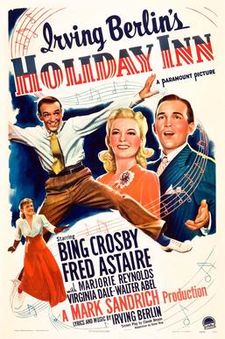
Holiday Inn:

This 1942 American musical film starring Bing Crosby and Fred Astaire, deserves inclusion if only for introducing the world to the song White Christmas (a white Christmas nonetheless being completely alien to us here in Oz). The only Oscar the film received was for Best Original Song for that Irving Berlin number.

Some facts and trivia from a past Bytes post:

-------oOo-------

Story:

Bing Crosby runs an inn that opens only on holidays (sounds like a good way to lose money) so there’s lots of singing. His friend is Fred Astaire so there’s also a lot of dancing. Oh, and Bing falls in love.

-------oOo-------

Kemmons Wilson, who founded the "Holiday Inn" motel chain in 1952, named it after this movie.

-------oOo-------

This is one of the first examples of how a hit song can help propel a film's box office. In this case, the song was Bing Crosby singing "White Christmas." Later examples include the title tune from Ghostbusters, Whitney Huston's "I Will Always Love You" from The Bodyguard and Celine Dion's "My Heart Will Go On" from Titanic.

-------oOo-------

Movie quote:
Linda Mason: My father was a lot like you, just a man with a family. Never amounted to much, didn't care. But as long as he was alive, we always had plenty to eat and clothes to keep us warm.
Jim Hardy: Were you happy?
Linda Mason: Yes.
Jim Hardy: Then your father was a very successful man.


White Christmas:

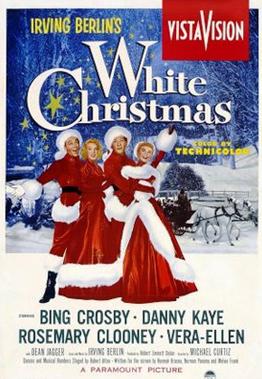
Capitalising on the popularity of the song “White Christmas” from Holiday Inn, Paramount Pictures made the film “White Christmas” in 1954 which again starred Bing Crosby and featured the song. The movie was a smash hit.

In summary, a successful song-and-dance team (Crosby and Danny Kaye) become romantically involved with a sister act (Rosemary Clooney, George’s aunt, and Vera Ellen) and team up to save the failing Vermont inn of their former commanding general (Dean Jagger).

A Christmas classic.

-------oOo-------

Some facts and trivia:

-------oOo-------

Until 1997, "White Christmas" was the best selling music single ever. It was passed at that time by "Goodbye, England's Rose", the Elton John rework of "Candle in the Wind" done for Princess Diana's funeral. These two songs still rank Number 1 and 2.

However, an update in the 2009 edition of The Guinness Book of Records named both to be "winners" by stating that John's recording is the "best-selling single since UK and US singles charts began in the 1950s," while maintaining that "the best-selling single of all time was released before the first pop charts," and that this distinction belongs to "White Christmas," which it says "was listed as the world's best-selling single in the first-ever Guinness Book of Records (published in 1955) and—remarkably—still retains the title more than 50 years later."

-------oOo-------

For the song "Gee, I Wish I Was Back In The Army", there is the lyric, "Jolson, Hope And Benny all for free". This is a reference to three wartime entertainers: Al Jolson, Bob Hope and Jack Benny. The original words were "Crosby, Hope and Jolson all for free", but the lyric was changed because with Bing Crosby in the cast the original lyric would break the fourth wall.

-------oOo-------

White Christmas (1954) was the first film photographed in Paramount's widescreen VistaVision process. A radical departure from the other widescreen formats of the era, VistaVision did not extend the width of the screen as much as it raised the height, which produced a significantly clearer image. Not surprisingly, the hundred or so films shot in VistaVision (notably High Society [1956], North by Northwest [1959] and White Christmas) have provided the most vivid clarity when transferred to high definition home video formats, as VistaVision applied the same principle and was, in effect, the first experiment in high definition.

-------oOo-------

The Vermont inn is the remodeled Connecticut inn set from Bing Crosby's earlier movie Holiday Inn (1942)

-------oOo-------

The "I'd Rather See a Minstrel Show" sequence points to changing times in terms of Hollywood's sensitivity to racial norms. The set design, props, costuming and musical arrangement are all typical of vintage minstrel shows, but the performers are not in black-face. This was progress, as Holiday Inn (1942), which inspired this production, featured a black-face number only twelve years earlier.


The Shop Around the Corner

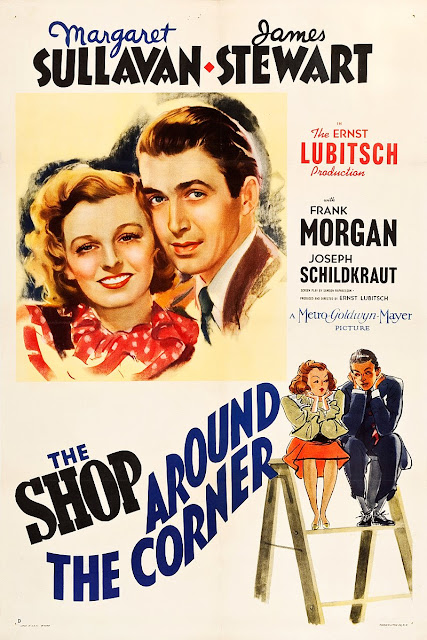
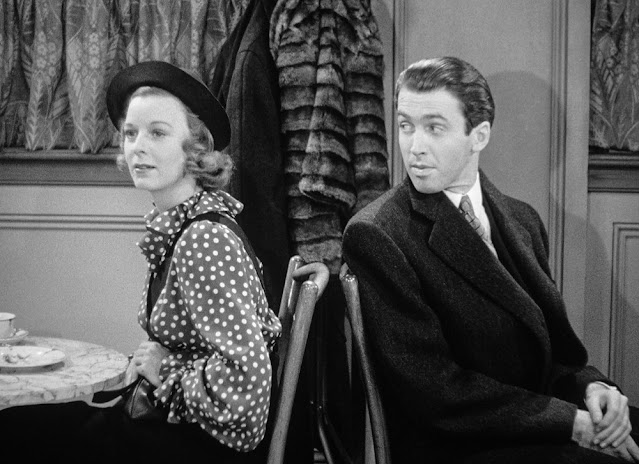
This 1940 American romantic comedy film starring Margaret Sullavan, James Stewart and Frank Morgan is the inspiration for the 1998 film You've Got Mail starring Tom Hanks and Meg Ryan, but without Christmas.

Two employees at a gift shop can barely stand each other, without realising that they are falling in love through the post as each other's anonymous pen pal.

Watch it if you get the opportunity, an oldie but a goodie (much like a pot of us).

-------oOo-------

Some facts and trivia:

-------oOo-------

In You've Got Mail (1998), which is based on this film, Meg Ryan's character owns a bookstore named The Shop Around The Corner.

-------oOo-------