Friday, September 27, 2013

Funny Friday


Having posted some photographic items during the week, it seems appropriate to have a few giggles on a photography/photographer theme:


A photographer took a self portrait in a park.
Due to lighting conditions he used the built in flash on the camera.
He quickly got arrested for flashing and exposing himself in the park.


I just saw a poster on a tree saying: 'This is a photograph of our dog which is missing. If found please call us'
So I phoned them up and said, "I've just found the photograph of your dog."


Two new models are waiting as the photographer gets his equipment ready.
One model says to the other,”What is he doing now?”
“He’s getting ready to focus”, she replies.
To which the first model exclaims,”FOCUS, but he hasn’t even paid us yet!”


Q: What did Mozart do when his Olympus broke?
A: He borrowed Pachelbel’s Canon.

(That should probably have been a Corn Corner item).


Limerick Spot:

There was a young curate of Salisbury
Whose manners were halisbury-scalisbury.
He walked about Hampshire
Without any pampshire
Till the vicar compelled him to walisbury.

[In the English Post Office the abbreviation for Hampshire is "Hants. and that for Salisbury is "Sarum."]

Okay, another then to make up for that one. This is a classic limerick, an oldie but goodie . . . 

There once was a plumber from Lee
Who was plumbing his girl by the sea.
She said “Stop your plumbing,
I think someone’s coming!”
Said the plumber, still plumbing, “It's me!” 

(“Plumbing” is a slang term for sexual intercourse, as is the related expression “laying some pipe”)


Thursday, September 26, 2013

Quote


" 'It became necessary to destroy the town to save it', 
a United States major said today. He was talking about the decision by allied commanders to bomb and shell the town regardless ofcivilian casualties, to rout the Vietcong.”

- Statement attributed to an unnamed U.S. officer by Associated Press correspondent Peter Arnett in his writing about Bến Tre city on 7 February 1968.

Ben Tre is the capital city of Ben Tre Province in the Mekong Delta area of southern Vietnam. Nearly destroyed by Allied bombing, it played a significant role in the Vietnam War.. Reports of the assault and resulting civilian casualties called into question the war aims of the United States.

The quote “It became necessary to destroy the town to save it” was later distorted to "We had to destroy the village in order to save it."


Arnett (above, right) was a junior AP reporter when he was covering the war in Vietnam, later going on to become CNN’s chief correspondent during the Gulf War. Back in 1968 during the Tet Offensive a small American unit battled the Viet Cong for 2 days in the battle of Ben Tre. Arnett entered the city after it was secured and spoke with various army officers, later saying that the comment was made by one of the officers he spoke to but refusing to identify which officer. Then Major Phil Cannella believes he is the officer quoted but says that it was taken out of context and quoted incorrectly, maintaining that he said the Viet Cong had destroyed the town and it was a shame.

Nonetheless the phrase has developed a life of its own and is often quoted, as it was then, to illustrate the absurdity of war and of military thinking.

Some similar quotations:

"Bomb them back to the stone age."
- U.S. General Curtis LeMay during the Vietnam War

“Better dead than red.”
- Anti-communist phrase first used during World War 2 and believed to have been coined by Nazi Germany’s propaganda minister Joseph Goebbels to incite opposition to the Soviet Red Army. It was used udring the Cold War and trotted out again during the Vietnam War.

“If you've got them by the balls, their hearts and minds will follow.”
- U.S. Green Berets slogan during the Vietnam War.


Wednesday, September 25, 2013

Some Song Factlets

____________________


Whilst driving with Kate with the radio, “Blinded By the Light” came on, which in turn touched off a discussion about the lyric “wrapped up like a douche”. It is a mondegreen, the term coined for misheard lyrics. The term originated in 1954 with writer Sylvia Wright, who commented that she had always thought the lines from a 17th century ballad were “They hae slain the Earl O' Moray, and Lady Mondegreen”, when correctly it was “They hae slain the Earl O' Moray and laid him on the green”. “Wrapped up like a douche” is correctly “revved up like a deuce”, but the V sound in "revved" is almost unpronounced, and the S sound in "deuce" comes across as "SH" due to a significant lisp of the recording artists, Manfred Mann’s Earth Band. Writer of the song Bruce Springsteen originally wrote the line as “cut loose like a deuce”, the deuce referred to being a 1932 Ford hot rod, as in “little deuce coupe”. Springsteen wrote the song by locking himself in his bedroom with a rhyming dictionary. According to him “The rhyming dictionary was on fire.”

____________________


While dealing with lyrics, how about the meaning of colitis in the Eagles’ "Hotel California": “On a dark desert highway, cool wind in my hair, warm smell of colitis rising up through the air." Colitis is an inflammation of the large intestine. One commentator has mentioned that the above lyric should not be confused with the Beatles’ lyric “The girl with colitis goes by.” In Hotel California, the word is actually “colitas”, being a Spanish word that means literally, "little tails", which in the context of the song is a reference to 'colas,' the tip of a marijuana branch, where it is more potent and with more sap (said to be the best part of the leaves). The Eagles’ manager has confirmed that the word 'colitas' was translated for them by their Mexican-American road manager as 'little buds.' 

____________________


The terms “rock” and “roll” were used in the 1920’s by black people to mean partying, carrying on, and/or having sex. “Shaking” was a similar expression, hence the sexual innuendo in Jerry Lee Lewis’s “Whole Lotta Shaking Goin’ On” in 1957. By the 1930’s the terms came to mean music with a particular beat, the words being used in both the song titles and in the lyrics. Wynonie Harris’s 1948 record "Good Rockin' Tonight" hit No 1, was followed by other hit rock songs.  


By 1952 radio DJ Alan Freed became aware of the large sales of rhythm and blues records to white teenagers. He changed the name of his popular music show from "Record Rendezvous" to "Moon Dog's Rock 'n' Roll House Party" and began playing R&B tunes, changing the description from R&B to “rock ‘n’ roll” to appeal more to a white audience, although he was one of the first to highlight music by black artists to white audiences.  Today he is credited with having popularised the term "rock and roll". Sadly his career ended with the payola scandal.  He died in 1965 with problems associated with alcoholism.


Bill Haley and the Comets recorded "Rock Around the Clock" in 1954, its use in “Blackboard Jungle” boosting its status as a teen anthem generally credited with making rock 'n' roll a worldwide phenomenon. Today Elvis’s 1954 recording of “That’s All Right, Mama” is, however, considered by many to be the start of the modern rock ’n’ roll era.


Tuesday, September 24, 2013

Love on the Streets


I came across the above image some time ago, even posted it as I recall, but only recently became aware that it was created by Baltimore artist Michael Owen. From there it has grown into a task known as The Baltimore Love Project, to paint the mural onto 20 walls in Baltimore. The idea behind it is to express love by connecting people and communities across Baltimore City through these love themed murals.


Which started me wondering about other love themed street art that uses the word Love.

Here are some that I found . . .


Monday, September 23, 2013

City of Shadows: Women

Continuing some of the images from the City of Shadows exhibition at the Police and Justice Museum in Sydney.  Today's images are of women, details being included where known.  Btw, my wife Kate reminded me that a comment was made by Peter Doyle in his film at the exhibition that this was the first time in their lives that many of the people depicted had had their photograph taken.

Rosie Steele was a drug runner for East Sydney cocaine trafficker Harry Newman. She was fined £30 in 1928 after she and another woman were arrested with a number of ‘five shilling sniffs’ in their possession.

Why is there a man's photo in this collection, I imagine you are asking.  Harry Leon Crawford, pictured above, who was charged with the murder of his wife, was in fact Eugeni Falleni, a woman and mother, who had passed as a man since 1899. 

In 1914, as ‘Harry Crawford’, Falleni had married the widow Annie Birkett. Three years later, shortly after she announced to a relative that she had found out ‘something amazing about Harry’, Birkett disappeared. Crawford told neighbours that she had run off with a plumber. In 1919 Birkett’s young son, who had remained in Crawford’s custody, told an aunt of attempts made on his life by his drunken stepfather. The aunt contacted police. A charred body which had been found in Lane Cove in 1917 was belatedly identified as Birkett’s. ‘Crawford’s’ astonished second wife, when finally convinced of Falleni’s true gender remarked:

“I always wondered why he was so painfully shy …”

The photograph shown here shows Falleni in male clothing, probably on the day of her arrest. The negative was found in a paper sleeve inscribed ‘Falleni Man/Woman’. It is also possible that Falleni was made to dress in a man’s suit for the photograph.

The press depicted Falleni as a monster and pervert.  Convicted of murder and sentenced to death, commuted to detainment at the Governor's Pleasure, Falleni was released in 1931 after 11 years.  In 1938 falleni was struck by a car in Oxford Street and died the next day.

Annie Gunderson was charged with stealing a fur coat from a Sydney department store called Winn’s Limited, in 1922. Police records do not indicate whether the fur she is wearing is the stolen item. Aged 19.


Nancy Cowman, 19

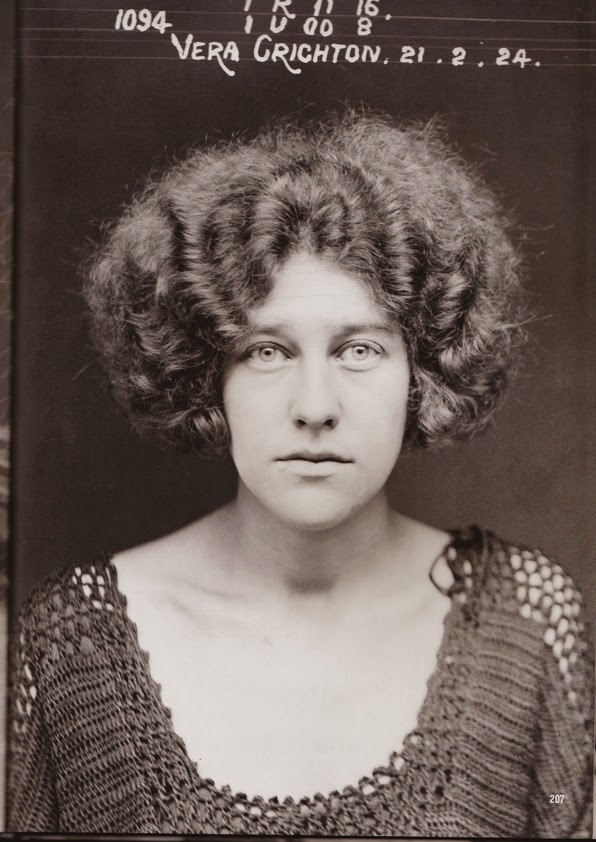
Vera Crichton, 23

Nancy Cowman and Vera Crichton, photographed in 1924, were charged, along with three others, with 'conspiring to procure a miscarriage' on a third woman. Cowman (alias Divvers, Denvers,) was eventually acquitted; Crichton was 'bound over to appear for sentence if called upon within three years'. Their three male co-accused received sentences of 12 and 18 months hard labour.''

Matilda “Tilly” Devine, 1925, one of the heads of the Sydney underworld in the 1920’s, being involved in a wide range of activities, including sly-grog, razor gangs and as the madam of Sydney’s brothels. The TV series Underbelly Razor featured her and her ongoing battle with other crime head Kate Leigh. When photographed above in 1925 she had been charged with slashing a man’s face in a barber shop with a razor. She received a two year gaol sentence.

Kate Leigh, 1915

Kate Leigh, 1930

Kate Leigh was also one of the heads of Sydney’s underworld in the 1920’s, s involved in after-hours drinking venues, sly-grog, prostitution, illegal betting, gambling and, from the mid-1920s, cocaine trafficking. She was also one of the main figures of Underbelly Razor.

It wasn’t until the formation of the Scientific Investigation Bureau (SIB) in 1945 that standard procedure was enforced for mug shots. Until then even dance routines were obviously acceptable. Here friends of the missing Rene Flowers, quite probably a vaudeville performer, strike an interesting pose.

“Child unknown found wandering at large”. Mid 1920s, details unknown.

Convicted of selling liquor without a licence. Alice Clarke was an entrepreneur who took advantage of restrictive liquor regulations, which forced pubs to close at 6pm. As a “sly grogger” she sold high-priced alcohol from a private residence. Clarke’s arrest came only weeks after the legislation was introduced. Aged 42

Alice Adeline Cooke, convicted of bigamy and theft.