* * * * * * * * * * *
Wednesday, November 13, 2013
Tuesday, November 12, 2013
Elephants in Rooms
TIME magazine has been criticised for its latest cover. The main story is about Chris Christie, the plain-speaking governor of the US state of New Jersey, who is tipped to be a future president.
He's also overweight, which is why TIME magazine’s cover featuring Mr Christie and the headline 'The Elephant In The Room' was savaged as a "cruel" fat joke this week:
- News report
Reading the above started me wondering as to the origin of the expression. Some info and trivia . . .
* * * * *
The Oxford English Dictionary defines the phrase as meaning “A significant problem or controversial issue which is obviously present but ignored or avoided as a subject for discussion, usually because it is more comfortable to do so.”
* * * * *
According to the OED, the first recorded usage of the phrase as a simile was in The New Your Times on June 20, 1959: "Financing schools has become a problem about equal to having an elephant in the living room. It's so big you just can't ignore it."
The OED also states that the first published reference for this usage is the title of a 1984 book, An Elephant in the Living Room: A Leader’s Guide for Helping Children of Alcoholics, by Marion H. Typpo and Jill M. Hastings.
* * * * *
Originators of the expression and similar concepts date from much earlier than the above recorded instances.
In 1882 Mark Twain wrote a story, The Stolen White Elephant, which looks at the bumbling efforts of detectives trying to find an elephant that was right on the spot after all.
The expression appeared in a British journal in 1915 where it was presented as a trivial illustration of a question British schoolboys would be able to answer, e.g., "Is there an elephant in the class-room?"
In 1935, comedian Jimmy Durante starred on Broadway in the Billy Rose stage musical Jumbo, in which a police officer stopped him while leading a live elephant and asked him, "What are you doing with that elephant?" Durante's reply, "What elephant?", was a regular show-stopper. Durante reprised the piece in the 1962 film version of the play, Billy Rose's Jumbo.
* * * * *
In 2006 British street artist Banksy had an exhibition in Los Angeles entitled “Barely Legal”.
The centrepiece of the exhibition was an elephant painted to resemble the wallpaper of the room in which it was standing:
The elephant, named Tai, was painted in that fashion to sumbolise how the problem of world poverty is ignored.
Although Los Angeles's Animal Services Department had given a permit for the 38-year-old female elephant to appear at the exhibition, officials later said that they regretted granting the permit and ordered Tai's owners, Have Trunk Will Travel, to remove the floral spray-paint.
According to ASD head Ed Boks "I think it sends a very wrong message that abusing animals is not only OK, it's an art form. We find it no longer acceptable to dye baby chicks at Easter, but it's OK to dye an elephant. Permits will not be issued for such frivolous abuse of animals in the future."
* * * * *
The Elephant in the Room
Terry Kettering
There’s an elephant in the room.
It is large and squatting,
so it is hard to get around it.
Yet we squeeze by with,
“How are you?” and, “I’m fine,”
and a thousand other forms of trivial chatter.
We talk about the weather;
we talk about work;
we talk about everything else—
except the elephant in the room.
There’s an elephant in the room.
We all know it is there.
We are thinking about the elephant
as we talk together.
It is constantly on our minds.
For, you see, it is a very big elephant.
It has hurt us all, but we do not talk about
the elephant in the room.
Oh, please, say her name.
Oh, please, say “Barbara” again.
Oh, please, let’s talk about
the elephant in the room.
For if we talk about her death,
perhaps we can talk about her life.
Can I say, “Barbara” to you
and not have you look away?
For if I cannot,
then you are leaving me alone
in a room—with an elephant.
* * * * * * * * * * *
Monday, November 11, 2013
11 November
* * * * *
On 11 November 1880, Irish Australian bushranger Ned Kelly was hanged at Melbourne Gaol. His last words were “Such is life” and “Ah, well, I suppose it has come to this.” He was aged 26 and he, his brother Dan and friends Steve hart and Joe Byrne had been outlaws for 2 years. At the final stand at Glenrowan on 28 June 1880, where Ned and the other members of the Kelly Gang fought the police wearing home made armour, all except Ned were killed.
Kelly Death Mask
* * * * *
On 11 November 1975 the Queen’s representative in Australia, the Governor General Sir John Kerr, dismissed the elected government of Prime Minister Gough Whitlam, and installed the leader of the Opposition, Malcolm Fraser, as the head of a caretaker government pending an election being held. Fraser, having a majority in the Senate, had blocked the money Bills (similar to what happened to Obama recently) to force an election to capitalise on Labor's unpopularity but Whitlam refused to go to the polls.
After Kerr had sacked Whitlam and his government, Kerr sent his Official Secretary, David Smith, to proclaim the dissolution from the front steps of Parliament House. The sacking had become known and an angry crowd was gathered at the front of Parliament House. Smith read the proclamation and concluded with the traditional words “God save the Queen.”
Whitlam, who had been standing behind Smith, stepped forward and stated:
"Well may we say "God save the Queen", because nothing will save the Governor-General!
The Proclamation which you have just heard read by the Governor-General's Official Secretary was countersigned Malcolm Fraser, who will undoubtedly go down in Australian history from Remembrance Day 1975 as Kerr's cur.
They won't silence the outskirts of Parliament House, even if the inside has been silenced for a few weeks ... Maintain your rage and enthusiasm for the campaign for the election now to be held and until polling day."
In the election that followed, on 13 December, Fraser’s Coalition won a record victory, with 91 seats in the House of Representatives to Labor's 36 and a 35–27 majority in the expanded Senate
* * * * *
On 11 November 1918 at 5.00am, the Armistice was signed which formally ended hostilities in World War 1. It provided that fighting would cease “at the 11th hour of the 11th day of the 11th month”. The delay was to enable the news to reach the many parts of the Western Front.
Although the news that fighting would cease at 11.00am was quickly spread, intense warfare continued right until the last minute . . .
* * *
Many artillery units continued to fire on German targets to avoid having to haul away their spare ammunition. The Allies also wished to ensure that, should fighting restart, they would be in the most favourable position. Consequently there were 10,944 casualties on the last day of the war with 2,738 losing their lives.
* * *
The Commonwealth War Graves Commission (CWGC) states that their records show that 863 Commonwealth soldiers died on November 11th 1918, though this figure also includes those who died on that day but of wounds received prior to November 11th.
* * *
The Americans took heavy casualties on the last day of the war when General John "Black Jack" Pershing, believing that the terms of the Armistice were too lenient and that the Germans had to be taught a lesson, ordered that German positions be attacked. The US Marines took over 1,100 casualties in attempting to cross the River Meuse. The 89th US Division suffered 300 casualties in capturing the town of Stenay on the morning of 11 November 1918.
When the losses became known in the US, Congress held a hearing via a House of Representatives Committee on Military Affairs that examined whether senior army commanders had acted appropriately in the last few days of the war. Pershing remained unapologetic, stating that although he knew about the timing of the Armistice, he did not trust the Germans to carry out their obligations. He therefore, as commander in chief, ordered the army to carry on as it would normally do as any “judicious commander” would have done. Pershing also pointed out that he was merely carrying out the orders of the Allies Supreme Commander, Marshall Ferdinand Foch, that were to “pursue the field greys (Germans) until the last minute”.
* * *
Information about German casualties is more difficult to ascertain. It is believed that the last casualty of World War One was a junior German officer called Tomas who approached some Americans to tell them that the war was over and that they could have the house he and his men were just vacating. However, no one had told the Americans that the war had finished because of a communications breakdown and Tomas was shot as he approached them after 11.00am.
* * *
Augustin Trebuchon was the last Frenchman to die when he was shot on his way to tell fellow soldiers that hot soup would be served after the ceasefire. He was killed at 10:45 am
* * *
The last soldier from the UK to die, George Edwin Ellison of the 5th Royal Irish Lancers, was killed earlier that morning at around 9:30 am while scouting on the outskirts of Mons, Belgium.
* * *
The final Canadian, and Commonwealth, soldier to die, Private George Lawrence Price, was shot and killed by a sniper just two minutes before the armistice to the north of Mons at 10:58 am, to be recognized as one of the last killed with a monument to his name.
* * *
American Henry Gunther is generally recognised as the last soldier killed in action in World War I. He was killed 60 seconds before the armistice came into force while charging astonished German troops who were aware the Armistice was nearly upon them.
Gunther's squad had approached a roadblock of two German machine guns in the village of Chaumont-Devant-Damvillers. Gunther got up, against the orders of his sergeant and close friend, Ernest Powell, and charged with his bayonet. The German soldiers, aware of the armistice that would take effect in one minute, tried to wave Gunther off. He kept going and fired "a shot or two". When he got too close to the machine guns, he was shot and killed instantly.
The writer James M Cain, then a reporter for the Baltimore Sun, interviewed Gunther's comrades afterward and wrote that "Gunther brooded a great deal over his reduction in rank, and became obsessed with a determination to make good before his officers and fellow soldiers." Gunther had earlier been demoted from sergeant to private for having advised a friend to do anything to avoid being drafted.
His divisional record states “Almost as he fell, the gunfire died away and an appalling silence prevailed.”
* * * * * * * * * *
Sunday, November 10, 2013
More Great Moments in Law
Some amusing legal incidents from the last few days plus an item from the US . . .
* * * * *
Great Moment 1:
“You will have to delete that expression from your lexicon when we go to trial.”
- Barrister (who shall remain nameless) to my ethnic client in conference this week, referring to an expression the client uses. The client has poor English language skills and an interpreter has been ordered for the hearing that is coming up.
* * * * *
Great Moment 2:
Myself to client: “You have shown your family dog, along with your daughter, as a financial dependent?”
Client: “Do you know how much that dog costs me with food and vet bills?”
* * * * *
Great Moment 3
No 1 son had a mention in the Court of Criminal Appeal last Thursday. I went with him because I had a matter in a nearby tribunal a little later. Whilst we were waiting in court for his matter to come up, the Registrar dealt with a matter where the other party was representing himself and appeared via audio visual link insofar as he was in custody.
Inmate: “It’s like this, Your Honour.”
Registrar: “Address me as ‘Registrar’ “
Inmate: “Okay, it’s like this, Your Registrar . . .”
* * * * *
Great Moment 4
(This has been the subject of an earlier, briefer post in Bytes).
As has been seen in past Bytes, American judges are much flamboyant, eccentric, bizarre and just plain weird than those in England and Australia.
The following case continues that tradition.
People v. Arno
153 Cal. Rptr. 624, 628 n.2 (majority), 644 n.14 (dissent) (Cal. Ct. App. 1979).
In 1975 Norman Arno and Leonard Steer were convicted in the municipal court of three counts of possessing obscene films with intent to distribute. Whilst in an office suite, from where they ran their business, they had been kept under observation by police officers in the opposite building, looking into their windows with 10-power binoculars.
Arno and Steer appealed their conviction, the appeal coming before the California Court of Appeals in 1979. Sitting on the appeal were Judges Thompson, Lillie and Hanson.
The main issue was whether evidence based upon a view of business premises aided by the use of high powered binoculars was illegally obtained evidence. At that time the issue of optically aided view had not been addressed in California.
The majority, Judges Thompson and Lillie, decided as follows:
1. the use of optical aids in the nature of binoculars, telescopes and the like is not itself determinative of the admissibility in evidence of the product of the observation;
2. the primary determinative factor is the presence or absence of a reasonable expectation of privacy of the person whose conduct, property, or documents is observed;
3. reasonable expectation of privacy in the context here is tested by the extent to which the person has exposed his conduct, property, or documents to public view by the naked eye;
4. if the purpose of the optically aided view is to permit clandestine police surveillance of that which could be seen from a more obvious vantage point without the optical aid, there is no unconstitutional intrusion; and
5. if the purpose of the optical aid is to view that which could not be seen without it, there is.
The majority also said:
“We recognize that special circumstances involving a high degree of danger to life or property may permit an optically aided view and that there may be situations in which probable cause may be established to the satisfaction of a magistrate so that the aided view may be authorized by a warrant. We do not reach those latter issues on the record here.”
Put simply, the surveillance was unlawful because the defendants’ constitutionally protected reasonable expectation of privacy was breached by the use of high power binoculars, the evidence was out and the conviction was overturned.
The majority decision did not sit well with Judge Hanson. He wrote a strident, lengthy and detailed dissenting judgment which included the following:
The majority opinion appears to me to be somewhat unclear and contains some contradictory statements. However, as I read it, it has either misapplied the irrational exclusionary rule . . . or has ignored judicial precedent . . .
. . . the majority opinion as I construe it has the net practical result of unduly restricting law enforcement officers' utilization of binoculars while engaged in their official duties of detecting and acquiring evidence of a wide range of criminal activities involving pornography, narcotics, prostitution, pimping, bookmaking and the like, irrespective of the magnitude of the operations. This latter group of crimes has been loosely referred to as "victim-less crimes" which is a gross misnomer. There are no victim-less crimes. Society is the victim. {Page 90 Cal.App.3d 538} The majority opinion in my view unduly restricts law enforcement officers from protecting society's interest in respect to the commission of the types of crimes mentioned above.
So Judge Hanson got it off his chest, implying that Judge Thompson, who had written the majority judgment, and Judge Lillie, who went along with it, were pro-smut.
This time it was Thompson and Lillie’s turn to be pissed off. They added a footnote to the case report:
FN2 We feel compelled by the nature of the attack in the dissenting opinion to spell out a response:
1. Some answer is required to the dissent's charge.
2. Certainly we do not endorse "victimless crime."
3. How that question is involved escapes us.
4. Moreover, the constitutional issue is significant.
5. Ultimately it must be addressed in light of precedent.
6. Certainly the course of precedent is clear.
7. Knowing that, our result is compelled. (See Funk & Wagnall's The New Cassell's German Dict., p. 408, in conjunction with fn. 6 of dis. opn. of Douglas, J., in Ginsberg v. New York (1967) 390 U.S. 629, 655-656 [20 L.Ed.2d 195, 212-213, 88 S.Ct. 1274].)
As one writer has put it, look at the initial letters of the 7 points and then recall Country Joe McDonald at Woodstock shouting “What’s that spell? What’s that spell?”
The word “schmuck” is Yiddish in origin where it means “penis”. It has also come to mean someone who is stupid or foolish, or an obnoxious, contemptible or detestable person.
Judge Hanson, maintaining the dignity of the bench, let the matter rest there. Well, actually, no, he didn’t, I made that up. He added his own footnote in reply:
FN14 I have heretofore eschewed responding to footnote 2 of the majority opinion in kind since it would be beneath the dignity of this office. Although I still will not respond in kind, with the filing of a modification to footnote 2 on March 20, 1979, some comment is compelled.
I decry the lack of propriety, collegiality and judicial temperament displayed in footnote 2. I abhor the loss of public respect for the legal profession and the judiciary footnote 2 has engendered by reason of the report in the Los Angeles Times on March 13, 1979 (circulation 1,034,329). One certainly cannot fault the Los Angeles Times for using an English dictionary (Webster's) since California published opinions for over 125 years have been written in English and our jurisdiction obviously does not extend seven thousand miles to the Rhine in Germany.
I construe the Ginsberg reference in footnote 2 within the context of the case at bench as a personal affront to every California citizen and their duly elected representatives in the California State Legislature who have deemed it a wise public policy to enact our criminal obscenity laws and to all public servants charged with the responsibility of enforcing those laws. It is no wonder that California has the odious distinction of being the porno capital of the world.
They do things differently in America.
* * * * *
Bonus Great Moment:
Speaking of brief, this must be the shortest judgment on record. It is the entire judgment in 1970 case in the Michigan Court of Appeals:
“The appellant has attempted to distinguish the factual situation in this case from that in Renfroe v. Higgins Rack Coating and Manufacturing Co., Inc. (1969), 17 Mich.App. 259, 169 N.W.2d 326. He didn’t. We couldn’t. Affirmed. Costs to appellee.”
Michigan Court of Appeals Judge J. H. Gillis
Denny v. Radar Industries Inc., 28 Mich. App. 294, 184 N.W.2d 289 (1970)
Saturday, November 9, 2013
UTA Flight 772
Byter Sue sent me a link to a fascinating and moving item that is the subject of today’s Bytes. Sue described it in the following terms:
“It reminded me of the running mare in I think Wales. Beautiful only from a distance, enormous work performed by people with a shared goal. Both with a human sacrifice and an attempt to portray the magnitude of life in an infinitely larger universe.”
The link sent is to a post by an unidentified writer, reposted below, about a memorial to the victims of a terrorist bomb attack on an airplane.
Link:
Thanks, Sue.
* * * * *
I Noticed This Tiny Thing On Google Maps. When I Zoomed In… Well, Nothing Could Prepare Me.
November 2, 2013 In the News
A friend told me to go to a certain latitude and longitude on Google Maps. When I noticed it seemed to be in the middle of an African desert, I thought he was just sending nonsense. But when I zoomed in, my mind was blown. I noticed a tiny icon that looked like an airplane.
So I did some more research and discovered there’s an incredibly tragic and beautiful story behind it.
UTA Flight 772 was a scheduled flight operating from Brazzaville in the Republic of Congo to Paris CDG airport in France. The flight never made it. All on board perished.
Eighteen years later, families of the victims gathered at the crash site to build a memorial.
Due to the remoteness of the location, pieces of the wreckage could still be found at the site.
The memorial was created by Les Familles de l’Attentat du DC-10 d’UTA, an association of the victims’ families along with the help of local inhabitants.
The memorial was built mostly by hand and uses dark stones to create a 200-foot diameter circle
The Tenere region is one of the most inaccessible places on the planet. The stones were trucked to the site from over 70 kilometers away.
170 broken mirrors, representing each victim, were placed around the circumference of the memorial.
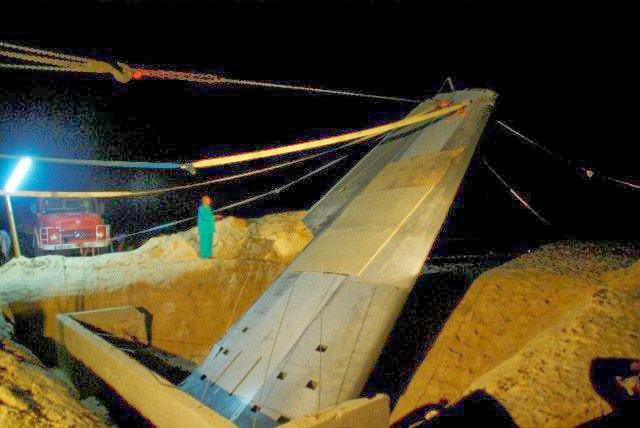
The memorial is anchored by the starboard wing of the aircraft which was trucked to the site from 10 miles away. Workers had to dig up the wing and empty it of sand.
The memorial was partly funded by the $170 million compensation package provided by the Libyan government.
The completed memorial.
The memorial can be seen from Google Earth and Google Maps.
Six Libyans were ultimately convicted of this terrorist attack. They used a suitcase bomb to blow up the plane, which resulted in 155 passengers and 15 crew members meeting their demise.
Even in the face of this tragedy, the families constructed this beautiful memorial to never forget what happened. They will live on in their hearts, in the desert, and even on Google Earth forever.
* * * * * * * * * * *
Subscribe to:
Posts (Atom)