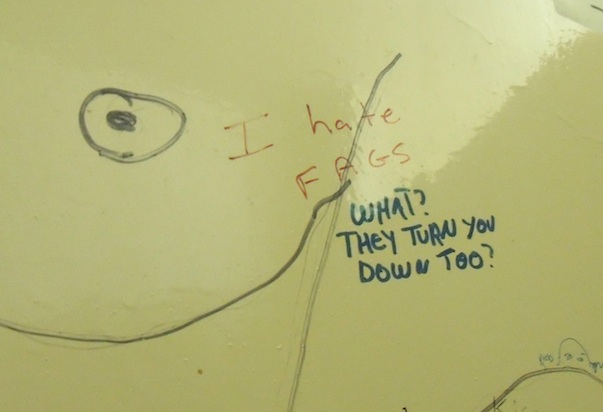
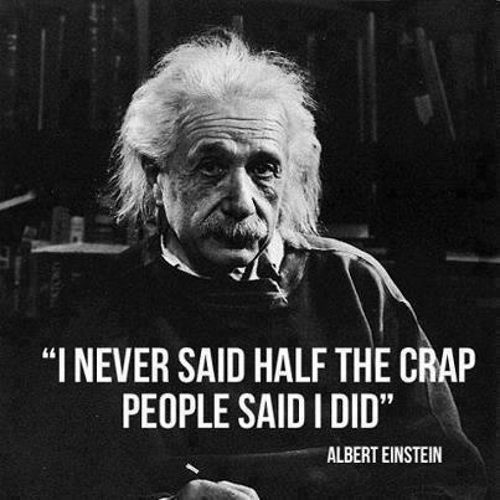
Bonus: a couple of graffiti . . .
Tuesday, June 9, 2015
Monday, June 8, 2015
Quote for the Day
“Ah no, my good friends,
once a philosopher,
twice a pervert.”
- Voltaire (1694-1788)
Voltaire had attended an orgy in Paris at the request of his friends, never having been to one before and always being open to new experiences. He said to his friends that he had learned many new things and had enjoyed the experience. Asked to go again the next night, he responded as above.
Drones
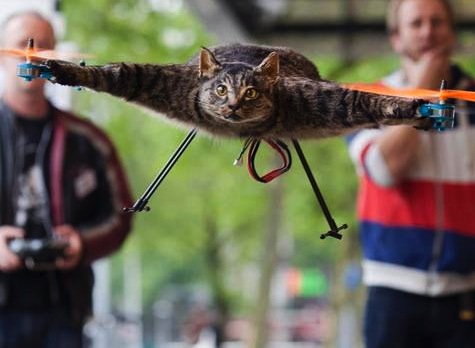
I posted an item last week that a restaurant in Singapore had replaced waiters with drones for food and drinks delivery. Amazon uses drones for transport of goods within its warehouses and has patented the delivery process in the population at large. Drones are being used for photographic purposes, for spying and surveillance, for sporting competitions and for recreation. One guy even turned his deceased pet cat into a drone, the subject of a past Bytes.
I had contemplated presenting a Funny Friday on the topic of drones but decided that the humour was lacking, at least for me, about something that is used for military purposes to kill people.
Nonetheless it had me wondering about the word origin of “drone.”
The word “drone” has a number of meanings, the most notable being
a bee;
an unmanned aerial vehicle;
an unmanned combat aerial vehicle;
a continuous note or chord.
Bee:
Within the bee world, drones are male honey bees which are the product of an unfertilised egg. Unlike the female worker bee, drones do not have stingers and do not participate in nectar and pollen gathering. A drone's primary role is to mate with a fertile queen. (Don't think that that would so great: immediately after mating, which is aerial and lasts only a couple of seconds, the drone's genitalia snaps off and is explosively torn from his body, remaining in the Queen Bee to act as a plug to prevent semen loss. It does not prevent mating with more drones, the Queen usually mates with several drones).
Worker bees are easy to distinguish from drones
Unmanned aerial vehicle:
Such vehicles are aircraft without on-board human pilots, their movement being controlled remotely by a person on the ground or by an automated computer system. Some examples:
Toy drone
Camera drone
Parcel drone
Unmanned combat aerial vehicle:
Military drones are used for surveillance, combat and as decoys. In 1973 during the Yom Kippur war Israel used target drones to cause Egypt to fire its entire anti-aircraft missile stock. Israel further developed unmanned aerial vehicles (UAVs) and their use in the 1970’s and 1980’s. In the late 1980’s Iran deployed UAVs armed with rocket propelled grenades during the Iran-Iraq war, the first time an armed drone was used in war. Inspired by the Israeli example, the US further developed the use of drones in combat. Presently only the US, UK, Israel, Pakistan and China possess drones capable of delivering missiles.
Word origin:
The use of the word “drone” for the male bee dates back to Old English times. Because that bee’s only role was to mate with the Queen Bee, unlike worker bees, by the 16th century the word had also come to be applied to lazy humans. Further, at around that time the word “drone” was also being used as a verb, with the meaning to buzz like a bee or to speak in a monotonous fashion reminiscent of a bee's persistent hum.
The modern use of the word has a connection with bees.
Military analyst and historian Steven Zaloga has explained the application of the term to UAVs as follows:
Drone is one of the oldest official designations for remotely controlled aircraft in the American military lexicon. in 1935, when the chief of naval operations Adm. William Standley, visited Britain, he was given a demonstration of the Royal Navy’s new DH 82B Queen Bee remotely controlled aircraft that was used for anti-aircraft gunnery practice. On his return, Standley assigned an office, Cmdr. Delmer Fahrney at the Radion Division of the Naval Research Laboratory, to develop a similar system for US Navy gunnery training. Fahrney adopted the name drone to refer to these aircraft in homage to the Queen Bee. Drone became the official US Navy designation for target drones for many decades.
http://intercepts.defensenews.com/2013/05/the-origin-of-drone-and-why-it-should-be-ok-to-use/
It seems quite appropriate in that a drone could only function when controlled by an operator on the ground or in a "mother" plane.
According to Zaloga, the term drone was used exclusively by the Pentagon and the US military until near the end of the Vietnam war. This was changed to UAV in the 1990’s, to Unmanned Aerial System (UAS) around the year 2000 and to Remotely Piloted Aircraft (RPA) a couple of years ago. The general public and the media simply keeps calling them drones.
That usage has also come to be used as a verb with the meaning of being struck by a missile fired from a drone.
Ben Zimmer, writing in the Wall Street Journal:
On the domestic front, posters critical of U.S. policy rework the Obama campaign mantra "Yes We Can" into "Yes We Drone." And riffing off "Don't tase me, bro," the famous plea by a student who was hit by a police Taser at a 2007 speech by John Kerry, protesters have embraced the slogan, "Don't drone me, bro!"
http://www.wsj.com/articles/SB10001424127887324110404578625803736954968
Sunday, June 7, 2015
Quote for the Day
“Do you know how long a year takes when it’s going away?” Dunbar repeated to Clevinger. “This long.” He snapped his fingers. “A second ago you were stepping into college with your lungs full of fresh air. Today you’re an old man.”
“Old?” asked Clevinger with surprise. “What are you talking about?”
“Old.”
“I’m not old.”
“You’re inches away from death every time you go on a mission. How much older can you be at your age? A half minute before that you were stepping into high school, and an unhooked brassier was a close as you ever hoped to get to Paradise. Only a fifth of a second before that you were a small kid with a ten-week summer vacation that lasted a hundred thousand years and still ended too soon. Zip! They go rocketing by so fast. How the hell else are you ever going to slow time down?” Dunbar was almost angry when he finished.
“Well, maybe it is true,” Clevinger conceded unwillingly in a subdued tone. “Maybe a long life does have to be filled with many unpleasant conditions if it’s to seem long. But in that event, who wants one?”
“I do,” Dunbar told him.
“Why?” Clevinger asked.
“What else is there?”
- Joseph Heller (1923-1999)
Catch-22
Zambuks
Recently our trivia night shared part of the floor at the club (separated by walls, fortunately) with a St John Ambulance Brigade Annual Dinner. Some of us knew some of them and, in response to an apology for any disruption, I replied “It’s okay, I was a Zambuk myself when I was young.”
By way of explanation, the St John Ambulance Brigade is a charitable organisation that teaches first aid and provides voluntary assistance by having members attend contact sport matches, parades, functions etc in uniform with first aid kits. These adult officers are accompanied by younger members, known as cadets. I was a cadet in my younger years and attended training etc every Friday night.
Cadets assisting at an Anzac Day march, known as doing “duty”. Back in my day 300 hours got you a badge for your uniform.
Cadets training, here learning CPR
My use of the term “Zambuk” caused a few initial quizzical looks and at least one “A what?” The person to whom I made the comment, of my vintage, knew what I was talking about but apparently the word is no longer in use.
Here are some comments.
* * * * * * * * * *
St John Ambulance Brigade personnel on duty at football matches were, back then, commonly referred to as Zambuks. These days there is much greater organisation and professionalism in the sport. In the bygone years first grade footballers had other jobs as well as playing football, there were no trainers or medical people as part of the team and first aid was rendered by the Zambuks. If the matter was serious, an ambulance was summoned for a trip to hospital or someone, such as a club official, drove the player there.
How did they come by that nickname?
* * * * * * * * * *
Zam-Buk is an antiseptic ointment herbal balm, first sold in the UK in 1902 and still available. It is believed that the name comes from an African town by the same name.
At a time when a graze or cut could result in infection and sometimes death, the availability of a handy and inexpensive antiseptic was welcome.
Some early ads:
* * * * * * * * * *
St John officers rendering first aid at football matches began carrying Zam-Buk as part of their kit, applying the ointment to cuts and grazes to minimise the risk of infection.
Soon they became known as Zam-Buk Men, a name that was supported by their black and white uniforms, the colour of the Zam-Buk tin.
From there it was but a short step for the first aiders to become known as “zambuks” or “zambucks”.
* * * * * * * * * *
From the website of Rose & Co, which revived the brand and name, and is the present day distributor of the ointment:
The Zam-Buk Company was formed in the early 1900s by CE Fulford in Leeds, Yorkshire. The name suggests that it is African in origin, and although rarely heard today, it was used in Australia and New Zealand to describe the first-aid officers present on the rugby pitch who would administer healing antiseptic ointment to wounds and injuries. It quickly became available in Canada, Australia, New Zealand and South Africa and was a household name for the majority of the 20th Century.
http://www.rose-apothecary.co.uk/blog/?p=150
* * * * * * * * * *
Saturday, June 6, 2015
Quote for the Day
"Oh, women lawyers – I would put them all behind bras."
- Sir Leslie Herron (1902-1973)
NSW Supreme Court Chief Justice
to Ms Gaudron (later to be a justice on the High Court) and other female barristers in the early 1970s when they suggested the exclusion of sexist remarks in his usual speech of welcome to new barristers.
People: Ada Emily Evans
Regular Byters will know that No 1 son, Thomas, has joined the fraternity of the wig and gown and is now a barrister. He will be a baby barrister, also known as a “reader”, for 12 months under the supervision of one or more suitably qualified and experienced barristers, who are known as “tutors”.
No 1 son, as a reader, has a small office, "the Readers’ Room", at Ada Evans Chambers.
From the website of those chambers:
Ada Evans Chambers has almost 30 members of varying levels of seniority, including Queen’s Counsel. Each barrister is a sole practitioner, conducting individual practice as a specialist advocate and provider of advice and other legal services.
Which brings me to the point of this post, a brief bio of Ada Evans, after whom the chambers are named.
Born Ada Emily Evans in 1872 in England, she was the youngest daughter of a foreman at a stoneworks. In 1883 at age 11 she migrated with her family to Sydney, attending Sydney Girls’ High School and the University of Sydney where she obtained a Bachelor of Arts in 1895. Her intended career was teaching and, with her sister, she established a small private school, Cheltenham College, in Summer Hill but this came to an end by reason of ill health.
In 1881 the University of Sydney had resolved to allow equal education and opportunity to women “in complete equality with men.”
University of Sydney, 1870's
University of Sydney, view from Parramatta Road, 1870's,
Vocalising equality is one thing; doing is another.
Some readers may be aware of a marvelous British production Bramwell, the story of a female doctor who establishes a free hospital in the East End of London in 1895 and of the prejudices she encounters in the male dominated medical profession.
The male dominated legal profession in Sydney in the late Victorian era was no different.
No doubt drawing inspiration from her mother's legal family, Ada determined to pursue a career in law, convinced that there was a need to counter the prejudices of an all male legal system.
In 1899 she enrolled in the University of Sydney Law School, despite the fact that there had been no female law graduate before her, no practising women lawyers and that as the law stood, she would have no right to practise, even if she did graduate.
It is sometimes difficult to comprehend the sheer unfairness, hostility and discriminatory attitudes of those times when being looked at through 21st century eyes and with 21st century attitudes.
Even when I was studying contract law, married women were grouped in the category of “abnormal” legal persons with “lunatics and infants” (the latter being anyone under 18), on the basis that special laws applied to married women in respect of husbands’ liability for their debts.
Back in 1881 when the University opened its educational doors, the Bulletin opined that “a girl who has received a higher education is generally a prig or a poseur.”
Ada’s enrolment, in 1899, went through only because the dean, Professor Pitt Cobbett, was on leave.
He most certainly would have blocked the enrolment. When he returned from leave, he met with her and advised her that she would find medicine more suitable insofar as she did not have the physique for law. Ada declined and carried on with law, no doubt drawing the ire of her male peers, lecturers and admitted lawyers, much as Bramwell did in her TV series.
An application to the Supreme Court to be registered as a student-at-law was rejected in that the rules only provided for “persons” to be admitted as barristers and solicitors, judicial authority holding that “persons” meant “males”. The rules of practice legislation did not actually disqualify women from becoming lawyers, the common law at the time held that legislation had to specifically confer rights or privileges on women for it to apply to them in that women were not included in the definition of persons.
She persevered, graduating in 1902, the first female law graduate in Australia.
An application to practise law was again refused on the same basis as before, a situation that also existed in England, thereby also preventing her from practising law there.
Unable to practise, she and her brother purchased a property , Kurkulla, at Bowral and turned the 6 hectares into a self supporting farm, not only for herself but also for several family members.
Kurkulla as it looks today
She did not, however, give up on her dream of practising law. She campaigned to have the law changed and for women to be put on an equal footing with men. Such campaigns were also conducted in other States and in the UK.
High Court Justice Mary Gaudron has quoted from an anonymous author of a 1920 English book Concerning Solicitors:
It is difficult to understand why up to now there have been female surgeons, doctors and oculists in this country and female lawyers in many other countries, but no female lawyers in the United Kingdom. Clearly, both branches of the law offer as excellent an opening for the same type of celibate woman with exceptional talent as any other profession.
The truth is that the differences between the sexes have been grossly exaggerated by priests, journalists and fools generally, and there can be no doubt that at least one per cent of women are quite as intelligent as any man."
http://www.hcourt.gov.au/assets/publications/speeches/former-justices/gaudronj/gaudronj_wlasp.htm
In 1918 NSW passed the Women’s Legal Status Act, finally enabling Ada Evans to register as a student at law. Ada could now be enrolled but could not be admitted until she had served 2 years as a student-at-law. In 1921 she was finally admitted, the first woman admitted to the NSW Bar. She declined a brief that was immediately offered, citing the length of time that had elapsed since her graduation.
Similar legislation had been passed in New Zealand in 1896; in Victoria in 1903; in Tasmania in 1904; in Queensland in 1905 and in South Australia in 1911. It was passed in Western Australia in 1923.
Ada Evans died at Kurkulla on 27 December 1947 and was cremated in Sydney.
According to the Australian Dictionary of Biography:
. . . intelligent, confident and compassionate, Ada Evans was well equipped to take her place as a member of the legal profession, but was frustrated in doing so by the law itself. Like many pioneers she was unable to reap the reward of her labours, but as Professor W. Jethro Brown had predicted when encouraging her to persevere with her legal studies, her reward would be 'the glory of the pioneer'.
http://adb.anu.edu.au/biography/evans-ada-emily-6118
Friday, June 5, 2015
Subscribe to:
Posts (Atom)