Tuesday, November 8, 2016

Winged Victory


War Memorial, Cnr. Coronation Parade and Liverpool Road, Enfield (Former Enfield Town Hall in background)

One thing that Australia is not short of is war memorials. Most towns and suburbs have a memorial erected outside the local RSL Club, in a park or outside the Town Hall with a statue of some sort honouring servicemen who fought, and died, in various wars.  Sometimes, as above, the memorial has as a centrepiece an item of military hardware.

In the years following white settlement of Australia, troopers were used to quell aboriginal resistance and convict rebellions and to quash the miners’ revolt at Eureka. Australian troops traveled to New Zealand in 1845 to fight in the first Anglo-Maori War and again in 1860. They also traveled overseas to take part in the Sudan campaign of 1885, the Boer War (1899-1901) and the Boxer Rebellion in China (1900-1901). The first time Australian troops saw action as representatives of a nation, rather than as a group of colonies, was in World War 1. From a population of fewer than five million, 416,809 men enlisted, with over 60,000 killed and 156,000 wounded, gassed, or taken prisoner.

Following the end of WW1, and even during its course, numerous memorials were erected dedicated to those who had made the ultimate sacrifice.

Marrickville, the area in which I reside, was no exception.

A memorial dedicated to the 457 Marrickville soldiers who died during the First World War was unveiled in 1919. Although only a small municipality, over 4,000 men from the area enlisted to serve.

The memorial consisted of a brass depiction of Nike, the Greek goddess of victory. Known as Winged Victory, she stood atop an 8 metre granite plinth. The statue was designed and erected by Gilbert Dobel and was over 4 metres tall, symbolising victory by holding a laurel wreath in her right hand and an upraised sword in her left. Although the sword was raised in victory, the eyes were downcast in sorrow for those who had secured the victory at the cost of their lives.

Winged Victory, photo taken in 1919 by Gilbert Dobel


Marrickville War Memorial Opening Ceremony, 1922

16,000 gathered at the dedication of the statue on 24 May 1919 and there Winged Victory remained, until 1962. In that year the statue was moved to a shed in Petersham because of safety concerns, the metal at the base having deteriorated and threatening to cause the statue to topple. She remained in the shed, sad and forgotten, until restored and re-erected as part of the Bicentennial project. Only the top half of the statue was original, the bottom half having been replaced by a replica cast when the bottom half could not be located.

Restoration of the statue, the bottom half being recreated in wax clay


In 2009 she was removed again, large cracks in the statue having raised safety concerns, as well as issues of stability. The original top half is now on display in a gallery in the Australian war Memorial in Canberra.


Which brings me to the point of today's post.

In April 2015 a re-imagined version of Winged Victory was erected as part of the Town Hall upgrade.

Created by artists Peter Corlett and Darien Pullen, it maintains the same dimensions as the original statue but the pose has been altered by having the sword lowered. According to sculptor Damien, "I was chasing an image of peace and sacrifice.” (The lowering of the sword apparently also stopped it acting as a lightning rod, the cause of damage to the original statue).

I drive by the statue regularly and an always fascinated by the beauty of it, the blending of the themes of victory and sacrifice in a statue that is, well . . . sexy.

Here are some pics of the construction and dedication of Winged Victory, with some extra of the statue itself.

Tell me what you think.

Gallery:


Dedication in 2015


Monday, November 7, 2016

Quote for the Day


Prediction: you will henceforth think of a drowning man with his arms raised whenever you now see "lol".


Readers Write and Some Clarke Bedford

__________________________________

From Tobye P in the US, in respect of the post about the art of John Atkinson Grimshaw:
Wow! Great Bytes! I love the quote-and I love Grimshaw’s work! I believe I’ve heard his (unusual) name, but I don’t know that I’ve seen much of his work. Fabulous, thanks! I may look for some prints… 
As to why he isn’t more well-known…could it be the hair? I’m just sayin’…

Have a great weekend, and thanks for your effort to keep us informed-and trivial!
Regards, Tobye 
Thanks Tobye. :-)


From Leo M in response to the same post:
Beautiful Otto. 
It reminds me, I came upon a painter in Strasbourg in August 2014 I was not familiar with and then found out he was famous in the Grimshaw way. 
I will look up his name for you. 
Leo
Thanks, Leo.
__________________________________

Meet Clarke Bedford…

Clarke is a retired art conservator from the Smithsonian’s Hirshhorn Museum and Sculpture Garden in Washington, D.C.

He lives in Hyattsville in Maryland in the US, where his claim to fame now is the decoration of his house and cars. Staring in 2000, Clarke began adding bits of metal that he salvaged or bought to both his house and his cars. He calls his house "As-sem-blage Co-ttage," pronounced in rhyming French. 

Here’s some pics of Clarke Bedford and his works . . . 


Sunday, November 6, 2016

Quote for the Day

“The door to Australia is closed to those who seek to come here by boat with a people smuggler- it is closed.”

- Prime Minister Malcolm Turnbull 
to reporters last Sunday, advising that government policy will be to deny all  entry forever to boat people, irrespective of whether they are refugees or not.


Bonus quote:

“There’s nothing personal, nothing personal, it’s just business.”

- Malcolm Turnbull, when asked if he planned to “make up” with Tony Abbott after taking over as Prime Minister after a leadership challenge

Movie buffs will recall Michael Corleone’s celebrated line in The Godfather — delivered by Al Pacino in the 1972 classic — as Michael is rising to the leadership of his mobster family.

“It’s not personal, Sonny,” he tells his brother. “It’s ­strictly business.”


Remember . . .

__________________________________


The above words are widely quoted and are from a poem. More of that later in this post.

I was going to do a Bytes about it on the 5th of November but guess what. . . I forgot!


So here it is, the day after 5 November.
__________________________________

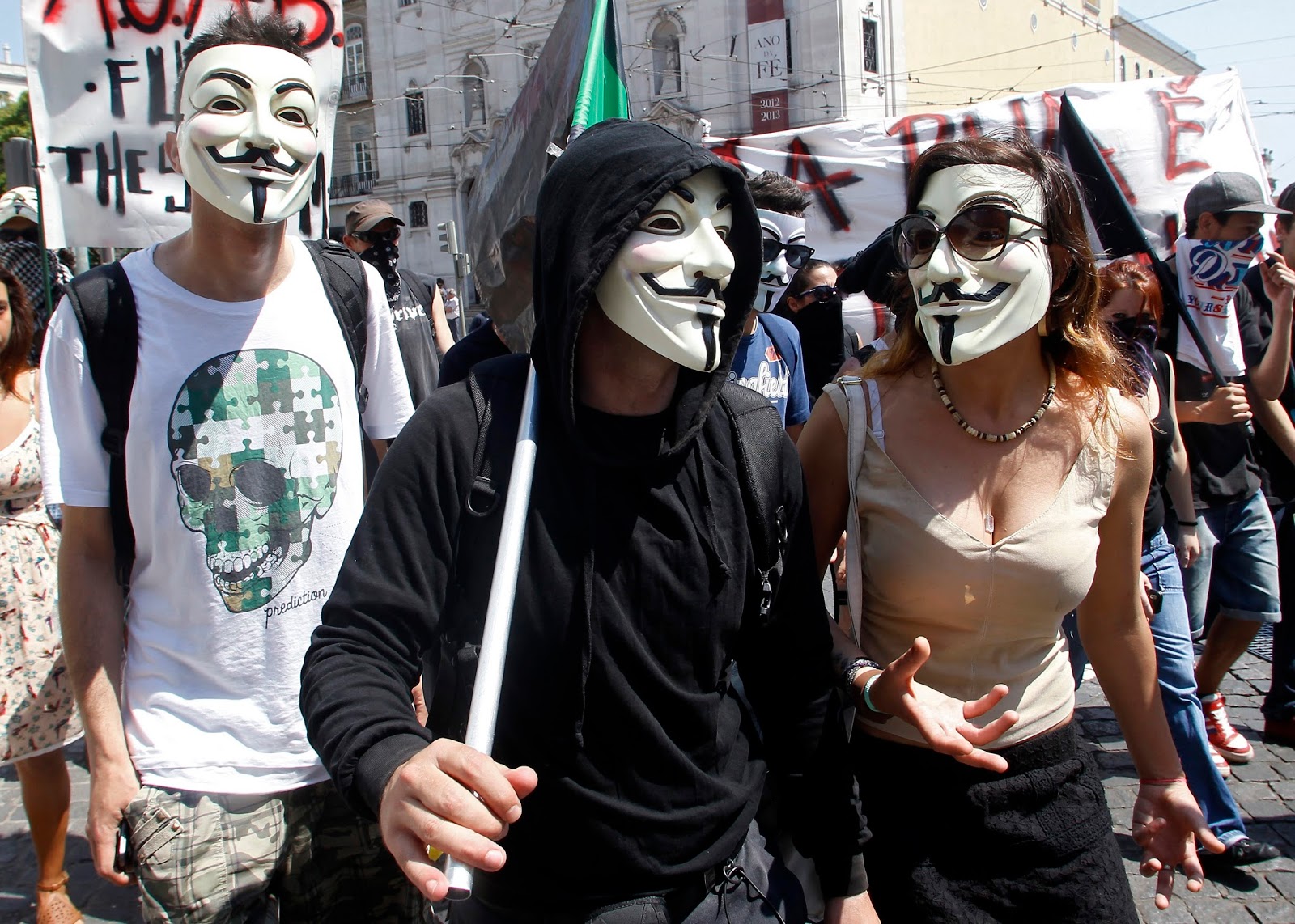
The figure in the mask, above, by the way, is from the film V for Vendetta. The setting for that pic is a future United Kingdom under the control of a neo-fascist regime. Hugo Weaving is V, a masked freedom fighter who seeks to inspire a revolution by terrorist acts. 

More about that and the mask below.
__________________________________

The poem:

The poem is about the attempt of Guy Fawkes to blow up the English Parliament on 5 November 1605

According to the site from where the poem below has been taken, “This traditional verse exists in a large number of variations and the [below] version has been constructed to give a flavour for the major themes that appear in them.”


The Fifth of November

Remember, remember! 
The fifth of November, 
The Gunpowder treason and plot; 
I know of no reason 
Why the Gunpowder treason 
Should ever be forgot! 
Guy Fawkes and his companions 
Did the scheme contrive, 
To blow the King and Parliament 
All up alive. 
Threescore barrels, laid below, 
To prove old England's overthrow. 
But, by God's providence, him they catch, 
With a dark lantern, lighting a match! 
A stick and a stake 
For King James's sake! 
If you won't give me one, 
I'll take two, 
The better for me, 
And the worse for you. 
A rope, a rope, to hang the Pope, 
A penn'orth of cheese to choke him, 
A pint of beer to wash it down, 
And a jolly good fire to burn him. 
Holloa, boys! holloa, boys! make the bells ring! 
Holloa, boys! holloa boys! God save the King! 
Hip, hip, hooor-r-r-ray!
__________________________________

The history:
  • Known commonly as the Gunpowder Plot, and in earlier centuries as the Gunpowder Treason Plot and the Jesuit Treason, it was an attempt by Catholics to assassinate the Protestant King James 1 of England and VI of Scotland.
  • The plan was to blow up the House of Lords during the opening of the English Parliament on 5 November, 1605, thus inspiring (so it was believed) a revolt that would see James’s 9 year old daughter, Princess Elizabeth, installed as the Catholic head of state. It was intended that along with James, much of the English aristocracy would be killed, along with James’s son Henry, and that Elizabeth would be a puppet queen, raised as a Catholic and later married to a Catholic bridegroom.
  • There were 13 active conspirators, led by Robert Catesby. One of the conspirators was Guy Fawkes who, having 10 years military experience fighting in the Spanish Netherlands in suppression of the Dutch Revolt, was given charge of the explosives.

  • The plot was revealed to the authorities by an anonymous letter. A search of the House of Lords at about midnight on 4 November discovered Fawkes and 36 barrels of gunpowder.
Discovery of the Gunpowder Plot (c. 1823), by Henry Perronet Briggs
  • Having been discovered, most of the conspirators fled London. After a battle, Catesby was killed and 8 conspirators, including Fawkes, were tortured, tried and sentenced to be hanged, drawn and quartered.
  • Asked why he had so much gunpowder, Fawkes advised that it was "to blow you Scotch beggars back to your native mountains." His resistance to the torture inspired King James to say admiringly that he had "a Roman resolution".
  • Whilst climbing the scaffold to be hanged, Fawkes jumped to his death, cheating the hangman. He was nonetheless drawn and quartered.
  • Parliament designated 5 November as a day of thanksgiving for "the joyful day of deliverance". This remained in force until 1859.
  • Despite being one of 13 conspirators, Guy Fawkes became the public face of the Gunpowder Plot, the annual celebration with bonfires becoming known as Guy Fawkes Night, Guy Fawkes Day, Plot Night and Bonfire Night. From the 1650’s fireworks accompanied the bonfires and from 1673 an effigy was placed at the top of the bonfire. Originally this was the Pope, in that in 1673 the heir presumptive, James, Duke of York, made public his conversion to Catholicism. Later the effigy was of Guy Fawkes, the figure becoming known as “the guy”. The figure was usually masked.
English children preparing for Guy Fawkes night celebrations (1954)
  • During the 19th century, "guy" came to mean an oddly dressed person, but in American English it simply referred to any male person.
________________________________

The Mask:
  • V for Vendetta is a novel written by Alan Moore and illustrated by David Lloyd, concerning a nuclear war in the 1980’s and a fascist state following in the 1990’s. V is the revolutionary who wears a Guy Fawkes mask and seeks to foment revolution by terrorist acts. David Lloyd’s illustration of the mask is based on the face of Guy Fawkes.
Cover of the book V for Vendetta.
  • The book gave rise to a comic book series in 1982 and in 2006 Warner Bros released the film of the same name, retaining the use of the same mask.
  • When developing the story, illustrator David Lloyd made a handwritten note: 
"Why don't we portray him as a resurrected Guy Fawkes, complete with one of those papier-mâché masks, in a cape and a conical hat? He'd look really bizarre and it would give Guy Fawkes the image he's deserved all these years. We shouldn't burn the chap every Nov. 5th but celebrate his attempt to blow up Parliament!" 
       Writer Alan Moore commented that, due to Lloyd's idea, 
"All of the various fragments in my head suddenly fell into place, united behind the single image of a Guy Fawkes mask."
  • Since release of the film, the mask has become a widespread symbol of protest and preserver of identity, keeping the wearer anonymous.
  • It has become a well-known symbol for the online hacktivist group Anonymous, and used by members of the Occupy movement, and other anti-government and anti-establishment protests around the world.

__________________________________

A 2007 poll by the BBC asked the nation who they thought were the Greatest Britons. The winner was Winston Churchill. The top 10 were:

1. Winston Churchill (28.1%)
2. Isambard Kingdom Brunel (24.6%)
3. Princess Diana (13.9%)
4. Charles Darwin(6.9%)
5. William Shakespeare (6.8%)
6. Sir Isaac Newton (5.2%)
7. Queen Elizabeth I (4.4%)
8. John Lennon (4.2%)
9. Horatio Nelson (3%)
10. Oliver Cromwell (2.8%)

Included in the 100 was Guy Fawkes.

__________________________________

Guy Fawkes is sometimes toasted as "the last man to enter Parliament with honest intentions.”