Monday, December 16, 2019

I READ THE NEW TODAY, OH BOY . . .


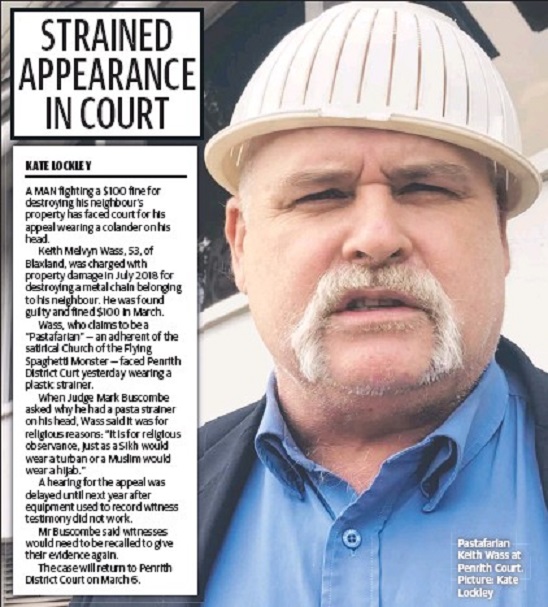
Holy headgear:

From The Daily Telegraph (NSW) 14 December 2019: 

For those not aware: 

-  The Flying Spaghetti Monster is the deity of the Church of the Flying Spaghetti Monster, or Pastafarianism. 

- Pastafarianism (a portmanteau of pasta and Rastafarianism) is a social movement that promotes a light-hearted view of religion and opposes the teaching of intelligent design and creationism in public schools. 

- According to adherents, Pastafarianism is a "real, legitimate religion, as much as any other". In New Zealand, Pastafarian representatives are authorized to officiate weddings. However, in the United States, a federal court has ruled that the "Church of the Flying Spaghetti Monster" is not a real religion. In August 2018 the Dutch Council of State also ruled that Pastafarianism is not a religion. 

- The "Flying Spaghetti Monster" was first described in a satirical open letter written by Bobby Henderson in 2005 to protest the Kansas State Board of Education decision to permit teaching intelligent design as an alternative to evolution in public school science classes. In the letter, Henderson demanded equal time in science classrooms for "Flying Spaghetti Monsterism", alongside intelligent design and evolution.[After Henderson published the letter on his website, the Flying Spaghetti Monster rapidly became an Internet phenomenon and a symbol of opposition to the teaching of intelligent design in public schools. 

-  Pastafarians claim that a colander is holy headwear for members of the Church of the Flying Spaghetti monster, leading to some countries and authorities allowing identity and driver licence applicants to be so photographed . . . 
_____________ 

In July 2011 Austrian pastafarian Niko Alm won the legal right to be shown in his driving license photo wearing a pasta strainer on his head, after three years spent pursuing permission and obtaining an examination certifying that he was psychologically fit to drive. He got the idea after reading that Austrian regulations allow headgear in official photos only when it is worn for religious reasons. 

______________ 

In July 2013, a member of the Czech Pirate Party from Brno was given permission to wear a pasta strainer on his head for the photograph on his official Czech Republic ID card.The Brno City Hall spokesman explained, "The application complies with the laws...where headgear for religious or medical reasons is permitted if it doesn't hide the face". 

______________ 

In January 2014 a member of the Pomfret, New York Town Council, Christopher Schaeffer, wore a colander while taking the oath of office. 

______________ 

n June 2014 a New Zealand man obtained a driver's license with a photograph of himself wearing a blue spaghetti strainer on his head. This was granted under a law allowing the wearing of religious headgear in official photos. 

______________ 

In November 2014 former porn star Asia Carrera obtained an identity photo with the traditional Pastafarian headgear from a Department of Motor Vehicles office in Hurricane, Utah. The director of Utah's Driver License Division says that about a dozen Pastafarians have had their state driver's license photos taken with a similar pasta strainer over the years. 

______________ 

In 2016 in Nijmegen, The Netherlands, Pastafarian and law student Mienke de Wilde petitioned the courts to be allowed to wear a colander in her driver's license photo. She lost the petition, both at first instance and on appeal. 


 Watch what your pooch eats this festive season. . . .

As we indulge at Christmas, bear in mind that what we enjoy may kill your dog if he or she eats it. 

Make sure that you don’t give the following to your dog or allow your dog to get hold of any of them: 

● Chocolate: It is toxic to dogs and cats, even in small quantities. 

● Nutmeg: One of the lesser known poisonous foods. Dogs can suffer from tremors, seizures, issues with the nervous system and even death. 

● Avocadoes: They contain a dangerous toxin which can damage the heart, lungs and tissue of many different animals. 

● Turkey skin, pork crackling, sausages and fatty meats: These can lead to inflammation of the pancreas due to high fat content. 

● Onions and garlic: Can cause gastric irritation and anaemia if they are consumed in large quantities 

● Grapes and raisins: Can cause acute kidney failure. 

● Macadamia nuts: Can be toxic to dogs. Symptoms will likely occur within 12 hours and can include vomiting, hyperthermia and elevated heart rate. 


A man eats KFC at a vegan protest . . . 

A man has gone viral on social media after he was filmed holding a box of KFC and tucking in to a drumstick, metres away from vegan activists. 


Click on the following link to see the video: 

The man has been both praised and slammed after he was caught on camera tucking in to a box of KFC just metres from a confronting vegan protest. Footage of the unidentified Sydney man, uploaded to the social media app TikTok, has already gone viral, garnering close to 300,000 likes. The video, captioned “Meat eating protest in Sydney gets a hungry visitor”, was shot just outside Sydney’s Town Hall — one of the busiest areas of the CBD. 

News.com:

13 December 2019 


Sunday, December 15, 2019

THOUGHT FOR THE DAY


KIRIE

--------oOo------- 

Kirie, meaning “cut-out picture” in Japanese, is the Japanese art of cutting designs by hand from a single sheet of white paper using a craft knife and then contrasting them against a black background to make them visible. The art dates back over 1,000 years and was initially used in religious ceremonies. 

Papercutting as an art form wasn’t, and isn’t, confined to Japan. Many other countries have rich heritages of papercutting, some works being immensely elaborate and some being simply silhouettes, although that said, that also takes considerable skill. Danish author Hans Christian Andersen was also a papercut artist and French painter Henry Matisse explored paper-cut illustration and decoupage.

Some examples: 

 Chinese paper cuttings 

Middle Eastern paper cutting, 19th century 

Polish paper cutting 

Which is all by way of introduction to some mazing Japanese kirie artists and kirie art . . . 

--------oOo------- 

Nahoko Kojima 

Nahoko Kojima is a professional contemporary Japanese paper cut artist, born in Japan in 1961. She has reinterpreted traditional flat mounted paper cut art as large-scale, sculpture-like paper cut creations, often suspended mid-air. 

Nahoko Kojima’s papercut sculpture of a life size whale, which took a year to complete. 


--------oOo------- 

Masayo Fukuda 

Masaya Fukuda makes incredibly detailed papercuts, her work being reminiscent of lace. In 2018 she revealed a detailed octopus that looks like it had been drawn by pen rather than cut with a scalpel: 


--------oOo------- 

Shu Kubo 

Shu Kubo is a mixed media paper cutting artist with a background in architecture . . . 


--------oOo------- 

One final papercut . . . 


Saturday, December 14, 2019

THOUGHT FOR THE DAY


THE PULITZER AND WORLD PRESS PHOTOS OF THE YEAR: 1990


 --------oOo--------


Pulitzer Prizes for Photography:
Between 1942 and 1967 a Pulitzer Prize for Photography was awarded for photojournalism, that is, for photographs telling a news story. In 1968 that award was replaced by awards in two new categories:
· the Pulitzer Prize for Spot News Photography (photography in the nature of breaking news, as it has been called since 2000); and
· the Pulitzer Prize for Feature Photography (human interest and matters associated with new items).


World Press Photo of the Year:
From 1955 World Press Photo has awarded prizes for the best photographs in 10 categories, with an overall award for the image that "... is not only the photojournalistic encapsulation of the year, but represents an issue, situation or event of great journalistic importance, and does so in a way that demonstrates an outstanding level of visual perception and creativity".

The photographs are interesting not only in their own right but for being windows on history.

--------oOo--------
Award:
Pulitzer Price for Breaking News Photography
Year:
1990
Photographer:
Photo staff of the Oakland Tribune, California
Photograph(s):
Photographs of devastation caused by the Loma Prieta earthquake of October 17, 1989.
  
The Photographs:

 John and Maedell Stafford are helped from the lower deck of the Cypress structure at West Grand Avenue, Oakland by a neighbour/passerby on October 17, 1989. West Oakland neighbours and workers brought their own ladders and rope and climbed into the wreckage to help. This is one of a series of photos that won the Oakland Tribune the 1990 Pulitzer Prize for Spot News Photography. 

Comments:

On October 17, 1989, a magnitude 6.9 earthquake hit the San Francisco Bay Area, killing 67 people and causing more than $5 billion in damages. Despite the fact that the disaster was one of the most powerful and destructive quakes ever to hit a populated area of the United States, the death toll was relatively small. The disaster is known as both as the San Francisco-Oakland earthquake and the Loma Prieta earthquake because it was centered near Loma Prieta Peak in the Santa Cruz Mountains.

A  2 kilometre (1.25-mile) segment of the two-level Cypress Street Viaduct along the Nimitz Freeway (Interstate 880), just south of the San Francisco-Oakland Bay Bridge, collapsed during the quake, resulting in 42 fatalities when the upper level of the road crashed onto the cars on the lower level.

The photostaff of The Oakland Tribune won the 1990 Pulitzer Prize for photographs of the aftermath of the October 17, 1989, Loma Prieta earthquake.

It had previously won a Pulitzer for a photograph of a small private plane narrowly missing a B-29 Superfortress in 1950,


___________________
  
Award:
Pulitzer Feature (Human Interest) Photograph
Year:
1990
Photographer:
David C Turnley, Detroit Free Press
Photograph(s):
Photographs of the political uprisings in China and Eastern Europe."
  
The Photograph:

1990: David C. Turnley – “The Romanian Revolution.” Romanian people celebrating the end of communism with tears in their eyes and peace signs in the air.
  
Comments:

In addition to his 1990 Pulitzer, Turney has also been awarded gongs for the World Press Photo Picture of the Year in 1988 for a photo taken in Leninakan after the devastating Spitak earthquake and again in 1991 for a picture of a U.S. Sergeant mourning the death of a fellow soldier during the Gulf War. He has been a runner-up for the Pulitzer Prize in photography four times.

From 1985 to 1997, Turnley covered the struggle to end Apartheid, revolutions in Eastern Europe, the student uprising in China, the Bosnian War and the Gulf war, and the fall of the Soviet Union. In addition to publishing numerous books, he has directed an Emmy-nominated documentary for CNN on the Dalai Lama, and a feature-length documentary set in Cuban dance hall, La Tropical. He directed the documentary Shenandoah, released in 2012, about the 2008 murder and attempted cover up of an immigrant from Mexico by a group of local high school football stars from Shenandoah, Pennsylvania.

Gallery:


-----------oOo-----------
  
Award:
World Press Photograph of the Year
Year:
1990
Photographer:
Georges Merillon
Photograph(s):
Kosovar Conflict
The family of Nashim Elshani grieves around his deathbed; he was killed while protesting for Kosovar autonomy.
  
The Photograph:

The family of Nashim Elshani grieves around his deathbed; he was killed while protesting for Kosovar autonomy.

Does anyone else feel that this resembles an old masters’ painting?
  
Comments:

The conflict:

The Kosovo War was an armed conflict in Kosovo that started in late February 1998 and lasted until 11 June 1999. It was fought by the forces of the Federal Republic of Yugoslavia (by this time consisting of the Republics of Serbia and Montenegro), which controlled Kosovo before the war, and the Kosovo Albanian rebel group known as the Kosovo Liberation Army (KLA), with air support from the North Atlantic Treaty Organisation (NATO) from 24 March 1999, and ground support from the Albanian army.

The KLA was formed in 1991 and initiated its first campaign in 1995 when it launched attacks targeting Serbian law enforcement in Kosovo. In early 1998, KLA attacks targeting Yugoslav authorities in Kosovo resulted in an increased presence of Serb paramilitaries and regular forces who subsequently began pursuing a campaign of retribution targeting KLA sympathisers and political opponents;  this campaign killed 1,500 to 2,000 civilians and KLA combatants.

After attempts at a diplomatic solution failed, NATO intervened, justifying the campaign in Kosovo as a "humanitarian war". This precipitated a mass expulsion of Kosovar Albanians as the Yugoslav forces continued to fight during the aerial bombardment of Yugoslavia (March–June 1999). By 2000, investigations had recovered the remains of almost three thousand victims of all ethnicities, and in 2001 a United Nations administered Supreme Court, based in Kosovo, found that there had been "a systematic campaign of terror, including murders, rapes, arsons and severe maltreatments", but that Yugoslav troops had tried to remove rather than eradicate the Albanian population.

The war ended with the Kumanovo Treaty, with Yugoslav and Serb forces agreeing to withdraw from Kosovo to make way for an international presence. The Kosovo Liberation Army disbanded soon after this, After the war, a list was compiled which documented that over 13,500 people were killed or went missing during the two year conflict. The Yugoslav and Serb forces caused the displacement of between 1.2 million to 1.45 million Kosovo Albanians. After the war, around 200,000 Serbs, Romani and other non-Albanians fled Kosovo and many of the remaining civilians were victims of abuse.

The NATO bombing campaign has remained controversial, as it did not gain the approval of the UN Security Council and because it caused at least 488 Yugoslav civilian deaths including substantial numbers of Kosovar refugees.

The photograph:

From the article "The mother, icon of the Pietà" at:
 The “Pietà of Kosovo”: it is by the medieval term that the collective conscience has chosen to designate one of the most famous journalistic photographs of recent years. On 29 January 1990, the photographer Georges Mérillon took part in the funeral vigil of Nasimi Elshani in the village of Nagafc, Kosovo: the young man who had just been killed by the Serbian militia, rests in peace before his mother, surrounded by other women of the family who watch over his body wrapped in a white shroud. The collective conscience immediately recognized this photo and took possession of it. In 1991 it won the World Press Photo Prize – at the very moment when the Gulf War had broken out – and went round the world. The Prize gave an immediate preference to the “plastic quality” of the photograph rather than to the importance of the political event to which it refers. Indeed, in 1991 international attention was not focused on Yugoslavia, and even less on Kosovo. It was necessary to wait for the exodus of Kosovans and NATO’s intervention in 1999 for this photo, considered an icon from that moment on, to become a testimony that left us with a piece of political information. From that moment the scene in the background became legible, revealing the historical reality which is inherent in it and whose roots are sunk deep in a long history of suffering and war., , , ,
The image of pain evokes the sufferings of all mothers in a cry that pierces through time: the image is vibrant, the image is surprising. Christian devotion and contemporary photography are combined as in an eternal scene of compassion. The suffering mother is beside her dead son. But whereas the Pietà refers to the Passion of Christ on which Vespers meditates on the moment of his deposition from the Cross, the photograph captures live a Muslim funeral rite, in which only women take part while the men stay in another room before accompanying the body to the cemetery. United in the same pain, the two images are thus radically distinguished, one calling to mind the Christian world, the other, the Muslim world. What is more, the photograph of Georges Mérillon does not reproduce a model, as one might say, for example, of a copy. It does not copy the medieval Pietà: there is no repetition of the archetypes of Western painting. On the contrary, the photographic icon seems to indicate the continuity of an image in movement. Thus it immediately calls to mind the medieval image of the Pietà and, even before that, the scenes of mourning painted on ancient vases. The common foundation of worship in the Balkans, in which the Christian and Muslim religions are interwoven, let us not forget it, is always that of Greek antiquity. . . . . 
In the Yugoslavian tragedy, through the strength of the Muslim women a vibrant pride is present which can put an entire people back on their journey and transform groans into combat. “Around Nasimi’s body are Sabrié, his mother, who is standing by his head, and on the left is Aferdita, his young 16-year-old sister. His other sister Ryvije is in the centre in tears”, as Georges Mérillon describes it. It is they who bear witness to the force of life in their defeat of death in order to attain life. Then the Pietàs become icons to open up space and time in order to emerge from the darkness.


Friday, December 13, 2019

THOUGHT FOR THE DAY


FUNNY FRIDAY


------😊😊😊----

Oops, wrong holly . . . 

. . . still the wrong one . . . 

. . .   that's the one!

Everyone is aware that . . .


No doubt things are becoming more hectic and stressful so take a moment to have a coffee and read the items in Funny Friday, guaranteed to raise a smile or your money back.

A Christmas theme to some of the items but be warned, there is also risque content ahead.


------😊😊😊----

SOME HUMOUR . . .

When I was six, Santa gave me coal for Christmas, so the next year I decided to get back at him and poison his cookies.
Somehow, the bastard found out and killed my Dad.

--------oOo-------

Just finished buying the family Christmas tree and as the clerk was tying it down he asked me, "So you plan on putting this up yourself then?"
"No you sicko - I was thinking in front of the window in the den."

--------oOo-------

A Russian, a Frenchman, and an Englishman are in an art museum admiring a painting of Adam and Eve in the gardens of Eden.

The Englishman takes a look at the painting and says "They look so calm, they must be British!"

The Frenchmen responds "No, no! They're naked, so beautiful, they must be French!"

The Russian says "They have no food, no shelter, nothing but an apple to eat, and they are being told this is paradise? ...They're clearly Russian!"

--------oOo-------

Paddy and Mick worked together in St. John's and both were laid off, so they went to the unemployment office.   When asked his occupation, Paddy answered, "Panty Stitcher. I sew the elastic onto ladies cotton panties and  thongs."   The clerk looked up panty stitcher on his computer and finding it classified as unskilled labour, he gave him $80 a week unemployment pay.  

Mick was next and when asked his occupation replied, "Diesel fitter."   Since diesel fitter was a skilled job, the clerk gave Mick $160 a week.  

When Paddy found out he was furious. He stormed back into the office to find out why his friend and co-worker was collecting double his pay.  

The clerk explained, "Panty Stitchers are unskilled and Diesel Fitters are skilled labour." 

 "What skill?" yelled Paddy. "I sew the elastic on the panties and the thongs. Mick puts them over his head and says: "Yep, diesel fitter!"

--------oOo-------

A blind man went to a restaurant.  "Menu, sir?" asked the owner.

"I'm blind. Just bring me one of your dirty forks. I will smell it and order." The confused owner got a fork. The blind man smelled the fork with a deep breath.

"Yes, I will have the lamb with seasoned potatoes and spring vegetables"

"Unbelievable!" thought the owner. The blind man ate and left.

Two weeks later, the blind man returned. The owner, wanting to see how good his sense of smell was, quickly went to the kitchen where his wife Brenda was cooking. He said, "Do me a favour and rub this fork over your privates”,  which she does. He then goes to the blind man and gives him the fork.

The blind man takes it, puts it to his nose and says, "Oh interesting, I never knew Brenda worked here."


------😊😊😊----

FROM THE VAULT . . .

A guy walks into a bar and sees a man sitting at the end with the smallest head he's ever seen. In fact, it is only about two inches high. So, he sits down next to him and asks, "How is that you have such a small head?" The man replies, "Well you see, I was stranded on a deserted island and was combing the beach, when I came across an ornate bottle. When I opened it to see what was inside, a beautiful genie appeared and told me that I would be granted three wishes. My first wish was for a luxurious boat to take me home." The man continues, "A large yacht appeared just off shore. Then for my second wish, I asked to be wealthy, so I would want for nothing when I got home." The man goes on, "After a large pile of gold coins appeared on the deck of the yacht, I asked to make passionate love to the genie for my third wish. The genie told me that she could not do that, so I asked, 'How about a little head?'"

------😊😊😊----

LIMERICK OF THE WEEK . . .

There was a young girl of La Plata
Who was widely renowned as a farter.
Her deafening reports
At the Argentine sports
Made her much in demand as a starter.

------😊😊😊----

GALLERY:


------😊😊😊----


CORN CORNER:

My Christmas advice:
Forget the past, you can't change it.
Forget the present, because I didn't get you one.

--------oOo-------

So last year I started a tradition, I carry a pebble and throw it at anyone who sings Christmas songs before December....
I call it my Jingle Bell Rock.

--------oOo-------

Why was the smoker disappointed on Christmas?
Because he got clothes but no cigar.

--------oOo-------

Tampax have announced they will be removing the string from the tampon and replacing it with tinsel!
This will be for the Christmas period only.