Sunday, July 4, 2021

G SPOT: AMAZING DID YOU KNOWS?


Friend Graham, for whom the G Spot is named (at least in Bytes), sent me another email with a feast of fascinating facts, a trove of tremendous trivia, a plethora of prodigious perspicacity, a . . . well, you get the idea.

Thanks, G.

Here is Graham's email, with occasional by the way comments from myself.

Hi Mr O,

Here are some amazing facts that I have come across over the years doing a trivial little pastime. . . . . . .


Woolly mammoths lived at the time of the pyramids


When construction of the Great Pyramids began 4,500 years ago, there were still woolly mammoths living on Wrangel Island, off the coast of Siberia.

Although, most woolly mammoths died out by 10,000 years ago, a small group of 500 to 1,000 survived there until 1650 BC.


Cleopatra lived closer to the invention of the cell phone than to the building of the Great Pyramid


The Queen of the Nile lived from 69 BC to 30 BC, about 2,500 years after the Great Pyramid was finished in 2560 BC, but only about 2,000 years before Motorola produced the first handheld mobile phone in 1973.


Queen Elizabeth and Marilyn Monroe were born 41 days apart


Marilyn Monroe was the queen of Hollywood, but Queen Elizabeth II is the real thing, and actual queen.

Marilyn born Norma Jeane Mortenson in Los Angeles on the 1st June, 1926, just 41 days after Princess Elizabeth on 21st April.

Elizabeth became queen in 1952, around the time Marilyn was starring in Monkey Business with Cary Grant.


Ghengis Khan is as old as Notre Dame


In 1163,Temujin, who would one day be known as Genghis Khan, was born in the Hentiyn Nuruu mountains near Ulan Bator, Mongolia.

That same year, Louis VII and Pope Alexander III laid the cornerstone beginning construction on the cathedral in Paris that would become Notre Dame.


The guillotine was last used in the same year that Star Wars came out


The last guillotining in France was carried out on torture-murderer Hamida Djandoubi on September 10, 1977, almost four months after Star Wars hit theatres. New York’s World Trade Centre was also finished the same year.


Hamida Djandoubi was a Tunisian agricultural worker and convicted murderer. He moved to Marseille, France, in 1968 and six years later he kidnapped, tortured and murdered 22-year-old Élisabeth Bousquet, his nurse after a leg amputation as a result of a work accident. He was sentenced to death in February 1977 and executed by guillotine in September that year. He was the last person to be executed in Western Europe, and he was the last person to be lawfully executed by beheading anywhere in the Western world, although he was not the last person sentenced to death in France. Marcel Chevalier served as chief executioner.

Hamida Djandoubi

Marcel Chevalier

Marcel Chevalier (1921 - ) worked as the last chief executioner in France, succeeding his wife’s uncle as chief executioner in 1975, a position held until 1981, when capital punishment was abolished under president François Mitterrand. The method of application of the death penalty for civil capital offences in France from 1791 to 1981 was beheading with the guillotine. Military executions were by firing squad.

Chevalier, who started his executioner's career in 1958, performed about 40 executions. After his appointment as chief executioner, on 1 October 1976, he executed only two people. They were the last two executions in France. His son Éric was present at those last two executions in order to prepare him for succession to chief executioner upon his father's eventual retirement.

There is good reason for keeping it in the family, as explained in this extract from crimescribe.com:
Executioners, disparagingly nicknamed ‘les bourreaux’ ["the executioners"] by their countrymen, occupied a contradictory place in French society. Until the execution of German serial killer Eugen Weidmann in June, 1939 the French public hadn’t minded turning out in their thousands to watch these men work, but had always despised and shunned them at the same time.

Schools refused to accept their children. In the days of regional executioners they were forced to live just outside whichever town or village they lived in. Even bakers would keep the executioner’s bread separate so their other customers would know their bread wasn’t tainted, an old French folk tale said that anything touched by the executioner was also touched by the Devil himself. Even churches refused to marry them except into the families of other executioners. By the time Chevalier became the last to perform his office all French executioners could be traced to only a handful of families, not always illustrious ones at that.
Source:

On other point . . . prisoners in France who had been condemned to death did not know the date on which they would be executed until the day arrived. When the executioner, known only by staff cand condemned alike as “The Man From Paris” arrived at the prison, all condemned had to wait to see which would be executed that day.


Orville Wright Was Still Alive When The Sound Barrier Was Broken


The first powered flight, on December 17th, 1903, a few miles south of Kitty Hawk, North Carolina, earned Wilbur and Orville Wright a well deserved place in the history books.

Wilbur died early in 1912, but Orville lived until 1948, living long enough to meet Chuck Yeager and to learn of his breaking of the sound barrier in his Bell X-1 airplane, on October 14th, 1947.


Confucius, Socrates and Buddha all lived around the same time


Buddha was born Siddhartha Gautama in 480 BCE in present-day Nepal and died aged 80 in 400 BCE in present-day India.

Confucius was born Kǒng Qiū, in 551 BCE Zou, China and died aged 72 in 479 BCE in Si River, China.

Socrates was born in 470 BCE in Athens, Greece and died aged 71 in 399 BCE in Athens, Greece.


Mark Twain's birth and death coincide with Halley's Comet


Samuel Langhorne Clemens, known more popularly by his nom de plume, Mark Twain, was born in 1835, the same year that Halley's Comet made its first appearance. The comet made a second appearance in 1910, the year that Twain died, and the author, according to the New York Times, famously predicted that the two events would coincide.


Stephen Hawking shares his birth and death with Galileo and Einstein


Theoretical physicist, cosmologist, and author Stephen Hawking was famously born on the 8th January 1942, the 300th anniversary of Italian astronomer,

physicist and engineer Galileo Galilei's death, and died on 14th March 2018, what would have been German-born theoretical physicist Albert Einstein's

139th birthday. His ashes were interred at Westminster Abbey on 15 June 2018,in the nave between the graves of Sir Isaac Newton and Charles Darwin.


John Wilkes Booth's brother saved Abraham Lincoln's son from death


While in a train station in New Jersey, Lincoln's son, Robert Todd Lincoln, leaned up against a stopped train, nearly falling onto the tracks as it started up again. Edwin Booth grabbed him by the collar and saved him just in time.

The younger Lincoln recognized his hero and wrote about the incident, but it wasn't until years later that Booth found out who he had saved.


Robert Todd Lincoln witnessed three presidential assassinations


Though he wasn't there at the theatre in Washington, DC, during his father's fateful shooting, he was rushed to his deathbed and sat by his side until the elder Lincoln passed away in 1865. In 1881 he was an eye-witness to the killing of President James A. Garfield in Elberon, New Jersey and then in 1901, as the guest of President William McKinley in Buffalo, New York, saw the president fatally shot.


Two Dennis the Menace characters emerged in different countries at the same time


Dennis the Menace, the lovable, mischievous, little boy, first appeared in March of 1951 with his dog, Ruff.

But in the same month of that very same year, across the Atlantic in the U.K., another cartoon Dennis the Menace was launched.

The British Dennis was a bit more sinister than his American counterpart, intentionally rather than inadvertently causing chaos.

Amazingly, there are no signs of plagiarism, as the characters were made independently but simultaneously, ultimately occupying a similar place in their respective country's cultural landscape.


Alec Guinness predicts James Dean's death


In 1955 while arriving for dinner at the Villa Capri in Los Angles, Alec Guinness saw James Dean’s new "sinister" looking car and told him, "If you get in that car, you will be found dead in it by this time next week." Dean was killed exactly one week later when “Little Bastard” crashed head on into a Ford Custom Tudor coupe on US Route 466 near Cholame, California.

After Dean's fatal accident, the recoverable parts of the Porsche 550 Spyder were re-sold, and went on to cause several other accidents for their new owners, including two other independent fatalities and several injuries.


Snopes.com, the authoritative debunking site, credits as "true" that Dean made a public service clip for young people before his death in which he told thme not to speed.

The site acknowledges that Guinness claims to have given the advice but does not investigate whether it is true or not.

It states:
The future Obi-Wan Kenobi wrote of an encounter that took place in Los Angeles in September 1955 when he was dog-tired and starving after a 16-hour flight from Copenhagen and had failed to find seating in any of three restaurants because his female companion, Thelma Moss, was wearing slacks:
I became aware of running, sneakered feet behind us and turned to face a fair young man in sweat-shirt and blue-jeans. “You want a table?” he asked. “Join me. My name is James Dean.” We followed him gratefully, but on the way back to the restaurant he turned into a car-park, saying, “I’d like to show you something.” Among the other cars there was what looked like a large, shiny, silver parcel wrapped in cellophane and tied with ribbon. “It’s just been delivered,” he said, with bursting pride. “I haven’t even driven it yet.”

The sports car looked sinister to me, although it had a large bunch of red carnations resting on the bonnet. “How fast is it?” I asked. “She’ll do a hundred and fifty,” he replied. Exhausted, hungry, feeling a little ill-tempered in spite of Dean’s kindness, I heard myself saying in a voice I could hardly recognise as my own, “Please, never get in it.” I looked at my watch. “It is now ten o’clock, Friday the 23rd of September, 1955. If you get in that car, you will be found dead in it by this time next week.”

He laughed. “Oh, shucks! Don’t be so mean!”
Source:

What else would you expect from a Jedi Master?

Saturday, July 3, 2021

THOUGHT FOR THE DAY


AUSTRALIAN FOLK SONGS: LAZY HARRY’S

-------☹😊☹-------


A country’s folk songs, dating from before mass communications and often from areas and situations of isolation, whether in the country, onboard ship, on the goldfields and so on, frequently record in song such things as events, people, feelings, opinions and culture. They can be more than just a rollicking good, traditional song – often they are a glimpse of the past, an insight into a different era, lifestyle, hardship and people. They will also show how far we have travelled. Perhaps in 200 years songs about Covid will have developed the status of folk songs.

-------☹😊☹-------


The Song:

Australia has its own songs that parallel those of the US where the drovers hit town at the end of bringing in a herd, used their money on alcohol and women, ended up broke and set off to the next herd. The difference in Oz is that instead of drovers we had shearers, the end of the line was not the herd at market but the end of the shearing season and instead of Dodge or Abilene, we have Gundagai and Bathurst.

Why so many songs about Gundagai?

Gundagai is located 390 kilometres (240 mi) south-west of Sydney and is virtually only a fly speck on the map of NSW, with a population of 1,925 according to the 2016 census. It is known for its tourist attraction of the dog sitting on the tucker box (tucker = food; tucker box = food box) and the background to that story and image have been visited before in Bytes:

The statue of the dog sitting on the tucker box, at Gundagai
The story is worth reading, click on the link above.

Sheridan Street, Gundagai, 2019

So why so many songs about Gundagai . . .
Five Miles from Gundagai (aka Lazy Harry’s)
Nine Miles from Gundagai
Flash Jack from Gundagai
The Road to Gundagai

The late and great Australian folk singer Gary Shearston says of the song Lazy Harry:
Maybe this one explains why Gundagai is mentioned so often in the songs of the Riverina shearers. It was a town they had to come through on the way to Sydney from many parts of the Riverina; and maybe a lot of them set off with Sydney in their eye, but found the girls and the beer in Gundagai too tempting.

Australian folk song pioneer A L Lloyd’s similarly comments:
Work like horses, spend like asses, used to be said of the oldtime shearers. They would knock up a sizeable cheque in the shearing sheds, and then set out for a spree in the distant city. The chances were, they'd get no more than halfway before they'd spent the lot. Perhaps that's why the otherwise unremarkable town of Gundagai shows so prominently in the folk song. It lies just about midway between the big sheds of the New South Wales Riverina and the bright lights of Sydney. Many a shearer, making his way towards the capital with his cheque, got no further than Lazy Harry's grog-shop on the road from Wagga to Gundagai.

From The Mudcat Café:
I had a think about why we hear so much about Gundagai … and bullockies (bullock-team drivers - and I suspect that it is because Gundagai was a natural camping spot for bullock teams plying north to Sydney or south to Albury on the Murray River .. and even on to Melbourne. Gundagai was built where the main southern road from Sydney, what is now laughingly called the Hume Highway, crossed the Murrumbidgee River, the second largest river in the state (and the largest is only just in the state - as it forms the border with Victoria ... but is totally claimed by New South Wales!).

Until 1867, there was no bridge and crossing was by ferry p- a daunting job for a bullock team … probably involving unloading the highest part of the load to lower the centre of gravity … and not upset the ferry. Bullock teams must have spent a long time camped in close proximity and the area became a centre of 'bullocky folklore' - a pretty robust animal! 

It's a rollicking good song with a positive outlook, rather than a bitter or negative one.

Point of interest: Banjo Paterson printed the lyrics in his songbook Old Bush Songs

-------☹😊☹-------

The Lyrics:

Lazy Harry's

Oh we started down from Roto when the sheds had all cut out
We'd whips and whips of Rhino as we meant to push about
So we humped our blueys serenely and made for Sydney town
With a three-spot cheque between us as wanted knocking down

Chorus
But we camped at Lazy Harry's, on the road to Gundagai
The road to Gundagai
Not five miles from Gundagai
Yes we camped at Lazy Harry's on the road to Gundagai

Well we struck the Murrumbidgee near the Yanco in a week
And passed through old Narrandera and crossed the Burnett Creek
And we never stopped at Wagga for we'd Sydney in our eye
But we camped at Lazy Harry's on the road to Gundagai

Oh I've seen a lot of girls my boys and drunk a lot of beer
And I've met with some of both chaps as has left me mighty queer
But for beer to knock you sideways and for girls to make you sigh
You must camp at Lazy Harry's on the road to Gundagai

Well we chucked our blooming swags off and we walked into the bar
And we called for rum-an'-raspb'ry and a shilling each cigar
But the girl that served the poison she winked at Bill and I
And we camped at Lazy Harry's not five miles from Gundagai

In a week the spree was over and the cheque was all knocked down
So we shouldered our Matildas and we turned our back on town
And the girls they stood a nobbler as we sadly said good-bye
And we tramped from Lazy Harry's not five miles from Gundagai

Last chorus
And we tramped from Lazy Harry's not five miles from Gundagai
The road to Gundagai
Not five miles from Gundagai
Yes we tramped from Lazy Harry's on the road to Gundagai

-------☹😊☹-------

Link:

Great version by the original Bushwackers & Bullockies Bush Band, from 1973:

-------☹😊☹-------

Glossary:

Roto:
Roto is a small settlement situated in the far-west of New South Wales. At the 2016 census, Roto and the surrounding area had a population of 41.

when the sheds had all cut out:
When the shearing season had come to an end and the shearing sheds were no longer operating. Most farmers shear their sheep in late spring or early summer, when the weather turns warmer, to ensure sheep do not get too hot and start to attract flies.

whips and whips of rhino:
The word “rhinoceros” and later the shortened “rhino” was used as a slang term for money or cash from the late 17th century, much in the same way as we use “dough” or “bucks” today. The origin is unknown.

humped our blueys:
Bluey: swag, the collection of possessions and daily necessities carried by a person travelling, usually wrapped in a tied off blue blanket, hence the name.
Humping: Carrying, toting.


three-spot cheque:
A cheque for one hundred pounds or more.

wanted knocking down:
Just had to be spent.

struck the Murrumbidgee:
Reached the Murrumbidgee River, the second longest river in Australia.


Yanco:
Small village, population 505

Narrandera:
A town located in the Riverina region of southern New South Wales, adjacent to the Murrumbidgee River, population 3,746.

Wagga:
Wagga Wagga is a major regional city in the Riverina region of New South Wales, straddling the Murrumbidgee River, with an urban population of more than 56,000 as of June 2018, Wagga is the ninth largest inland city in Australia and is located midway between the two largest cities in Australia—Sydney and Melbourne.

shilling each cigar:
Expensive cigar. When I was a kid, before Australia went decimal, we had to learn our currency as 12 pennies make one shilling, 20 shillings make one pound. The amount in pounds, shillings and pence, by way of example as 19 pounds, 7 shillings and 9 pence, was written as £19/7/9. Before calculators, we had to solve maths problems such as take £3/19/4 from £31/3/5.

Matildas:
Another name for swag, hence waltzing matilda was the same as humping a bluey.

the girls they stood a nobbler:
A measure of alcohol.

-------☹😊☹-------

Gallery:


Shearing shed 1886-1891
As you can see, backbreaking work, no wonder they had blowouts at the end of the shearing season


Shearing shed outback NSW c 1885


The Golden Fleece, by Tom Roberts 1894


Shearing the Rams by Tom Roberts, 1890


Shears made by Robert Sorby, Sheffield, UK, company still manufacturing today.


Shearers sharpening blades in 1915.


Shearers wore moccasins made from old sacks to prevent slipping and absorb sweat, as well as reducing back strain.


The remnants of the "cookie" stove, last used in the 1950s, that helped to feed huge shearing teams.

Friday, July 2, 2021

FUNNY FRIDAY


-----o😊o-----

Some more funnies for Friday and another risqué content warning . . . in short, the usual Friday.

Stay safe and stay well, Byters.

-----o😊o-----

SOME HUMOUR:

---------oOo--------

Sean is the vicar of a Protestant parish in Dublin and Patrick is the priest at the Roman Catholic Church across the road.

One day they are seen together, erecting a sign which says:

"THE END IS NEAR.
TURN YOURSELF AROUND NOW
BEFORE IT IS TOO LATE."

As a car speeds past them, the driver leans out his window and yells,

"Leave people alone, you religious nutters. We don't need your lectures."

From around the next curve they hear screeching tyres and a big splash.

Shaking his head, Father Patrick says "Dat's da terd one dis morning’."

"Yaa," Sean agrees, then adds, "Do ya tink maybe da sign should just say ….

"BRIDGE CLOSED" ?

---------oOo--------

In Jerusalem, a journalist heard about a very old Jewish man who had been going to the Wailing Wall to pray, twice a day, every day, for a long, long time. She went to the Wailing Wall and there he was!

She watched him pray and after about 45 minutes, when he turned to leave, she approached him for an interview. “Sir, how long have you been coming to the Wall and praying?”

“For about 50 years,” said the old man.

“50 years! That’s amazing! What do you pray for?”

“Well, I pray for peace. I pray for all the hatred to stop and I pray for all our children to grow up wise, in safety and friendship.”

“How do you feel after doing this for 50 years?”

“Like I’m talking to a wall!”

---------oOo--------

A man goes in for an interview for a job as a TV news broadcaster. The interview went quite well with one problem - he kept winking at the camera.

The interviewer said, "Although you have a lot of the qualities we're looking for, the fact that you keep winking is a real problem. I'm afraid we won't able to hire you unless you get it under control."

"Oh, that's no problem," said the man. "If I take a couple of aspirin I stop winking for a couple of hours. More than enough time to get the broadcast done."

"Alright, show me," said the interviewer.

So the man reached into his pocket. First he put his hand in his right pocket, and as he took it out he pulled out loads of condoms of every variety and size, but no pills. Next he dug into his left pocket, and again pulled out an embarrassing amount of condoms in all shapes and colours before finally finding the packet of aspirin. He took the aspirin and the second take went without a single hitch.

The interviewer said, "That's amazing, I'd hire you on the spot, except that we're not in the habit of hiring such womanisers. We've had too many sexual harassment suits."

"Excuse me!" exclaimed the man, "I'm a happily married man, not a womaniser!"

"Well how do you explain all the condoms, then?" asked the interviewer.

The man sighed. "Have you ever tried going into a pharmacy, asking for aspirin and winking all the while?"

-----o😊o-----


The Presbyterian church called a meeting to decide what to do about their squirrel infestation.

After much prayer and consideration, they concluded that the squirrels were predestined to be there, and they should not interfere with God’s divine will.

At the Baptist church, the squirrels had taken an interest in the baptistry. The deacons met and decided to put a water-slide on the baptistry and let the squirrels drown themselves. The squirrels liked the slide and, unfortunately, knew instinctively how to swim, so twice as many squirrels showed up the following week.

The Lutheran church decided that they were not in a position to harm any of God’s creatures. So, they humanely trapped their squirrels and set them free near the Baptist church. Two weeks later, the squirrels were back when the Baptists took down the water-slide.

The Episcopalians tried a much more unique path by setting out pans of whiskey around their church in an effort to kill the squirrels with alcohol poisoning. They sadly learned how much damage a band of drunk squirrels can do.

But the Catholic church came up with a more creative strategy! They baptised all the squirrels and made them members of the church. Now they only see them at Christmas and Easter.

Not much was heard from the Jewish synagogue. They took the first squirrel and circumcised him. They haven’t seen a squirrel since.

-----o😊o-----


LIMERICK OF THE WEEK:

By moi . . .

William and Harry his brother
Attended to honour their mother,
It seemed somewhat ironic
On this love date iconic
Guests attending all hated each other.

-----o😊o-----


A couple arrived at town hall seconds before closing time, and caught a judge just as he was about to leave, and asked him to marry them. He asked if they had a licence and, when they said they didn't, he sent them off to get one.

They caught the Town Clerk just as he was locking up, and got the licence from him. When they got back to the judge, he pointed out they had filled the names in wrong -- with his where hers belonged and vice versa. They rushed back to the clerk's office, caught him again, and got another licence.

This time, the judge noticed that the Clerk had filled in the date in the wrong format. Again they caught the Clerk... and after five reissued licences, the judge was finally satisfied.

Judge: "I hope you appreciate why I made you keep going back. If there are irregularities in the licence, your marriage would not be legal, and any children you might have would be, putting it delicately, technical bastards."

Groom: "That's funny - that's just what the clerk called you."

-----o😊o-----

GALLERY:


-----o😊o-----


CORN CORNER:

I got kicked out of schizophrenia group therapy yesterday.

I was just trying to be polite but I guess it was wrong to say "Don't mind me, guys. Pretend I'm not here."

---------oOo--------

My grandma always used to say, "An apple a day keeps the doctor away. "

I don't know if that's true, or just one of Granny's myths.

---------oOo--------

Two hats are hanging on a hat rack.

One looks at the other and says, "You stay here, I'll go on a head."

---------oOo--------

A Vietnamese man who recently moved to America is down on his luck and missing home. He decides to spend his last $5 on an authentic Vietnamese dinner hoping it will remind him of home.

He finds the nearest Vietnamese restaurant and makes the walk there, hoping to make it in time before they close. When he enters the owner greets him in Vietnamese and he responds in kind. Happy to be speaking his native language again the man makes small talk with the owner. After pleasantries he asks for a menu, but as he starts reading it his face expresses his disappointment. The cheapest option on the menu are the spring rolls for $7.

Noticing the sudden change in attitude the owner asks the man if there is a problem. The man looks up from the menu and sheepishly pulls out his only $5 bill. The man explains his situation and apologizes for the wasted time.

The owner thinks for a moment before offering to make the man a plate with soon-to-be expired ingredients. The owner explains that the restaurant is about to close and the food will go to waste anyway.

The man is ecstatic and offers up his $5. The owner accepts it and begins preparing the food. The man can’t believe how delicious the food is and thanks the owner once more for his generosity. The owner thanks the man for being willing to work with him. They both come away from the experience feeling like they got a good deal.

It was a Nguyen-Nguyen situation.

(In Vietnamese, the family name “Nguyen” is pronounced “Win”)

-----o😊o-----


QUOTE FOR THE DAY


Clint Eastwood as Gunny Highway, Heartbreak Ridge

Thursday, July 1, 2021

QUOTE FOR THE DAY


BIZARRE BUILDINGS, PART 1

-------☹😊☹-------

Some of the world’s most bizarre buildings . . .

-------☹😊☹-------

Ecology Centre, China:


The three-story building was inspired by the lake’s most famous inhabitants: Chinese mitten crabs. The palm-sized crustaceans have hairy, white-tipped claws (hence the “mitten” name) and are a Chinese delicacy during the autumn months. The architectural version is large, rising more than 52 feet high and measuring roughly 250 feet long.

In February 2016, however, the Chinese government issued a ban on “ugly architecture”, nearly seven years after President Xi Jinping famously criticised the “weird” buildings popping up across China in recent decades.

As China has experienced rapid urbanisation over the past 40 years, numerous projects turned out to be eyesores – from the “giant trousers” structure of the China Central Television headquarters in Beijing to the half-Temple of Heaven, half-US Capitol building in nearby Hebei province.

The National Development and Reform Commission, China’s top economic planner, issued a directive in February that said “the construction of ugly architecture should be strictly banned”. Under the new directive, buildings are to be "economical, functional, aesthetically pleasing" and "environmentally friendly".

Some Chinese examples:

Circular money-shaped skyscraper in Guangzhou, China:


The Guangzhou Circle was designed by Italian architect Joseph di Pasquale and opened in 2013. It is the world's tallest circle-shaped building at 138m and stands on the banks of the Pearl River. It houses the world’s largest stock exchange for raw plastic material and, according to di Pasquale, the form was “inspired by the strong iconic value of jade discs and numerological tradition of feng shui.” This is because not only does the 50m-wide hole punched through the centre make it look like an ancient Chinese coin, but when the building is reflected in the river it forms the lucky number eight. And an infinity symbol. And the insignia of ancient dynasty that reigned in this area 2,000 years ago.

The Gaungzhou Circle at night

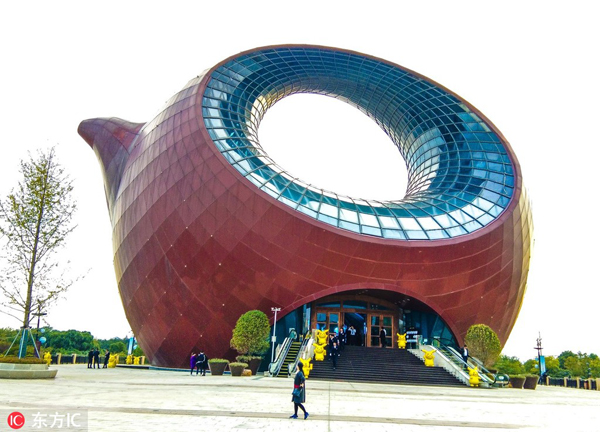
The teapot building:


The tourist information centre in an area famous for its red clay teapots is in the shape of . . . a teapot. Funded by the second richest man in China, Wang Jianlin of the Dalian Wanda group, it is 10 stories in height and rotates as well.

The teapot building at night

Meitan Tea Museum in southern Guizhou province:


The tourist information centre teapot may rotate but it’s not the biggest teapot building in China. That title goes to the Meitan Tea Museum in southern Guizhou province, which has a height of 74m. It comes complete with a neighbouring tea-cup building. If it were ever filled it would hold 28m litres of tea. 

Chester teapot:

It trounces the previous Guinness World Record for the Largest Teapot Monument which was set by the Chester Teapot, built by William “Babe” Devon in West Virginia in 1938 – which stands just four metres high.

World's Largest Teapot postcard from the 1950s, 
Chester Teapot, West Virginia US

According to the postcard:
12 Feet in Height, 44 Feet in Width. "The Teapot" was originally brought to Chester, West Virginia to represent the largest pottery industry in the world at one time. It was a hires Root Beer Barrel advertisement and, in 1938, was brought in to Chester where it was converted to a teapot. In 1990, its restoration was completed by a group of citizens from the City of Chester, WV.

It originally sat on Carolina Ave, but was moved next to the Jennings Randolph Bridge and restored in 1990. Since then there have been two more restorations.
World's Largest Teapot postcard from the 1990s.
The little teapot/creamer on the left is presently in City Hall.

Gate of the Orient, China:


Dubbed “a big pair of pants”, the legs of the Gate of the Orient were joined together with a majestic crotch on the skyline of the ancient city of Suzhou in 2012. 74 storeys in height, the office building has been declared the largest gateway building in the world and no doubt takes the title of the world’s largest trouser-shaped building as well. Locals have also said that walking through its gaping arch is “like being forced to crawl between someone else’s legs.”

Headquarters of China Central Television (CCTV):


The headquarters of China Central Television (CCTV) was named the Best Tall Building Worldwide from the Council on Tall Buildings and Urban Habitat in 2013, yet some have called it "big pants" due to its resemblance to a pair of trousers. It has also been described as a pair of “big boxer shorts”, as well as likened to someone squatting above the city, ready to offload a nasty surprise.

Location of the China State-run newspaper:


The building which houses China's state-run newspaper People's Daily has often been remarked on for its phallic appearance. Can’t see it myself but that is probably because my mind is pure. The 150m-tall erection is situated close to the CCTV building in Beijing's business district.

North China University of Water Conservancy and Electric Power headquarters:


The North China University of Water Conservancy and Electric Power headquarters, which is shaped like a toilet, was constructed 5 months after the Chinese Government’s directive on no more weird buildings, leading to speculation that the directive has not been as effective as hoped. On the other hand, it has also been argued that the building does not intentionally look like a toilet.

Mobile phone building:


Rising above Huancheng Road in the provincial capital Kunming, the 11-storey mobile phone building features button-shaped windows and a penthouse office floor that looks out through the screen – plus a sinister blue hand, emerging from the ground and clutching its sides.