Monday, August 2, 2021

SYDNEY THEN AND NOW . . .

-------☹😊☹-------

SYDNEY STADIUM:

On Saturday 26 December 1908, American boxer Jack Johnson defeated the Canadian title-holder, Tommy Burns, for the heavyweight championship of the world. The bout took place at the Sydney Stadium, Rushcutters Bay, before a crowd of 20,000 fans.

The following is from a previous Bytes item on Jun 19, 2010 . . .

THEN:

One of the advantages of getting older is the memories one has of events and places that these days are only moments in history. One such memory is that of the Sydney Stadium. Before the ANZ Stadium (or whatever it is called these days) there was the Sydney Entertainment Centre, and before that there was the Sydney Stadium, also known as The Tin Shed and The Old Tin Shed. I recall as a lad my father regularly taking the family to the Friday night wrestling at the Stadium, watching the likes of Killer Kowalski, Mark Lewin, Domini DeNucci, Skull Murphy, Tex McKenzie and Spiros Arion do battle.
"Never in the history of showbiz, in any major city anywhere in the whole wide world has there ever been anything like it for a big night venue -- whether it be a world championship boxing stoush, dwarf wrestling, roller derbies, religious revivals, pop and jazz concerts ... you name it. The Stadium ... was just something else. It was uniquely Oz. Uniquely Sydney. Nowhere else was there or could there have been a joint like the Old Tin Shed."

- John Byrell
Built in 1908 by boxing promoter Hugh MacIntosh, it was an open air stadium, the biggest in the world at the time, located at the corner of New South Head Road and Nield Avenue, Rushcutters Bay on a former Chinese market garden. Its first title fight took place on 24 August 1908 when Canadian World Heavyweight Champion Tommy Burns knocked out local boy Bill Squires. Not long after, on Boxing Day 1908, 20,000 spectators saw Jack Johnson defeat Burns, becoming the first black World Heavyweight Champion. 

A photograph of the fight and the Stadium spectators appears below. Note the stand at the right for filming. The fight was stopped in the 14th round by the police and Johnson won on a TKO.


Those interested in Johnson’s subsequent career –
- the search for a Great White Hope to defeat him;
- the race riots and attempted lynchings following his defeat of James Jeffries;
- his conviction under the Mann Act for transporting a woman across State lines for an immoral purpose (even though when he did so there was no Mann Act);
- his imprisonment for a year and a day;
- his invention of a patented modified wrench whilst in prison;
- Congress’ 2009 petition to President Obama for a pardon
can read about it at:

The Sydney Stadium was roofed in 1911. In 1912 MacIntosh transferred his interests to Reginald “Snowy” Baker who subsequently built stadiums in Melbourne and Brisbane, both named Festival Hall.

Sydney Stadium operated most nights of the week, primarily for boxing and wrestling bouts.


Note in the pic above the boxing and wrestling figures at either side of the word "Stadium".

From 1955 American expatriate entrepreneur Lee Gordon began using the Stadium for imported music acts and stars, including Johnny Ray and Frank Sinatra. Gordon also promoted local talents, originally as support acts for imported names and later in their own right – Johnny O’Keefe, Johnny Devlin, Col Joye.

According to Milesago: Australasian Music & Popular Culture (Venues) at:
In the late Fifties Gordon made his name with his legendary series of 'Big Show' concerts -- star-studded events headlined by big American names, with Australian acts supporting. Through these shows, Gordon almost single-handedly launched the first wave of rock in Australia, touring a host of groundbreaking rock'n'roll and R&B acts including Little Richard, The Everly Brothers, Bill Haley & The Comets, Duane Eddy, Eddie Cochrane, Johnny Cash, Jimmie Rodgers, Gene Vincent, Buddy Holly & The Crickets, LaVern Baker, Big Joe Turner and Chuck Berry.
There was never anything fancy about Sydney Stadium, as the local name, the Old Tin Shed, would indicate. It was roughly circular and seated about 12,000 on crude tiered wooden seats. I recall the sense of excitement in going there as a child, the lights, the atmosphere, the sense of anticipation (as a kid you think the wrestling is real) as you went through the tunnels to the seats. I als recollect that no matter where you sat you could look through the timber rails that made up the seats, and the gaps, to the bare ground below the seats, sometimes quite a distance if you were in the nose bleed sections. I also remember that people simply dropped their papers, food containers etc to the bare ground underneath the tiered seats, as well as their cigarette butts. How they didn’t have a fire in that dire trap is unknown to me. The venue was built with an iron and wood frame and covered in corrugated iron, walls and roof. It was unlined, uninsulated, no air condtioning, and was cold in winter and hot in summer. Accoustics were poor and, once screaming started, made listening to lyrics difficult. The screaming at the 1964 Beatles concert was recorded at well over 100 decibels. A modern day loud, amplified rock concert is usually around the 115 decibel level.

The Stadium had a central stage or ring, depending on the nature of the event. The circular stage could be turned by hand so that all the speactors had a front view for a period. This rotation was done by srage hands pushing the stage to its new position in a circular motion, usually a quarter turn at a time.

According to Milesago:
Many performers nearly fell when the stage was rotated, as the motion was often very jerky. Bob Dylan reportedly had to ask one of his band to catch him, and The Small Faces incurred the stage hands' ire when lead singer Steve Marriott reportedly abused them -- in retaliation the stage was left in one position for most of their performance.
The Sydney Stadium's final concert presentation was The Four Tops, supported by The Flying Circus, on 1 June 1970.

NOW:

In 1973 the Sydney Stadium was demolished to make way for the overhead section of the Eastern Suburbs Railway.

All that remains now are some photographs and some plaques.

And memories.


Commemorative plaque representing the historical site where Sydney Stadium stood from 24th August 1908 until 9th October 1970 at what is now the Weigall Sportsground in Rushcutters Bay in Sydney.


-------☹😊☹-------

SYDNEY FIRE STATION, CASTLEREAGH STREET:

THEN:


Horse-drawn fire appliances outside the city fire station in Castlereagh Street.


Metropolitan Fire Station No 1, Castlereagh Street, Sydney


The opening of Central Fire Station (1888).


A later view

Note the firemen in their brass helmets.  Hard to make out so here is a better pic with then and now:


My reason in posting this is that my mother, now no longer with us, was already a collector of brass and copper items before the family to Australia from Holland, even shipping her items to Oz.  She continued her bower bird collecting activities after arrival in Oz long before it became popular here  One of her purchases was a brass fireman's helmet which I still have, albeit unpolished . . . 


Looks like a movie prop from the film Gladiator, doesn't it.  
Note the fire breathing dragon on the top.
Here is a polished version . . . 


Apparently polishing of brass helmets, brass buttons, the brass fittings on the vintage fire engines and the handle on the big brass door (kidding, I tossed in the last one) was a regular and important part of the firemen's ritual.

NOW:


The old Sydney Fire Station on Castlereagh St is undergoing renovations to the original building after completion of the new building next door. Firefighters going from the old building to the new.


-------☹😊☹-------

PYRMONT BRIDGE:

THEN:


Sydney from Pyrmont.


First Pyrmont Bridge, 1857-1900


Pyrmont Bridge 1874


Pyrmont Bride construction (beside the old) looking west, c1900


Pyrmont Bridge


Pyrmont Bridge 1902


Tarring wood blocks on Pyrmont Bridge, 1902.


Pyrmont Bridge, 1907
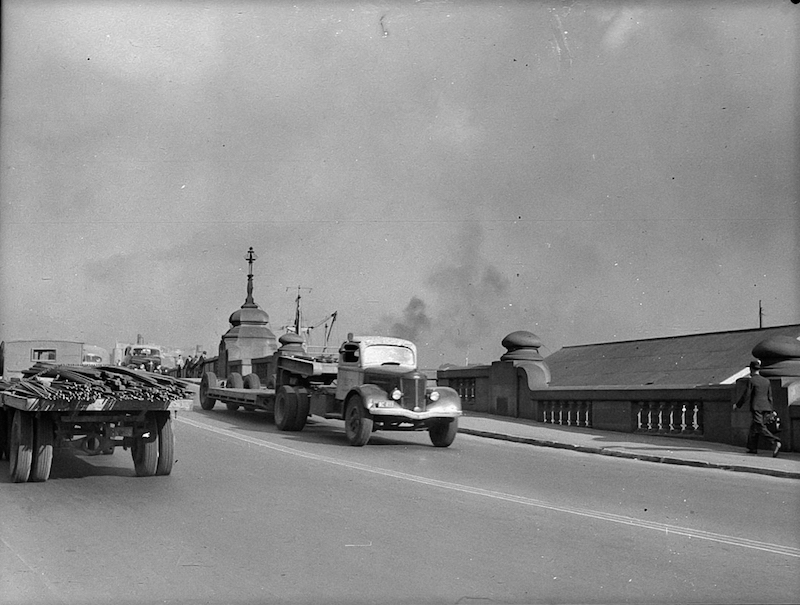

Trucks on Pyrmont Bridge 1926


Heavy load on Pyrmont Bridge, 1927


Pyrmont Bridge 1934

NOW:


--------o😊😊😊o-------

Sunday, August 1, 2021

QUOTE FOR THE DAY


MY THIRD TOP 10 + 2, CONTINUED . . .

-------☹😊☹-------

Continuing the third list of my personal Top 10 + 2 films, based on the Otto Watchability and Repeated Watching Index © . . .

The list so far:
1. Breakfast Club
2. The Enemy Below
3. The Searchers
4. The Quiet Man
5. Forrest Gump
6. Midnight Sting

(Steve, you probably won’t like these next ones either).

Warning: spoilers ahead.

-------☹😊☹-------

7. Once Upon a Time in the West (1968)


I watched this on TV the other night and was captivated all over again. Just the first 20 minutes alone – the scene at the railway station with the three bad guys waiting for the Charles Bronson character Man With the Harmonica (as he is only identified) – is worth the price of admission. That is what is shown on the poster above. The dust coats, the repetitive squeaking windmill sound, the hard men in a harsh environment, the minimal action and sound slowly building the tension . . . beautiful. A short film in itself. And what superb dialogue:
    Harmonica: [facing three men] And Frank?
    Snaky: Frank sent us.
    Harmonica: Did you bring a horse for me?
    Snaky: Well... looks like we're...
    [snickers]
    Snaky: ...looks like we're shy one horse.
    Harmonica: [shaking head] You brought two too many.

Once Upon a Time in the West (Italian: C'era una volta il West, "Once upon a time (there was) the West") is a 1968 epic Spaghetti Western film directed by Sergio Leone, who co-wrote it. It stars Henry Fonda, Charles Bronson, Jason Robards and Claudia Cardinale, plus has a great score by Ennio Morricone.

  • Afraid of being typecast after having made three spaghetti Westerns in a row with Sergio Leone, Clint Eastwood declined the role of harmonica.
  • The film is the first instalment in Leone's Once Upon a Time trilogy, followed by Duck, You Sucker! and Once Upon a Time in America, though the films do not share any characters in common.
  • The original version by the director was 166 minutes when it was first released on 21 December 1968. This version was shown in European cinemas, and was a box-office success. For the US release on 28 May 1969, Once Upon a Time in the West was edited down to 145 minutes by Paramount and was a financial flop.
  • Up to this film, Henry Fonda has always been cast as a good guy. He originally turned down the role of Frank but director Sergio Leone flew to the United States and met with Fonda, who asked why he was wanted for the film. Leone replied, "Picture this: the camera shows a gunman from the waist down pulling his gun and shooting a running child. The camera pans up to the gunman's face and...it's Henry Fonda".
  • Henry Fonda prepared for his role as the villain "Frank" by arriving in Italy with a pair of brown coloured contact lenses and a moustache. When Sergio Leone saw them, he ordered them removed. Leone had planned an important close-up shot of Frank's entrance and wanted the audience to instantly recognize Fonda with his blue eyes.
  • For the opening sequence where the three men in dustcoats waited for the train, filmmakers lightly coated the face of Jack Elam with jam and began filming close-ups while letting a fly out of a jar filled with flies, attempting to get Elam's reaction as one would land on his cheek.
  • Unlike the Dollars trilogy, which were all solely shot in Spain, Sergio Leone travelled to the U.S. to shoot some scenes in the iconic Monument Valley, one of John Ford's favourite locations, making it the first "spaghetti Western" to be shot in the U.S.
  • Sergio Leone made hundreds of references to films that influenced him. Some were quite obvious (like three men waiting for the train as in High Noon (1952)) and some were very subtle, like the choice of Woody Strode's sawed-off Winchester rifle, similar to the weapon Steve McQueen carried in Wanted: Dead or Alive (1958). McQueen referred to this unique weapon as a "Mare's Leg".
  • The Indian woman who flees from the train station in the opening sequence was played by Hawaiian Princess Luukialuana (Luana) Kalaeloa. the real life wife of Woody Strode, one of the men in the dustcoats.

If you love cowies, spaghetti westerns, a good Sergio Leone film, and Bronson and Fonda, don’t go past this if you haven’t yet seen it.

-------☹😊☹-------

8. Shawshank Redemption (1994)


Many would think that this great film should have been in my first Top 10 + 2 list and I would be hard put to contest that view except to say that a cut must be made somewhere. Many also felt that it should not have missed out to Forest Gump for Best Pic and I agree (Gump also getting the nod for Best Director and Best Actor). Shawshank missed the Oscar boat entirely, paralleled by being a flop at the box office. Wiki summarises it as follows: “Many reasons were cited for its failure at the time, including competition from films such as Pulp Fiction and Forrest Gump, the general unpopularity of prison films, its lack of female characters, and even the title, which was considered to be confusing for audiences.”

Which all goes to show that many people getting it wrong doesn’t equal being right. The movie is a homage to the strength and dignity of the human spirit at times of adversity and crushing events.

How many great moments:
  • Red’s final speech to the parole board.
  • The comeuppance of the warden.
  • The sadness of Brooks’ departure, unable to cope with freedom after becoming institutionalised.
  • Andy’s emergence in the rain from the sewer pipe, his escape being a rebirth.
  • Red and Andy reuniting.

  • The prison site, which was planned to be fully torn down after filming, became a tourist attraction. The Mansfield Reformatory Preservation Society, a group of enthusiasts of the film, purchased the building and site from Ohio for one dollar in 2000 and took up maintaining it as a historical landmark, both as its purpose as a prison and as the filming site. A 2019 report estimated the attraction to be earning $16 million in annual revenue.
  • The oak tree, under which Andy leaves his note for Red, ended up becoming a symbol of hope for many because of its role in the film, attracting thousands of visitors annually. The tree was partially destroyed in 2011 when it was split by lightning, news of the damage being reported across the United States on newscasts, in newspapers, and on websites as far away as India. The tree was completely felled by strong winds in 2016.

Red approaches Andy’s oak.

The oak after the 2016 damage.
  • The wood was used to make expensive souvenirs: key chains and magnets ($40), mini rock hammers ($85), bottle openers ($130), and shadow boxes with an inscription of Andy's note to Red ($500). Still, as Andy tells Red in the film, “no good thing ever dies.”
-------☹😊☹-------

Numbers 9 and 10 + 2 to come, what will they be?


Saturday, July 31, 2021

THOUGHT FOR THE DAY


FUNNY FRIDAY

-------☹😊☹-------


You're right, today is Saturday, s
o why is Funny Friday appearing today? Because with the current lockdown here in Sydney, I lost track of my days and overlooked it.


Better late than never, here is Funny Friday . . . 

A caution: risqué content and language follows.

-------☹😊☹-------

SOME HUMOUR:
________________

My wife told me we should split up because I keep pretending to be a detective.

I said good idea, we can cover more ground that way.
________________

I once dated a girl named Rachel, but she turned out to be a nasty bitch. As a result, I now refuse to associate with women named Rachel.

Then again, I could just be Rachel profiling
________________

When Chuck Norris updates Windows . . . 

. . . Microsoft accepts his terms and conditions
________________

I agree, those previous three should have been in Corn Corner.
________________

How do you tell the difference between a fully vaccinated person and an unvaccinated person if they aren't wearing a mask?

Ask them who won the election.
________________

In a few years, when you rummage through your old clothes and find a used mask in a pocket, you will smile . . .

. . . from behind your hazmat suit's visor.

-------☹😊☹-------


FROM THE VAULT:

A Texan variation on a Jewish joke posted in the past . . .

An elderly couple, Margaret and Bert, moved to Texas.

Bert always wanted a pair of authentic cowboy boots, so seeing some on sale, he bought them and wore them home. Walking proudly, he sauntered into the kitchen and said to his wife, ' Notice anything different about me'?

Margaret looked him over. "Nope'.

Frustrated, Bert stormed off into the bathroom, undressed and walked back into the kitchen completely naked except for the boots. Again he asked Margaret, a little louder this time, ' Notice anything different NOW'?

Margaret looked up and exclaimed, 'Bert, what's different? It's hanging down today, it was hanging down yesterday, it'll be hanging down again tomorrow!'

Furious, Bert yelled, 'AND DO YOU KNOW WHY IT'S HANGING DOWN, MARGARET?'

Nope', she replied.

‘IT'S HANGING DOWN BECAUSE IT'S LOOKING AT MY NEW COWBOY BOOTS!!!!’

Without changing her expression, Margaret replied, ' Shoulda bought a hat Bert, shoulda bought a hat.

-------☹😊☹-------


Two lawyers walk into a restaurant.

They put their briefcases on the floor and order two coffees. They get their coffee and pull out lunches from their briefcases.

"Sorry," the waitress says, "You can`t eat your own food here."

The lawyers look at one another, shrug their shoulders and swap sandwiches.

-------☹😊☹-------


LIMERICK OF THE WEEK:

A young woman got married at Chester.
Her mother she kissed and she blessed her.
Says she, "You're in luck,
He's a stunning good fuck.
For I've had himself myself down in Leicester.

-------☹😊☹-------

GALLERY:


-------☹😊☹-------

Introducing a new category for Funny Friday . . . 


-------☹😊☹-------


CORN CORNER:
________________

I used to believe that sticks and stones could break my bones, but words could never hurt me.

But then someone hit me with a dictionary.
________________

My mum is an anti vaxxer...

Calls herself Mrs DoubtPfizer.
________________

By revealing the punchline first

How do you ruin a good joke?
________________

What is two times more disgusting than finding a worm in your apple?

Finding half a worm in your apple

-------☹😊☹-------

Friday, July 30, 2021

THOUGHT FOR THE DAY


FROM THE VAULT: KEEP ON TRUCKIN'

Origin: Keep on Truckin'

From the vault January 24, 2010, with added content.


The phrase “Keep on Truckin’ “ is now a general form of encouragement in the sense of telling someone that they’re doing a good job and also as an equivalent to telling someone to go for it. It originated in the 1920’s and 1930’s with jazz musicians. Blind Boy Fuller incorporated it in a song by the name of Keep on Truckin’:

Truckin' on down the line
Hey hey hey
I say keep on truckin'
Truckin' my blues away
Keep on truckin' mama
Truckin' my troubles away
I say keep on truckin' mama
Truckin' my troubles away
Do that thing you do so well
I can tell what you been doin'
By the way that you smell.
Keep on truckin' mama
Truckin' my troubles away.

Right: Blind Boy Fuller

In 1968 Robert Crumb used the phrase as the title for a one page comic, being the first issue of Zap Comix, illustrating it with the image that has become associated with the phrase.

Robert Crumb, self portrait

Drawn in Crumb’s distinctive style, it shows cartoon men strutting confidently across a barren landscape. 


The strip’s drawings became iconic images of optimism during the hippie era. Like most underground comics, it was not copyrighted and was extensively used on t shirts, posters and other items. It has also led to variations on the Crumb image:


Although the phrase came to mean keep on keepin' on, or get it done, or hang in there, in the original Blind Boy Fuller song "Truckin' My Blues Away," as with a lot of suggestive blues songs that use alternative words, it was a rhyming word for the sex act. Fuller's song praises a girl who "keep on trucking mama, trucking my blues away." In one part he says to the listener "Catch you truckin' with her, I'm gonna sure shoot you down," and later he tells his girl she doesn't need to leave, and to "Wait a little while you might wanna truck some more."

Crumb was not happy about the hippies using the phrase as the '60s equivalent of a motivational poster., hated the fact that he had become a spokesperson for counter culture and was not pleased at his image being so used. According to him:
I became acutely self-conscious about what I was doing. Was I now a ‘spokesman’ for the hippies or what? I had no idea how to handle my new position in society… Take Keep on Truckin’ for example. Keep on Truckin is the curse of my life. This stupid little cartoon caught on hugely. There was a D.J. on the radio in the seventies who would yell out every ten minutes: ‘And don't forget to KEEP ON TR-R-RUCKIN’!’ Boy, was that obnoxious… I didn't want to turn into a greeting card artist for the counter-culture!
One final note:

Director Terry Zwigoff (Crumb, Ghost World) told Roger Ebert:
He was offered, like, millions to license the 'Keep on Truckin' drawing for Toyota, but they only wanted that one drawing. He wanted to sell them a lot of other stuff. He tells them, 'How about I have this girl with her head cut off being stuffed into the trunk of the Toyota?' When they didn't go for that, he turned them down.

So there you have it, folks, and remember . . .