Monday, November 13, 2023

POETRY SPOT


Pioneers

by Andrew Barton 'Banjo' Paterson

They came of bold and roving stock that would not fixed abide;
There were the sons of field and flock since e’er they learned to ride;
We may not hope to see such men in these degenerate years
As those explorers of the bush – the brave old pioneers.


‘Twas they who rode the trackless bush in heat and storm and drought;
‘Twas they that heard the master-word that called them further out;
‘Twas they that followed up the trail the mountain cattle made
And pressed across the mighty range where now their bones are laid.


But now the times are dull and slow, the brave old days are dead
When hardy bushmen started out, and forced their way ahead
By tangled scrub and forests grim towards the unknown west,
And spied the far off promised land from off the ranges’ crest.


Oh! Ye, that sleep in lonely graves by far-off ridge and plain,
We drink to you in silence now as Christmas comes again,
The men who fought the wilderness through rough unsettled years –
The founders of our nation’s life, the brave old pioneers.


Saturday, November 11, 2023

BACK, HOPEFULLY

---------oOo---------


Hopefully today’s posts will go out, marking the end of the server problems that have prevented emails going out and therefore accounting for the lack of Bytes items.

A thank you to those who enquired if I was well and if that was the reason for my silence – I am fine and have not rung down the curtain and joined the choir invisible, as it is put in the Monty Python ‘Dead Parrot’ sketch.


---------oOo---------

THOUGHTS FOR THE DAY

---------oOo---------


Today is Remembrance Day, a memorial day observed in Commonwealth member states since the end of the First World War in 1919 to honour armed forces members who have died in the line of duty.

The day is also marked by war remembrances in several other non-Commonwealth countries.

Some facts about Remembrance Day appear below.

From ‘For the Fallen’, commonly known as ‘The Ode’, by Laurence Binyon

They went with songs to the battle, they were young,
Straight of limb, true of eyes, steady and aglow,
They were staunch to the end against odds uncounted,
They fell with their faces to the foe.

They shall grow not old, as we that are left grow old:
Age shall not weary them, nor the years condemn
At the going down of the sun and in the morning
We will remember them.


REMEMBRANCE DAY FACTS

---------oOo---------

  • Remembrance Day marks the anniversary of the end of the First World War, the Armistice, on 11 November, 1918.
  • World War I was originally known as the Great War. It began in August 1914 when Britain and Germany went to war but many countries, such as Australia and New Zealand (who formed the famous ANZACs), immediately declared their allegiance to Britain and joined the war. Many such allergiances were due to the system of treaties and support agreements. This partnership was known as the ‘Allied Forces’.
  • The main nations in the Allied Forces were Britain, France and Russia. Later, they were supported by countries such as Canada and the United States. The Allied Forces fought the Central Powers: Germany, Austria-Hungary, Italy, and the Ottoman Empire (Turkey).
  • During the four years of World War I, Australia was involved in some of history’s most tragic conflicts, such as the famous landing at Gallipoli, horrific battles on the Western Front (France and Belgium) and in the Middle East.
  • In 1918, after suffering a number of defeats and heavy losses, the German forces agreed to an armistice with the Allied troops and this signalled the end of WWI. The treaty was signed at 5am on 11 November 1918, but did not officially come into effect until six hours later at 11am. The armistice was met by celebration around the world.
  • For this reason, Remembrance Day was originally called Armistice Day. In Australia, it was renamed in 1997. The name change broadened the meaning of the day, widening the focus from World War I, to a day which commemorates those who served in any war or conflict.
  • In most countries, Remembrance Day is observed on 11 November to recall the end of First World War hostilities. Hostilities formally ended "at the 11th hour of the 11th day of the 11th month" of 1918, in accordance with the armistice signed by representatives of Germany and the Entente between 5:12 and 5:20 that morning. "At the 11th hour" refers to the passing of the 11th hour, or 11:00 am. The First World War officially ended with the signing of the Treaty of Versailles on 28 June 1919.
  • Every year, nations around the globe fall silent for one minute at 11am on the 11th day of the 11th month to remember those who have served their country during war. This practice stems from King George V’s declaration on 6 November 1919 that people throughout the Commonwealth should suspend their normal activities so that in “perfect stillness the thoughts of everyone may be concentrated on reverent remembrance of the Glorious Dead”.
  • The Flanders poppy was one of the first plants to grow on the blood-soaked battlefields of France and Belgium. In nineteenth century English poetry, poppies often symbolised sleep or oblivion. After WWI, silk poppies were sold on Armistice Day with proceeds going to a charity for French children and to the Returned Soldiers League (RSL).
  • Many people wear a sprig of rosemary on Remembrance Day and on ANZAC Day. Since ancient times this aromatic herb has been recognised as a sign of remembrance and loyalty. For Australians, rosemary is even more significant as this plant grows wild on the Gallipoli peninsula, serving as another reminder of the ANZAC troops who lost their lives there.
  • An old tale describes the Virgin Mary spreading her blue cloak over a flowering rosemary bush. The story says that the white flowers turned blue and from that day on the bush was called the ‘Rose of Mary’.
  • On Remembrance Day, flags are flown at half-mast from 10.30am to 11.03am as a sign of mourning and respect. It is said that this tradition stems from sailing ships that lowered their sails at sea to honour an important person or mark a death.
  • There are a number of rules associated with flying the Australian flag at half-mast. The flag can never be flown at half-mast at night. If in a group of flags, all flags should be lowered to half-mast, however, Australia’s should be lowered last and raised first.
  • The Unknown Soldier is intended to represent all men killed during war, especially those with no known resting place. The original Unknown Soldier was entombed at Westminster Abbey in London on Remembrance Day 1920. On the same day, France entombed an Unknown Soldier below the Arc de Triomphe.
  • It was not until Remembrance Day 1993 that Australia laid to rest an Unknown Soldier in the Hall of Memory at the Australian War Memorial in Canberra. At his side was a bayonet and a golden sprig of wattle. The soldier was buried in a coffin made from Tasmanian Blackwood which was scattered with soil from the French battlefield, Pozières.
  • It is estimated that over 60,000 Australians died in the Great War, many of these have no known graves. This left the Western Front dotted with memorials and cemeteries commemorating the fallen. Many Australians travel to these locations, as well as others in Egypt and Turkey, to pay tribute to the events that occurred and to remember all who served and fell there.
  • In modern times, these pilgrimages have become increasingly popular around Remembrance Day and ANZAC Day. On these days, many locations, such as Gallipoli, Villers-Bretonneux and Bullecourt, hold special commemorative ceremonies. These ceremonies are made up of many traditional elements such as a parade, wreath laying, the Last Post (played on a bugle) and a minute of silence.
  • The word ‘armistice’ means a truce or peace arrangement. It comes from the Latin word ‘arma’, meaning arms and ‘stitium’, meaning ‘a stopping’, giving us the meaning: to put down your arms ie weapons.
  • The famous poem In Flanders Fields that made the red poppy such an iconic symbol, was written by Canadian Lieutenant Colonel John McRae. It is said that it only took him 20 minutes to write buy, dissatisfied with it, McCrae tossed the poem away. A fellow officer retrieved it and sent it to newspapers in England. The Spectator, in London, rejected it, but Punch published it on 8 December 1915. The poem went on to become hugely popular with the public, and has since become an abiding symbol of remembrance worldwide.
  • It was not just men who went to war. In World War I, many Australian women volunteered as cooks, drivers, interpreters and other skilled positions. Female nurses served in countries such as Egypt, France and Greece, often in dangerous conditions, close to the frontline where they were exposed to shelling.
  • World War I was the first armed conflict where aircraft were used. There were around 3000 Australian airmen who served with the Australian Flying Corps.
  • The conditions in WWI trenches were so horrifying that they gave their name to numerous ailments that occurred there. These include: ‘Trench Foot’ (a fungal foot infection), ‘Trench Nephritis’ (an inflammation of the kidneys) and ‘Trench Fever’ (a painful infection caused by lice).
  • It is estimated that the WWI trench system on the Western Front measured approximately 475 miles (764km) in length.
  • Many countries (such as Canada, the United Kingdom, France, Belgium and Poland) also observe Remembrance Day.
  • During the Second World War, many countries changed the name of the holiday. Member states of the Commonwealth of Nations adopted Remembrance Day, while the US chose Veterans Day.


Friday, November 10, 2023

BYTES INTERRUPTION


For those wondering where Bytes has gone and why there have been no emails sending out daily posts, I have been experiencing server problems that has preveneted the psosts going out. Think of it as an outahe equivalent to that which hit Optus, but longer. (I am with Optus but thos glitch was not optus related).

It is being worked on, hopefully back to normal soon.

- Otto

Tuesday, November 7, 2023

QUOTE FOR THE DAY


SOME MORE MELBOURNE CUP ITEMS

---------oOo---------

Months before the 1870 race, Ballarat publican Walter Craig had a vivid dream. In this dream he watched his own horse, Nimblefoot, win the Cup, but he noticed his jockey was wearing a black armband. Craig’s premonition was that his horse would win the Cup, but that he would not live to see it. So strong was his conviction that the story gained great currency and was reported in the press before the Cup was run (this is verified by the Trove newspaper database).

Astonishingly, Craig’s horse Nimblefoot won the cup, with the jockey wearing a black crepe armband to mourn Walter Craig who, just as he had dreamed, died before the race.

---------oOo---------

Jockey John Letts rode the 40/1 outsider Piping Lane to win the Cup in 1972.

Letts was a South Australian, a late booking because he could make the horse’s light weight of 48 kilograms. When approached for the ride he decided not to reveal he had not ridden at Flemington previously. He asked a friend among the local jockeys for advice and was told “make your move at Chiquita Lodge”.

In the run Letts gained a good position. As the field began the long turn for home, he scanned the horizon for Chiquita Lodge. “I was looking up in the sky for some multi-storey hotel or apartments,” he recalled. Nothing like that appeared and the jockey grew desperate. Then he saw the favourite Gunsynd being urged forward and decided to get onto its tail. In the straight Piping Lane surged past Gunsynd and went on to an easy win.


Later Letts confronted his informant about the Chiquita Lodge tip. He was embarrassed to learn that Chiquita Lodge was a famous stable that ran down the side of the racecourse with its name painted in huge letters on the roof.

Letts capitalised on his 1972 win to become one of the country’s leading jockeys and won another Melbourne Cup in 1980 – leading all the way.

---------oOo---------

The story of the 1906 winner Poseidon and its ardent admirer, a Chinese market-gardener named Jimmy Ah Poon, also has its element of humour.

Poseidon was a three-year-old colt in the spring of 1906. He began a sequence of big-race wins at Randwick in September, then won at Hawkesbury, followed up in the AJC Derby, but then ran second in the Metropolitan Handicap. He then travelled to Melbourne and won four races in a row, culminating in the Melbourne Cup. In autumn 1907 Poseidon raced five times for three more wins and two seconds.

Ah Poon supplied Poseidon with his favourite food, carrots, from his garden. They became firm friends. He bet 10 pounds on the horse at Randwick then “let it ride” at Hawkesbury and in the Derby.

At the urging of the owner he laid off on the Metropolitan defeat, then again bet all-up in each of the Melbourne wins. He did the same in the autumn, but somehow knew not to bet on the losses.

Bookmakers, who not surprisingly had come to know him well, wryly nicknamed him “The Possum” for his pronunciation of “Poseidon” when placing bets, but also for his cunning in avoiding losing days.

He was not seen at the track thereafter and it is believed he returned to China with his fortune intact.

---------oOo---------

The Cup of 1890 was won by “Old Jack” or Carbine, the horse that several racing heavyweights judge superior to Phar Lap.

Carbine wins the Cup in 1890.

It is one of the earliest for which we have images of the contestants approaching the winning post. It is thus of significance in the history of photography.

The picture also captures a large section of the crowd watching the race intently, in which a keen-eyed latter-day researcher named Jack Pollard spotted a crime in progress. One racegoer is being “dipped” – that is, having his pocket picked (circled in the photo). One hopes that the victim was not holding a winning ticket.

---------oOo---------

The youngest jockey to ever win the Melbourne Cup was just 15 years old.

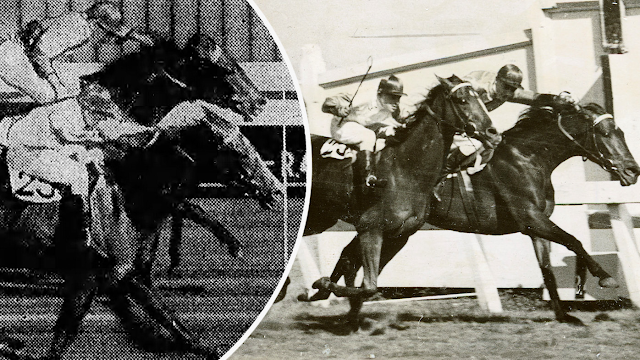
It was 1948 and it was the first time a photo finish was used in the race.

Rimfire, an 80-1 outsider, beat Dark Marne, just. Without the photo evidence the race could have easily gone to the other rider or ended in a dead heat.


Ray Neville had placed second in the Caulfield Cup two weeks before the big race.

Rimfire’s jockey was re-positioned to ride the race favorite instead, and the trainer, Stan Boyden, was out of options. Young Neville was picked to ride Rimfire at the last minute. His previous win had not gone unnoticed, and he was small. It would have to do.

According to Ray Neville’s daughter Christine Currie:

“There is no way they would put someone so young and unexperienced like my dad on an expensive horse like that today. [Rimfire] was an 80 to one outsider. The jockeys thought it was a joke and the trainer was not placing any bets. He would tell us as kids that as he was coming round the last bend he just went for it. He thought he might just have a chance – he was as shocked as everybody else.”

Ray Neville won 25 pounds, enough for a new suit and a saddle, which was later stolen, and was presented with a whip and a cup. That night he sat on a bench and had fish and chips for dinner – no grand celebration for the youngster in those days.

“It will never ever happen again, my dad was the youngest on record and most likely always will be,” Ms Currie said.

Mr Neville won 25 pounds, enough for a new suit and a saddle, which was later stolen, and was presented with a whip and a cup.

That night he sat on a bench and had fish and chips for dinner – no grand celebration for the youngster in those days.

“It will never ever happen again, my dad was the youngest on record and most likely always will be,” Ms Currie said.

Mr Neville continued to ride until 1968 and worked in the racing world issuing barrier certificates well into his 50s.

He died suddenly in 2008, five weeks after his 60th birthday.

A photograph captures Ray Neville as he dismounts Rimfire after winning the race.

H. G. Raymond with Jockey Ray Neville, after their 1948 Melbourne Cup success with Rimfire.


Sunday, November 5, 2023

QUOTE FOR THE DAY

As I note below, Tuesday is Melbourne Cup Day, it brings to mind a comment made by Trudy, a legal secretary who used to be part ot my office years ago. Asked about her prediction for the winning horse, she replied:

"Don't ask me, all I know about horses is that one end eats and the other shits."

MELBOURNE CUP

-----oOO-----

Tuesday will be Melbourne Cup day so here are some facts and trivia items . . . 

From:

-----oOo-----

Fun Facts about the Melbourne Cup

It’s the race that stops the nation at 3pm, the first Tuesday in November- The Melbourne Cup! In celebration of Australia’s biggest race, our blog post today has gathered all the fun facts we can find about the world’s greatest “2-mile” race.

The Race that Stops the Nation
  • The first running was in 1861
  • It wasn’t always run on a Tuesday, or even in November! The first Tuesday in November became tradition after 1875. Over the first decade of the race, it was run on a Thursday, and even once in October.
  • The first running in 1861 was won by Archer, a stallion who had been travelled on foot from Terara NSW, a mere 800km from the track. Archer went on to win the 1862 running as well, placing him in an elite category of horses to have won the cup more than once.
  • Up to 39 horses have taken to the starting barriers, which was in the running of the 1890 Cup. In the modern era, the race is capped at 24 starters.
  • Over 100,000 people flock to Flemington on Race Day. 2003 holds an attendance record of over 122,700 spectators.
The “Cup” 
  • It wasn’t until 1865 that a trophy was awarded for winning “The Cup”. The first trophy was in fact deemed so unattractive that it was sold by the winner, and eventually re-presented as a prize at the local Hunt Club
  • Trophy design was original for each running, up until 1919 when the traditional Cup style we recognize today, was adopted
  • The $1 Million prizemoney of the 1985 Melbourne Cup made it the first race in Australia to reach over a million. This prize pool has continued to expand, to over $8 million in 2021
  • There has never been a dead heat for first prize, meaning no sharing of the cup! However there have been two instances where 3rd place getters were inseparable.
Cup Records 
  • The fastest time which the 3200m race has been run was 3:16.3 minutes, set by Kingston Rule in 1990
  • The longest winning margin is 8 lengths, achieved by Archer (1862) and Rain Lover (1968)
  • Makybe Diva holds the most cup wins for a single horse, passing the post first in 2003, 2004 and 2005
  • Bart Cummings, the Cup King, has trained the most winners, with 12 titles.
  • Two jockeys in history have won the cup on 4 occasions. Bobby Lewis in the early 1900’s and Harry White in the 1970’s.
  • Lloyd Williams is the most successful Melbourne Cup winning Owner, with 7 titles
Girl Power 
  • Ever heard of Melbourne Cup winner Briseis? Briseis won the 1876 running, as a 3yo filly. Within the same week though, she also ran in, and won, the Victorian Derby and the Oaks! To top it all off, she was jockeyed by the youngest winner in the race’s history, almost 13yo Peter St Albans
  • First female jockey to ride in the race was Maree Lyndon in 1987, riding Argonaut Style
  • Sheila Laxon trained mare Ethereal to claim the 2001 Cup, and title of first female winning trainer
  • Gai Waterhouse, the Queen of Australian Racing trained Fiorente to top glory in 2013
  • In 2015 Michelle Payne wrote history as the first female jockey to be first over the line, with $101 odds, Prince of Penzance.
  • 11 mares have won the race over its recorded history
A numbers game 
  • No horse has ever won from barrier 18, nor won with the number 18 saddlecloth
  • Barrier 5 has been most successful
  • Brew in 2000 was the last horse to win from the outermost barrier, jumping from gate 22.
  • Numbers 4 and 12 share the record for most wins, with 11 each
They come from afar 
  • Vintage Crop, in 1993, was the first Northern Hemisphere trained horse to salute for the cup
  • Internationals have dominated the field. Of the past 5 running’s, 4 winners have come from abroad. In 2020 the first 4 past the post were all bred outside of Australia
  • Vow and Declare (2019) was the first Australian bred and trained horse to win since Shocking (2009)
Happy Melbourne Cup, and best of luck!


Saturday, November 4, 2023

QUOTE FOR THE DAY


BUREAUCRACY

 ----oOo-----

I have been told that yesterday's Bytes post was aparrently not sent to subscribers by the server for some reason, so I am reposting it - I was experiencing some computer glitches and that may have been the cause.

Please let me know if this is received.

-----oOo-----

From the vault . . .


How To Create Bureaucracy, Policy, And Procedures


1. Start with a cage containing five apes. In the cage, hang a banana on a string and put stairs under it. Before long, an ape will go to the stairs and start to climb towards the banana.

2. As soon as the ape touches the stairs, spray all of the apes with cold water. After a while, another ape makes an attempt with the same result - all the apes are sprayed with cold water.

3. Turn off the cold water. If, later, another ape tries to climb the stairs, the other apes will try to prevent it even though no water sprays them.

4. Now, remove one ape from the cage and replace it with a new one. The new ape sees the banana and wants to climb the stairs. To his horror, all of the other apes attack him. After another attempt and attack, he knows that if he tries to climb the stairs, he will be assaulted.

5. Next, remove another of the original five apes and replace it with a new one. The newcomer goes to the stairs and is attacked. The previous newcomer takes part in the punishment with enthusiasm.

6. Again, replace a third original ape with a new one. The new one makes it to the stairs and is attacked as well. Two of the four apes that beat him have no idea why they were not permitted to climb the stairs, or why they are participating in the beating of the newest ape.

7. After replacing the fourth and fifth original apes, all the apes which have been sprayed with cold water have been replaced.

Nevertheless, no ape ever again approaches the stairs. Why not?

"BECAUSE that's the way it's always been done around here."


If the above item seems a bit extreme, note the following comments by someone responding online to the above:

Heard a story about a woman who always cut the end off the leg of lamb before putting it in to roast, it was because her mother did. When the mother was asked, it was for the same reason. When the grandmother was asked, her answer was "because my pan is too small". The younger generations had the right size pans but continued to trim!

By the way . . .


QUOTE FOR THE DAY


BUREAUCRACY

-----oOo-----


FROM THE VAULT

-----oOo-----


How To Create Bureaucracy, Policy, And Procedures

1. Start with a cage containing five apes. In the cage, hang a banana on a string and put stairs under it. Before long, an ape will go to the stairs and start to climb towards the banana.

2. As soon as the ape touches the stairs, spray all of the apes with cold water. After a while, another ape makes an attempt with the same result - all the apes are sprayed with cold water.

3. Turn off the cold water. If, later, another ape tries to climb the stairs, the other apes will try to prevent it even though no water sprays them.

4. Now, remove one ape from the cage and replace it with a new one. The new ape sees the banana and wants to climb the stairs. To his horror, all of the other apes attack him. After another attempt and attack, he knows that if he tries to climb the stairs, he will be assaulted.

5. Next, remove another of the original five apes and replace it with a new one. The newcomer goes to the stairs and is attacked. The previous newcomer takes part in the punishment with enthusiasm.

6. Again, replace a third original ape with a new one. The new one makes it to the stairs and is attacked as well. Two of the four apes that beat him have no idea why they were not permitted to climb the stairs, or why they are participating in the beating of the newest ape.

7. After replacing the fourth and fifth original apes, all the apes which have been sprayed with cold water have been replaced.

Nevertheless, no ape ever again approaches the stairs. Why not?

"BECAUSE that's the way it's always been done around here."


If the above item seems a bit extreme, note the following comments by someone responding online to the above:

Heard a story about a woman who always cut the end off the leg of lamb before putting it in to roast, it was because her mother did. When the mother was asked, it was for the same reason. When the grandmother was asked, her answer was "because my pan is too small". The younger generations had the right size pans but continued to trim!


By the way . . .


Friday, November 3, 2023

THOUGHT FOR THE DAY


FUNNY FRIDAY

---- 😊😊😊 -----


Byter Tim B sent me a limerick which relies on a Latin phrase so today’s them is Latin humour, some being from past Bytes . . .

Caution, some risque language ahead.


---- 😊😊😊 -----

SOME HUMOUR:
__________

I'm proud that I got 40% on my Latin exam.

After all, you should always XL.
__________

The professor gave me a C on my Latin exam...

Aced it!
__________

A Roman walks into a bar and says "I'll have a martinus please." The bartender, a little puzzled replies, "Don’t you mean a martini?" The Roman scoffs and says "If I wanted two I would have asked."
__________

I was hiking in the woods with the famed scatologist, Diedre Oppings, when we came across a brown mass.

"Bear?", I asked.

"No, clearly canine," she replied. She poked at it with a stick. "I think, a cocker spaniel mix, with..." She took a deep sniff. "Ah yes, poodle."

"You mean...?"

"Yes," she replied. "It's cocker poodle doo."
__________

Which reminds me of an oldie . . .

The Montana State Department of Fish and Game is advising hikers, hunters, fishermen and golfers to take extra precautions and keep alert for bears while hiking.

They advise people to wear noise producing devices such as little bells on their clothing to alert but not startle the bear unexpectedly. They also advise carrying pepper spray in case of an encounter with a bear.

It is also a good idea to watch for fresh signs of bear activity and know the difference between black bear and grizzly bear droppings.

Black bear droppings are smaller and contain berries and possibly squirrel fur.

Grizzly bear droppings have little bells in them and smell like pepper spray.
__________

A little boy named johnny is going to visit his neighbour's baby who was born with no ears.

"Listen Johnny, you must not mention the baby's ears, or i'll spank you." Johnny's mum explains to him. They arrive at the neighbour's house, and Johnny asks the neighbour: "So how much does he weigh?"

"He weighs a lot for his age, he's very healthy." The neighbour is excited to have someone so interested in her baby.

"Has he spoke yet?" Johnny asks. "He's already said mama, he shouldn't have said that for weeks." The neighbour getting even more excited.

"How's his eyesight?" Johnny asks next. "His eyesight is perfect." The neighbour states.

"Good, cause he's fucked if he needs glasses." Johnny replies.

---- 😊😊😊 -----


A reporter goes to Israel to cover the fighting. She is looking for something emotional and positive and of human interest. Something like that guy in Sarajevo who risked his life to play the cello everyday in the town square.

In Jerusalem, she heard about an old Jew who had been going to the Wailing Wall to pray, twice a day, every day, for a long, long time. So she went to check it out. She goes to the Wailing Wall and there he is! She watches him pray and after about 45 minutes, when he turns to leave, she approaches him for an interview.

"Rebecca Smith, CNN News. Sir, how long have you been coming to the Wailing Wall and praying?"

"For about 50 years."

"What do you pray for?"

"For peace between the Jews and the Arabs. For all the hatred to stop. For all of our children to grow up in safety and friendship."

"How do you feel after doing this for 50 years?"

"Like I'm talking to a fucking wall."
__________

Several centuries ago, the Pope decided that all the Jews had to leave the Vatican. Naturally there was a big uproar from the Jews, so the Pope agreed to debate with a member of their community. If the Jews won, they could stay. If the Pope won, the Jews would leave.

Knowing they had no choice, the Jews picked old Rabbi Moshe to represent them. His Latin wasn't very good, but he was a man of great faith and well respected. He accepted, on condition that it would be a silent debate. The Pope agreed. After all, what could be easier than a silent debate?

On the day of the great debate, Moshe and the Pope sat opposite each other.

After a minute the Pope raised his hand and showed three fingers. Moshe looked back and raised one finger.

The Pope waved his fingers in a circle around his head. Moshe pointed to the ground.

The Pope pulled out a wafer and a glass of wine. Moshe pulled out an apple.

The Pope stood up and said, "I give up. This man is too good. The Jews can stay."

As the puzzled cardinals clustered around the Pope, he explained: "First I held up three fingers to represent the Trinity. He held up one finger to remind me that one God is common to both our religions. When I waved my finger around me to show that God was all around us, he pointed down to show that God is also right here with us. When I showed him the wine and the wafer to show that God absolves us from our sins, he showed me an apple to remind me of original sin. He had an answer for everything. What could I do?"

Meanwhile, the Jews had crowded around Moshe. "What happened?" they asked. "Well," said Moshe, "He says to me, 'You Jews have three days to leave.' So I gave him the finger. Then he tells me the whole city would be cleared of Jews. So I said to him, 'We're staying right here'".

"And then?" asked a woman.

"Who knows?" said Moshe. "He took out his lunch so I took out mine."

---- 😊😊😊 -----


LIMERICK OF THE WEEK:

We lawyers love our Latin legal expressions, even if it puts one in mind of the centurion making Brian correct the Latin graffiti in Life of Brian. Byter Tim B sent me a limerick based on a Latin legalism, which I will get to a little later.

By way of introduction, let me repost the following item from Bytes Sept 4, 2012:

In 1983 the House of Lords was debating the Occupier’s Liability Bill, which sought to provide that a duty of care was owed to trespassers in certain situations. One of the Lords who spoke on the Bill was Lord Mishcon. In his speech he referred to Serjeant Sullivan.

The Serjeants-at-Law were an order of barristers that were the oldest in England. Dating back to 1300, the order was formally created by Henry 11 but their numbers began to decrease when Elizabeth 1 created the position of Queen’s Counsel. No more Serjeants were created from 1873 when the Judicature Act came into force. Lord Lindley (1828-1921) was the last English Serjeant-at-Law; A M Sullivan (1871-1959) was the last Irish Serjeant.

A M Sullivan

From Lord Mishcon’s speech from Hansard:
Volenti non fit injuria is a maxim of our common law well known to lawyers. "If you voluntarily take a risk you cannot complain about an injury resulting from it", is a rough and ready translation. But there is also a maxim which clearly applies to the criminal trespasser (if I may so call him) and that is ex turpi causa non oritur action - ... "no right of action stems from a wicked cause". These maxims, so beloved of lawyers, sometimes lead my profession into the pompous belief that the layman of necessity knows of them and understands them.

If I may digress, there is a classic and, I think, lovely story ascribed to the last of the great Irish Serjeants, Serjeant Sullivan, who was undaunted by any court before whom he appeared. On this occasion he was appearing in the Court of Appeal for an appellant workman in a workman's injury case. Said one of the learned Lord Justices: "Has your client never heard of the maxim, 'Volenti non fit injuria'?"—to which came the immediate reply in lovely Irish tones: "My Lord, in the small village in Antrim from which my client comes, it forms the sole topic of conversation."

Which brings me to Tim’s limerick, which has actually appeared in Bytes previously.

The Latin phrase “De minimis non curat lex” means “The law does not concern itself with trifles", a legal doctrine by which a court refuses to consider trifling matters. An alternative translation is that the law does not bother with small things, indicating that beneath a certain low level, a matter will be regarded as too trivial, and treated as such.

Tim’s limerick, worth a repost . . .

There once was a lawyer named Rex
With minuscule organs of sex.
Arraigned for exposure,
He maintained with composure,
"De minimis non curat lex."

Thanks, Tim.

---- 😊😊😊 -----

GALLERY:


---- 😊😊😊 -----


CORN CORNER:
__________

A Roman walks into a bar. He holds up two fingers and says 'Five beers, please'.
__________

5 ants rented an apartment with another 5 ants.

Now they’re tenants.
__________

My friend Joe recently started the Dolly Parton diet

It’s really made Joe lean, Joe lean, Jo lean, Joe leeeaaaannn
__________

I got fired from my job because I kept asking my customers whether they would prefer “Smoking” or “Non-smoking”.

Apparently the correct terms are “Cremation” and “Burial”.

---- 😊😊😊 -----