Sunday, March 10, 2024
Saturday, March 9, 2024
THOUGHT FOR THE DAY
“Not to brag, but I consider myself as a mix between Rambo and Einstein...
I have Rambo's intelligence and Einstein's muscles.”
INTERNATIONAL WOMEN’S DAY
-----oOo-----
Last Friday, March 8, was International Women’s Day, so a belated message of appreciation to all women for their contributions, caring and for just being there, especially to my wife Kate. Numero uno.
__________
Some facts:
International Women's Day is a holiday celebrated annually on March 8 as a focal point in the women's rights movement. IWD gives focus to issues such as gender equality, reproductive rights, and violence and abuse against women. Spurred by the universal female suffrage movement, IWD originated from labour movements in North America and Europe during the early 20th century.
The earliest version reported was a "Women's Day" organised by the Socialist Party of America in New York City on February 28, 1909. This inspired German delegates at the 1910 International Socialist Women's Conference to propose "a special Women's Day" be organised annually, albeit with no set date; the following year saw the first demonstrations and commemorations of International Women's Day across Europe.
In 1911 the first International Women's Day was marked by over a million people in Austria-Hungary, Denmark, Germany, and Switzerland. In Austria-Hungary alone, there were 300 demonstrations, with women parading on the Ringstrasse in Vienna, carrying banners honouring the martyrs of the Paris Commune. Across Europe, women demanded the right to vote and to hold public office, and protested against employment sex discrimination.
After the Russian Revolution in 1917, IWD was made a national holiday on March 8; it was subsequently celebrated on that date by the socialist movement and communist countries. The holiday was associated with far-left movements and governments until its adoption by the global feminist movement in the late 1960s. IWD became a mainstream global holiday following its promotion by the United Nations in 1977.
International Women's Day is a public holiday in several countries. The UN observes the holiday in connection with a particular issue, campaign, or theme in women's rights.
__________
The symbol for International Women’s Day is a female gender symbol. It is usually accompanied by the colours purple, green and white.
According to the International Women's Day website, purple stands for dignity and justice, green for hope, and white for purity. "The colours originated from the Women's Social and Political Union (WSPU) in the UK in 1908."
__________
The day’s purpose varies by country. In some, it's a day of protest, while in others, it's a means to promote gender equality. In some countries, International Women's Day is observed as a national holiday.
IWD is recognized as an official national holiday in Armenia, Belarus, Cambodia, Cuba, Georgia, Laos, Mongolia, Montenegro, Russia, Uganda, Ukraine and Vietnam.
In certain countries like Albania, Macedonia, Serbia and Uzbekistan, Women's Day has been combined with Mother's Day, a merger to highlight the importance of women as mothers.
In China, many women are given a half-day off work, while the Italian Festa della Donna is celebrated by the giving of mimosa blossoms.
__________
In 1917, the celebration of Women's Day in Russia got them the right to vote.
Women in Russia commemorated the day that year by going on strike for 'bread and peace' in order to protest World War I and campaign for gender equality. Tsar Nicholas II was far from happy and authorized General Khabalov of the Petrograd Military District to shoot any woman who refused to stand down. They did not back down and the protests remained and led to the Tsar’s abdication. The interim government granted women the right to vote as a result of their protest action.
Female protesters in Petrograd on 8 March 1917
__________
Friday, March 8, 2024
IG NOBEL PRIZES 2023
The Nobel Prize is the most prestigious award given for intellectual achievement. However, the Ig Nobel Prize, first awarded in 1991, celebrates the most trivial and ridiculous things the best and brightest minds have studied.
The Ig Nobel Prize is a satiric prize awarded annually since 1991 to celebrate ten unusual or trivial achievements in scientific research. Its aim is to "honor achievements that first make people laugh, and then make them think." The name of the award is a pun on the Nobel Prize, which it parodies, and on the word ignoble.
Organized by the scientific humor magazine Annals of Improbable Research (AIR), the Ig Nobel Prizes are presented by Nobel laureates in a ceremony at the Sanders Theater at Harvard University, and are followed by the winners' public lectures at the Massachusetts Institute of Technology.
Ten prizes are awarded each year in categories including physics, chemistry, physiology/medicine, literature, economics, and peace, public health, engineering, biology, and interdisciplinary research.
Winners receive $10 trillion Zimbabwean dollars, which is virtually worthless, and each is given one minute to deliver an acceptance speech enforced by an 8-year-old girl, Miss Sweatie Poo, whining "Please stop. I'm bored."
Throwing paper planes onto the stage is a long-standing tradition. For many years Professor Roy J. Glauber swept the stage clean of the airplanes as the official "Keeper of the Broom". Glauber could not attend the 2005 awards because he was traveling to Stockholm to claim a genuine Nobel Prize in Physics.
Although the Ig Nobel Awards are veiled criticism of trivial research, history shows that trivial research sometimes leads to important breakthroughs.For instance, in 2006, a study showing that one of the malaria mosquitoes (Anopheles gambiae) is attracted equally to the smell of Limburger cheese and the smell of human feet earned the Ig Nobel Prize in the area of biology. As a direct result of these findings, traps baited with this cheese have been placed in strategic locations in some parts of Africa to combat the epidemic of malaria.
__________
2023 Winners
The 33rd First Annual Ig Nobel Prize ceremony took place on Thursday, 14 September 2023, Winners were”
Chemistry and Geology:
Jan Zalasiewicz,F
For explaining why many scientists like to lick rocks.
According to Jan Zalasiewicz, a geologist at the University of Leicester:
Mineral particles within rocks stand out better on a wet surface than on a dry one, so licking makes rocks easier to identify in the field. Zalasiewicz was also nostalgic for the days when scientists did more than just lick rocks—they cooked and, in some cases, actually ate the materials they studied, saying “We’ve lost the art of recognizing rocks by taste."
Literature:
Chris Moulin, Nicole Bell, Merita Turunen, Arina Baharin, and Akira O'Connor
For studying the sensations people feel "when they repeat a single word many, many, many, many, many, many, many times."
The study participants copied the same selection of words over and over (and over) and were told to stop if they started feeling "peculiar," which usually occurred (in two-thirds of the participants) after 30 repetitions, or about one minute—the point of "semantic satiation." For instance, there were sensations of words losing their meaning the more one looked at them , or a familiar word suddenly seemed strange.
Nutrition:
Homei Miyashita and Hiromi Nakamura
For experiments to determine how electrified chopsticks and drinking straws can change the taste of food.
Medicine:
Christine Pham, Bobak Hedayati, Kiana Hashemi, Ella Csuka, Tiana Mamaghani, Margit Juhasz, Jamie Wikenheiser, and Natasha Mesinkovska
For using cadavers to explore whether there is an equal number of hairs in each of a person's two nostrils.
They used 20 cadavers (10 male and 10 female) from the medical school at the University of California, Irvine. Not only were the hairs counted in each nostril, but they used a measuring tape to determine the distance of hair growth at the upper, lateral, and lower nostril. The results: The average nose hair count per nostril is between 120 and 122 hairs, and nose hairs typically grow over a range of 0.81 to 1.035 centimeters.
Mechanical Engineering:
Te Faye Yap, Zhen Liu, Anoop Rajappan, Trevor Shimokusu, and Daniel Preston
For re-animating dead spiders to use as mechanical gripping tools.
Public Health:
Seung-min Park
For inventing the Stanford Toilet, a device that uses a variety of technologies such as dipstick test strip for urine, a computer vision system for defecation analysis, an anal-print sensor paired with an identification camera, and a telecommunications link that can analyze the substances that humans excrete.
Physics:
Bieito Fernández Castro, Marian Peña, Enrique Nogueira, Miguel Gilcoto, Esperanza Broullón, Antonio Comesaña, Damien Bouffard, Alberto C. Naveira Garabato, and Beatriz Mouriño-Carballido
For measuring the extent to which ocean-water mixing is affected by the sexual activity of anchovy fishes.
Education:
Katy Tam, Cyanea Poon, Victoria Hui, Wijnand van Tilburg, Christy Wong, Vivian Kwong, Gigi Yuen, and Christian Chan
For carefully studying the boredom of teachers and students.
Students and their teachers from two secondary schools were asked to keep a diary for two weeks, recording their degree of boredom; students were also asked to rate how bored they perceived the teachers to be and how motivated they felt each day in class. The researchers found that, indeed, when a teacher was bored, students were less motivated to learn. And even though students' perception of when teachers were bored was inaccurate, their perceptions also resulted in lower motivation. Boredom begets boredom, no matter if it's real or perceived.
Communication:
MarÃa José Torres-Prioris, Diana López-Barroso, Estela Cà mara, Sol Fittipaldi, Lucas Sedeño, AgustÃn Ibáñez, Marcelo Berthier, and Adolfo GarcÃa
For studying the mental activities of people who are expert at speaking backward.
Psychology:
Stanley Milgram, Leonard Bickman, and Lawrence Berkowitz
For experiments on a city street to see how many passersby stop to look upward when they see strangers looking upward.
This study reported on the relationship between the size of a stimulus crowd, standing on a busy city street looking up at a building, and the response of passersby. As the size of the stimulus crowd was increased a greater proportion of passersby adopted the behavior of the crowd.
(This should get the award for proving the bleeding obvious).
Thursday, March 7, 2024
FUNNY FRIDAY
I recently watched again the film Australia with Hugh Jackman and Nicole Kidman. Hugh Jackman’s character in the film is called ’Drover’, which for the benefit of overseas readers, in Oz means an experienced stockman who moves livestock, usually sheep, cattle, and horses "on the hoof" over long distances.
So today’s theme is drovers, which includes items posted in Byes in the past.
As always, enjoy readers.
Caution: risqué content ahead.
---- 😊😊😊 -----
SOME HUMOUR:
__________
A drover walks into a pub and orders 3 beers. He drinks a sip of each in turn. When he finish he orders 3 more.
The bartender says,”You know, a beer goes flat after I pour it. They taste better if you bought one at a time.”
The cattleman replies, “Well, you see, I’ve 2 brothers overseas. When we left home, we promised we’ll drink this way to remember the days when we drank together. So I brink one beer for each brother and for myself.”
The drover became a regular at the pub, always ordering 3 beers. One day he comes in and orders 2. All the regulars take notice and fall silent.
The bartender finally says, “I don’t want to intrude, but condolences for your loss.”
The drover looked puzzled, then a light dawns in his eyes.
“Oh, no, everyone’s just fine,” he laughs. “It’s just my wife and I joined the Salvation Army and I had to quit drinking. Hasn’t affected my brothers though.”
__________
A drover from a huge cattle station in the outback appeared before St. Peter at the Pearly Gates asking to be let in.
"Have you ever done anything of particular merit?" St. Peter asked.
"Well, I can think of one thing," the drover offered.
"On a trip to the back blocks of Broken Hill out in New South Wales, there was this gang of bikies threatening some young sheila. I told ‘em to leave ‘er alone, but they wouldn't listen.
So, I went up to the biggest bloke, tattoos everywhere, and smacked ‘im in the face, kicked ‘is bike over, ripped out ‘is nose-ring, and threw it on the ground.
I yelled, "Now, back off!! Or I'll kick the crap out of the lot of ya!"
St. Peter was impressed, "When did this happen?"
"Oh, ‘bout a couple o’ minutes ago."
__________
An old drover walks into a barber shop in Black Stump Crossing, NT, Aussie, for a shave and a haircut.
He tells the barber he can't get all his whiskers off because his cheeks are wrinkled from age.
The barber gets a little wooden ball from a cup on the shelf and tells the old drover to put it inside his cheek to spread out the skin.
When he's finished, the old drover tells the barber that was the cleanest shave he'd had in yonks, but he wanted to know what would have happened if he had accidentally swallowed that little ball.
The barber replied, "Just bring it back in a couple of days like everyone else does."
__________
Col and Frank were drovers who had come to town for a beer. At the bar, Col got into conversation with another man and said “So what do you do for a living?” The man replied “I’m a taxidermist. I stuff animals.”
“Do you stuff sheep?” Col asked.
“Yes.”
“Do you stuff kangaroos?”
“All the time.”
“What about dogs?”
“Yes, often.”
Later, Frank asked Col “What is he then?”
Col replied “He says he’s a taxi bloke but I reckon he’s a drover like us.”
__________
Two drovers are out in the back of beyond (the outback, aka the never never) having an argument about who has the smarter dog.
Drover One: "I can prove it, Red fetch us a feed!"
A couple of hours go by without old Red coming back, and Drover One wears it solid but Red finally crawls back with a bunch of bananas looking much the worse for wear.
Drover Two: "Not too shabby but watch this, Blue fetch us a feed!".
Blue takes off at a rate of knots, comes back with a stick.
Drover One pisses himself laughing but Blue carries on disappearing, coming back with sticks and Drover Two just smiles.
This carries on for half an hour, before Blue comes back with a billy full of water and takes off again.
Drover One is looking a little less smug but still laughing.
Blue comes back with two eggs, drops them into the billy, lights the fire, swings the billy, times the eggs to perfection, puts out the fire, tips the hot water out and sticks his bum in the air.
Drover One: "Well f@#k me, you do have the smarter dog but why has he buried his face in the sand with his arse waving in the breeze?
Drover Two: "He knows I don't have an egg cup!"
__________
Two drovers walk into a bar and sit down for a drink.
A woman sitting next to them drinking her martini starts choking on her olive.
One drover says to the other drover, "I'm going to help that there woman." He looks at her and says, "Are you choking?" And she nods yes. "Do you want me to help you?" Again she nods yes.
With that, the drover lifts up her dress, pulls down her panties, and licks her bare butt. She gets so flustered she spits out the olive and he saves her life.
As the drover sits down next to his friend he says, "That there hind lick manoeuvre works every time."
__________
Two Aussie cattle drovers are standing in an outback bar.
One asked, "What are you up to, mate?"
The other replied, "Ahh, I'm takin' a mob of 6000 from Goondiwindi to Gympie."
"Oh yeah ... and what route are you takin'?"
"Ah, probably the missus; after all, she stuck by me durin' the drought."
---- 😊😊😊 -----
LIMERICK OF THE WEEK:
The limerick's quite callous and rude,
Its morals disgustingly lewd;
It’s not worth the reading
By persons of breeding -
I’s designed for us vulgar and rude.
So in that vein, I also present to you ;
A limerick writer named Symes
Said “I’m so frustrated at times:
I can do -ock and -uck.
But with -unt I get stuck.
I’m really quite hopeless with rhymes.”
---- 😊😊😊 -----
GALLERY:
---- 😊😊😊 -----
CORN CORNER:
__________
Cowboys don’t roll joints.
They tumble weed.
__________
Everyone knows where the Big Apple is......
Does anyone know where Minneapolis?
__________
What's the funniest state in the USA?
West Virginia. The whole place is hill areas.
__________
What's made of brass and sounds like Tom Jones?
Trombones.
---- 😊😊😊 -----
Wednesday, March 6, 2024
OVER OR UNDER?
Today, Byters, we have a matter that affects every home, office and public amenity: should toilet paper rolls be he hung in the over or under manner?
Over
Under
Some comments:
The US advice column Ask Ann Landers reported that the subject was the most controversial issue in the column's history and, at 15,000 letters in 1986, provoked the highest number of responses.
The main reasons given by people to explain why they hang their toilet paper a given way are ease of grabbing and habit.
The over position is said to:
- reduce the risk of accidentally brushing the wall or cabinet with one's knuckles, potentially transferring grime and germs;
- make it easier to visually locate and to grasp the loose end;
- give the option to fold over the last sheet to show that the room has been cleaned; and
- is generally the intended direction of viewing for the manufacturer's branding, so patterned toilet paper looks better this way.
The under position is said to:
- provide a more tidy appearance, in that the loose end can be more hidden from view;
- reduce the risk of a toddler or a house pet such as a cat unrolling the toilet paper when batting at the roll; and
- in a recreational vehicle, reduce unrolling during driving.
The over position is shown in illustrations with the first patents for a free-hanging toilet-roll holders, issued in 1891:
In various surveys, around 70% of people prefer the over position.
In a survey of 1,000 Americans, Cottonelle found that "overs" are:
- more likely than "unders" to notice a roll's direction (~75 percent);
- to be annoyed when the direction is "incorrect" (~25 percent); and
- to have flipped the direction at a friend's home (~30 percent).
My view: - it should be over.
By the way:
By 1950, toilet paper was a major market and additional colors were introduced to give consumers more variety. Many people enjoyed matching the color of their toilet paper to their bathroom’s interior decor. Still, this trend faded over time as concerns mounted over the health effects of the dyes.
Eventually, toilet paper returned to a bleached, white standard. Toilet paper itself is naturally off-white; the pulp used to make toilet paper is brown, but the glue that holds it together creates a white appearance. Bleach is added for aesthetics, but some people argue that the bleached toilet paper is softer and more absorbent.
Tuesday, March 5, 2024
CULINARY TERMS – WORD ORIGINS
Baker's Dozen
The phrase baker's dozen can be traced to England in the 13th century.
In medieval England, bread was a basic staple of the populace, and in the 1260s, King Henry III enacted a law that controlled the size and cost of a loaf. One popular story to explain the baker’s dozen says that bakers would add an extra loaf to a lot of 12 in order to avoid the stiff penalties for selling underweight bread to customers.
However, food historians have pointed out that there’s little evidence for this explanation. Further, buying 12 loaves of bread at a time would have been an awful lot for a medieval peasant.
Instead, the phrase seems more likely to come from transactions with bread middlemen, known as “hucksters,” who would buy bread from bakeries and then roam the streets hawking their carb-heavy wares. Since the law controlled how much the baker charged a retailer and how much the retailer could charge the customer, there wasn’t a way for the retailer to make a profit, so a 13th loaf—sometimes called the in-bread or the vantage loaf—was thrown in as a freebie so the retailer could make some money. It made sense for bakers to incentivize street peddlers with this free loaf; they could move a lot more product through roaming retailers than if they had to sell all the bread themselves.
Barbecue
When Spaniards landed in the New World, they observed Indigenous people using raised, wooden frames to cook their meat and fish. The apparatuses could be placed directly on a heat source, the way we grill ,meat and seafood today, or they could be propped near a fire and heated indirectly, similarly to how barbecue pitmasters slow-cook their meat.
The word for these tools was barbacoa, according to a Spanish account recorded in 1526. This became barbecue in English, and at some point, a Q got thrown in the mix.
Some sources suggest the Q comes to us from the French phrase barbe à queue, or “beard to tail,” a nod to a whole animal being cooked, but this explanation is probably more folklore than fact.
A preoccupied vegan named Hugh
Picked up the wrong sandwich to chew.
He took a big bite
before spitting, in fright,
"OMG, WTF, BBQ!"
Al Dente
The phrase al dente literally translates from Italian to mean “to the tooth.” It describes the texture of cooked pasta when it’s tender but firm and chewy when you bite into it. If your pasta is
By the way, throwing spaghetti at a wall to see if it’s done doesn’t actually work. Overcooked pasta and al dente pasta can both be sticky enough to adhere to surfaces, so the trick isn't useful for timing your pasta. Do a taste test instead.
Pasta alla carbonara
The names of some Italian pasta dishes tell you more about the dishes’ origin stories than their ingredients.
Pasta alla carbonara translates to something like pasta “in the manner of charcoal makers.”
According to legend, workers first made the dish over campfires to fuel their long days.
Consisting of eggs, cured pork, and pasta, carbonara makes sense as a low-maintenance, high-energy, working-class lunch.
However there’s no way to confirm the validity of this explanation. The name carbonara could be a reference to the charcoal fire the dish was prepared over rather than the people who made it, or to the generous gratings of pepper placed on top, which might have looked like coal dust.
Some believe that pasta carbonara originated with the carbonari, a 19th-century secret society of Italian revolutionaries.
Carpaccio
Beef or fish that’s prepared carpaccio style—a.k.a. raw and thinly sliced—is named after Italian Renaissance painter Vittore Carpaccio.
He wasn’t the person who invented it, however. Venetian restaurateur Giuseppe Cipriani first served the dish to Countess Amalia Nani Mocenigo after she had been instructed by her doctor to abstain from eating cooked meat. The sight of it inspired romantic feelings in Cipriani. Upon noticing the red color of the dish, he named it after Carpaccio, who used similar shades in his artwork.
Tandoori
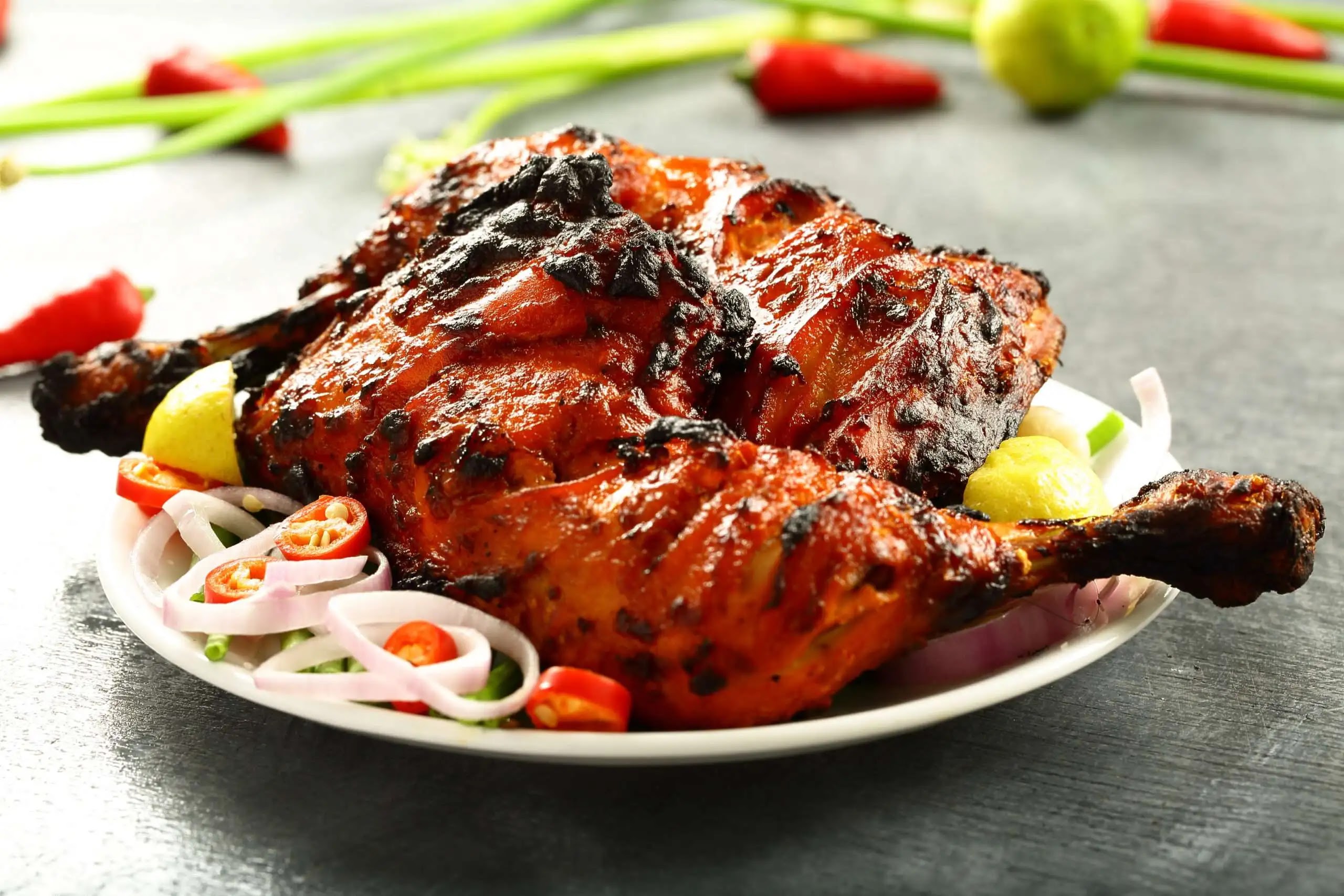
Tandoori chicken is named after the cylindrical, charcoal-fired clay oven it's cooked in.
In modern-day Pakistan, archaeologists unearthed 5000-year-old clay vessels similar to tandoors along with charred chicken bones. This may technically be the scraps of an early tandoori chicken dinner, but it would take thousands of years before the dish became what people know today.
The details are somewhat disputed, but the most popular story goes that in the 1930s, a restaurant called Moti Mahal opened up in Peshawar, modern Pakistan. After the Partition of India, a new version of the restaurant opened up in India, bringing the dish to widespread popularity.
In the early 1960s, first lady Jackie Kennedy was served tandoori chicken on a flight from Rome to New Delhi, and today you can order tandoori chicken in restaurants around the world.
The success of the dish spurred many variations, including chicken tikka masala.
BTW:
I kid you not, this is a real restaurant name:
The name of the restaurant is actually Nagina Tandoori Indian Cuisine, which is in Dublin Ireland, however, unfortunately for the restaurant owners, the N in Nagina had an accident and the restaurant has since been known for its quirky new name.
Monday, March 4, 2024
Subscribe to:
Posts (Atom)