
Tuesday, January 28, 2020

Fence Week, continued: More Unique Fences

-------oOo------- 


We are coming near to the end of Fence Week, readers, the last instalment will be tomorrow. As far as Fence Week goes, it will be the last post (ha ha).

Hopefully you will have found the various posts interesting and informative, 

Today’s fence post (ha ha) is another visual one, a look at some notable and distinctive fences around the world . . . 

-------oOo------- 


The Buckingham Palace Fence: 

Buck Palace has an impressive security fence designed to keep the uninvited out. Nonetheless at least 12 people have gained unauthorised entry into the palace or its grounds since 1914, The most famous of these entries was by Michael Fagan, who broke into the palace twice in 1982, entering the Queen's bedroom on the second occasion. At the time, news media reported that he had a long conversation with the Queen while she waited for security officers to arrive, but in a 2012 interview, Fagan said the Queen ran out of the room, and no conversation took place. It was only in 2007 that trespassing on the palace grounds became a specific criminal offence. 


 Meghan Markle, aged 15, photographed on a fence outside Buckingham Palace when visiting London in 1996.  The security fence is further back.

-------oOo------- 


The Aquarium Fence: 

Millionaire topographical engineer Mehmet Ali Gökçeoğlu bought a luxurious villa in Çeşme, Turkey, then In 2005, built a 50 metre aquarium fence filled with fish and octopuses that has become a tourist attraction in its own right. Located on the shores of the Aegean Sea, it is linked to the Aegean through a 400 metre-long buried pipeline so that the water is changed continuously. There is also a surveillance system to prevent damage by members of the public and tourists. 


-------oOo------- 


The Lovelock Fences:

Love lock fences have existed for over 100 years but became popular and spread in the early 2000s. The practice involves locking a padlock onto a fence, bridge or other structure as a symbol of the love of the persons placing it, often with engravings of initials, names or comments. 

Notwithstanding the sentiments and symbolism, many authorities have taken the view that it amounts to vandalism, as well as raising safety concerns by reason of the considerable weights involved. 

By way of example, the locks on the Pont Des Arts bridge in Paris caused parts of it to collapse, causing the locks to be removed in 2015 and be replaced by a special type of glass. 

Lovelocks on the Pont Des Arts 

Another pic of the Pont Des Arts 

I wrote about love locks in 2014, here is the link to that post and to some amazing photographs: 

Two years later I wrote about the removal in Paris, at: 

Worth a look. 

-------oOo------- 


The Bra Fence: 

In 1999 people living in Central Otago, New Zraland, found four bras mysteriously hanging on a nearby fence along the Cardrona Valley Road in Otago. More people kept adding bras to the fence and the place became a major tourist attraction. For some it was just a quirky thing to do, for others it was a personal statement, sometimes of female empowerment. 

The fence was a cause of controversy. Some local residents objected to its decency, some that it would upset Asian students at a nearby college, some that it presented the wrong image for the area and some that it was a traffic hazard with people slowing to view. However, local sheep farmer John Lee, who had become the unofficial guardian of the site, refused to remove the bras from the fence, claiming that 90% of letters received about the fence were positive, and that the bras were the most photographed attraction in the area. 

The fence became so popular that eventually the traffic hazard argument held way and the fence was moved from the main highway to the driveway entrance of Kelly Spaans and Sean Colbourne's horse trekking and quad biking business "The Cardrona", where it can still be seen in all its glory, with more being added regularly. 


-------oOo------- 


The Licence Plate Fence:

Remember the truck in the Speilberg film Duel, with the vehicle licence plates of the victims fixed to the front of the truck? Various places have licence plate fences and walls, not as souvenirs as victims but because the owners conduct scrap and salvage yards and because more get donated. 

The one above is in Missouri


-------oOo------- 

The UXO Fences: 

UXO stands for unexploded ordnance, ie unexploded bombs, mines etc. It is estimated that up to 30% of bombs dropped on Laos, Cambodia and Vietnam during the Vietnam War failed to explode, either through defects or from being dropped too low. The UXO causes fatalities and injuries, as well as making land unsafe to farm. There are ongoing removal and disarmament programs. Once retrieved and disarmed, such ordnance has been utilised in construction of fences and gates, as seen in these photographs from Laos: 


-------oOo------- 

Miscellaneous fences: 

Tyre fence, Wales 

Mirror fence 

Slate fence 

Ski fence 

Pencil fence 

Bicycle fence, Rockport, Texas 

Another bicycle fence 

Another ski fence 

Shoe fence, New Zealand . . . 

. . . and a thong fence in New Zealand (US readers: flip glops; New Zealand readers: jandals)
Related image
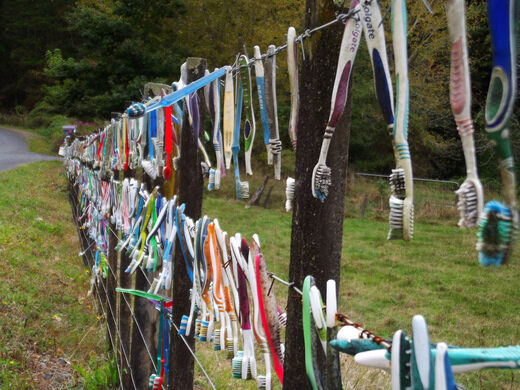
Toothbrush fence, New Zealand. 
What is it with these Kiwis and their weird fences?

Related image


Bottle fence 

 Wheel fence #1 

Wheel fence #2 

Wheel fence #3

God knows, I simply found the pic, ne comments.  Nightmare stuff.


Monday, January 27, 2020

Thought for the Day


Fence Week, continued: Facts and Trivia, Pt 1

--------oOo------- 


Fences and Walls: 

A fence is a structure enclosing an area, or separating one area from another, typically outdoors, and is usually constructed from posts that are connected by boards, wire, rails or netting. 

A fence differs from a wall in that generally, walls are made of solid materials such as concrete while fences are made of light materials such as wire mesh among other materials. Fences, unlike walls, can be made of live plants. 

(Some of the items below relate to walls as well as fences).

--------oOo------- 

Origin of the word “fence”: 

The word “fence” comes from “defence", originally “defense”. It entered English in the early 14th century from the Old French “defense,” which was derived from the Latin “defendere,” meaning “to protect; defend.” Although the word “fence” developed in the 14th century meaning “the action of defending,” by the 15th century “fence” was beginning to assume its modern meaning of “barrier” or “enclosure.” 

The use of “fence” to mean “use of a sword in combat,” as in “fencing”, developed in the 17th century. It was based on the blocking of one’s opponent’s strikes so that it too is based on “defense”. 

The use of “fence” as criminal slang to mean a person who buys stolen goods dates back to the 17th century. Again this relates to the original concept of “defense” in that a criminal fence, by buying “hot” goods from a thief, provides a defence by relieving the thief of the burden of holding the evidence (and quite possibly being caught with it) until a buyer can be found. Once stolen goods are “fenced,” it becomes much harder to prove theft. One writer has commented that in the context of this meaning, good fences make life easier for bad neighbors. 

--------oOo------- 


Robert Frost popularised the saying “Good fences make good neighbors” with his 1914 poem "Mending Wall": 
... 
He will not go behind his father's saying, 
And he likes having thought of it so well 
He says again, 'Good fences make good neighbors.' 

He did not, however, originate it. The Dictionary of Proverbs lists it as a mid 17th century proverb. Similar sentiments have been expressed in other countries and cultures. Even Benjmain Franklin had a view: "Love thy neighbor, yet don't pull down your hedge." 

“Mending Wall" is an ambiguous poem in meaning. Some believe the narrator of the poem dislikes the wall that divides him from his neighbor. Others think the poem tells the story of a well-established relationship and ritual between two friends and neighbours. 

--------oOo------- 


Beginnings of fences: 

Fences originated from a need to prevent domesticated livestock from roaming and to keep them out of cultivated areas such as gardens and crop fields. or fields of crops, where they were unwanted. The earliest fences were made of available materials, usually stone or wood. Where stones were plentiful, fences were built up by the stones being removed from cultivated areas, which meant that stone walls and fences were built up over the years, even continuing to this day. In other areas, fences were constructed of timber. Log fences or split-rail fences were simple fences constructed in newly cleared areas by stacking log rails. Earth could also be used as a fence; an example was what is now called the sunken fence, or "ha-ha," a type of wall built by digging a ditch with one steep side (which animals cannot scale) and one sloped side (where the animals roam). 

--------oOo------- 

Dry stone fences and walls:

Many areas of England and even Australia have stone fences, but they are especially prolific in Ireland. Many of those fences are the result of clearing land of stones for agriculture, the quality of the fences and walls (which are usually constructed dry) vary from simple stacking to sturdy placement by stonemasons. 

Dry stone wall, Australia, with rabbit hole in front 

England 

Ireland 

--------oOo------- 


Famine Walls:

There are stone walls and fences in Ireland that go straight up and down mountain sides, not serving any discernible function. These walls were built during the time of the Great Famine, which followed the potato blight of 1845-1849. The Irish were disproportionately reliant on potatoes, which led to widespread starvation, as well as disease. 

At that time wealthy British landowners living in Ireland extended loans that had to be earned through work.  That work was the building of stone walls from the base of mountains to the tops, walls that had no purpose. Because the people who had to do the work were starving and weak, it was much harder on them. The walls and fences so built, which still stand today, are known as Famine Walls.


--------oOo------- 

Spite fences and walls: 

A spite fence is a term used to refer to an overly tall fence, structure in the nature of a fence, or a row of trees, bushes, or hedges, constructed or planted by someone to annoy a neighbor, the effect being to deprive the neighbour of a view. 

Several US states and local governments have regulations to prohibit spite fences, or related regulations such as those establishing a maximum allowed height for fences. In the United Kingdom, the terms spite wall or blinder wall (as in, to blind the view of a neighbour) are more commonly used. 

Charles Crocker, a railroad investor and owner of a house on Nob Hill in San Francisco, built a high fence to spoil his neighbour’s view after the neighbor wanted many times the market value of his property to sell to Crocker. The fence finally came down in 1905 after Crocker’s estate bought the neighbour’s property from the neighbour’s widow’s estate. In 1906 the Crcoker mansion and neighbouring buildings were gutted by fire as a result of the San Francisco earthquake, Rather than rebuild, Crocker’s family decided to donate the block to charity and it became the site of a cathedral. Funnily enough a site of hostility and hate became one of love and compassion. 

A spite wall in Lancashire, England, built in 1880 by the owner of the land on the left, in reaction to the unwanted construction of the house on the right. In those days there was no such thing as planning permission so the house on the left built this very solid wall two stories high right on the edge of their land boundary and very near to the wall and windows of the house on the right. It has become a famous structure which people now come to see. 

Same spite wall as above - bad fences (and walls) make bad neighbours.

Spite fence, Toronto, 1937 

Spite Wall, “Calderville”, Brooklyn US. 1919