Sunday, February 25, 2024

QUOTE FOR THE DAY


MORE MISCELLANEOUS FACTS

---- 😊😊😊 -----

There really was a Macbeth:

Shakespeare’s Macbeth, king of scots, was a real person.

The historical facts concerning him, as they are given by writers at all close to his lifetime:
He was the dux (or general) of King Duncan, whom he killed—probably somewhere in Moray—in 1040.
He succeeded to the throne, ruled for fourteen years, resisted at least one English attack, and in 1050 visited Rome on pilgrimage.
In 1054 he was defeated in battle by Siward, the Anglo-Danish Earl of Northumbria, who installed Malcolm, son of Macbeth’s predecessor, as king.
Three years later Malcolm defeated and killed Macbeth at Lumphanan in Aberdeenshire.
__________

Macbeth’s successor:

Macbeth was initially succeeded by his stepson Lulach.

Lulach was know by various epithets – Lulach the Idiot, the Unfortunate, the Simple-minded and the Foolish.

Following the death of Macbeth, the king's followers placed Lulach on the throne. Lulach appears to have been a weak king, as his nicknames suggest, and ruled only for a few months before being assassinated and usurped by Malcolm III.

It is also plausible his nicknames are the results of negative propaganda, and were established as part of a smear campaign by Malcolm III..
__________

Stanley Kubrick, who gave us cinema classics like 2001: A Space Odyssey, The Shining, and A Clockwork Orange, funded his early career by playing illegal chess games for money in New York parks.

During the 1950s, Kubrick would often be found in Washington Square, a park in New York City, playing chess from 12 noon until 12 midnight:

“When I was waiting for things to happen, you know, when I was waiting to get a reply which could take several months to come, many times I would go to the park, I did that from 12 o’clock at noon until 12 o’clock at midnight,” he once explained to The New Yorker. “I could stay there twelve hours a day, with some breaks for food. During the day, I tried to get a table which had shadow, and at night I would try to get a table under the street lamps.”

The illegal games in the park after hours could earn him around $20 a day.
__________

In 19th century versions of Cinderella, her sisters called her Cinder-slut:

"When she had done her work she used to creep away to the chimney-corner and seat herself among the cinders, and from this the household name for her came to be Cinder-slut; but the younger sister, who was not so ill-tempered as the elder, called her Cinderella."

__________

Benigno Simeon Aquino, who wasPresident of the Philippines from 2010 to 2016, was known as Noynoy and PNoy.

His sisters are called Pinky and Ballsy.
__________

In 1895, the only two cars in Ohio crashed into each other.
__________

Firenadoes, sometimes called a fire whirl or fire devil is a whirlwind induced by a fire and often (at least partially) composed of flame or ash. These start with a whirl of wind, often made visible by smoke, and may occur when intense rising heat and turbulent wind conditions combine to form whirling eddies of air. These eddies can contract a tornado-like vortex that sucks in debris and combustible gases.

The phenomenon was first verified in the 2003 Canberra bushfires and has since been verified in the 2018 Carr Fire in California and 2020 Loyalton Fire in California and Nevada.

__________

Galileo was born on the day that Michelangelo died – 18 February 1564
__________

Rearranging the letters of 'President Clinton of the USA' gives:

To copulate, he finds interns.
__________


The tallest ever human was a man called Robert Wadlow.

Robert Wadlow was an American man who grew to be 8 foot 11 inches tall! That's nearly three metres! Sadly Robert's height wasn't good for his health, and he passed away at only 22 years old.
__________

Johnny Cash became a pain killer addict again after an ostrich atttack.

The incident took place at the “House of Cash” in Hendersonville, Tennessee, which featured offices, a museum, a recording studio, a gift shop—and an enclosure for exotic animals, including ostriches.

According to Cash:
That day, though, he was not happy to see me. I was walking through the woods in the compound when suddenly he jumped out onto the trail in front of me and crouched there with his wings spread out, hissing nastily.

All he did was break my two lower ribs and rip my stomach open down to my belt, If the belt hadn’t been good and strong, with a solid belt buckle, he’d have spilled my guts exactly the way he meant to. As it was, he knocked me over onto my back and I broke three more ribs on a rock—but I had sense enough to keep swinging the stick, so he didn’t get to finish me. I scored a good hit on one of his legs, and he ran off.

Those five broken ribs hurt. That’s what painkillers are for, though, so I felt perfectly justified in taking lots of them. Justification ceased to be relevant after that; once the pain subsided completely I knew I was taking them because I liked the way they made me feel. And while that troubled my conscience, it didn’t trouble it enough to keep me from going down that old addictive road again.


Saturday, February 24, 2024

THOUGHT FOR THE DAY


SONGSPOT

Popular Songs Trivia

---- 😊😊😊 -----

The first commercial CD pressed in the United States was Bruce Springsteen’s Born in the U.S.A in 1984.


Those who thought the title track was Springsteen’s way of expressing his admiration for Ronald Reagan’s administration took the album cover at face value. Those who uncoded the deeper meaning behind the track started a rumor that the cover was Springsteen secretly relieving himself on the American symbol.
__________

Bob Marley gave songwriting credits on “No Woman No Cry” to his childhood friend Vincent Ford, who ran a soup kitchen in Jamaica. Royalties from the hit song helped keep the kitchen running.

Marley grew up with Ford in the Trenchtown area of Kingston. Ford taught Marley the basics of the guitar and the two became close friends. While running a soup kitchen, Ford allowed Marley and his musicians to practice on his premises.
__________

Simon and Garfunkel bickered nonstop while recording “Bridge over Troubled Water.” Garfunkel wanted Simon to sing it (“I’m sorry I didn’t,” Simon has said), and Simon never liked Garfunkel’s closing “Sail on, silver girl” verse.
__________

According to Steve Cropper, Otis Redding was still pondering adding a 4th verse to “Sittin’ On) The Dock of the Bay” or lyrics to an outro. Otis just finished up the song with a whistle as a placeholder because he had nothing else left to add. Presumably, when he was to get back from his trip to Wisconsin, he and Cropper were going to finish it up. Redding died on that trip in a plane crash, a grief-filled Cropper returned to the studio to edit the song, heard the whistle outro again, and thought it fit perfect with the fade-out but needed and overdub. Thus, the call to musician Sam ‘Bluzman’ Taylor, who provided the end whistle in the studio version of the song.
__________

Michael Jackson was so absorbed in writing “Billie Jean” on a ride home from the studio one day that he didn’t even notice his car was on fire. A passing motorcyclist alerted him—saving the King of Pop and one of the world’s catchiest tunes.

The song was written and composed by Jackson, the lyrics describing a woman, Billie Jean, who claims that the narrator is the father of her newborn son, which he denies. Jackson said the lyrics were based on groupies' claims about his older brothers when he toured with them as the Jackson 5.
_________

Paul McCartney woke up one morning with the tune to “Yesterday” in his head but not the lyrics. The placeholder words he worked with: “Scrambled eggs … oh, my baby, how I love your legs …”
__________

The BBC banned Bing Crosby’s “I’ll Be Home for Christmas” during World War II, worried its “sickly sentimentality” would lower the morale of homesick troops.
__________

Barry Manilow’s “I Write the Songs” was written by … someone else (on-again/off-again Beach Boy Bruce Johnston, to be exact).
__________

Led Zeppelin’s “Stairway to Heaven” was the most-requested radio song of the ’70s. Yet singer/lyricist Robert Plant once pledged $1,000 to a public radio station that promised to never play it again. (“I’ve heard it before,” he later said.)
__________

The Caroline in Neil Diamond’s “Sweet Caroline” is none other than Caroline Kennedy, whom Neil saw in a magazine photo in the ’60s. “It was a picture of a little girl dressed to the nines in her riding gear, next to her pony,” he recalled.
__________

The stories about how Diamond was inspired to write Cracklin’ Rosie are apocryphal. "Crackling RosΓ©" is the name of an inexpensive sparkling wine once produced by Andres Wines of British Columbia, Canada, which was popular among the Indigenous population. One story suggests that Diamond heard a story about a native Canadian tribe while interviewing in Toronto, Canada—the tribe had more men than women, so the lonely men of the tribe would sit around the fire and drink their wine together—which inspired him to write the song.
__________

The chord that starts Jimi Hendrix’s “Purple Haze” is a tritone—known as the devil’s interval and banned from some Renaissance church music for sounding too evil.
__________

Number of songs Elvis Presley recorded: more than 800.

Number of songs Elvis Presley wrote solo: zero. (He earned a few cowriting credits.)
__________

“Girls Just Want to Have Fun” was written by … a boy. Philadelphia singer Robert Hazard wrote and recorded the original version four years before Cyndi Lauper made it a hit.
__________

“Somewhere over the Rainbow” (listed by American Film Institute as the greatest film song ever) is about a girl lifting herself up from rural Kansas but also about America rising up from the Great Depression under FDR’s New Deal, of which song cowriter Yip Harburg was a supporter.
__________

Queen and David Bowie wrote “Under Pressure” in one night (then got pizza).


Friday, February 23, 2024

QUOTE FOR THE DAY


WORD ORIGINS

---- 😊😊😊 -----

Nanny state

Nanny state is a term of British origin that conveys a view that a government or its policies are overprotective or interfering unduly with personal choice. The term likens such a government to the role that a nanny has in child rearing.

An early use of the term comes from Conservative British Member of Parliament Iain Macleod who referred to "what I like to call the nanny state" in the 3 December 1965 edition of The Spectator.

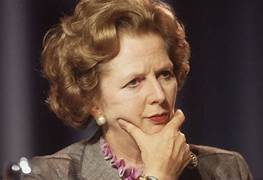
The term was popularised by journalists Bernard Levin and Auberon Waugh and later by Prime Minister Margaret Thatcher.

__________

TINA Principle

"There is no alternative" (TINA) is a political slogan arguing that capitalism is the only viable system.

The slogan is strongly associated with the policies and persona of the Conservative British prime minister Margaret Thatcher.

In a speech to the Conservative Women's Conference on 21 May 1980, Thatcher appealed to the notion saying, "We have to get our production and our earnings into balance. There's no easy popularity in what we are proposing but it is fundamentally sound. Yet I believe people accept there's no real alternative."

The slogan was often used by Thatcher to signify Thatcher's claim that the market economy is the best, right and only system that works, and that debate about this is over. Thatcher described her support of markets as flowing from the moral principle that for human behavior to be moral requires free choice by people.

__________

Jackboots and Hobnail boots

Meaning:
1. a boot
2. ruthlessly and violently oppressive

A jackboot is a military boot such as the cavalry jackboot or the hobnailed jackboot. The hobnailed jackboot has a different design and function from the former type. It is a combat boot designed for marching. It rises to mid-calf or higher without laces and sometimes has a leather sole with hobnails.

Jackboots of the Household Cavalry, British Army.

In footwear, a hobnail is a short nail with a thick head used to increase the durability of boot soles or provide traction.

Hobnailed boots are boots with hobnails (nails inserted into the soles of the boots), usually installed in a regular pattern, over the sole. They usually have an iron horseshoe-shaped insert, called a heel iron, to strengthen the heel, and an iron toe-piece. They may also have steel toecaps. The hobnails project below the sole and provide traction on soft or rocky terrain and snow, but they tend to slide on smooth, hard surfaces.

They have been used since antiquity for inexpensive durable footwear, often by workmen and the military. Examples include the caligae of the Roman military, the "ammo boot" in use by the British and Commonwealth armies from the 1860s and the US Army "trench boots" of World War I.

Hobnailed boots

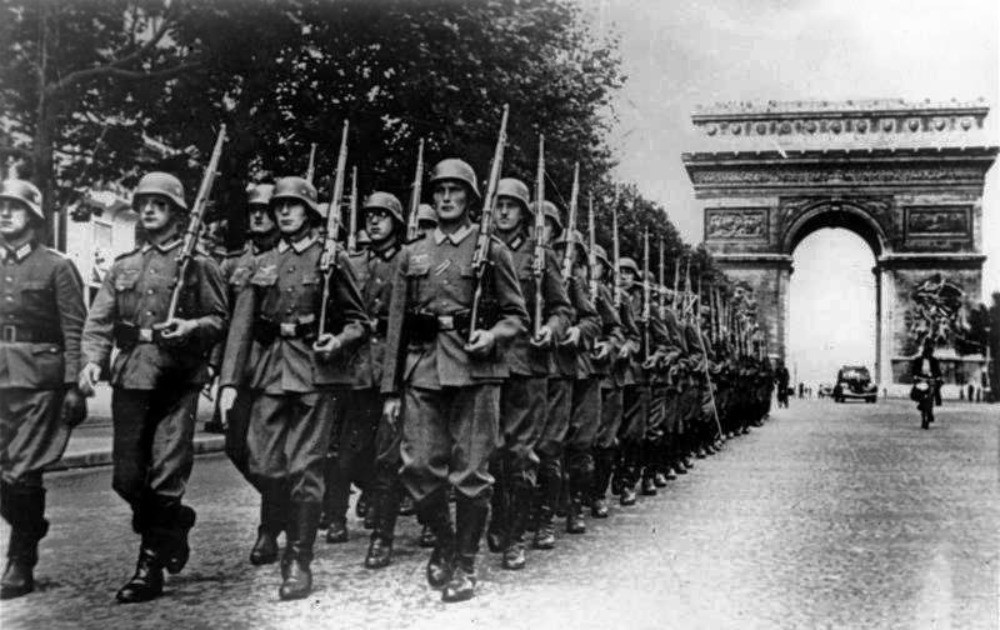
Jackboots have been associated popularly with totalitarianism, since they were worn by German military and paramilitary forces in the run-up to and during the Second World War.

The boots of German soldiers had hobnails not only to make the jackboots more durable, the hobnails added to the theatrics of a marching German army by creating a sharp click sound when each boot hit the hard streets.

Third Reich German officer’s jackboots


__________

Iron curtain

The Iron Curtain is a term used to describe the political boundary dividing Europe into two separate areas from the end of World War II in 1945 until the end of the Cold War in 1991. The term symbolizes the efforts by the Soviet Union (USSR) to block itself and its satellite states from open contact with the West, its allies and neutral states.

The use of the term "Iron Curtain" as a metaphor for strict separation goes back at least as far as the early 19th century. It originally referred to fireproof curtains in theatres. The author Alexander Campbell used the term metaphorically in his 1945 book It's Your Empire, describing "an iron curtain of silence and censorship [which] has descended since the Japanese conquests of 1942".

Its popularity as a Cold War symbol is attributed to its use in a speech Winston Churchill gave on 5 March 1946, in Fulton, Missouri, soon after the end of World War II:
From Stettin in the Baltic to Trieste in the Adriatic, an iron curtain has descended across the Continent. Behind that line lie all the capitals of the ancient states of Central and Eastern Europe. Warsaw, Berlin, Prague, Vienna, Budapest, Belgrade, Bucharest and Sofia; all these famous cities and the populations around them lie in what I must call the Soviet sphere, and all are subject, in one form or another, not only to Soviet influence but to a very high and in some cases increasing measure of control from Moscow.
__________

Cold War:

A cold war is a state of conflict between nations that does not involve direct military action but is pursued primarily through economic and political actions, propaganda, acts of espionage or proxy wars waged by surrogates.

This term is most commonly used to refer to the American-Soviet Cold War of 1947–1989.

The expression "cold war" was rarely used before 1945.

In 1934, the term was used in reference to a faith healer who received medical treatment after being bitten by a snake. The newspaper report referred to medical staff's suggestion that faith had played a role in his survival as a "truce in the cold war between science and religion".

At the end of World War II, George Orwell used the term in the essay "You and the Atom Bomb" published on October 19, 1945, in the British magazine Tribune. Contemplating a world living in the shadow of the threat of nuclear war, he warned of a "peace that is no peace", which he called a permanent "cold war".Orwell directly referred to that war as the ideological confrontation between the Soviet Union and the Western powers.

The definition which has now become fixed is of a war waged through indirect conflict.

__________

Spit and polish

Meaning:

Extreme attention to cleanliness, orderliness, smartness of appearance, and ceremony

Spit and polish was first recorded in 1895. The term originated in the meticulous cleaning by military officers to maintain their required spick-and-span image, which often involved polishing objects, such as their shoes, by spitting on them and then rubbing them with a cloth. Notably, the Victorian British navy was commonly referred to as the "Spit and Polish Navy" for the thoroughness in which they carried out this order.


Thursday, February 22, 2024

QUOTE FOR THE DAY


FUNNY FRIDAY

---- 😊😊😊 -----


Welcome to another Funny Friday, readers - I am stll recovering from my recent unwellness so have not yet returned to work.

That sets the theme for days FF - work items.

As always, enjoy and stay well.


---- 😊😊😊 -----

SOME HUMOUR:
__________

The phone rings at work.

Boss: Why don't you answer it?

Me: I'll let it ring for a while. That way they'll think I have other stuff to do than talk on the phone.

Boss: ANSWER IT GODDAMMIT!

Me: 911, what's the emergency?
__________

I met my girlfriend whilst she was working at the zoo.

There she was in her uniform – straightaway I knew she was a keeper.
__________

A young artist exhibits his work for the first time and a well known art critic is in attendance.

The critic says to the young artist, "Would you like my opinion on your work?"

"Yes, " says the artist.

"It's worthless," says the critic

The artist replies, "I know, but tell me anyway."
__________

My dad was fired from his job in road work for theft...

I didn't believe it at first. But when I got home, all the signs were there.
__________

When you die, the last part of your body to stop working are your pupils.

They dilate.
__________

When my wife starts to sing, I always go outside and do some garden work....

so our neighbors can see there's no domestic violence going on.

---- 😊😊😊 -----


Worth another airing . . .


A little boy is excited because the circus has come to town. They had a parade with a band and animals and clowns! Oh, the clowns were fabulous! He was so excited that he got a ticket right away.

The show began and there were stunts and people on the high wire and trained animals. Then out came a tiny car and out from it poured a endless stream of clowns who did the funniest things you ever saw. It was absolutely hilarious. Then all of a sudden the clowns stopped and started looking around, all puzzled. They searched high and low and still they kept going. Finally one clown stopped and addressed the audience, "we seem to have lost our horse and we need help finding him. Would the person in row 32 seat H please stand up?" The boy notes that he is in that seat so he stands up! The clown says, "Ah! We've found the horse's ass, now we need to find the rest of the horse!"

The audience roars with laughter and the boy turned beet red. He tore from the tent in humiliation, mostly because he didn't know what to say! He decided that would never happen to him again. He pulled out his most recent copy of Boy's Life and found an ad for a book for snappy comebacks, so be bought it. It arrived and he proceeded to memorise it in its entirety. He had the local librarian borrow similar books that he also memorised.

As he grew up, he practised his snappy comebacks, but was he ready? No! He went to a college that allowed you construct your own major, so he majored in Snappy Comebacks. He studied Moliere, Shakespeare, Henny Youngman, Phyllis Diller, all the greats. He earned his major. Was he ready? No. He went on to get a PhD in snappy comebacks. Was he ready? No. He started publishing papers presenting a full taxonomy of snappy comebacks, classifying them by type, cultural reference, social import and final impact. Was he ready? Yes.

He returned to his home town and waited for the circus. When it arrived, they had a parade with a band and animals and clowns! Oh, the clowns were fabulous! He got a ticket right away for the same seat.

The show began and there were stunts and people on the high wire and trained animals. Then out came a tiny car and out from it poured an endless stream of clowns who did the funniest things you ever saw. It was absolutely hilarious. Then all of a sudden the clowns stopped and started looking around, all puzzled. They searched high and low and still they kept going. Finally one clown stopped and addressed the audience, "We seem to have lost our horse and we need help finding him. Would the person in row 32 seat H please stand up?" The boy notes that he is in that seat so he stands up!

The clown says, "Ah! We've found the horse's ass, now we need to find the rest of the horse!"

And he says in a loud, steady voice, "FUCK YOU CLOWN!"
________

The above item is what is known as a shaggy dog story, a long involved story that ends without any point, sometimes a pun or an anti-climax. Another example is the item posted two weeks ago about the monk and the strange sound.

The first recorded use of the term is in 1937 when the following appeared in Esquire magazine: Esquire magazine, May 1937: "One of the more sporting ways of finding out which ones are not [sane] is to try shaggy-dog stories on them."

The term is believed to have originated from a story where a young boy enters his dog into a contest to find the shaggiest dog. He wins the local contest, then the regional contest and so on, winning bigger and bigger contests. Eventually he makes it to the world championship for shaggy dogs. When the judges had inspected all the dogs they said to the boy about his dog “He’s not so shaggy.”

It may not be funny but that is the point. A shaggy dog story story builds an expectation that is either not met or is met in an unexpected way.

---- 😊😊😊 -----


LIMERICK OF THE WEEK:

A young girl, imprudent and errant,
Did things that more cautious girls daren’t.
She hoped and expected
To go undetected
But is slowly becoming ap-parent.

---- 😊😊😊 -----

GALLERY:


---- 😊😊😊 -----


CORN CORNER:
__________

I told my doctor that I broke my arm in two places. He told me to stop going to those places.
__________

What's the difference between inlaws and outlaws? Outlaws are wanted.
__________

When my wife said she was leaving because of my obsession with The Monkees, I thought she was joking.

And then I saw her face.
__________

My wife left me over my obsession with Phil Colins, saying it will never get me anywhere..
take a look at me now.
__________

I used to be addicted to the Hokey Pokey, but I turned myself around.
__________

What's the purpose of reindeer?

To make the grass grow sweetie
__________

My wife left a note on the fridge saying, "This isn't working, goodbye."

I opened the refrigerator and it works just fine. Weird.

---- 😊😊😊 -----

Wednesday, February 21, 2024

THOUGHT FOR THE DAY


HENRY LAWSON - SOMETHING DIFFERENT


Henry Lawson (1867 – 1922), was an Australian writer and bush poet. Along with his contemporary Banjo Paterson, Lawson is among the best-known Australian poets and fiction writers of the colonial period and is often called Australia's "greatest short story writer".

A vocal nationalist and republican, Lawson regularly contributed to The Bulletin, and many of his works helped popularise the Australian vernacular in fiction. He wrote prolifically into the 1890s, after which his output declined, in part due to struggles with alcoholism and mental illness. At times destitute, he spent periods in Darlinghurst Gaol and psychiatric institutions.

After he died in 1922 following a cerebral haemorrhage, Lawson became the first Australian writer to be granted a state funeral.

The following poem – Written Out - by Lawson gives an insight into his private hell and demons.
"Written Out" contrasts with Lawson's earlier work, known for its focus on the Australian bush and rural hardship. This poem delves into the darker elements of urban life and explores themes of degradation, societal hypocrisy, and the fragility of reputation. It captures the bleak reality of a writer struggling with alcoholism and the judgment and pity he faces from both admirers and detractors. Lawson's portrayal of the writer's descent into self-destruction is a stark depiction of the challenges faced by artists in the face of adversity.


Written Out

- Henry Lawson

Sing the song of the reckless, who care not what they do;
Sing the song of a sinner and the song of a writer, too—
Down in a pub in the alleys, in a dark and dirty hole,
With every soul a drunkard and the boss with never a soul.

Uncollared, unkempt, unshaven, sat the writer whose fame was fair,
And the girls of the streets were round him, and the bullies and bludgers there;
He was one of themselves and they told him the things that they had to tell—
He was studying human nature with his brothers and sisters in hell.

He was neither poor nor lonely, for a place in the world he’d won,
And up in the heights of the city he’d a thousand friends or none;
But he knew that his chums could wait awhile, that he’d reckon with foes at last,
For he lived far into a future that he knew because of the past.

They remembered the man he had been, they remembered the songs he wrote,
And some of them came to pity and some of them came to gloat:
Some of them shouted exulting—some whispered with bated breath
That down in a den in the alleys he was drinking himself to death.

Thus said the voice of the hypocrites—and the true hearts sighed with pain,
‘Oh! he never will write as he used to write! He never will write again;’
A poet had written his epitaph in numbers of sad regret,
And the passing-notice was pigeon-holed, and the last review was set.

But the strength was in him to rise again to a greater height, he knew,
For the sake of the friends who were true to him and the work that he had to do;
He was sounding the depths that he had to know, he was gathering truths for his craft,
And he heard the chatter of little men—and he turned to his beer and laughed.


Tuesday, February 20, 2024

THOUGHT FOR THE DAY


THOSE WE LOST in 2023

For the last 8 years, British artist Chris Barker has compiled a homage to those we lost in the previous year. He does this by way of a photo montage in the style of the Sgt Pepper album cover.

The 2023 version features Pogues singer Shane MacGowan front-and-center above the bass drum, flanked by Tina Turner and Sinead O’Connor. Just a few spots down, Tony Bennett smiles next to British guitar great Jeff Beck, with beloved comedian/actor Pee Wee Herman copping a squat in the foreground.

According to Barker, “This is the most overwhelming number of huge significant losses I remember in the eight years doing this since 2016. The front two or three rows are all really recognizable legends. It’s a bit much to be honest,” Barker says of the list that includes the above mentioned, as well as beloved British actor Barry “Dame Edna” Humphries, Raquel Welch, Friends star Matthew Perry, CSNY singer David Crosby, composer Burt Bacharach, De La Soul’s Trugoy the Dove and Calypso singer/civil rights activist Harry Belafonte.

Among the other faces in the crowd are: actors Richard Roundtree (Shaft), Michael Gambon (Harry Potter), Alan Arkin (Little Miss Sunshine), Lance Reddick (The Wire), Angus Cloud (Euphoria), Suzanne Somers, Richard Belzer, Gina Lollarigida, Jerry Springer and game show host Bob Barker, singers/musicians Sixto Rodriguez, Gary Rossington (Lynyrd Skynyrd), Jimmy Buffett, Yukihiro Takahashi (Yellow Magic Orchestra), Tom Verlaine (Television), Robbie Robertson (The Band), Steve Mackey (Pulp), Tim Bachman (BTO), John Gosling (The Kinks), Fred White (EW&F), Lisa Marie Presley, Randy Meisner (Eagles), Anita Pointer (Pointer Sisters), Astrud Gilberto, Dwight Twilley, Van Conner (Screaming Trees), Jane Birkin, The 45 King, Gary Wright, Paul Cattermole (S-Club 7), Gary Young (Pavement), Denny Laine (Wings) and Smash Mouth’s Steve Harwell.

See a key as to who’s who by clicking on:


I have split the montage into two panels to make it easier to view: