Showing posts sorted by relevance for query waltzing matilda. Sort by date Show all posts

Sunday, November 5, 2017

Australian Folk Songs, Part 1

______________


I was humming and singing an Australian folk song (“Bluey Brink”) to myself a couple of days ago and it struck me that many overseas people, as well as a lot of the younger generations, wouldn’t understand many of the terms and references. This post therefore starts a continuing series of a look at Oz folk songs, starting with the most widely known and often regarded as Australia’s unofficial national anthem . . .
______________

______________

Video:

Hear and see Slim Dusty sing it at: 

There is an alternative Queensland version, one that I actually prefer. Hear The Seekers sing it at:
______________

About:
  • Famed Australian bush poet Andrew “Banjo” Paterson (1864-1941) in 1895 whilst staying at Dagworth sheep station (sheep ranch for overseas readers) near Winton, Queensland. Banjo heard Christina Macpherson (1864-1936), a member of the family who owned the station, play a tune on the zither or autoharp. She had heard it played by a military band at a horse racing event the previous year, the tune being that of a Scottish folksong. Banjo decided to add Australian lyrics to the tune and based his lyrics on a story he had heard about an incident at Dagworth Station in 1891.
Banjo Paterson


Christina Macpherson
  • In that year there had been a widespread and nasty strike of shearers resulting from disputes between unionised and non-unionised labour. It was known as the Great Shearers’ Strike, ending when the union workers ran out of money and food and only after the Qld Premier called in the military. It brought the colony close to civil war and the outcome is credited as being one of the factors for the formation of the Australian Labor Party.
  • At Dagworth Station, the strike resulted in firearms being discharged and the woolshed being set alight by striking shearers, killing over 140 lambs. The owner of Dagworth Station, Bob Macpherson (the brother of Christina) and 3 policemen gave chase to a man named Samuel Hoffmeister, who had been one of the shearers who torched the woolshed. Rather than be captured, Hoffmeister shot and killed himself at the Combo Waterhole. Bob Macpherson and Paterson are said to have taken rides together at Dagworth and that they found the skin of a slaughtered sheep at the waterhole. Macpherson then told Paterson the story of the shearer who had suicided there.
  • There has been speculation by some historians and researchers that Hoffmeister had been shot dead by Bob Macpherson and his body left at the waterhole, also that it is a political allegory about workers’ rights.
The Combo Waterhole, thought to be the location of the story that inspired "Waltzing Matilda".

A fortified temporary shearing shed at Dagworth Station following the 1894 arson of the main shed. The three troopers at left are thought to be those referred to in "Waltzing Matilda", while the squatter was Bob Macpherson, fourth from right
  • Although there is no evidence to support that Banjo Paterson and Christina Macpherson entered into a relationship, nonetheless there is speculation that they were infatuated with each other. Paterson's engagement of 8 years to Sarah Riley, who attended Dagworth Station with Banjo, ended soon after this time.
  • Christina Macpherson remained single all her life and died in obscurity, her grave not even having a marker. 
  • Copyright in Australia lasts for 50 years after the death of creator of the work. Paterson died in 1941 so that the song came out of copyright in 1991. Christina Macpherson never claimed copyright on the music. Banjo Paterson sold the lyrics to Waltzing Matilda to Angus and Robertson, publishers, in 1895 and they in turn sold it in 1902 to James Inglis & Co, the owners of the "Billy Tea" trademark. 
  • Carl Fischer Music falsely copyrighted the song in the United States as on original composition in 1941. Since there was no challenge to this by anybody this copyright in the United States stands and has subsequently been renewed. When Australia used Waltzing Matilda in the closing ceremonies of the Atlanta Olympics in 1996 it had to pay royalties to Carl Fischer Music. That company however maintains that it was only acting as an agent for Allans Music in Australia and that the royalties collected in the United States were remitted back to Allans Music. Allans Music went into liquidation in 2012 and was bought by Australian Musical Imports.
______________

Lyrics:

Once a jolly swagman camped by a billabong,
Under the shade of a coolibah tree,
And he sang as he watched and waited 'til his billy boiled,
Who'll come a-waltzing, Matilda, with me?

Waltzing Matilda, Waltzing Matilda,
Who'll come a-waltzing, Matilda, with me?
And he sang as he watched and waited 'til his billy boiled,
Who'll come a-waltzing, Matilda, with me?

Along came a jumbuck to drink at the billabong,
Up jumped the swagman and grabbed him with glee,
And he sang as he stowed that jumbuck in his tucker bag,
You'll come a-waltzing, Matilda, with me.

Waltzing Matilda, Waltzing Matilda,
Who'll come a-waltzing, Matilda, with me?
And he sang as he watched and waited 'til his billy boiled,
Who'll come a-waltzing, Matilda, with me?

Up rode the squatter, mounted on his thoroughbred,
Down came the troopers, one, two, three,
Whose is that jumbuck you've got in your tucker bag? 
You'll come a-waltzing, Matilda, with me.

Waltzing Matilda, Waltzing Matilda,
Who'll come a-waltzing, Matilda, with me?
And he sang as he watched and waited 'til his billy boiled, 
Who'll come a-waltzing, Matilda, with me?

Up jumped the swagman, leapt into the billabong,
You'll never catch me alive, said he,
And his ghost may be heard as you pass by the billabong,
Who'll come a-waltzing, Matilda, with me.

Waltzing Matilda, Waltzing Matilda,
Who'll come a-waltzing, Matilda, with me?
And he sang as he watched and waited 'til his billy boiled,
Who'll come a-waltzing, Matilda, with me?
______________

Story:

1st Verse
A swagman is resting under a eucalyptus tree on the banks of a wateriole. He is singing and passing the time, has lit a fire and is boiling something in a tin can (most likely tea).

2nd Verse
While there, he notices a sheep wandering down to the waterhole for a drink. The swagman catches the sheep, kills it, probably eats what he can and stows the rest in his food pack.

3rd Verse
Unfortunately for the swagman, the wealthy landowner comes by the waterhole. He is mounted on his fine, expensive horse and is accompanied by three policemen. They catch the hapless swagman red-handed with the remains of the sheep, telling him that he is under arrest for stealing and killing the sheep.

4th Verse
The swagman jumps into the waterhole, declaring that he will not be caught alive. He drowns in the waterhole and, ever since that day, his ghost still haunts the waterhole and can be heard singing his song.
______________

Glossary:

The lyrics contain many distinctively Australian English words, some now rarely used outside the song. 

Waltzing:
Derived from the German term “auf der Walz”, which means to travel while working as a craftsman and learn new techniques from other masters.

Matilda:
According to a letter to Rt. Hon. Sir Winston Churchill, KG from Harry Hastings Pearce, 19 February 1958. Harry Pearce Papers, NLA Manuscript Collection, MS2765)[24, National Library of Australia:
Matilda is an old Teutonic female name meaning "mighty battle maid". This may have informed the use of "Matilda" as a slang term to mean a de facto wife who accompanied a wanderer. In the Australian bush a man's swag was regarded as a sleeping partner, hence his "Matilda". 
Waltzing Matilda:
To “waltz Matilda" is to travel with a swag, that is, with all one's belongings on one's back wrapped in a blanket or cloth. 

Swagman:
A swagman or “swaggie” was a man who travelled the country looking for work. The swagman's "swag" was a bed roll that bundled his belongings.


Billabong:
A cut-off river bend found alongside a meandering river

Coolibah tree:
A kind of eucalyptus tree which grows near billabongs

Jumbuck:
An aboriginal word for sheep.

Billy:
A billycan is a lightweight cooking pot in the form of a metal bucket commonly used for boiling water, making tea or cooking over a campfire[ or to carry water. More commonly known simply as a billy or occasionally as a billy can/billycan, the term derived from the large cans used for transporting bouilli or bully beef on Australia-bound ships or during exploration of the outback, which after use were modified for boiling water over a fire.

Tucker bag:
Tucker means food, the term tucker bag therefore meaning a bag for carrying food.

Troopers:
Mounted policemen

Squatter:
Australian squatters started as early farmers who raised livestock on land which they did not legally have the legal title to use; in many cases they later gained legal use of the land even though they did not have full possession, and became wealthy thanks to these large land holdings. It has been said that in the context of the song, the squatter's claim to the land may be as uncertain as the swagman's claim to the jumbuck.
______________

Waltzing Matilda mural on the side of an Ansett Boeing 737-300 in the mid-1990s


Monday, April 25, 2016

Anzac Day 2016


The lyrics of Eric Bogle’s song And the Band Played Waltzing Matilda make apt reading this Anzac Day. 

Hear the song sung by Eric Bogle at: 

"And The Band Played Waltzing Matilda"
- Eric Bogle

Now when I was a young man, I carried me pack, 
And I lived the free life of a rover
From the Murray's green basin to the dusty outback, 
Well, I waltzed my Matilda all over.
Then in 1915, my country said ‘Son, 
It's time you stopped rambling, there's work to be done.’
So they gave me a tin hat, and they gave me a gun, 
And they marched me away to the war.

And the band played Waltzing Matilda, 
As the ship pulled away from the quay,
And amidst all the cheers, the flag-waving and tears, 
We sailed off for Gallipoli. 

And how well I remember that terrible day, 
How our blood stained the sand and the water.
And of how in that hell that they called Suvla Bay, 
We were butchered like lambs at the slaughter.
Johnny Turk he was waiting, he'd primed himself well, 
He shower'd us with bullets, and he rained us with shell, 
And in five minutes flat, he'd blown us all to hell
Nearly blew us right back to Australia.

But the band played Waltzing Matilda, 
When we stopped to bury our slain.
We buried ours, and the Turks buried theirs, 
Then we started all over again. 

And those that were left, well we tried to survive, 
In that mad world of blood, death and fire,
And for ten weary weeks, I kept myself alive, 
Though around me the corpses piled higher.
Then a big Turkish shell knocked me arse over head, 
And when I woke up in my hospital bed,
And saw what it had done, well I wished I was dead. 
Never knew there was worse things than dyin'.

For I'll go no more waltzing Matilda, 
All around the green bush far and free
To hump tent and pegs, a man needs both legs- 
No more waltzing Matilda for me. 

So they gathered the crippled, the wounded, the maimed, 
And they shipped us back home to Australia.
The legless, the armless, the blind, the insane, 
Those proud wounded heroes of Suvla.
And as our ship pulled into Circular Quay, 
I looked at the place where me legs used to be.
And thanked Christ there was nobody waiting for me, 
To grieve, to mourn, and to pity.

But the band played Waltzing Matilda, 
As they carried us down the gangway.
But nobody cheered, they just stood and stared, 
Then they turned all their faces away. 

And so now every April, I sit on me porch, 
And I watch the parades pass before me.
And I see my old comrades, how proudly they march, 
Reviving old dreams of past glories.
And the old men march slowly, old bones stiff and sore. 
They're tired old heroes from a forgotten war
And the young people ask 
‘What are they marching for?’ 
And I ask myself the same question.

But the band plays Waltzing Matilda 
And the old men still answer the call,
But as year follows year, more old men disappear, 
Some day no one will march there at all. 

Waltzing Matilda, Waltzing Matilda, 
Who'll come a-waltzing Matilda with me?
And their ghosts may be heard as they march by that billabong, 
Who'll come a-waltzing Matilda with me? 


Some notes and comments: 

"Matilda" - the rolled up blanket tied with a piece if rope and strung to athe back of someone travelling by foot
"Swag" - same as Matilda, with personal items usually inside the tied off blanket
"Billabong" – cut off meander bands of creeks, lagoons 
“Waltzing Matilda” – to travel with one’s swag


The Gallipoli Campaign (April 25, 1915-January 8, 1916), was a major land and sea operation of World War I, in which British, French, Australian, and New Zealand forces unsuccessfully attempted an invasion of Turkey. The action was confined to the Dardanelles Strait and the tip of the Gallipoli (Gelibolu) Peninsula near Istanbul. The campaign was the first major military action of Australia and New Zealand as independent dominions, and is often considered to mark the birth of national consciousness in those nations. The date of the landing, 25 April, is known as "Anzac Day". It remains the most significant commemoration of military casualties and veterans in Australia and New Zealand. 

Bogle got it wrong in his lyric that “some day no one will march there at all”. The march has continued as newer wars provide more marchers. Also, young people have increasingly honoured and respected Anzac Day, including participation in the marches whilst wearing the medals of relatives (for the record, I am against that), giving rise to concern by some that it has detracted from the solemnity of the occasion.


Saturday, August 7, 2010

And the Band Played Waltzing Matilda


And The Band Played Waltzing Matilda

-  Eric Bogle

A memorable and most poignant of national songs, it was written by Scottish born Aussie songwriter and singer Eric Bogle. And The Band Played Waltzing Matilda encapsulates the jingoistic boys’ own feelings that existed at the beginning of WW1, the horror and carnage of the reality as experienced at Gallipoli, the futility of war and ultimately the apathy and ignorance of later generations with the passing of time. Overall it is a strong condemnation of the glorification and romanticism of war.

Waltzing Matilda has been described as Australia’s unofficial national anthem. The words mean travelling by foot from place to place with one’s goods in a bedroll. In the early days the bedroll consisted of a rolled up blanket with a person’s necessities, tied of at either end with a piece of string and slung over the shoulder or back. The bedroll, or swag (and hence the term swagman or swaggie) was known as a matilda. To go waltzing matilda meant to take to the road by foot with your swag.

Sunday, January 10, 2016

People on Australian Banknotes, Part 1: $5 and $10


Beginning a new series, a brief look at the people on the Australian banknotes, both the current polymer notes (started in 1992 and a full set for all denominations in circulation by 1996), and those preceding the polymer notes.
______________________________

$5:
______________________________

Queen Elizabeth II:


A portrait of Queen Elizabeth II is shown on the front of the $5 banknote together with a sprig of eucalyptus. The portrait is drawn from photographs commissioned by the Reserve Bank in 1984. The Queen gave approval to use this portrait on an Australian banknote in 1988, and it appeared on the first $5 polymer banknote on 7 July 1992.
______________________________

Sir Joseph Banks:


Sir Joseph Banks (1743–1820) was with Captain James Cook at the landing at Botany Bay in 1770. He played a major role in exploring and collecting many aspects of natural science in his travels with Cook. Though returning to England, Banks remained influential in the administration of the colony and in botanical studies of Australia.
______________________________

Caroline Chisholm:


Caroline Chisholm (1808–1877) first arrived in New South Wales in 1838. She worked to establish better conditions, including suitable employment and accommodation, for young migrant women. Her work expanded to include facilitating the passage to Australia of families. What Australia needed most, in her view, were 'good and virtuous women'.

The $5 banknote featured a woman, other than the Monarch, for the first time on Australia's currency notes. The portrait of Caroline Chisholm is set against a background of the women and children, sailing ships and Sydney foreshore of her time.
______________________________

Sir Henry Parkes:


Sir Henry Parkes,(1815-1895), the "Father of Federation", long advocated federation and breathed life into the ailing movement with a rousing speech in Tenterfield, New South Wales, in 1889. He continued to work towards this goal but died in 1896. 

To the right of Parkes, are architectural drawings of the Royal Exhibition Building in Melbourne which was the site of the first Commonwealth Parliament in 1901. Below this is a scene of the opening of Australia's First Federal Parliament based on a painting once again by Tom Roberts who was commissioned to record the opening. His Royal Highness The Duke of Cornwall and York (later to be King George V) who can be seen in the foreground, performed the honours. At the bottom is the Federation Pavilion in Sydney's Centennial Park which was specially constructed for the celebrations. To the left of Parkes is the Tenterfield School of Arts building, the site of his rousing speech in 1889. The six State badges are at the bottom left.
______________________________

Catherine Spence:


Catherine Spence (1825-1910) was a journalist and social reformer active in the cause of state children, a novelist and a prominent supporter of electoral reform. Although unsuccessful, she was the first woman to run for electoral office in Australia, a candidate for the Australasian Federal Convention of 1897. 

To the right on the banknote are portraits of prominent campaigners for Federation, one from each of the six colonies viz Clark (Tasmania), Barton (New South Wales), Forrest (Western Australia), Deakin (Victoria), Kingston (South Australia) and Griffith (Queensland). Barton became Australia's first Prime Minister, Deakin was Prime Minister on three occasions and Griffith was the first Chief Justice of the High Court.

To the left is a building of the South Australian Children's Department, Adelaide, with which Spence was closely involved for almost 40 years. A spray of wattle, a sun burst and the stars of the Southern Cross complete the back.
______________________________

$10:
______________________________

Francis Greenaway: 


Francis Greenway (1777–1837) was convicted of forging a contract and transported to New South Wales in 1814. A trained architect, Greenway was soon employed by Governor Macquarie in the planning and supervision of public buildings. His work included the Hyde Park Barracks and St James Church, Macquarie lighthouse at South Head and St Matthews Church, at Windsor. 
______________________________

Henry Lawson: 


Despite a harsh and impoverished childhood and an acute hearing problem, Henry Lawson (1867–1922) became one of Australia's best known authors. His writings captured the mateship and hardships of the 'underdog' in the gold fields and outback sheep country. 

The profile of Henry Lawson on the $10 note was accompanied by scenes of his childhood years, mainly from the gold town of Gulgong in New South Wales. These scenes were identified from photographs in the Holtermann Collection which came to light in 1951. 
______________________________

Andrew Barton "Banjo" Patterson:


Andrew Barton “Banjo” Patterson (1864-1941) was an Australian bush poet, journalist and author whose many ballads and poems about Australian life focused on the rural and outback areas. His more notable poems include "Waltzing Matilda", "The Man from Snowy River" and "Clancy of the Overflow". 

The note incorporates several references to Paterson’s life and work: 

· The portrait of Banjo Paterson is based on a photograph taken at the time of his return from the Boer War in 1900. As a war correspondent, he filed graphic accounts of the fighting for the Sydney Morning Herald, Melbourne Age, and also the international news agency Reuters. 

· Facing the portrait, the horseman reflects Paterson’s lifelong enthusiasm for horses and horsemanship, which resulted in his famous equestrian ballads. 

· The horseman is rounding up ‘brumbies’ (wild horses) which are seen emerging over Paterson’s left shoulder. According to the Reserve Bank of Australia, they are based on pictures that appeared in The Australian Newspaper in 1870 and The Illustrated Sydney News in 1875. 

· The images are inspired by ‘The Man From Snowy River’ – underneath are the famous poem’s opening lines: There was movement at the station, for the word had passed around That the colt from old Regret had got away 

· The ‘Waltzing Matilda’ logo, seen right of Paterson’s hat, was taken from Marie Cowan’s sheet music for Waltzing Matilda published in 1903. In possibly the first product placement ever, Cowan changed the words of the chorus to promote Billy Tea. 

· Lines from ’The Man from Snowy River’ also appear next to Paterson’s portrait in tiny print. 
______________________________

Dame Mary Gilmore: 


Dame Mary Gilmore (1865-1962) is depicted twice on the banknote, once as a young woman and in the background, a Dobell portrait of her in her later years. Gilmore was a celebrated author, poet, and social reformer campaigning for voting rights for women, relief of the poor and disadvantaged through a government welfare system and improved treatment of aborigines. In the 1890's she spent several years in a utopian community established in Paraguay. 

A bullock dray with bales of wool is also shown. Images of homesteads or other outback buildings are shown at far left and right. An outback woman with a hat features as the orange merges into the blue towards the left. The profile of an extract from one of Gilmore's poems is at the extreme left: "No foe shall gather our harvest or sit on our stockyard rail".

Portrait of Dame Mary Gilmore by William Dobell, 1957

"The painting is far more important than the sitter. This painting will still be carrying my identity when my own work is forgotten."
- Dame Mary Gilmore 1957


Thursday, August 13, 2020

Poetry Spot: The Man Who Was Away


Time for another Banjo Paterson poem, one of his lesser known ones which folk musos Wallis and Matilda have put to music.

The Poet:


Andrew Barton "Banjo" Paterson (1864 – 1941) was an Australian bush poet, journalist and author. Paterson wrote many ballads and poems about Australian life, focusing particularly on the rural and outback areas, including the district around Binalong, New South Wales, where he spent much of his childhood. Paterson's more notable poems include "Clancy of the Overflow" (1889), "The Man from Snowy River" (1890) and "Waltzing Matilda" (1895), regarded widely as Australia's unofficial national anthem.

Paterson was a law clerk with a Sydney-based firm and was admitted as a solicitor in 1886. In the years he practised as a solicitor, he also started writing. From 1885, he began submitting and having poetry published in The Bulletin, a literary journal with a nationalist focus. Over the next decade, Paterson published works in The Bulletin under the pseudonym of "The Banjo", the name of his favourite horse.

The Poem:

The Man Who Was Away

-        Andrew Barton “Banjo” Paterson

The widow sought the lawyer's room with children three in tow,
She told the lawyer man her tale in tones of deepest woe.
She said, "My husband took to drink for pains in his inside,
And never drew a sober breath from then until he died.

"He never drew a sober breath, he died without a will,
And I must sell the bit of land the childer's mouth to fill.
There's some is grown and gone away, but some is childer yet,
And times is very bad indeed -- a livin's hard to get.

"There's Min and Sis and little Chris, they stops at home with me,
And Sal has married Greenhide Bill that breaks for Bidgeree.
And Fred is drovin' Conroy's sheep along the Castlereagh
And Charley's shearin' down the Bland, and Peter is away."

The lawyer wrote the details down in ink of legal blue --
"There's Minnie, Susan, Christopher, they stop at home with you;
There's Sarah, Frederick and Charles, I'll write to them today,
But what about the other son -- the one who is away?

"You'll have to furnish his consent to sell the bit of land."
The widow shuffled in her seat, "Oh, don't you understand?
I thought a lawyer ought to know -- I don't know what to say --
You'll have to do without him, boss, for Peter is away."

But here the little boy spoke up -- said he, "We thought you knew;
He's done six months in Goulburn gaol -- he's got six more to do."
Thus in one comprehensive flash he made it clear as day,
The mystery of Peter's life -- the man who was away.

The Bulletin, 15 December 1894

The song:

Here is the link for the Wallis & Matilda version of the poem, set to music:


Wallis and Matilda is an Australian folk group that for over 30 years has been musically interpreting the works of Banjo Paterson.

Some bonus Wallis and Matilda:

Clancy of the Overflow:

The Man form Snowy River:

I must say that the Wallis and Matilda interpretation of The Man from Snowy River is not my fave, I prefer the Slim Dusty version.  Here is the link:


Tuesday, March 18, 2025

OZ VERNACULAR

(Mainly for overseas readers. It is also a segue for tomorrow's Bytes).

-----------ooOoo-----------

BILLABONG:

A cut-off meander bend of a river, formed most commonly when floodwaters createa new straighter channel.

The word comes from the south-western New South Wales Aboriginal language Wiradjuri: bila ‘river’ + bang (a suffix probably indicating a continuation in time or space, or functioning), the combination signifying a watercourse that runs only after rain. First recorded in the 1830s.
1861 Burke & Wills, Exploring Expedition:
At the end of a very long waterhole, it breaks into billibongs, which continue splitting into sandy channels until they are all lost in the earthy soil.


A billabong

Banjo Paterson's popular song "Waltzing Matilda" is set beside a billabong.
__________________________

BILLY:

A vessel for the boiling of water, making of tea, etc., over an open fire; a cylindrical container, usually of tin, enamel ware, or aluminium, fitted with a lid and a wire handle.

It comes from the Scottish dialect word billy-pot meaning ‘cooking utensil’. Possibly reinforced by bouilli tin (recorded 1858 in Australia and 1852 in New Zealand, with variant bully tin recorded in New Zealand in 1849 but not until 1920 in Australia), an empty tin that had contained preserved boeuf bouilli 'bully beef', used as a container for cooking.

It is not, as popularly thought, related to the Aboriginal word billabong. Billy is first recorded in the 1840s.

1859 W. Burrows, Adventures of a Mounted Trooper in the Australian Constabulary:
A 'billy' is a tin vessel, something between a saucepan and a kettle, always black outside from being constantly on the fire, and looking brown inside from the quantity of tea that is generally to be seen in it.


The Jolly Swagman in Winton; the town made famous by the Waltzing Matilda song. Note the billy next to him.
__________________________

DAMPER:


Damper is a thick home-made bread traditionally prepared by early European settlers in Australia. It is a bread made from wheat-based dough, flour, salt and water, with some butter if available, is kneaded and baked in the coals of a campfire, either directly or within a camp oven. I used to make it to go with lamb stew. Can’t beat it.

Etymology

The word "damper" originated as a specific use of the British word "damper", meaning "something that takes the edge off the appetite". There was likely also some influence from the phrase "damp down" as in "to damp down a fire".

When cooked as smaller, individually-sized portions, the damper may be known as "bush scones" or "johnnycakes" (also "johnny cakes").

Damper was eaten by stockmen who travelled in remote areas for long periods, with only basic rations of flour (much less bulky than baked bread), sugar and tea, supplemented by whatever meat was available. It was also a basic provision of squatters.
__________________________

BUNYIP

An amphibious monster supposed to inhabit inland waterways. Descriptions of it vary greatly. Some give it a frightful human head and an animal body. Many descriptions emphasise its threat to humans and its loud booming at night. It inhabits inland rivers, swamps, and billabongs. The word comes from the Aboriginal Wathaurong language of Victoria. Bunyip is first recorded in the 1840s.

__________________________

Monday, November 6, 2017

Readers Write

______________

______________

From Mal T on a possible subject for Bytes: 
I have a number of clients in Honiara in the Solomon Islands and because I was training the locals, I had to learn a little of the local Pigin English. As the Solomons is made up of many, many islands and there are numerous language groups onetoks (one talk), the only effective way to communicate with a group from different islands, is by using Pigin. This spurred my interest in the history of the use of Pigin in the Solomons as well as Vanuatu where they use a different version of Pigin (bislama) which is the official language of Vanuatu – many of the terms in Bislama can be amusing such as:Godfella cum mixmaster – Helicopter
Pis blo – toiletTittybasket – braBugarup – broken or not working Anyway, I digress, I was fascinated to find the extent to which Queensland cane farmers recruited Melanesians from the Pacific Islands – mostly by force so this Black birding as it was called was legalized slavery in Australia. You may well have covered this in past bytes but if so I missed it. Pigin was developed by the cane farmers so they could communicate with Melanesians who spoke no English and often couldn’t even speak to each other as they come from different islands or language groups. This is not a very proud part of Australia’s history but important. Cheers, 
Thanks Mal.

It will be a future Bytes topic, too detailed and complex to cover now.
______________

Some communications in response to the mention of Villawood Migrant Hostel in the post on the death of George Young (Easybeats) . . .

From Robyn T: 
I'm battling to keep up with your Bytes (heaven knows where you find the time to compose them) but enjoyed the one on the Easybeats as it pertained to the Villawood Hostel. So sometime you must relate the story about your Dad's efforts to extricate you therefrom. The photos of old Sydney are always winners too.

Thanks, Robyn.

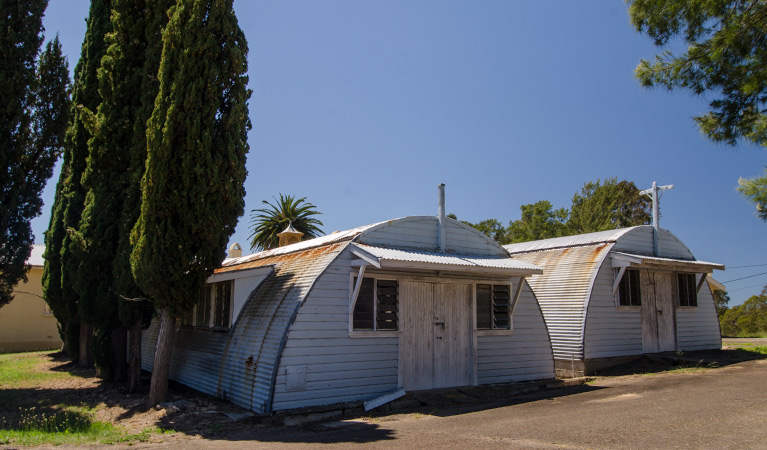
My parents, brothers and I ended up in Scheyville (pronounced Skyville) Migrant Hostel), not Villawood, in a heatwave in December.  We lived in Nissen corrugated iron huts that were unbearably hot, airconditioning being the opening of a window.  My parents found used sticking plasters on the walls and began by thoroughly washing the entire place.  It was located about 60 kilometres outside of Sydney and was in the middle of the bush, in those days bush beginning not far out of Sydney.  My dad obtained a job and a pushbike, cycling a great distance to work in the morning and back again in the evening.  One day I will tell the full story.

Some of the Nissen huts remain as part of the National Park.

From Rosie J: 
Great Bytes.  My parents’ address on my birth certificate is shown as Villawood Hostel (1971).

Thanks, Rosie.

Villawood Migrant Hostel, 1950's
______________

From Steve M about Waltzing Matilda: 
Really enjoyed Waltzing Matilda today Otto. I know it is far from politically correct to say this as the song has nothing ‘regal’ or ‘stately’ about it, but I have always felt it would make a wonderful National Anthem. It’s the story of the foundation of this country, of the people who carved the path towards the future that we now share with so many diverse cultures. We are all so privileged to call Australia home today, and it would be nice to see us embrace the mistakes and misgivings of the past, and recognise the hardships of those who came before us.
 I always want to stand and join in the singing when it plays anywhere. Marvellous lyrics, great tune. God Bless Australia!

Thanks, Steve. 

Unable to agree that a song about a man who dies after stealing a sheep should be our national anthem.  And did he suicide or did he drown in attempting to get away?

The Jolly Swagman statue in Winton, the place where the song was written.


Friday, April 25, 2014

Anzac Day


Today is Anzac Day in Australia and new Zealand, a day that is probably the most sacred in the secular calendar. The date, 25 April, honours the members of the Australia and New Zealand Army Corps (ANZAC) who fought at Gallipoli in Turkey in World War 1, but the day is a national day or remembrance for those Australians who served and died in all wars, conflicts and peacekeeping operations and the contributions of those who have served. The day includes dawn services, marches by servicemen, remembrance ceremonies and reunions, as well as a blind eye to two up gambling games at local pubs. 

In honour of Anzac Day, there is no Funny Friday today.

Bytes has previously had other posts about Anzac Day and these can be accessed by clicking the following links:

The first Anzac Day:

The Battle of the Nek:

Some Anzac day items:

And the Band Played waltzing Matilda:

General Birdwood:

Anzac Biscuits

Today's Bytes is a display of a selection of photographs taken during the Gallipoli campaign:

A Turkish sniper, disguised as a bush. The 2 Australian soldiers are wearing regulation uniform, which suggests that the photo was taken early in the campaign. As the campaign wore on, the heat caused uniforms to be discarded. Bare chests and singlets were not uncommon.

To make the Turks think that the Anzacs were still on Gallipoli when their evacuation took place under cover of night, the soldiers rigged up devices that caused rifles to fire periodically. This was done by dripping water into cans connected to rifle triggers, causing the rifles to fire even long after being left.

Dummy soldiers used to make the Turks think that the trenches were still manned.

When the Anzacs left Gallipoli they took their artillery with them. So as not to alert the Turks, they replaced the withdrawn pieces with wooden mockups.

The lessons learned at Gallipoli came in handy in other campaigns. The above horse mockups were erected in the Jordan Valley to trick the Turks into believing that there was a strong concentration of Desert Mounted Corps, part of the Light Horse.

On 17 December 1915, a famous game of cricket was played at Shell Green, Anzac, as Turkish shells passed overhead. The batsman, Major George Macarthur Onslow, 7th Light Horse Regiment, NSW, has just been caught out. The game was part of the various deceptions planned to deceive the Turks that all was normal at Anzac while the evacuation was being carried out

Periscope rifle developed by Sergeant William Beech (pictured above with his invention) of the 2nd Battalion Australian Imperial Force (AIF), in May 1915, during the Gallipoli campaign. The device allowed a soldier to aim and fire a rifle from a trench, without being exposed to enemy fire.

Australian light horseman using a periscope rifle, Gallipoli 1915. Note the relaxation of uniforms, the trench conditions and the depth of the trences, as well as the rifles and bayonets.

An Australian officer visits a comrade's grave at Lancashire Landing Cemetery, Helles, Gallipoli, 

When the Anzacs secretly evacuated Gallipoli, taking with them every soldier, their animals and equipment without the loss of a single man, it was nonetheless disturbing for many that they were leaving behind dead friends and comrades. Men in two’s and threes visited the cemeteries to tidy graves of friends and erect new crosses. Ons soldier said to General Birdwood on the final day, pointing to a little cemetery, "I hope they won't hear us marching down the deres [gullies]"
(Official History of Australia in the War; The Story of Anzac, Volume II, p 882)

Chaplain Walter Dexter looking out over North Beach, Anzac. On 16 December 1915, three days before the final evacuation, Dexter walked around Anzac leaving behind him something of Australia:
…I went up the gullies and through the cemeteries, scattering silver wattle seed. If we have to leave here, I intend that a bit of Australia, shall be here. I soaked the seed for about 20 hours, and they seem to be well and thriving."
- Chaplain Walter Dexter, 16-17 December 1915

Australian soldier on the day of evacuation.

8 Australian Graves at Gallipoli in a small fenced off area next to a walkway. The head and foot of each grave is marked by two large round bombs.

Australian 'Diggers' burying dead Anzac comrades between lines during ceasefire May 24, 1915

Unidentified Australian soldier offering a wounded Turkish soldier a cup of water at Gallipoli, 1915.

"They were some of our newer Australian soldiers – 17th Infantry – and that is how they regard the Turk and the Turk regards them. The most pathetic evidence that I have heard of is a little wooden cross found in the scrub, just two splinters of biscuit box tacked together, with the inscription “Here lies a Turk.” The poor soul would probably turn in his grave if his ghost could see that rough cross above him. But he need not worry. It was put there in all sincerity. Some Australian found him and buried him exactly as he would bury one of his own men – with that last little homage to mark the resting-place of a man fighting for his country."
[Charles Bean, dispatch, Commonwealth of Australia Gazette, 13 January 1916, p 92]

Remains of dead bodies on Hill 60. Anzac. Australian war Graves Photographic Archive.

The bleached bones of Australians, New Zealanders and Turks look the same, giving added meaning to the words of Mustafa Ataturk, front line commander of the Turkish forces at Gallipoli, the founder of the Republic of Turkey and its first President:

Heroes who shed their blood and lost their lives! You are now lying in the soil of a friendly country. Therefore rest in peace. There is no difference between the Johnnies and Mehmets to us where they lie side by side here in this country of ours. You, the mothers, who sent their sons from far away countries wipe away your tears; your sons are now lying in our bosom and are in peace. After having lost their lives on this land they have become our sons as well.

- Ataturk’s tribute in 1934 to the Anzacs who died at Gallipoli, inscribed on a memorial in Gallipoli and on the Kemal Ataturk Memorial, Canberra.