Sunday, June 9, 2013

Pulitzer and World Press Photos of the Year: 1962

Continuing the list of the winners of the Pulitzer Prize for Photography, from inception in 1942; and the World Press Photograph of the Year, from inception in 1955.

**********


Year:  1962

Award:  Pulitzer Prize for Photography

Photographer:  Paul Vathis, of Associated Press

Photograph:  Serious Steps

About the photograph:

April 1961 and the new government of President John F Kennedy is beset by problems and difficulties. The Bay of Pigs Invasion, an attempt by a CIA trained force of Cuban exiles to invade southern Cuba to overthrow the government of Fidel Castro, had proved disastrous. Supported by the US government and encouraged by it, the fallout tarnished Kennedy. Castro was furious and Soviet leader Nikita Kruschev capitalised on the situation, hammering the US publicly. The Cold War still raged. Many began to question Kennedy’s fitness to lead.

Kennedy, hurting from the bungled Cuba op, invited former President Eisenhower to lunch at Camp David. “I asked President Eisenhower here to bring him up to date on recent events and get the benefit of his thoughts and experience” said Kennedy to the press contingent covering the meet. Privately Eisenhower blamed Kennedy for failing to adequately consider and assess the proposed invasion, for failure to adopt a leadership role in respect of it and for failing to ensure that it would be successful once he had decided to go with it. Publicly he said “I am all in favor of the United States supporting the man who has to carry the responsibility for our foreign affairs.”

The press were given their photo opportunity and the leader and former leader obliged. Here are some of the photo op shots:


The photo op finished, the photographers began to leave. Vathis heard Eisenhower tell Kennedy “I know a place where we can talk.” (This was Kennedy's first trip to Camp David; Eisenhower had regularly conducted business at Camp David and had invited numerous foreign heads ther, including Kruschev) The new president and the former president, former general, headed away from the throng.

As Vathis kneeled to pack his camera, he glanced up. He later recalled “There were just two of them, all by themselves, their heads bowed, walking up the path. They looked so lonely.”

Press Secretary Pierre Salinger had said no more pictures but Vathis was unable to resist. He grabbed his camera and fired off two quick shots between the legs of a surprised Secret Service agent. The press secretary was not pleased. According to Vathis “Pierre said ‘I told you guys to leave this alone,’ and I said, 'I’m just changing my film.' ” 

Vathis’s photograph expressed more than the posed photographs taken earlier, an unguarded moment when a young president, battered and with the weight of the world on his shoulders, seeks advice from an older predecessor, the man he replaced.

About the photographer:

Paul Vathis was born in 1925, one of 8 children of Greek immigrant parents in Pennsylvania. A marine combat veteran, he photographed bomb damage of South pacific island caves despite never having held a camera prior to WW2. He joined Associated Press in 1946 and remained a photographer there for the next 56 years.

In 2002 he died in his sleep at home, aged 77.

During his career Vathis provided the only newspaper photographs of Wilt Chamberlain's history-making 100-point basketball game in 1962. He had gone to the game as a spectator, taking his son as a 10th birthday present. He also photographed the 1987 suicide at a news conference of R. Budd Dwyer, Pennsylvania state treasurer at the time, after he was convicted of taking a bribe. In 1979 Vathis also covered the Three Mile Island nuclear power accident.

Then-Gov. Tom Ridge dashes into the press pool covering the National Governors Association 92nd Annual Meeting to greet Associated Press photographer Paul Vathis, a familiar face from Harrisburg.

By the way:

The presidential retreat known as Camp David had been established by President Franklin Roosevelt but had been known as “Shangri-la”. Eisenhower planned to close the retreat and get rid of other “needless luxuries” upon taking office in 1953 but, after visiting it, he decided to retain it.  He did however change the name,  naming it “Camp David” after his grandson David Eisenhower. His political opponents talked of renaming it Shangri-la after Ike left office but Kennedy, after defeating Eisenhower, vetoed any name change and so it has remained to the present.

**********


Year:  1962

Award:  World Press Photograph of the Year

Photographer:  Hector Rondon Lovera

Photograph:  “Aid from the Padre”

Comments:

In 1961 and 1962 there were a number of military revolts in Venezuela against the government, all unsuccessful, with shooting and death in the streets.

On 4 June 1962 Navy chaplain Luis Padillo was in the middle of one such revolt, at Puerto Cabello. It was the scene of some of the bitterest fighting in Venezuelan history. Official casualty figures for the military were 47 dead and 89 wounded. Unofficial estimates put the toll, including civilians, at more than 300 dead.

Padillo was in the midst of the fighting, giving last rites to dying soldiers. With sniper fire bullets hitting the ground nearby, a wounded soldier pulled himself up by clinging to the priest’s cassock. Mortally wounded, he continued to hold onto the priest, almost like a child clinging to its mother.

Photographer Hector Rondon Lovera arrived in the town just as tanks began rolling in. The above photograph was taken from a position of lying flat on the ground to avoid being shot. He said later that he was unaware as to how he came to take it.

The other photographs taken by Lovera that day – the fighting, the injured, the dead – can be viewed by clicking on the following link:

Padillo continued giving last rites to the dying:


By the way:

On a different, but related, aspect, those whose knowledge of the art of Norman Rockwell is limited to Saturday Evening Post covers may be surprised to learn of a different side. In 1963 Rockwell left the Post for Look magazine. No longer tied to painting nostalgia and whimsy, he began recording reality as part of his support of the Civil Rights Movement. His painting Murder in Mississipppi, his version of the murders of three young civil rights workers in Mississippi, is based on Lovera’s photograph:


A look at Rockwell's works and analyses of some of his paintings, including Murder in Mississippi, can be read at:

**********

Saturday, June 8, 2013

Tap, Bojangles and More


This item is quite lengthy. I was tempted to split it into 2 parts but ‘Some More’ Week has concluded so here it is in full, long weekend reading.

(For overseas readers, Monday is a holiday in Oz in honour of the Queen’s birthday. Her Maj was actually born on 21 April but celebrating her birthday on 10 June enables announcement of twice yearly honours awards, on Australia Day on 26 January and approximately mid year. [Does anyone else think it ironic that one day celebrates independence and the other colonialism?]  In England, the Trooping of the Colour has, since 1748, been used to honour Her Maj’s birthday. The TOTC is when they have a fancy parade from Buck Palace and the Queen inspects the troops. It is held on a Saturday in June because of the likelihood of better weather. The TOTC is also the occasion for Brit Honours announcements).


I have mentioned previously how looking something up on the net sends you off into more and more fascinating side trails so that eventually you have spent a couple of hours off topic.

I stated in the recent post on clogs that English Lancashire clog dancing gave rise to tap dancing. Before the Irish are upset, I will also note that Irish step dancing is also a forebear of tap. 

Whilst reading up on the history of tap dancing I came across the story of Bill “Bojangles” Robinson. 


Wondering whether he was the subject of the song Mr Bojangles, I read further. It’s so interesting (to me, at least)that it is posted as this week’s Bytes article, in full.


Tap dance:

During the mid-1800’s, many Irish immigrants moved to America, fleeing the Irish famine and bringing with them their own dance rhythms and steps. Over the next 50 years these styles were adopted and varied by African slaves, resulting in a fusion of cultures that produced jazz, blues and percussive dance. 

Tap came to be incorporated into minstrel shows, originally as a satire on the black dance styles but eventually as a popular dance style in its own right. When the minstrel shows declined tap moved to the popular vaudeville stage. Blacks were not allowed to perform alone, they could only perform as part of a duet with a white performer. 

Bryant's Minstrels
An illustration from the playbill for a minstrel show, highlighting singing and dancing by actors in blackface.

One of the earliest known 'rhythm' dancers was William Henry Lane, also known as 'Master Juba'. By the 1840s his unique rhythmical style of dance was hugely popular, and he was one of the very few black performers who performed solo alongside white dancers, touring saloons and minstrel shows in New York, New England and London. His style of dance was an intricate fusion of African steps, jigs, shuffles and slides, finger snapping and clapping. 

Master Juba

From vaudeville tap also moved to Broadway and into the speakeasy clubs. Many famous bands included tap dances as part of their show. For a while, every large city in the U.S. had amateur street tap performers. At the time, tap dance was also called jazz dance, because jazz was the music with which tap dancers performed.

During the 1930s, 1940s, and 1950s, the best tap dancers moved from Vaudeville to cinema and television.


Bill “Bojangles” Robinson (1878-1949):


Before television there was going to the movies. Before Michael Jackson, before Gene Kelly, before Fred Astaire, there was Bill “Bojangles” Robinson. 

From Feetbeats – American Tap:

In an age where television was unknown, going to the cinema was one of the most popular forms of entertainment. Cinema audiences were hungry for light hearted, 'feel good' romantic escapism with lavish sets, glorious costumes, memorable songs and spectacular dance routines. In the 1930s, tap musicals, such as those choreographed by Busby Berkeley, featured hundreds of young women dancing en masse in spectacular formation. Close ups reveal that the skill of the individual dancers may have been somewhat lacking, but the overall effect captivated audiences. 
'Bojangles' Robinson made a screen name for himself appearing alongside child star, Shirley Temple. Racial segregation rules prohibited a black man from appearing on screen dancing with a white female, unless, as in this case, she was a child and he was playing the role of a servant. These prejudices prevented black performers from taking leading roles or even appearing alongside white artists as equals. The first film musical with an all black cast was 'Stormy Weather' (1943), starring Bill 'Bojangles' Robinson, the Nicholas Brothers, Lena Horne and Fats Waller. 

Stormy Weather is loosely based on Robinson’s own life.

Born in 1878 in Richmond, Virginia, he was given the nickname “Bojangles” at an early age but claimed to be unaware of its origin. He was busking as a dancer in local beer gardens from the age of 5 and dropped out of school early to pursue dancing, joining a dance troupe at age 8 and touring. Further touring and vaudeville followed, along with nightclub and musical comedy performances. For the next 25 years he was popular on Broadway but did not dance for white audiences until he was aged 50, having devoted his career to the black theatre circuit and having had opportunities limited by racism.

Under the management of Marty Forkins from 1908, he matured and became a solo performer in nightclubs, earning $3,500 per week. 

His stair dance was one of his famous performing trademarks, much like Michael Jackson’s moonwalk, a dance that he claimed to have invented on the spur of the moment by dancing up stairs to the King of England who was waiting to grant him an honour.

In 1928 when Robinson was 50 he appeared before his first white audiences when Lew Leslie produced Blackbirds, an all-black revue. As the star performer, Robinson soon captivated white audiences. During the next decade he performed in fourteen motion pictures for RKO, 20th Century Fox and Paramount. His most frequent role was that of an old antebellum butler opposite Shirley Temple in such films as The Little Colonel (1935), The Littlest Rebel (1935), Rebecca of Sunnybrook Farm (1938) and Just Around the Corner (1938).

Bill “Bojangles” Robinson with Shirley Temple, stair dance from The Little Colonel (1935)

After his run with motion pictures, Robinson returned to the stage in 1939 at the age of 61 to perform in The Hot Mikado, a jazz rendition of the Gilbert and Sullivan Operetta performed at the New York World’s Fair. 

The Hot Mikado poster, 1939


Poster 1937

To celebrate that 61st birthday, Robins danced down Broadway from Columbus Circle to 44th Street. He continued to perform well into his sixties before he died of a chronic heart condition in 1949. Performers and fans of dance still pay tribute to Bill "Bojangles" Robinson, a man of professional genius and personal generosity. In 1989 a joint U.S. Senate/ House resolution declared "National Tap Dance Day" to be May 25th, the anniversary of Bill Robinson's birth.

A Bill Robinson moment:

Robinson was once seated in a restaurant when a racist customer objected to his presence. The manager suggested that it might be better if Robinson left. Robinson smiled and asked, "Have you got a ten dollar bill?" Politely asking to borrow the manager's note for a moment, Robinson added six $10 bills from his own wallet and mixed them up, then extended the seven bills together, adding, "Here, let's see you pick out the coloured one". The restaurant manager served Robinson without further delay.

Some video links of Bill “Bojangles” dancing, click on the links to view:

Sand Dance from the film Stormy Weather (1943), at about the 1.56 mark:

Stair Dance with Shirley Temple, form The Little Colonel (1935):

Dancing with Jeni Le Gon; singing with Fats Waller, from the film Hooray For Love (1935):


Mr Bojangles:

Which brings us to the song Mr Bojangles. Does it refer to Bill “Bojangles” Robinson?

Here are the lyrics:

I knew a man,
Bojangles,
and he'd dance for you
in worn out shoes,
with silver hair,
a ragged shirt,
and baggy pants.
the old soft shoe.
jump so high,
jump so high,
then he'd lightly touch down.

I met him in a cell
in New Orleans,
I was down and out.
He looked to me to be the very eyes of age
as he spoke right out,
talked of life, talked of life,
laughed, slapped his leg and stepped.

He said the name "Bojangles"
and he danced a lick
across the cell.
grabbed his pants,
a better stance, 
and wow he jumped up high.
clicked his heels.
he let go a laugh,
let go a laugh,
shook back his clothes all around.

Mr. Bojangles.
Mr. Bojangles.
Mr. Bojangles.
dance.

he danced with those at minstrel
shows & county fairs,
throughout The South.
He spoke with tears
of fifteen years
of how his dog and him,
had travelled about.
his dog up and died,
he up and died,
after twenty years he still grieves.

He said "I dance
now and every chance at
honkey-tonks,
for drinks and tips.
But most of time
I spend behind these county bars,
cause I drinks a bit."

he shook his head.
and as he shook his head,
I heard someone ask please,

Mr. Bojangles.
Mr. Bojangles.
Mr. Bojangles.
dance,

Video links:

The Harry Nilsson version:

Jerry Jeff walker version:

The Song:

Mr Bojangles was written in the mid 1960’s by Jerry Jeff Walker and was included on his 1968 album of the same name. Numerous other artists have recorded covers - Bob Dylan, John Denver, Sammy Davis Jr. and Neil Diamond – but the one I like best is Harry Nilsson’s. Beautiful song, although sad, and a beautiful recording of it. Nothing beats Nilsson Schmilsson. 

From Wikipedia:

Walker has said he was inspired to write the song after an encounter with a street performer in a New Orleans jail and that the song does not refer to the famous stage and movie personality Bill “Bojangles” Robinson. Walker said while in jail for public intoxication in 1965, he met a homeless white man who called himself "Mr. Bojangles" to conceal his true identity from the police. He had been arrested as part of a police sweep of indigent people that was carried out following a high-profile murder. The two men and others in the cell chatted about all manner of things, but when Mr. Bojangles told a story about his dog, the mood in the room turned heavy. Someone else in the cell asked for something to lighten the mood, and Mr. Bojangles obliged with a tap dance

From Walker’s book Gypsy Songman:

"One of the guys in the cell jumped up and said, 'Come on, Bojangles. Give us a little dance.' 'Bojangles' wasn't so much a name as a category of itinerant street entertainer known back as far as the previous century. The old man said, 'Yes, Hell yes.' He jumped up, and started clapping a rhythm, and he began to dance. I spent much of that long holiday weekend talking to the old man, hearing about the tough blows life had dealt him, telling him my own dreams." 

Walker also described writing the song after he had moved to Texas:

“. . . it came, just sort of tumbling out, one straight shot down the length of that yellow pad. On a night when the rest of the country was listening to The Beatles, I was writing a 6/8 waltz about an old man and hope. It was a love song. In a lot of ways, Mr. Bojangles is a composite. He's a little bit of several people I met for only moments of a passing life. He's all those I met once and will never see again and will never forget."

Two internet views on the song, from the Song Meanings website

This song is really sad. Considering that the title has the word "Bojangles" in it, you'd think it would be funnier. But it's about a hobo whose clothes are ragged, has no money, dances for quarters, whose dog died, who was thrown in jail. In spite of all that, he still can laugh and have a good time. But people don't seem to understand him. They just say "please" and want him to dance for them and do his sad little routine.

**********

I actually see it as an uplifting song. Despite all of his hardships, Mr. Bojangles is loved by those he comes into contact with and has an uncanny ability to brighten everyone's day. He doesn't use society's expectations as a measurement for success, without a care for money or material possessions. All that matters is laughter and friendship. His love for others is highlighted by how he still grieves for his dog 20 years later. He has a big heart. Seems like one of those people who finds the best in everyone. He's what all of us should strive to be.

**********

Statue of Bill "Bojangles" Robinson in Robinson Square, Richmond, Virginia


Friday, June 7, 2013

'Some More' Week: Funny Friday

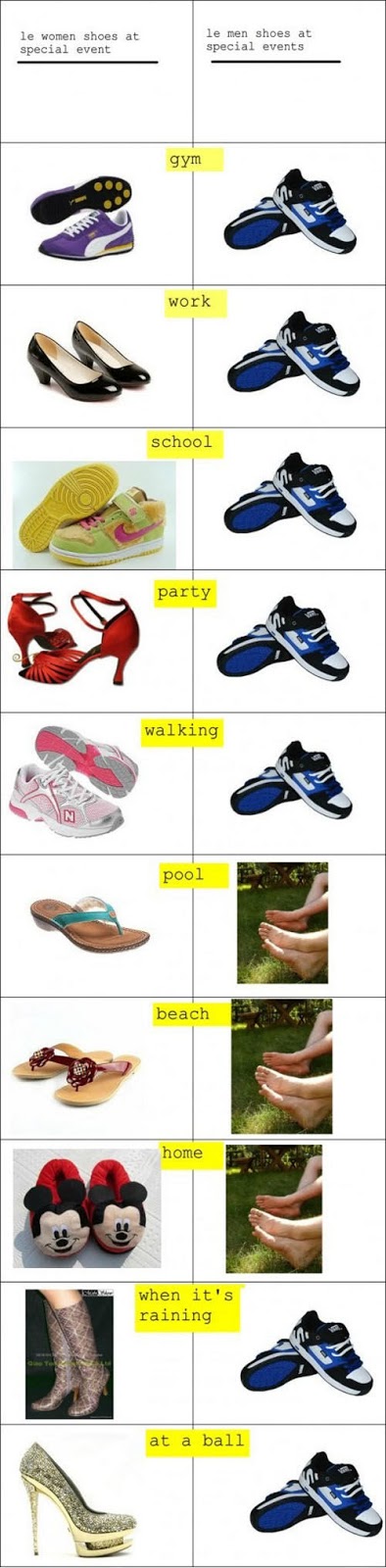
Differences Between Men and Women, Part 2

Part 1 is at:

I had some items on the above topic ready to post for Funny Friday when I received an email from Terry yesterday on that same topic. Here are most of Terry’s . . .


and some from me . . . 


Limerick Spot:

A risque limerick today, plus two explaining and apologising for it:


The explanation and apology:

A limerick packs anatomical,
Laughs in a space economical.
But the good ones I've seen,
So seldom are clean,
And the clean ones so seldom are comical.

The limerick's callous and crude,
Its morals distressingly lewd.
It's not worth the reading,
By persons of breeding,
It's designed for us vulgar and rude.


Today's limerick:

There was a young fellow named Bliss, 
Whose sex life was strangely amiss. 
For even with Venus, 
His recalcitrant penis, 
Would never do better than t 
                                         h 
                                           i 
                                           s


Wednesday, June 5, 2013

'Some More' Week - 3 More Factlets (Music)


A factoid is a questionable or spurious (unverified, false or fabricated) statement presented as a fact, but without supporting evidence. The word can also be used to describe a particularly insignificant or novel fact, in the absence of much relevant context. The word is defined by the compact Oxford English Dictionary as "an item of unreliable information that is repeated so often that it becomes accepted as fact".

Factoid was coined by Norman mailer in his 1973 biography of Marilyn Monroe. Mailer described a factoid as "facts which have no existence before appearing in a magazine or newspaper", and created the word by combining the word “fact” and the ending “-oid” to mean "similar but not the same". The Washington Times described Mailer's new word as referring to "something that looks like a fact, could be a fact, but in fact is not a fact."

Language expert William Safire in his On Language column advocated the use of the word factlet to express a "little bit of arcana".

- Wikipedia

Or, the simpler version:
factoids = fake facts
factlets = trivial facts

**********


The whistling at the end of Otis Redding’s posthumous hit (Sittin’ On) The Dock of the Bay was used by him as a temporary fill. It may fit the nature of the song quite well – the melancholy man sitting on the dock doing nothing except singing and whistling, with sounds of surf and seagulls – but it was an unfinished song with 10 bars of music that Redding would have used for ad libbing some spoken words, as he often did in his songs. With the pressure of time, having to leave for other commitments, he couldn’t think of anything to add so just inserted a whistler filler until he could come back to it. Unfortunately he never did, he was killed 2 days later in 1967 in a plane crash. Steve Cropper (yep, he of the Blues Brothers Band – he and Donald “Duck” Dunn were founder members of Booker T and the MG’s as well), who played the guitar on the track, produced the final version immediately afterwards and it became the largest success of any of Redding’s works.

The Blues Brothers Band (or, more correctly, The Blues Brothers' Show Band and Revue) - Steve Cropper on guitar at left, Donald "Duck" Dunn on guitar in centre

**********

Mick Jagger, 1973

The 1973 hit by the Stones, Angie, was written by Mick Jagger and Keith Richards. There have been various theories and suggestions as to who Angie was: David Bowie’s first wife Angela, the actress Angie Dickinson, or Keith Richards's newborn daughter, Dandelion Angela. Richards, who wrote almost all the music and lyrics for the song, claimed in his autobiography that the name Angie was a pseudonym for heroin, and that the song was about his attempt to quit using it while detoxing in Switzerland. Bowie’s wife Angela said in her autobiography that she once walked in on Jagger and Bowie in bed together. They weren’t doing anything, just together.  With no clothes on. Jagger has denied it. Nonetheless the rumour developed that the song was written to appease her.

David Bowie, 1973 tour program

Angela Bowie, with hubby David

**********


The phenomenon of misheard lyrics actually has its own name: they are called mondegreens. American writer Sylvia Wright originated the term in 1954 when she wrote in an article:

When I was a child, my mother used to read aloud to me from Percy’s Reliques, and one of my favorite poems began, as I remember: 
Ye Highlands and ye Lowlands,
Oh, where hae ye been?
They hae slain the Earl O' Moray,
And Lady Mondegreen. 
The actual last line was “And laid him on the green.”

One famous mondegreen is from Bruce Springsteen’s Blinded by the Light:

Probably the most misheard lyric of all-time comes from the chorus of the song “Blinded by the Light,” popularized in 1976 by Manfred Mann’s Earth Band. We hear: “Blinded by the light, wrapped up like a douche into the rotor in the night.” Obviously, it’s the use of the word douche that catches everyone’s attention. How does a douche get wrapped up, you wonder, and what’s it doing inside a rotor? 
Ah, but here’s the rub. The lyric is actually written: “Blinded by the light, revved up like a deuce, another runner in the night.” Believe it or not, Deuce is actually ‘60s slang for a 1932 Ford, or a “deuce coupe,” which explains why it can be revved up and run. Even more unbelievable, however, is the fact that this infamous lyric was actually penned by none other than Bruce Springsteen and performed on his debut album, Greetings From Asbury Park. Of course, the Boss probably had a curious reaction the first time he heard his deuce coupe suddenly transformed into a feminine hygiene product.