Thursday, October 9, 2014

Manneken Pis


Wednesday night is always trivia night and, as usual, last night’s questions included a geography question. In this case the question was:

Name the item, name the city and country in which it is located.

I knew this one because my mother had a similar brass statue about 8cm (3 inches) tall that stood on the sill of one of the lounge room windows. It was always referred to in my mother’s native Dutch as "Manneken Pis" (pronounced “mon-ner-ker-peace”, the mon being sounded as in “money”), meaning Little Man Piss”. She had brought it with her from the old country along with other brass and copper objects, long before it became fashionable to collect such things.

* * * * * * * 
Some facts and trivia about Manneken Pis:

* * * * * * * 
The statue dates from 1618, which replaced a similar fountain that dated back to 1388, and is located in Brussels. It is 61cm (24 inches) in height and shows a small, naked boy urinating into the basin of the fountain upon which he stands. It is a cultural icon of Belgium, as much as the Liberty Bell for Americans, Ned Kelly’s helmet for Australians and red phone boxes for the British. It is also the spiritual emblem of Brussels.


* * * * * * * 
As to why a statue in Belgium is known by a Dutch name, the Dutch language is one of the three official languages of Belgium, the other 2 being French and German. Dutch and Flemish are the same language.e

* * * * * * * 
The statue has been repeatedly stolen and replaced, the current statue dating from 1965. the current statue dates from 1965. The original restored version is kept safely in storage.

* * * * * * * 
There are various legends explaining the origin of the statue, including that the boy’s father was a tourist who lost his son in the city. After receiving help from villagers to find the boy, he gifted this statue to them. Another tale is one where the boy was a spy during a siege of the city and put out a bomb by urinating on the explosives.

* * * * * * * 
Several times each week the statue is dressed in costume, according to a published schedule which is posted on the railings around the fountain. His wardrobe consists of several hundred different costumes, many of which may be viewed in a permanent exhibition. The changing of the costume on the figure is a colourful ceremony, often accompanied by brass band music. Many costumes represent the national dress of nations whose citizens come to Brussels as tourists; others are the uniforms of assorted trades, professions, associations, and branches of the civil and military services.


* * * * * * * 
On occasion, the statue is hooked up to a keg of beer. Cups will be filled up with the beer flowing from the statue and given out to people passing by. 


* * * * * * * 
In the 80s another statue, Jeanneke Piswas built called Jeanneke Pis to give Manneken Pis a playmate. This other statue is a little girl fountain, but she is lesser known and hides in an alleyway a short distance away from Mannekin Pis.


* * * * * * * 
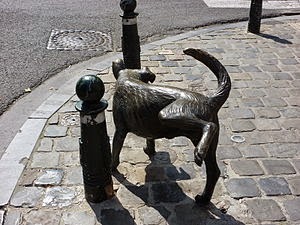
In 1998 the burghers of Brussels erected a further urinating statue, Zinneke Pis, this time of a dog. Ulike Manneken Pis and Jeanneke Pis, this one does not discharge water, or beer.

* * * * * * * * *

Tuesday, October 7, 2014

Trivia Tuesday


* * * * * * * *
In the context of being taken to task by Byter Nicolas for an apocryphal story about Napoleon, I asked whether anybody could translate for me Nic's concluding comment “Merci encore pour mon pain quotidien.”

I received the following response from Sue:

Ah Otto, I will echo his French: 
"Thank you again for my daily bread" 
But you can translate most languages for free here:
http://translation.babylon.com/french/to-english/
or here: 
https://translate.google.com/
Merci

* * * * * * * *
Whilst on the topic of apocryphal French stories, here is one posted some time ago but too good not to repeat. 

The story may or may not be urban myth. It has been examined by snopes.com, which states that whilst it has the hallmarks of an urban legend (unsourced, multiple versions and non-specific), it cannot establish one way or another whether it is true.

Nonetheless, some quotes are just too good to let pass, even if there is a question mark hanging over it... 

At the end of a long and probably very boring meal at a formal dinner, British Prime Minister Harold Macmillan turned to Madame de Gaulle and asked politely what she was looking forward to in her retirement. Quick as a flash the elderly lady replied: "A penis." Macmillan had been trained all his life never to appear shocked, but even he was a bit taken aback. After drawling out a series of polite platitudes, - "Well, I can see your point of view, don't have much time for that sort of thing nowadays" - it gradually dawned on him to his intense relief that what she was trying to say, under a heavy French accent, was “happiness.”


* * * * * * * *
Another bit of French trivia:


I mentioned to some people last week, as we entered a mediation room, that back in 1968 when there were peace talks in Paris to seek an end to the Vietnam War, the two sides spent months arguing over the shape of the mediation table. As soldiers and civilians alike kept dying, the arguments over the table design stalled.  Ultimately the table design was resolved but the peace talks would go on for another three and a half years, both publicly and secretly. Washington wanted all troops out of South Vietnam; Hanoi refused any provisional South Vietnamese government that involved leader Van Thieu. A peace accord was finally signed on 27 January, 1973.

As regards the table design:

The Paris Peace talks, which opened on May 10, continue to be plagued by procedural questions that impeded any meaningful progress. South Vietnamese Premier Nguyen Cao Ky refused to consent to any permanent seating plan that would place the National Liberation Front (NLF) on an equal footing with Saigon. North Vietnam and the NLF likewise balked at any arrangement that would effectively recognize the Saigon as the legitimate government of South Vietnam. Prolonged discussions over the shape of the negotiating table was finally resolved by the placement of two square tables separated by a round table. Chief U.S. negotiator Averell Harriman proposed this arrangement so that NLF representatives could join the North Vietnamese team without having to be acknowledged by Saigon's delegates; similarly, South Vietnamese negotiators could sit with their American allies without having to be acknowledged by the North Vietnamese and the NLF representatives. Such seemingly insignificant matters became fodder for many arguments between the delegations at the negotiations. 
- History Channel
This Day in History, 12 Dec 1968

* * * * * * * *

The name "Paris" is derived from its early inhabitants, the Celtic tribe known as the Parissii. The city was called Lutetia (more fully, Lutetia Parisiorum, "Lutetia of the Parisii"), during the Roman era of the 1st to the 4th century AD, but during the reign of Julian the Apostate (360–3), the city was renamed Paris. It is believed that the name of the Parisii tribe comes from the Celtic Gallic word parisio, meaning "the working people" or "the craftsmen".

* * * * * * * * *

Monday, October 6, 2014

Monday Miscellany: Some Odds, Ends and Personals . . .


____________________

An email from Nick:

Dear Otto,

Thanks for another interesting and entertaining Bytes. I have to admit, though, I doubted the Napoleon story when I read it. Apparently Snopes does too.

Merci encore pour mon pain quotidien.

N

Some comments:

Nick’s response was in respect of a trivia item:
Napoleon killed over a thousand people with a cough. In 1799 he was deciding whether to release 1,200 Turkish prisoners of war when he coughed and said, "Ma sacré toux!" (my darned cough) which sounded to officers like "Massacrez tous!" (Kill them all!). So they did.
Snopes.com is an authoritative site on internet myths, furphies and urban legends and if that says that the above tale is not correct, then I accept it.

Snopes also points out that whereas the above tale is untrue, Napoleon did order the execution of thousands of prisoners, the captured defenders and occupiers of the city of Jaffa. 

According to Etienne-Louis Malus, a doctor who had accompanied the army of Napoleon, soldiers cut the throats of men and women, the old and the young, Christians and Turks. Women were raped, bodies and houses were looted and corpses were defiled. Over a 3 day period, 3,000 prisoners were slaughtered. Sir Walter Scott, in his biography of Napoleon, says that this “bloody deed must always remain a deep stain on the character of Napoleon.”

The painting Napoleon visiting the plague victims of Jaffa by Antoine-Jean Gros shows the aftermath of the battle, with no indication of the horror to follow.

By the way, can anyone translate Nick’s French comment? Is it something to do with thanks, give us our daily bread?

____________________

From David in respect of the comments on whether e e cummings wanted his name written without capitals:

Re: Your MM on e e cummings.

I find this cartoon rather amusing:

____________________

The Art of Max Zorn:

I have previously posted items about different materials used for art, some of them unique and others bizarre.

I recently became aware of the art of Dutch artist Max Zorn, which I found fascinating not only because of his chosen artistic medium – packing tape – but also because of the beauty of his moody, comic book style, 1930’s-feel images.

Zorn applies the packing tape to glass, applying more layers to achieve darker tones and removing layers with a blade to lighten. A light source behind the glass brings the works to life.

They are reminiscent of the art of Frank Miller in Sin City, the first image below being of a Sin City scene (remember the opening scenes of the first Sin City film?)  Other works are scenes from other films.

Zorn says the idea to use packing tape began with his street art:

“There’s a lot of great street art by day, but it disappears after dark. I wanted to come up with urban art that uses night time as a setting, and there was nothing more inviting than the street lamps in Amsterdam. In the beginning I used packing tape to fill in larger sections of my marker drawings. Once I hung them on street lamps, the light’s effect opened up new ideas with ditching markers and just using tape.” 

Max Zorn’s website is at:

Here is a link to a video showing the creative process:

Some of Max Zorn’s works, available for purchase from his website (more works later):