Wednesday, March 8, 2017

Word Wednesday

For the word nerds . . . 
_____________________________

Jumbo:

What came first: the chicken or the egg? The word or the elephant? 

The word “jumbo”, meaning big, was certainly popularised by an elephant. The elephant that came to be called Jumbo had been captured as a calf in Africa in about 1860 and sold to a French botanical garden. In 1865 Jumbo was sold to the London Zoo and became a major attraction, especially because of his massive size and gentle temperament, growing to become one of the largest elephants ever. In 1882, to the consternation of the English public (including Queen Victoria, who petitioned for him to remain in London), Jumbo was sold to P T Barnum’s Circus. As in England, Jumbo became a major attraction in the US but was killed 3 years later when hit by a train. Barnum had Jumbo’s remains preserved and continued displaying them.


After Jumbo’s death, his name became synonymous with anything huge.

The word was already in existence by the time that Jumbo was captured in Africa. As early as 1823 the word was recorded in print as a slang term meaning “a big, clumsy person, animal or thing.” It has been suggested that this originated from a word for "elephant" in a West African language or possibly that it derived from “mumbo jumbo”, an African deity.

Jumbo with his keeper, 1882.
_____________________________

Mortgage:

The word “mortgage” derives from the words “mort”, meaning death, and “gage”, meaning pledge. Dating from the late 14th century, it reefers not to the death of the borrower but to the pledge: ithe debt becomes void or ‘dead’ when the pledge is redeemed, or, if the mortgagor fails to repay the loan, the property pledged as security is lost, or becomes ‘dead,’ to him or her.

_____________________________

Nightmare:

Nothing to do with horses.

The word "nightmare" derived from the Old English "mare", a mythological demon or goblin who torments others with frightening dreams. Subsequently, the prefix "night-" was added to stress the dream aspect. The Oxford English Dictionary traces the first use of “nightmare” in English to around 1300, as “a female spirit or monster supposed to settle on and produce a feeling of suffocation in a sleeping person or animal.” A “nightmare” came to mean any bad dream, whether accompanied by that suffocating feeling or not. The word "nightmare" is equivalent to the older Dutch term nachtmerrie and German Nachtmahr. 

Henry Fuseli, The Nightmare, 1781
_____________________________

Addict:

The word 'addict' evolves from the Latin word addictus, meaning to 'devote or surrender'. In ancient Rome being “addict”— originally an adjective—meant being forced by a judge to be a servant or slave, often because of debt. From there, “to addict” started meaning to voluntarily “bind or attach oneself to a person, party, or cause; to devote oneself to as a servant, adherent, or disciple.” The meaning of “addiction” then grew to mean a zealous, disciple-like devotion. There is also a suggested derivation that Roman soldiers were given slaves as a reward for their fine performances in battles. These slaves we known as 'addicts'. Eventually persons who were slaves to anything were called "addicts".


Monday, March 6, 2017

Quote for the Day

“Autumn is a second Spring when every leaf is a flower.”

- Albert Camus


Readers Write and March Dates

_____________________________


Readers Write . . . 

Thanks to all those who have sent me emails and comments.
_____________________________

Ugly buildings . . .

From Tobye P:

Ooooh-UGLY! Selfridges looks like an enormous caravan-but the Landmark Theatre looks like a nuclear plant. Selfridge’s may be worse by a slight margin-but they’re all awful all the time!

I hope you’re recovering nicely and out of danger-enjoy the weekend!

Regards, Tobye 

------------------ooOoo------------------

From Jay:

Hi Otto, saw this building two years ago in Hyderabad, India.
http://www.inspirefusion.com/fish_shaped_building_indi/ 

Cheers, Jay.


The building is a regional office for the National Fisheries Development Board located near Hyderabad, India. It comprises 4 storeys, was opened in 2012 and uses the pectoral fin as a canopy over the stairs. It was apparently inspired by Frank Gehry’s sculpture “Fish” in Barcelona:


The building has been criticised for taking an ugly image of a fish and turning it into an ugly building, without any creativity or abstraction.  It has also received critical comment for making the elderly and disabled manage the stairs to reach reception. One person has observed that if this is the office of National Fisheries, what must the offices of the sewer authority look like?


------------------ooOoo------------------

From Steve and Diane M:

Enjoyed the ugly buildings segment, Otto. How subjective is our appreciation or otherwise when it comes to architecture (and the arts in general). We are surprised that you missed out that monstrosity in Federation Square, Melbourne! It certainly goes ahead of most of the buildings you showed according to our votes.

As I pointed out in the post, there is more to come, the post was only Part 1.

Steve and Diane’s nomination is of Federation Square, designed by Peter Davidson and Don Bates. It has been described as being so ugly that, as a mother can only see beauty in a child that looks like a monkey, so only the designers themselves could hold fondness for the structure. Conversely, others love it!


From Wikipedia:
In 2009, Virtual Tourist awarded Federation Square with the title of the 'World's Fifth-Ugliest Building'. Criticisms of it ranged from its damage to the heritage vista to its similarity to a bombed-out war-time bunker due to its "army camouflage" colours. A judge from Virtual Tourist justified Federation Square's ranking on the ugly list claiming that: "Frenzied and overly complicated, the chaotic feel of the complex is made worse by a web of unsightly wires from which overhead lights dangle." It continues to be a "pet hate" of Melburnians and was recently discussed on ABC's Art Nation.  
The designers of Federation Square did not get any work for six months after the completion of the A$450 million public space, but did receive hate-mail from people who disliked the design.

The Australian Financial Review later reported that Melburnians have learned to love the building, citing the record number of people using and visiting it. In 2005 it was included on The Atlantic Cities' 2011 list of "10 Great Central Plazas and Squares".

https://en.wikipedia.org/wiki/Federation_Square

_____________________________

My hospital stay . . .

From Tim B

Otto, glad that you are now at home and best wishes for a speedy recovery. My 95 year old Mom has been in the hospital for the last 6 weeks and I know a lot of what you have been going though, right down to the strange room mates.

Tim
_____________________________

Dave Allen . . . 

From Steve and Diane M:

Forgot to mention Dave Allen, Otto. How did he lose his finger?

From Wikipedia:
Allen lost the top of his left forefinger above the middle knuckle after catching it in a machine cog. However, he enjoyed inventing stories to explain the loss, which became a minor part of his act. One version was that his brother John had surprised him by snapping his jaw shut when they were children, resulting in him biting it off. A further explanation he gave on his programme, Dave Allen at Large, was that he often stuck his finger in his whiskey glass, and it had been eaten away by strong drink. He also said it was worn away from repeatedly brushing the dust from his suit. One of his stand-up jokes was that, when he was a boy, he and his friends would go see a cowboy movie at the local cinema, then come out all ready to play Cowboys and Indians. Staring down at his truncated finger, he would mutter, "I had a sawn-off shotgun." On his show he told a long, elaborate ghost story, ending with "something evil" attacking Allen in a dark and haunted house. Allen grabbed and bit the attacker, the studio lights came back up, and it was his own left hand. 
https://en.wikipedia.org/wiki/Dave_Allen_(comedian)

____________________________


March Days:

This month's special days, courtesy of Brett B:

Month celebrations:
  • Irish American Month
  • Music in Our Schools Month
  • National Craft Month
  • National Frozen Food Month
  • National Irish American Heritage Month- designated by Congress in 1995.
  • National Nutrition Month
  • National Peanut Month
  • National Women's History Month
  • Red Cross Month
  • Social Workers Month
Did you Know? March was named for the Roman God "Mars"

Week Celebrations:
  • 2nd Week National Bubble Week
  • 2nd Week Crochet Week
March, 2017 Daily Holidays, Special and Wacky Days:
1 Ash Wednesday - date varies
3 Employee Appreciation Day first Friday in March
3 National Salesperson Day - first Friday in the month
9 Popcorn Lover's Day second Thursday
11 Worship of Tools Day - guys, you can relate
14 National Pi Day- Why today? Because today is 3.14, the value of Pi.
16 Incredible Kid Day - date varies
17 Submarine Day - the hero sandwich or the boat??
18 National Quilting Day - third Saturday of month
21 National Agriculture Day - date varies
21 Tea for Two Tuesday - third Tuesday in March

The above dates 1 - 31 are interactive, simply click on.


Sunday, March 5, 2017

Quote for the Day


Pulitzer and World Press Photographs of the Year, continued: 1984

Caution: Disturbing images
__________________________________


Between 1942 and 1967 a Pulitzer Prize for Photography was awarded for photojournalism, that is, for photographs telling a news story. In 1968 that award was replaced by awards in two new categories:
  • the Pulitzer Prize for Spot News Photography (photography in the nature of breaking news, as it has been called since 2000); and
  • the Pulitzer Prize for Feature Photography (human interest and matters associated with new items).
From 1955 World Press Photo has awarded prizes for the best photographs in 10 categories, with an overall award for the image that "... is not only the photojournalistic encapsulation of the year, but represents an issue, situation or event of great journalistic importance, and does so in a way that demonstrates an outstanding level of visual perception and creativity".

This series looks at the winners, from inception.
__________________________________

Year: 
1984

Award: 
Pulitzer Prize for Spot (Breaking) News

Photographer: 
 Stan Grossfeld, Boston Globe

Subject: 
A series of photographs which reveal the effects of war on the people of Lebanon.

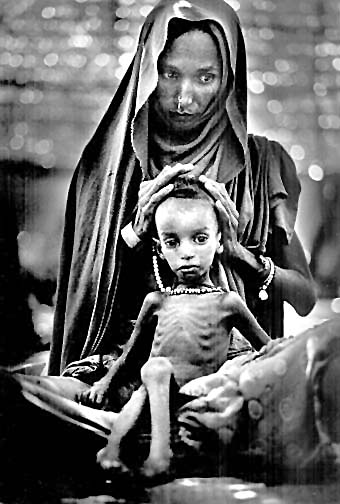
Ethiopian mother and child in Wad Sharafin Camp in the Sudan, 1984. The image has been referred to as the Third World Madonna and Child.

Background:
Between 1975 and 1990 Lebanon was subject to a civil war that took an estimated 120,000 lives. At 2012 approximately 76,000 people remained displaced within Lebanon with almost one million people having left Lebanon as a result of the war.

Before the war, Lebanon was multisectarian:
  • Sunni Muslims and Christians the majorities on the coastal cities;
  • Shia Muslims mainly based in the south and the Beqaa to the east;
  • the mountain populations being in their majority Druze and Christian. 
Although the government of Lebanon had been run by mainly Maronite Christian elites, the establishment of the state of Israel and the displacement of a hundred thousand Palestinian refugees to Lebanon during the 1948 and 1967 exoduses contributed to shifting the demographic balance in favor of the Muslim population. The Cold War caused further breakdown of the arrangements: Maronites sided with the West while leftist and pan-Arab groups sided with Soviet-aligned Arab countries.

Fighting between Maronite and Palestinian forces (mainly from the Palestine Liberation Organization) began in 1975. Shifting alliances left the situation fluid , with foreign powers such as Israel and Syria also becoming involved in the war. Peace keeping forces, such as the Multinational Force in Lebanon & UNIFIL, were also stationed in Lebanon. The fighting was brought to an end with the assistance of the Arab League with pardons of political crimes, dissolution of militias (with the exception of Hezbollah) and rebuilding, but religious tensions between Sunnis and Shias remain. 

The Photographer:
Stan Grossfeld (1951- ) is a photographer, writer and editor at The Boston Globe who has won two Pulitzer Prizes for photojournalism: 
  • in 1984 for Spot News Photography for a "series of unusual photographs which reveal the effects of war on the people of Lebanon"; and 
  • in 1985 for Feature Photography Pulitzer for a "series of photographs of the famine in Ethiopia and for his pictures of illegal aliens on the Mexican border."
Stan Grossfeld

Gallery:

Frightened children herded on board a truck


Comments:
“In some ways, it’s a lot easier with the digital revolution. Everyone has Wi-Fi and you can get your pictures up anywhere. You never knew what was on your film, but you can see it all with digital. There used to be so much more mystery to it. With digital, it’s all right there. I remember having to bribe flight attendants to bring my film back to Boston from all over the world. Then you just had to hope you had something on your film when it got there. It’s still storytelling but you can mould it more cohesively. It’s important to tell a story in an entertaining and truthful way. Show something different that [the consumer] didn’t know about and maybe try to make a difference in whatever we’re trying to show. I don’t look at myself as someone who makes an impact. My photos are seen by hundreds of thousands of people and they resonate in different ways with different people.” 
 - Stan Grossfeld
_____________________________

Year: 
1984

Award: 
Pulitzer Prize for Feature Photography

Photographer: 
Anthony Suau, The Denver Post

Subject: 
“A series of photographs which depict the tragic effects of starvation in Ethiopia and for a single photograph of a woman at her husband's gravesite on Memorial Day."


About the photograph:
Anthony Suau was at the Fort Logan National Cemetery in Denver, Colorado to take an appropriate Memorial Day photograph for the cover of the Denver Post when he saw a woman hugging the tombstone of her late husband. She released her hold and Suau fitted a longer lens in anticipation of the image being repeated. This she did and he took the photograph. He then waited for her to leave and sought her permission to publish the photograph. The woman, Mrs. Dorris Fielder, was the widow of Mr. Cecil Fielder, an Air Force veteran of World War II, the Korean Conflict and the Vietnam War.
__________________________________

Year: 
1984

Award: 
World Press Photograph of the Year

Photographer: 
Mustafa Bozdemir

Subject: 
Earthquake in Turkey

The image is too sad to post. Anyone who wants to see the photograph can click on the following link:


Comments: 
In Koyunoren, Turkey, Kezban Özer finds her five children who were buried alive after a magnitude-7.1 earthquake struck her village. The earthquake occurred at 5 a.m., when she and her husband were milking the cows and their children were sleeping. The earthquake destroyed 147 villages in the region and killed 1,336 people.


Saturday, March 4, 2017

Quote for the Day

The Pope is discussing the existence of God with an out-and-out atheist. The discussion starts off very correctly, but as the hours go by it gets more and more heated, and eventually the Pope turns to the man and says: “You are like a man who is totally blindfolded, in a dark room, looking for a black cat that is not there!”

The atheist says: “With all respect, your Holiness, I think there’s a great similarity between us both.”

The Pope says, “Whaddya mean, ‘similarity’?”

The atheist says: “Well, as far as I’m concerned, you are like a man who is totally blindfolded in a totally dark room looking for a cat that isn’t there. The only difference is that you found it.”

- Dave Allen (1936-2005)
Irish observational comedian, satirist and raconteur