Tuesday, November 7, 2023

SOME MORE MELBOURNE CUP ITEMS

---------oOo---------

Months before the 1870 race, Ballarat publican Walter Craig had a vivid dream. In this dream he watched his own horse, Nimblefoot, win the Cup, but he noticed his jockey was wearing a black armband. Craig’s premonition was that his horse would win the Cup, but that he would not live to see it. So strong was his conviction that the story gained great currency and was reported in the press before the Cup was run (this is verified by the Trove newspaper database).

Astonishingly, Craig’s horse Nimblefoot won the cup, with the jockey wearing a black crepe armband to mourn Walter Craig who, just as he had dreamed, died before the race.

---------oOo---------

Jockey John Letts rode the 40/1 outsider Piping Lane to win the Cup in 1972.

Letts was a South Australian, a late booking because he could make the horse’s light weight of 48 kilograms. When approached for the ride he decided not to reveal he had not ridden at Flemington previously. He asked a friend among the local jockeys for advice and was told “make your move at Chiquita Lodge”.

In the run Letts gained a good position. As the field began the long turn for home, he scanned the horizon for Chiquita Lodge. “I was looking up in the sky for some multi-storey hotel or apartments,” he recalled. Nothing like that appeared and the jockey grew desperate. Then he saw the favourite Gunsynd being urged forward and decided to get onto its tail. In the straight Piping Lane surged past Gunsynd and went on to an easy win.


Later Letts confronted his informant about the Chiquita Lodge tip. He was embarrassed to learn that Chiquita Lodge was a famous stable that ran down the side of the racecourse with its name painted in huge letters on the roof.

Letts capitalised on his 1972 win to become one of the country’s leading jockeys and won another Melbourne Cup in 1980 – leading all the way.

---------oOo---------

The story of the 1906 winner Poseidon and its ardent admirer, a Chinese market-gardener named Jimmy Ah Poon, also has its element of humour.

Poseidon was a three-year-old colt in the spring of 1906. He began a sequence of big-race wins at Randwick in September, then won at Hawkesbury, followed up in the AJC Derby, but then ran second in the Metropolitan Handicap. He then travelled to Melbourne and won four races in a row, culminating in the Melbourne Cup. In autumn 1907 Poseidon raced five times for three more wins and two seconds.

Ah Poon supplied Poseidon with his favourite food, carrots, from his garden. They became firm friends. He bet 10 pounds on the horse at Randwick then “let it ride” at Hawkesbury and in the Derby.

At the urging of the owner he laid off on the Metropolitan defeat, then again bet all-up in each of the Melbourne wins. He did the same in the autumn, but somehow knew not to bet on the losses.

Bookmakers, who not surprisingly had come to know him well, wryly nicknamed him “The Possum” for his pronunciation of “Poseidon” when placing bets, but also for his cunning in avoiding losing days.

He was not seen at the track thereafter and it is believed he returned to China with his fortune intact.

---------oOo---------

The Cup of 1890 was won by “Old Jack” or Carbine, the horse that several racing heavyweights judge superior to Phar Lap.

Carbine wins the Cup in 1890.

It is one of the earliest for which we have images of the contestants approaching the winning post. It is thus of significance in the history of photography.

The picture also captures a large section of the crowd watching the race intently, in which a keen-eyed latter-day researcher named Jack Pollard spotted a crime in progress. One racegoer is being “dipped” – that is, having his pocket picked (circled in the photo). One hopes that the victim was not holding a winning ticket.

---------oOo---------

The youngest jockey to ever win the Melbourne Cup was just 15 years old.

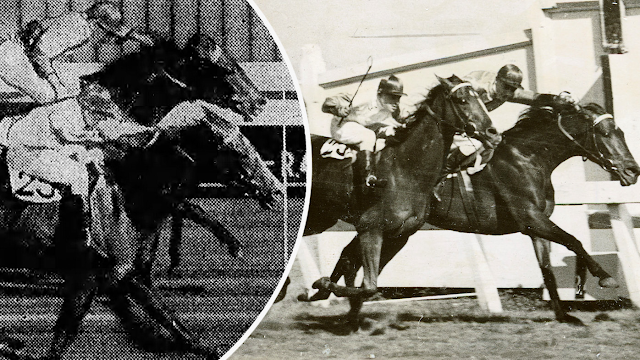
It was 1948 and it was the first time a photo finish was used in the race.

Rimfire, an 80-1 outsider, beat Dark Marne, just. Without the photo evidence the race could have easily gone to the other rider or ended in a dead heat.


Ray Neville had placed second in the Caulfield Cup two weeks before the big race.

Rimfire’s jockey was re-positioned to ride the race favorite instead, and the trainer, Stan Boyden, was out of options. Young Neville was picked to ride Rimfire at the last minute. His previous win had not gone unnoticed, and he was small. It would have to do.

According to Ray Neville’s daughter Christine Currie:

“There is no way they would put someone so young and unexperienced like my dad on an expensive horse like that today. [Rimfire] was an 80 to one outsider. The jockeys thought it was a joke and the trainer was not placing any bets. He would tell us as kids that as he was coming round the last bend he just went for it. He thought he might just have a chance – he was as shocked as everybody else.”

Ray Neville won 25 pounds, enough for a new suit and a saddle, which was later stolen, and was presented with a whip and a cup. That night he sat on a bench and had fish and chips for dinner – no grand celebration for the youngster in those days.

“It will never ever happen again, my dad was the youngest on record and most likely always will be,” Ms Currie said.

Mr Neville won 25 pounds, enough for a new suit and a saddle, which was later stolen, and was presented with a whip and a cup.

That night he sat on a bench and had fish and chips for dinner – no grand celebration for the youngster in those days.

“It will never ever happen again, my dad was the youngest on record and most likely always will be,” Ms Currie said.

Mr Neville continued to ride until 1968 and worked in the racing world issuing barrier certificates well into his 50s.

He died suddenly in 2008, five weeks after his 60th birthday.

A photograph captures Ray Neville as he dismounts Rimfire after winning the race.

H. G. Raymond with Jockey Ray Neville, after their 1948 Melbourne Cup success with Rimfire.


Sunday, November 5, 2023

QUOTE FOR THE DAY

As I note below, Tuesday is Melbourne Cup Day, it brings to mind a comment made by Trudy, a legal secretary who used to be part ot my office years ago. Asked about her prediction for the winning horse, she replied:

"Don't ask me, all I know about horses is that one end eats and the other shits."

MELBOURNE CUP

-----oOO-----

Tuesday will be Melbourne Cup day so here are some facts and trivia items . . . 

From:

-----oOo-----

Fun Facts about the Melbourne Cup

It’s the race that stops the nation at 3pm, the first Tuesday in November- The Melbourne Cup! In celebration of Australia’s biggest race, our blog post today has gathered all the fun facts we can find about the world’s greatest “2-mile” race.

The Race that Stops the Nation
  • The first running was in 1861
  • It wasn’t always run on a Tuesday, or even in November! The first Tuesday in November became tradition after 1875. Over the first decade of the race, it was run on a Thursday, and even once in October.
  • The first running in 1861 was won by Archer, a stallion who had been travelled on foot from Terara NSW, a mere 800km from the track. Archer went on to win the 1862 running as well, placing him in an elite category of horses to have won the cup more than once.
  • Up to 39 horses have taken to the starting barriers, which was in the running of the 1890 Cup. In the modern era, the race is capped at 24 starters.
  • Over 100,000 people flock to Flemington on Race Day. 2003 holds an attendance record of over 122,700 spectators.
The “Cup” 
  • It wasn’t until 1865 that a trophy was awarded for winning “The Cup”. The first trophy was in fact deemed so unattractive that it was sold by the winner, and eventually re-presented as a prize at the local Hunt Club
  • Trophy design was original for each running, up until 1919 when the traditional Cup style we recognize today, was adopted
  • The $1 Million prizemoney of the 1985 Melbourne Cup made it the first race in Australia to reach over a million. This prize pool has continued to expand, to over $8 million in 2021
  • There has never been a dead heat for first prize, meaning no sharing of the cup! However there have been two instances where 3rd place getters were inseparable.
Cup Records 
  • The fastest time which the 3200m race has been run was 3:16.3 minutes, set by Kingston Rule in 1990
  • The longest winning margin is 8 lengths, achieved by Archer (1862) and Rain Lover (1968)
  • Makybe Diva holds the most cup wins for a single horse, passing the post first in 2003, 2004 and 2005
  • Bart Cummings, the Cup King, has trained the most winners, with 12 titles.
  • Two jockeys in history have won the cup on 4 occasions. Bobby Lewis in the early 1900’s and Harry White in the 1970’s.
  • Lloyd Williams is the most successful Melbourne Cup winning Owner, with 7 titles
Girl Power 
  • Ever heard of Melbourne Cup winner Briseis? Briseis won the 1876 running, as a 3yo filly. Within the same week though, she also ran in, and won, the Victorian Derby and the Oaks! To top it all off, she was jockeyed by the youngest winner in the race’s history, almost 13yo Peter St Albans
  • First female jockey to ride in the race was Maree Lyndon in 1987, riding Argonaut Style
  • Sheila Laxon trained mare Ethereal to claim the 2001 Cup, and title of first female winning trainer
  • Gai Waterhouse, the Queen of Australian Racing trained Fiorente to top glory in 2013
  • In 2015 Michelle Payne wrote history as the first female jockey to be first over the line, with $101 odds, Prince of Penzance.
  • 11 mares have won the race over its recorded history
A numbers game 
  • No horse has ever won from barrier 18, nor won with the number 18 saddlecloth
  • Barrier 5 has been most successful
  • Brew in 2000 was the last horse to win from the outermost barrier, jumping from gate 22.
  • Numbers 4 and 12 share the record for most wins, with 11 each
They come from afar 
  • Vintage Crop, in 1993, was the first Northern Hemisphere trained horse to salute for the cup
  • Internationals have dominated the field. Of the past 5 running’s, 4 winners have come from abroad. In 2020 the first 4 past the post were all bred outside of Australia
  • Vow and Declare (2019) was the first Australian bred and trained horse to win since Shocking (2009)
Happy Melbourne Cup, and best of luck!


Saturday, November 4, 2023

QUOTE FOR THE DAY


BUREAUCRACY

 ----oOo-----

I have been told that yesterday's Bytes post was aparrently not sent to subscribers by the server for some reason, so I am reposting it - I was experiencing some computer glitches and that may have been the cause.

Please let me know if this is received.

-----oOo-----

From the vault . . .


How To Create Bureaucracy, Policy, And Procedures


1. Start with a cage containing five apes. In the cage, hang a banana on a string and put stairs under it. Before long, an ape will go to the stairs and start to climb towards the banana.

2. As soon as the ape touches the stairs, spray all of the apes with cold water. After a while, another ape makes an attempt with the same result - all the apes are sprayed with cold water.

3. Turn off the cold water. If, later, another ape tries to climb the stairs, the other apes will try to prevent it even though no water sprays them.

4. Now, remove one ape from the cage and replace it with a new one. The new ape sees the banana and wants to climb the stairs. To his horror, all of the other apes attack him. After another attempt and attack, he knows that if he tries to climb the stairs, he will be assaulted.

5. Next, remove another of the original five apes and replace it with a new one. The newcomer goes to the stairs and is attacked. The previous newcomer takes part in the punishment with enthusiasm.

6. Again, replace a third original ape with a new one. The new one makes it to the stairs and is attacked as well. Two of the four apes that beat him have no idea why they were not permitted to climb the stairs, or why they are participating in the beating of the newest ape.

7. After replacing the fourth and fifth original apes, all the apes which have been sprayed with cold water have been replaced.

Nevertheless, no ape ever again approaches the stairs. Why not?

"BECAUSE that's the way it's always been done around here."


If the above item seems a bit extreme, note the following comments by someone responding online to the above:

Heard a story about a woman who always cut the end off the leg of lamb before putting it in to roast, it was because her mother did. When the mother was asked, it was for the same reason. When the grandmother was asked, her answer was "because my pan is too small". The younger generations had the right size pans but continued to trim!

By the way . . .


QUOTE FOR THE DAY


BUREAUCRACY

-----oOo-----


FROM THE VAULT

-----oOo-----


How To Create Bureaucracy, Policy, And Procedures

1. Start with a cage containing five apes. In the cage, hang a banana on a string and put stairs under it. Before long, an ape will go to the stairs and start to climb towards the banana.

2. As soon as the ape touches the stairs, spray all of the apes with cold water. After a while, another ape makes an attempt with the same result - all the apes are sprayed with cold water.

3. Turn off the cold water. If, later, another ape tries to climb the stairs, the other apes will try to prevent it even though no water sprays them.

4. Now, remove one ape from the cage and replace it with a new one. The new ape sees the banana and wants to climb the stairs. To his horror, all of the other apes attack him. After another attempt and attack, he knows that if he tries to climb the stairs, he will be assaulted.

5. Next, remove another of the original five apes and replace it with a new one. The newcomer goes to the stairs and is attacked. The previous newcomer takes part in the punishment with enthusiasm.

6. Again, replace a third original ape with a new one. The new one makes it to the stairs and is attacked as well. Two of the four apes that beat him have no idea why they were not permitted to climb the stairs, or why they are participating in the beating of the newest ape.

7. After replacing the fourth and fifth original apes, all the apes which have been sprayed with cold water have been replaced.

Nevertheless, no ape ever again approaches the stairs. Why not?

"BECAUSE that's the way it's always been done around here."


If the above item seems a bit extreme, note the following comments by someone responding online to the above:

Heard a story about a woman who always cut the end off the leg of lamb before putting it in to roast, it was because her mother did. When the mother was asked, it was for the same reason. When the grandmother was asked, her answer was "because my pan is too small". The younger generations had the right size pans but continued to trim!


By the way . . .


Friday, November 3, 2023

THOUGHT FOR THE DAY


FUNNY FRIDAY

---- 😊😊😊 -----


Byter Tim B sent me a limerick which relies on a Latin phrase so today’s them is Latin humour, some being from past Bytes . . .

Caution, some risque language ahead.


---- 😊😊😊 -----

SOME HUMOUR:
__________

I'm proud that I got 40% on my Latin exam.

After all, you should always XL.
__________

The professor gave me a C on my Latin exam...

Aced it!
__________

A Roman walks into a bar and says "I'll have a martinus please." The bartender, a little puzzled replies, "Don’t you mean a martini?" The Roman scoffs and says "If I wanted two I would have asked."
__________

I was hiking in the woods with the famed scatologist, Diedre Oppings, when we came across a brown mass.

"Bear?", I asked.

"No, clearly canine," she replied. She poked at it with a stick. "I think, a cocker spaniel mix, with..." She took a deep sniff. "Ah yes, poodle."

"You mean...?"

"Yes," she replied. "It's cocker poodle doo."
__________

Which reminds me of an oldie . . .

The Montana State Department of Fish and Game is advising hikers, hunters, fishermen and golfers to take extra precautions and keep alert for bears while hiking.

They advise people to wear noise producing devices such as little bells on their clothing to alert but not startle the bear unexpectedly. They also advise carrying pepper spray in case of an encounter with a bear.

It is also a good idea to watch for fresh signs of bear activity and know the difference between black bear and grizzly bear droppings.

Black bear droppings are smaller and contain berries and possibly squirrel fur.

Grizzly bear droppings have little bells in them and smell like pepper spray.
__________

A little boy named johnny is going to visit his neighbour's baby who was born with no ears.

"Listen Johnny, you must not mention the baby's ears, or i'll spank you." Johnny's mum explains to him. They arrive at the neighbour's house, and Johnny asks the neighbour: "So how much does he weigh?"

"He weighs a lot for his age, he's very healthy." The neighbour is excited to have someone so interested in her baby.

"Has he spoke yet?" Johnny asks. "He's already said mama, he shouldn't have said that for weeks." The neighbour getting even more excited.

"How's his eyesight?" Johnny asks next. "His eyesight is perfect." The neighbour states.

"Good, cause he's fucked if he needs glasses." Johnny replies.

---- 😊😊😊 -----


A reporter goes to Israel to cover the fighting. She is looking for something emotional and positive and of human interest. Something like that guy in Sarajevo who risked his life to play the cello everyday in the town square.

In Jerusalem, she heard about an old Jew who had been going to the Wailing Wall to pray, twice a day, every day, for a long, long time. So she went to check it out. She goes to the Wailing Wall and there he is! She watches him pray and after about 45 minutes, when he turns to leave, she approaches him for an interview.
"Rebecca Smith, CNN News. Sir, how long have you been coming to the Wailing Wall and praying?"

"For about 50 years."

"What do you pray for?"

"For peace between the Jews and the Arabs. For all the hatred to stop. For all of our children to grow up in safety and friendship."

"How do you feel after doing this for 50 years?"

"Like I'm talking to a fucking wall."
__________

Several centuries ago, the Pope decided that all the Jews had to leave the Vatican. Naturally there was a big uproar from the Jews, so the Pope agreed to debate with a member of their community. If the Jews won, they could stay. If the Pope won, the Jews would leave.

Knowing they had no choice, the Jews picked old Rabbi Moshe to represent them. His Latin wasn't very good, but he was a man of great faith and well respected. He accepted, on condition that it would be a silent debate. The Pope agreed. After all, what could be easier than a silent debate?

On the day of the great debate, Moshe and the Pope sat opposite each other.

After a minute the Pope raised his hand and showed three fingers. Moshe looked back and raised one finger.

The Pope waved his fingers in a circle around his head. Moshe pointed to the ground.

The Pope pulled out a wafer and a glass of wine. Moshe pulled out an apple.

The Pope stood up and said, "I give up. This man is too good. The Jews can stay."

As the puzzled cardinals clustered around the Pope, he explained: "First I held up three fingers to represent the Trinity. He held up one finger to remind me that one God is common to both our religions. When I waved my finger around me to show that God was all around us, he pointed down to show that God is also right here with us. When I showed him the wine and the wafer to show that God absolves us from our sins, he showed me an apple to remind me of original sin. He had an answer for everything. What could I do?"

Meanwhile, the Jews had crowded around Moshe. "What happened?" they asked. "Well," said Moshe, "He says to me, 'You Jews have three days to leave.' So I gave him the finger. Then he tells me the whole city would be cleared of Jews. So I said to him, 'We're staying right here'".

"And then?" asked a woman.

"Who knows?" said Moshe. "He took out his lunch so I took out mine."

---- 😊😊😊 -----


LIMERICK OF THE WEEK:

We lawyers love our Latin legal expressions, even if it puts one in mind of the centurion making Brian correct the Latin graffiti in Life of Brian. Byter Tim B sent me a limerick based on a Latin legalism, which I will get to a little later.

By way of introduction, let me repost the following item from Bytes Sept 4, 2012:

In 1983 the House of Lords was debating the Occupier’s Liability Bill, which sought to provide that a duty of care was owed to trespassers in certain situations. One of the Lords who spoke on the Bill was Lord Mishcon. In his speech he referred to Serjeant Sullivan.

The Serjeants-at-Law were an order of barristers that were the oldest in England. Dating back to 1300, the order was formally created by Henry 11 but their numbers began to decrease when Elizabeth 1 created the position of Queen’s Counsel. No more Serjeants were created from 1873 when the Judicature Act came into force. Lord Lindley (1828-1921) was the last English Serjeant-at-Law; A M Sullivan (1871-1959) was the last Irish Serjeant.

A M Sullivan

From Lord Mishcon’s speech from Hansard:
Volenti non fit injuria is a maxim of our common law well known to lawyers. "If you voluntarily take a risk you cannot complain about an injury resulting from it", is a rough and ready translation. But there is also a maxim which clearly applies to the criminal trespasser (if I may so call him) and that is ex turpi causa non oritur action - ... "no right of action stems from a wicked cause". These maxims, so beloved of lawyers, sometimes lead my profession into the pompous belief that the layman of necessity knows of them and understands them.

If I may digress, there is a classic and, I think, lovely story ascribed to the last of the great Irish Serjeants, Serjeant Sullivan, who was undaunted by any court before whom he appeared. On this occasion he was appearing in the Court of Appeal for an appellant workman in a workman's injury case. Said one of the learned Lord Justices: "Has your client never heard of the maxim, 'Volenti non fit injuria'?"—to which came the immediate reply in lovely Irish tones: "My Lord, in the small village in Antrim from which my client comes, it forms the sole topic of conversation."

Which brings me to Tim’s limerick, which has actually appeared in Bytes previously.

The Latin phrase “De minimis non curat lex” means “The law does not concern itself with trifles", a legal doctrine by which a court refuses to consider trifling matters. An alternative translation is that the law does not bother with small things, indicating that beneath a certain low level, a matter will be regarded as too trivial, and treated as such.

Tim’s limerick, worth a repost . . .

There once was a lawyer named Rex
With minuscule organs of sex.
Arraigned for exposure,
He maintained with composure,
"De minimis non curat lex."

Thanks, Tim.

---- 😊😊😊 -----

GALLERY:


---- 😊😊😊 -----


CORN CORNER:
__________

A Roman walks into a bar. He holds up two fingers and says 'Five beers, please'.
__________

5 ants rented an apartment with another 5 ants.

Now they’re tenants.
__________

My friend Joe recently started the Dolly Parton diet

It’s really made Joe lean, Joe lean, Jo lean, Joe leeeaaaannn
__________

I got fired from my job because I kept asking my customers whether they would prefer “Smoking” or “Non-smoking”.

Apparently the correct terms are “Cremation” and “Burial”.

---- 😊😊😊 -----


Thursday, November 2, 2023

THOUGHT FOR THE DAY


AESOP'S FABLES: THE EAGLE AND THE ARROW

-----------oOo-----------

Aesop's Fables, or the Aesopica, is a collection of fables credited to Aesop, a slave and storyteller believed to have lived in ancient Greece between 620 and 564 BCE. Of diverse origins, the stories associated with his name have descended to modern times through a number of sources and continue to be reinterpreted in different verbal registers and in popular as well as artistic media. The fables originally belonged to the oral tradition and were not collected for some three centuries after Aesop's death. By that time a variety of other stories, jokes and proverbs were being ascribed to him.

-----------oOo-----------


The Eagle and the Arrow

An Eagle was soaring through the air when suddenly it heard the whizz of an Arrow, and felt itself wounded to death. Slowly it fluttered down to the earth, with its life-blood pouring out of it. Looking down upon the Arrow with which it had been pierced, it found that the shaft of the Arrow had been feathered with one of its own plumes. “Alas!” it cried, as it died, “We often give our enemies the means for our own destruction.”

Diferent version:

An eagle sat on a lofty rock, watching the movements of a Hare whom he sought to make his prey. An archer, who saw the Eagle from a place of concealment, took an accurate aim and wounded him mortally. The Eagle gave one look at the arrow that had entered his heart and saw in that single glance that its feathers had been furnished by himself. “It is a double grief to me,” he exclaimed, “that I should perish by an arrow feathered from my own wings.”

---------oOo---------

Some comments:

The story of the eagle brought down by an arrow vaned with its own feather is referred to in several ancient Greek sources.

It is generally applied to the misery of realising that one has contributed to one's own injury but also as a warning against self-reliant pride.

The earliest mention of the fable is a brief reference in the 5th century BCE to refer to the personal blame felt by Achilles for the death of his friend Patroclus. “So the eagle, pierced by the bow-sped shaft, looked at the feathered device and said, “Thus, not by others, but by means of our own plumage are we slain”.

A version titled "The Archer and the Eagle" and ascribed to Aesop appears in his Fables.

A 1544 illustration of the wounded eagle is accompanied by a verse commenting that its sorrow at being struck down is doubled by the knowledge that it has furnished the means for its own destruction.

A wider lesson is drawn from the incident in another interpretation. The dying bird blames humans for using its own parts against itself and claims that they have learnt this cruelty from the way they treat each other.

A 1691 French version starts from the perception that the bird in the poem was on the look-out for a hare. If another hunter brings it down while so engaged, then it is a case of poetic justice, of having inflicted on itself the harm it was purposing to inflict on others.

Condemnation of pride was the interpretation given the fable when it travelled eastwards in the 11th century - an eagle soars through the air, vaunting itself. When it is brought down by a hunter and recognises the feathers on the arrow, the realisation comes that it has been injured by its own means.


-----oOo-----


The above reminds me of a famous phrase created by cartoonist Walt Kelly for his comic strip Pogo. Kelly coined the phrase for an anti-pollution Earth Day poster in 1970 and used it again in a special comic strip created for Earth Day 1971. The saying caught the collective imagination of the public and is still used today . . .


Wednesday, November 1, 2023

THOUGHT FOR THE DAY


FROM THE VAULT: NOVEMBER

--------oOo--------

November is the eleventh month of the Gregorian calendar.

In the northern hemisphere, autumn is coming to an end, the last leaves are falling, and it’s getting quite cold out. In the southern hemisphere. temperatures are heating up with the beginning of summer just around the corner.

--------oOo--------

Some facts and trivia . . .

--------oOo--------

November’s name has remained unchanged since the ancient Roman calendar, which was in use until 45 BC. This first Roman calendar was only made up of ten months, with November being the ninth month. September meant seven, October meant eight, November meant nine and December meant ten – sept, oct, novem, decem.

When the Julian calendar was adopted in 45 BC two new months, January and February, were added, which pushed November back to the 11th month. Despite its change in position, November was never renamed.
__________

On November 19, 1978, the largest group suicide in history took place in Jonestown, Guyana. The group who took their lives were instructed so by Reverend Jim Jones, who was the leader of the suicide cult called the “People’s Temple”. Over 900 of the cult members drank a cyanide-laced drink, with those who refused being forced to consume it.

Jim Jones
__________

November is the last of the four months which have 30 days. The other months are September, April, and June.
__________

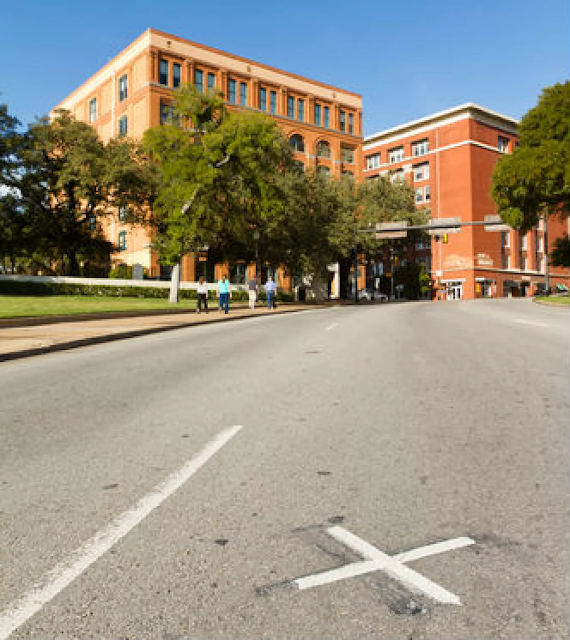
On November 22, 1963 President John F. Kennedy was fatally shot while riding along with his wife Jacqueline in a procession of cars. He was rushed to a hospital and was pronounced dead at 1 pm that day. Kennedy was the fourth US president to be assassinated, after Abraham Lincoln, James Garfield, and William McKinley.

My daughter, Acacia (whose birthday is November 20, btw), recently visited Dallas and sent me some pics. I was surprised to see that there are X’s painted on the ground where the shots hit . . .


The Texas Book Depository, now turned into a museum . . .


__________

The Anglo-Saxons had a fitting name for November. It’s usually at this time of the year in the northern hemisphere that cold winds start to chill to the bone, and as such, they called it “Wind Monath”, or wind month.

The Anglo-Saxons also called the month of November “Blod Monath”, or blood month. It gained this name as it was in November that they would traditionally slaughter cows to provide food for the long winter months.
__________

The fifth of November marks a historic day in the UK. On this day in 1605, a group of Roman Catholics plotted to blow up the English Parliament while King James I was inside. Fortunately, the plot was foiled. Every year festivities are held across the country to celebrate the group’s failure, which includes setting off countless fireworks, lighting bonfires, and even setting alight effigies of Guy Fawkes, one of the conspirators.


English Folk Verse (c.1870)

The Fifth of November

Remember, remember!
The fifth of November,
The Gunpowder treason and plot;
I know of no reason
Why the Gunpowder treason
Should ever be forgot!
Guy Fawkes and his companions
Did the scheme contrive,
To blow the King and Parliament
All up alive.
Threescore barrels, laid below,
To prove old England's overthrow.
But, by God's providence, him they catch,
With a dark lantern, lighting a match!
A stick and a stake
For King James's sake!
If you won't give me one,
I'll take two,
The better forme,
And the worse for you.
A rope, a rope, to hang the Pope,
A penn'orth of cheese to choke him,
A pint of beer to wash it down,
And a jolly good fire to burn him.
Holloa, boys! holloa, boys! make the bells ring!
Holloa, boys! holloa boys! God save the King!
Hip, hip, hooor-r-r-ray!

By the way . . .


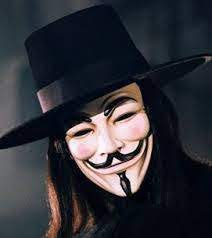
The Guy Fawkes mask (also known as the V for Vendetta mask or Anonymous mask) is a stylised depiction of Guy Fawkes (the best-known member of the Gunpowder Plot, an attempt to blow up the House of Lords in London on 5 November 1605) created by illustrator David Lloyd for the 1982–1989 graphic novel V for Vendetta. Inspired by the use of a mask representing Fawkes being burned on an effigy having long previously had roots as part of Guy Fawkes Night celebrations, Lloyd designed the mask as a smiling face with red cheeks, a wide moustache upturned at both ends, and a thin vertical pointed beard, worn in the graphic novel's narrative by anarchist protagonist V.

Following the release of the graphic novel and its 2006 film adaptation, this design came to represent broad protest, later also becoming a symbol for the online hacktivist group Anonymous.
__________

Thanksgiving is celebrated in the US on the fourth Thursday of November and has been celebrated since 1621. The first Thanksgiving was a feast celebrating the first bountiful harvest of the pilgrims of Plymouth and New England. It is still celebrated in a similar way, with families coming together and sharing plentiful amounts of food traditionally available during November.

Ron Cobb’s take on Thanksgiving
__________

The Full moon in November is traditionally called the Beaver Moon in the US. The tradition goes back to North America’s early colonial years, as it was during this time of year that hunters would set their beaver traps for the last time before the lakes and water sources they lived in froze over.
__________

November has just one birthstone, the radiant topaz. The topaz is symbolic of many things, but most of all it is a symbol of strength and honour. The ancient Greeks also believed that the stone had the ability to turn oneself invisible.


Common topaz in its natural state is colourless, though trace element impurities can make it pale blue or golden brown to yellow orange. Topaz is often treated with heat or radiation to make it a deep blue, reddish-orange, pale green, pink, or purple.
__________

November also only has one birth flower, the chrysanthemum. Different coloured chrysanthemums have different meanings though – a white flower symbolizes pure love and truth, a red flower says “I love you” while a yellow flower is a symbol of unrequited love.

In Australia, the chrysanthemum flower is often considered the official flower for Mother’s Day.

In Belgium, Hungary, Lithuania, France, Poland, Austria, and other parts of Europe, the chrysanthemum flower is used at funerals and as memorial flowers to honor the dead. In these places, the chrysanthemum is often associated with death.
__________

November 3, 1957, was a historic day for both Soviet Russia and the world. It was on this day that the first spacecraft carrying a live passenger was successfully launched into space. The passenger was Laika, a dog, an unassuming looking stray pooch who had been found on the streets of Moscow. The Soviets used stray dogs in their tests because they assumed that they would be used to the hunger and cold that they would inevitably experience in outer space.

No capacity for her recovery and survival was planned, and she died of overheating or suffocation hours into the flight. Little was known about the impact of spaceflight on living creatures at the time of Laika's mission, and the technology to de-orbit had not yet been developed, so Laika's survival was never expected.


Laika died within hours from overheating, possibly caused by a failure of the central R-7 sustainer to separate from the payload. The true cause and time of her death were not made public until 2002; instead, it was widely reported that she died when her oxygen ran out on day six or, as the Soviet government initially claimed, she was euthanised prior to oxygen depletion.
__________

The beginning of the end of the War of Independence began on November 30, 1782, when a provisional treaty was signed between the newly-formed United States of America and the Kingdom of Great Britain. The final treaty wasn’t completed and signed until nearly a year later in Paris on September 3, 1783.
__________

Some of the more notable people born in November include Mark Twain, Leonardo DiCaprio, Winston Churchill, Kurt Vonnegut, and Scarlett Johansson.

Those born in November can be born under one of two very different star signs. If you’re born before November 23rd then you have the sign of Scorpio. Those born on November 23rd or later have the sign of Sagittarius. Scorpios are said to value trust and honesty above other things, as well as being quite intense yet imaginative people. Those born under the sign of Sagittarius are quite different, being energetic and idealistic, while also generous and open-minded.
__________


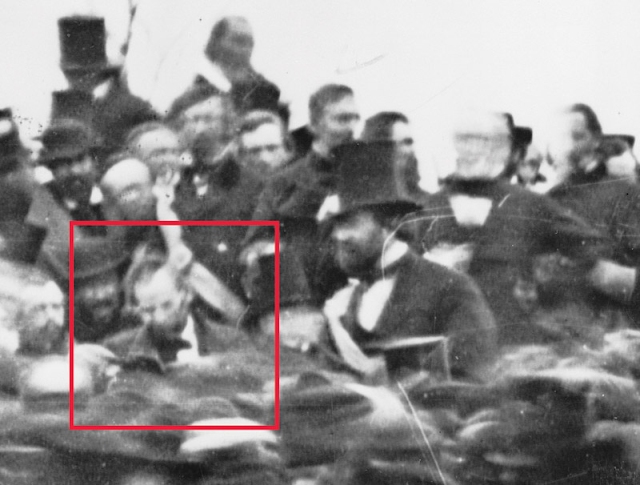
On November 19, 1863, President Abraham Lincoln delivered the Gettysburg Address at the consecration of the National Cemetery at the site of the Gettysburg battle. While Lincoln’s speech was just two minutes long it summed up everything important there is about democracy. Interestingly, Lincoln was in the middle of a minor bout of smallpox while he gave the speech, and looked drained and ghost-like.
Four score and seven years ago our fathers brought forth on this continent, a new nation, conceived in Liberty, and dedicated to the proposition that all men are created equal.

Now we are engaged in a great civil war, testing whether that nation, or any nation so conceived and so dedicated, can long endure. We are met on a great battle-field of that war. We have come to dedicate a portion of that field, as a final resting place for those who here gave their lives that that nation might live. It is altogether fitting and proper that we should do this.

But, in a larger sense, we can not dedicate—we can not consecrate—we can not hallow—this ground. The brave men, living and dead, who struggled here, have consecrated it, far above our poor power to add or detract. The world will little note, nor long remember what we say here, but it can never forget what they did here. It is for us the living, rather, to be dedicated here to the unfinished work which they who fought here have thus far so nobly advanced. It is rather for us to be here dedicated to the great task remaining before us—that from these honored dead we take increased devotion to that cause for which they gave the last full measure of devotion—that we here highly resolve that these dead shall not have died in vain—that this nation, under God, shall have a new birth of freedom—and that government of the people, by the people, for the people, shall not perish from the earth.

—Abraham Lincoln
Today, the phrase “government of the people, by the people, for the people” is still regarded as the best definition of democracy.

President Lincoln at Gettysburg. A crowd of citizens and soldiers surround Lincoln (with a red arrow pointing to his location in photo).