Tuesday, November 28, 2023

THOUGHT FOR THE DAY


POETRY SPOT

---------oOo---------

Henry Lawson (1867 – 1922), an Australian writer and bush poet, has featured regularly in Bytes posts, mostly for poems about the harshness of life in the bush and the grittiness of the cities.

Along with his contemporary Banjo Paterson, Lawson is among the best-known Australian poets and fiction writers of the colonial period and is often called Australia's "greatest short story writer".

A vocal nationalist and republican, Lawson regularly contributed to The Bulletin, and many of his works helped popularise the Australian vernacular in fiction. He wrote prolifically into the 1890s, after which his output declined, in part due to struggles with alcoholism and mental illness. At times destitute, he spent periods in Darlinghurst Gaol and psychiatric institutions. After he died in 1922 following a cerebral haemorrhage, Lawson became the first Australian writer to be granted a state funeral.


---------oOo---------

Here is a poem that is not in the usual Lawson mould . . .

---------oOo---------

Do You Think That I Do Not Know?

    - Henry Lawson

They say that I never have written of love,
As a writer of songs should do;
They say that I never could touch the strings
With a touch that is firm and true;
They say I know nothing of women and men
In the fields where Love's roses grow,
And they say I must write with a halting pen
Do you think that I do not know?
When the love-burst came, like an English Spring,
In days when our hair was brown,
And the hem of her skirt was a sacred thing
And her hair was an angel's crown.
The shock when another man touched her arm,
Where the dancers sat round in a row;
The hope and despair, and the false alarm
Do you think that I do not know?
By the arbour lights on the western farms,
You remember the question put,
While you held her warm in your quivering arms
And you trembled from head to foot.
The electric shock from her finger tips,
And the murmuring answer low,
The soft, shy yielding of warm red lips
Do you think that I do not know?
She was buried at Brighton, where Gordon sleeps,
When I was a world away;
And the sad old garden its secret keeps,
For nobody knows to-day.
She left a message for me to read,
Where the wild wide oceans flow;
Do you know how the heart of a man can bleed
Do you think that I do not know?
I stood by the grave where the dead girl lies,
When the sunlit scenes were fair,
And the white clouds high in the autumn skies,
And I answered the message there.
But the haunting words of the dead to me
Shall go wherever I go.
She lives in the Marriage that Might Have Been
Do you think that I do not know?
They sneer or scoff, and they pray or groan,
And the false friend plays his part.
Do you think that the blackguard who drinks alone
Knows aught of a pure girl's heart?
Knows aught of the first pure love of a boy
With his warm young blood aglow,
Knows aught of the thrill of the world-old joy
Do you think that I do not know?
They say that I never have written of love,
They say that my heart is such
That finer feelings are far above;
But a writer may know too much.
There are darkest depths in the brightest nights,
When the clustering stars hang low;
There are things it would break his strong heart to write
Do you think that I do not know?


Monday, November 27, 2023

THOUGHT FOR THE DAY


SOME PHOTOS OF THE PAST

---------oOo---------

Dr. Werhner von Braun,”Father of Rocket Science” and Walt Disney in 1954:


Von Braun worked with Walt Disney on a series of films, which popularized the idea of human space travel in the U.S. and beyond from 1955 to 1957.

He served as technical advisor on three space-related television films that Disney produced in the 1950s. Together, von Braun and Disney used the new medium of television to illustrate how high man might fly on the strength of technology and the spirit of human imagination.
__________

Some background and information:

Wernher von Braun (1912 – 1977) was a German and American aerospace engineer and space architect. He was a member of the Nazi Party and Allgemeine SS, and the leading figure in the development of rocket technology in Nazi Germany and later a pioneer of rocket and space technology in the United States.

As a young man, von Braun worked in Nazi Germany's rocket development program. He helped design and co-developed the V-2 rocket at Peenemünde during World War II. The V-2 became the first artificial object to travel into space on 20 June 1944. Following the war, he was secretly moved to the United States, along with about 1,600 other German scientists, engineers, and technicians, as part of Operation Paperclip. He worked for the United States Army on an intermediate-range ballistic missile program, and he developed the rockets that launched the United States' first space satellite Explorer 1 in 1958. He worked with Walt Disney on a series of films, which popularized the idea of human space travel in the U.S. and beyond from 1955 to 1957.

In 1960, his group was assimilated into NASA, where he served as director of the newly formed Marshall Space Flight Center and as the chief architect of the Saturn V super heavy-lift launch vehicle that propelled the Apollo spacecraft to the Moon. In 1967, von Braun was inducted into the National Academy of Engineering, and in 1975, he received the National Medal of Science.

Von Braun is a highly controversial figure widely seen as escaping justice for his Nazi war crimes due to the Americans' desire to beat the Soviets in the Cold War. He is also sometimes described by others as the "father of space travel", the "father of rocket science", or the "father of the American lunar program". He advocated a human mission to Mars.
__________

I have previously posted about the controversial aspects of Werhner von Braun’s Nazi background, Interesting reading, access by clicking on:
__________

Tom Lehrer wrote a song about Werhner with interesting lyrics.

Hear it and see Lehrer perform it at:

The lyrics:

Gather round while I sing you of Wernher von Braun,
A man whose allegiance
Is ruled by expedience.
Call him a Nazi, he won't even frown.
"Ha, Nazi schmazi," says Wernher von Braun.

Don't say that he's hypocritical,
Say rather that he's apolitical.
"Once the rockets are up, who cares where they come down?
That's not my department," says Wernher von Braun.

Some have harsh words for this man of renown,
But some think our attitude
Should be one of gratitude,
Like the widows and cripples in old London town
Who owe their large pensions to Wernher von Braun.

You too may be a big hero,
Once you've learned to count backwards to zero.
"In German or der English I know how to count down,
Und I'm learning Chinese," says Wernher von Braun.

---------oOo---------

Dinosaurs are transported on the Hudson River to the 1964 World’s Fair:


---------oOo---------

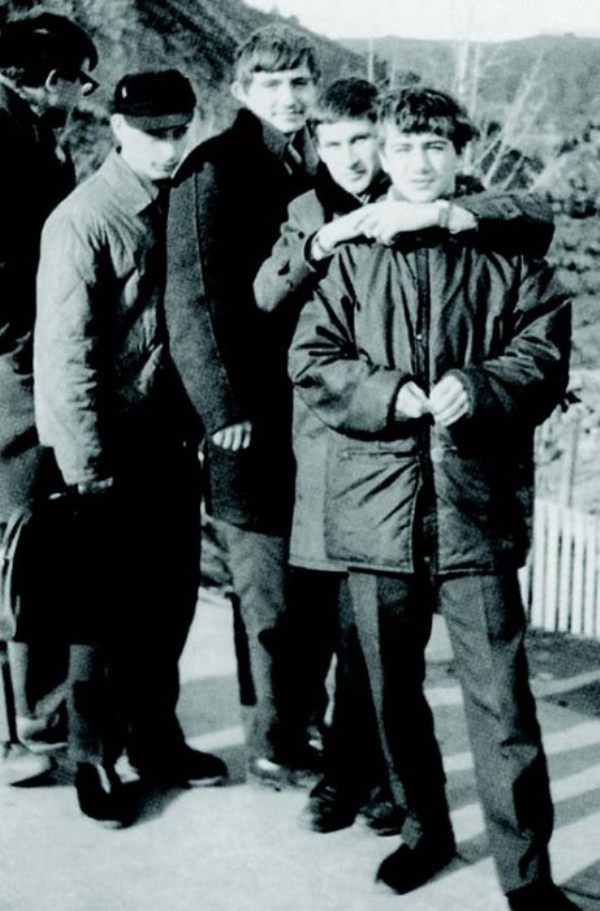
Vladimir Putin and his childhood friends in 1969. None of them have been seen since:


---------oOo---------

Future presidents Bill Clinton and George Bush with Governor George Wallace at a BBQ in 1983:


---------oOo---------

Children for sale in Chicago, 1948. Some parents sold their children due to poverty:


Hard to believe, right? Is it true? . . . .

From:

The Tragic Story Behind The Photo Of Four Children Who Had To Be Sold To Escape Poverty In The 1940s
Ananda Dillon
Updated September 24, 2021

America in the 1940s was a tumultuous place to live. World War II raged through the first half of the decade, finally ending in 1945 and leaving its mark on the country for decades. During the war, food and supplies were rationed, and, though the end of the war marked an economic boom in America, not everyone felt its effects. Recovery, in some instances, took years, and the Cold War turned international relations frosty when the Soviet Union asserted itself.

A photo of children for sale, taken in August of 1948, perfectly encapsulates the experience of those still down on their luck years after the war. The idea of any mother selling her children, let alone selling them with a sign posted in her front yard, feels preposterous by today's standards. But this 1948 image of children for sale is no joke, and the kids pictured did, in fact, find themselves sold off to strangers at the behest of their own parents.

Sadder still, the children for sale in the Chicago area went on to experience further hardship in their new homes. This 1948 image is truly one of those examples of film capturing an incredibly low moment that history won't let us forget.

In the tragic picture, the four children are seen on display on their front stoop as their mother hides her face from the photojournalist. The woman, Lucille Chalifoux, was only 24 years old, but pregnant with her fifth child at the time. Lucille and her husband Ray, age 40, were facing eviction from their apartment at the time. Ray had lost his job as a coal truck driver. Faced with the prospect of being homeless – and the daunting task of feeding so many mouths – they chose to auction off their own children.

Within two years, all four of the children pictured, as well as the child she was carrying, were sold off or given to other homes.

Seven-Year-Old RaeAnn Was Sold For $2

In the middle of the process of being purchased for $2, RuthAnn recalls that her younger brother Milton was crying so hard that the couple paying for her decided to take him as well. RuthAnn remembers the situation not so much as her mother trying to take care of the children but as her needing money for superficial pleasures. The couple who paid $2 for a 7-year-old girl was John And Ruth Zoeteman, farmers who ended up using their "adopted" kids as forced labor.

There is no evidence that they paid additional cash for Milton, or how much it would have been.

The Original Photo Ran In A Newspaper With A Heartbreaking Caption

The Valparaiso Vidette-Messenger ran the photo on August 5, 1948, with this caption, announcing the ages of the children and giving a bit of context yet very little background for such a tragic story.

“A big 'For Sale' sign in a Chicago yard mutely tells the tragic story of Mr. and Mrs. Ray Chalifoux, who face eviction from their apartment. With no place to turn, the jobless coal truck driver and his wife decide to sell their four children. Mrs. Lucille Chalifoux turns her head from camera above while her children stare wonderingly. On the top step are Lana, 6, and Rae, 5. Below are Milton, 4, and Sue Ellen, 2.”

According to a story in the NY Post, the photo grabbed public attention and soon made its way around newspapers in multiple states, even as far as Texas and New York.

Some Of The Children Were Allegedly Treated As Slaves In Their New Homes

Two of the children, RaeAnn and Milton, were sold to farmers John and Ruth Zoeteman for $2. The Zoetemans changed their names to Beverly and Kenneth and took them back to their farm. On the farm, the two children were reportedly regularly chained up in the barn. They were bought for the purpose of working on the farm and were forced to slave away for long hours. Milton even recalls his new "father" calling him a slave.

Media Buzz Helped Spur People To Donate To The Family, But No One Knows Where The Money Went

According to the NY Post, several days after the sad photo and its caption ran in a newspaper called the Chicago Heights Star, "A Chicago Heights woman offered to open her home to the children and that offers of jobs, homes and financial assistance poured in." However, it's unclear where the financial assistance was distributed, and whether it merely held the family together for another few years. Reportedly, it was another two years before the children were entirely sold off.

Family Members Accused The Mother Of Being Paid To Stage The Photo

Despite the legendary status of this photograph, to this day it is unknown how long the sign was posted, offering up the children for sale. As one writer noted, it might have been there just long enough for the photo to be taken, but it might have stood for years. Either way, some of the family members claimed the mother was just trying to drum up publicity by staging the photo.

In the days of reality TV when it seems many others are trying to do the same, it almost makes sense that perhaps Lucille Chalifoux was turning desperate times into desperate, inane actions.

Their Birth Mother Went On To Have Four More Children – And She Kept Them

The youngest child, David, whose birth name was Bedford Chalifoux, was given away at two years of age. When his adoptive family, the McDaniels, received him, he had bed bug bites all over his body. They raised him in a strictly religious fashion, but their proximity to his siblings RaeAnn and Milton allowed him to visit them at the farm on which they lived. He remembers untying them in the barn.

Years later, David reunited with his birth mother. Upon seeing him, she told him he looked just like his father but offered no apologies. He also met the four daughters she had during a later marriage: children which she kept.




Sunday, November 26, 2023

QUOTE FOR THE DAY


FACTS


---------oOo---------

The Darvaza gas crater, also known as the Door to Hell or Gates of Hell, is a burning natural gas field collapsed into a cavern near Darvaza, Turkmenistan. The floor and especially rim of the crater are illumined by hundreds of natural gas fires. The crater has been burning since the 1980's, as how the crater formed is unknown but it is said that a Soviet oil rig fell into the crater in 1971, and a geologist decided to get rid of the rig by setting the pit on fire. The resulting gas-fed flames continue burning to this day.

The burning natural gas field in Derweze, Turkmenistan. This image is made from three 17mm shots stitched together and the field of view is larger than it may appear (the field has roughly the size of two basketball courts).


Some facts:
  • The crater is 30m (99 feet) deep in the centre and 69m (226 feet) wide.
  • The temperature inside the crater can reach 1,000 degrees C (1,832degrees F).
  • Visitors can spend the night in yurts pitcheed beside the crater.
  • In 2014 explorer and adventurer George Kourounis was the first individual to descend into the crater and reach the bottom, wearing fire resistant gear. He says that in that gear he felt “ a bit like a baked potato.”

__________

Salar de Uyuni is the world's largest salt flat, or playa, at over 10,000 square kilometres (3,900 sq mi) in area. It is in southwest Bolivia, near the crest of the Andes at an elevation of 3,656 m (11,995 ft) above sea level.

Incahuasi island in the center of the Salar.

Some facts:
  • The Salar serves as the major transport route across the Bolivian Altiplano and is a prime breeding ground for several species of flamingos.
  • It has been used as a filming location for movies such as Star Wars: The Last Jedi (2017; as planet Crait).
  • The Palacio de Sal (Spanish for "Palace of salt") is a hotel built of salt blocks at the edge of Salar de Uyuni. The building was constructed of about 1 million 35-cm (14-inch) salt blocks, which are used for the floor, walls, ceiling and furniture, including beds, tables, chairs and sculptures. The sanitary system has been restructured to comply with the government regulations. The hotel has a dry sauna and a steam room, a saltwater pool and whirlpool baths.

Palacio De Dal
  • The salt forms eye-catching hexagon shapes on the surface. Groundwater seeping up to the surface evaporates, leaving a crust of salts and other minerals that had been dissolved in the water. Most striking, this process results in low ridges of concentrated salt that divide the playa into polygons: mostly hexagons with a smattering of pentagons and other geometric shapes.

  • During the rainy season (November to March) the water accumulates on the surface of the Salar de Uyuni and creates a giant mirror that perfectly reflects the sky and clouds above. It has been dubbed “The Mirror of God”.
__________

Hidden Beach is part of the Marieta Islands in Mexico.


Some facts:
  • Invisible from the outside, no boats can make their way into the little bay, so would-be visitors must hop into the water and swim under the rocks to reach their destination. Hidden Beach is only accessible through a water tunnel that must be swum with a snorkeling mask but no fins (to protect the delicate sea bed).
  • Only swimming and sunbathing is allowed.
  • The strange formation of the ‘hidden beach’ is due to military explosives testing in the 1900s, which left several craters and caves on the islands. However, an outcry led by Jacques Cousteau in the 1960s put an end to this practice, along with any other harmful human intervention.
  • Due to federal regulations, time inside Hidden Beach is limited to 20 minutes.


Saturday, November 25, 2023

THOUGHT FOR THE DAY


SOME MORE BADASS PEOPLE . . .


---------oOo---------

From:

---------oOo---------

Hugh Glass

Illustration of Hugh Glass and his legendary bear attack published at the time for a newspaper.

While scouting for game in Grand River in 1823, Hugh Glass ran into a grizzly-bear mom who attacked him to defend her two cubs.

Unable to reach his rifle as they wrestled on the ground, Glass was able to escape from her death grip and stab her with his knife while she shredded his face, chest, arm, and back with her claws. His wounds were so gruesome that his fellow trappers simply placed a bear hide over him as a funeral shroud and left him for dead so they could get out of the hostile territory and away from the Native Americans who had recently killed half of their crew. With pretty much anyone else, the whole horrendous story would have ended there.

But not Hugh Glass. When Glass eventually regained consciousness, he set his own leg, wrapped himself in his bear hide shroud, and started crawling along the banks of the Cheyenne River.

During the insane trek across country that followed, he prevented gangrene from infecting his wounded back by lying on a rotting log and allowing maggots to eat his dead flesh, sustained himself by killing and eating rattlesnakes, and crawled overland for six weeks until he reached civilization — which was really surprised and impressed to see him alive.

His story has been the basis of two feature-length films: Man in the Wilderness (1971) and The Revenant (2015).
__________

Juliane Koepcke

Revisiting the crash site for a documenttary

On Dec. 24, 1971, a Peruvian commercial airliner crashed in a thunderstorm over the Amazon, killing every one of the 92 crew members and passengers aboard, except for one person...

High school senior Juliane Koepcke fell a total of 2 miles from the sky into the Amazon rainforest strapped to her seat — and walked away from the accident. For 10 days. Through the jungle. With a concussion, a broken collarbone, and a hole in her right arm. Then she met up with some local lumberman and took a canoe home.

After recovering from her injuries, Koepcke assisted search parties in locating the crash site and recovering the bodies of victims. Her mother's body was discovered on 12 January 1972.

Koepcke returned to her parents' native Germany, where she fully recovered from her physical injuries.

__________

Dr. Leonid Rogozov

In 1961, Rogozov developed peritonitis, meaning that he would have to get his appendix taken out or die. The problem? He was the only doctor stationed at the Novolazarevskaya Station in Antarctica at the time, the nearest help was a thousand miles away, and a massive blizzard was forming, which meant that he would have to perform the appendectomy on himself.

With two non-medically trained researchers standing by to pass him tools, Rogozov used a mirror, some novocaine, and a scalpel to remove his appendix over the course of an excruciating two-hour operation. In 1961 he was awarded the Order of the Red Banner of Labour, which is some cool Soviet award for being a total badass.

The operation started at 02:00 local time on 1 May with the help of a driver and meteorologist, who provided instruments and held a mirror so Rogozov could observe areas not directly visible. Rogozov lay in a semi-reclining position, half-turned to his left side. A solution of 0.5% novocaine was used for local anesthesia of the abdominal wall. Rogozov made a 10–12 cm incision of the abdominal wall, but while opening the peritoneum he accidentally cut the cecum and had to suture it. Then he exposed the appendix. According to his report, the appendix was found to have a dark stain at its base, and Rogozov estimated it would have burst within a day. The appendix was resected and antibiotics were applied directly into the peritoneal cavity. General weakness and nausea developed about 30–40 minutes after the start of the operation so that short pauses for rest were repeatedly needed after that. By about 04:00 the operation was complete.

After the operation, gradual improvement occurred in the signs of peritonitis and in the general condition of Rogozov. Body temperature returned to normal after five days, and the stitches were removed seven days after the operation. He resumed his regular duties in about two weeks.

The incident resulted in a change of policy, and thereafter, extensive health checks were mandatory for personnel to be deployed on such expeditions.


__________

Jane Todd Crawford

In December 1809 in Green County, Kentucky, Jane Todd Crawford was informed that the thing she thought was a beyond-term pregnancy was actually a massive 22.5-pound ovarian tumor. In those days no one had ever successfully removed an ovarian tumor, but JTC wasn't the type to give up easily.

Tumor in tow, she rode horseback 60 miles to Danville to meet up with Dr. Ephraim McDowell, who was willing to cut the thing out of her in an operation that had never been previously attempted.

In those days, anesthesia was for wimps, and Jane opted for a dose of opium and five or six attendants to hold her down. She kept her spirits up by singing hymns and psalms until it was all over. Then she up and lived for another 32 years.

Grave of Jane Todd Crawford
__________


Agustina de Aragón


Agustina de Aragón became known as “the Spanish Joan of Arc” during the Spanish War of Independence, when, after showing up at a battle to bring apples to the gunners, she ended up running in the wrong direction in what was supposed to be a retreat of Spanish soldiers and attacking the French cannons at point blank range with a cannon of her own, annihilating an entire wave of attackers.

The Spaniards were so inspired and shamed that they turned around and ran back to help her out. After a short battle, the French decided they were nowhere near crazy enough to take on Agustina and her friends and gave up.

Later on, she was captured by the French, who were about to rue the day they ever met her, because she made a daring escape and took over a band of guerrillas, which she proceeded to lead on a series of raids against the French army.


Friday, November 24, 2023

THOUGHT FOR THE DAY


FUNNY FRIDAY

---- 😊😊😊 -----


It’s nice to have Bytes functioning normally again and for Funny Friday to go out when it’s supposed to.

Enjoy today’s humour, Byters, but there is some risqué content.

---- 😊😊😊 -----

SOME HUMOUR:
__________

A man goes for a walk in the park. On his walk, he sees two men sitting on a park bench and looking very down.

“What’s wrong?” he asked them.

One of the men looks up at the man and lets out a long sigh: “Take a seat and I’ll tell you.”

Curious, he sits down next to the two men.

“The paint’s wet,” the man says.
__________

After the Change of Command ceremony at an Army base, the new base commander sees a bench being guarded by two Privates. He asks the outgoing base commander the story behind that, outgoing base commander says it was that way when he took command. They check with the guy before, it was that way when he took command. Going back through prior commanders at the base, it was always like that when they took command. Eventually, they reach a 100 year old retired General. When they ask him, he’s incredulous - “You mean the paint still isn’t dry?”.
__________

The Olympian gold medallist in cross-country-skiing was being interviewed on TV and it came up in the interview that, what with training and all, he hadn't seen his wife for more than a year.

The interviewer asked, with a mischievous twinkle in his eye, "So, what's the first thing you plan to do when you get home, then?"

The gold medallist blushed furiously and said "No, no, I can't answer that on television, that is way too personal! Why don't you ask me, instead, the second thing I will do when I get home?"

"Alright, fine, what is the second thing you will do when you get home?"

The gold medallist responded, "Take my skis off.”
__________


A kindergarten student was having trouble putting on his boots, and asked his teacher for help.

Even with her pulling and him pushing, the boots still didn't want to go on. Finally they got both boots on. She grimaced when the little boy said, "They're on the wrong feet."

Sure enough, they were. The teacher kept her cool as together they worked to get the boots back on - this time on the correct feet. The little boy then announced, "These aren't my boots." The teacher sighed and pulled the boots off.

The boy then said, "They're my brother's boots. My Mom made me wear them."

The teacher felt like crying, but she mustered up the strength to wrestle the boots back onto his feet. "Now," she said, "where are your mittens?"

The boy replied, "I stuffed them in my boots...."

---- 😊😊😊 -----


#1

A farmer drove over to his neighbour’s house and knocked on the door.

A boy, about 9, opened the door.

“Is your mom or dad home?” The farmer asked the boy

“No, they went in to town.” The boy replied

“Well, how about your brother Howard?” The farmer asked

“No, he went with mom and dad.” The boy said

The farmer stood there for a minute shifting from one foot to another and mumbling when the boy says

“I know where the tools are if you need to borrow one or I could give my dad a message for you.”

“Well,” The farmer said uncomfortably “I wanted to talk to your dad about your brother Howard getting my daughter pregnant.”

The boy thought for a moment then said

“You’ll have to talk to my dad about that. I know he charges $500 for the bulls and $150 for the pigs, but I have no idea how much he charges for Howard.”
__________

#2

It’s the postman’s last day before retiring.

When he gets to Mrs Cohen’s house she opens the door, asks him to come inside and takes him to the kitchen where she gives him a bowl of chicken soup. When he has finished the soup she takes him upstairs, where she proceeds to make love to him.

Afterwards she gives him a 5 dollar bill.

The postman is confused and says “Mrs Cohen, you have given me chicken soup, made love to me and now you give me a five dollar note. I’m puzzled.”

She replies: "Ahhh, this morning I told my husband that this was your last day and I asked what we should give you. He said ‘Fuck him, give him five dollars,’ but the soup was my idea.”

---- 😊😊😊 -----


LIMERICK OF THE WEEK:

(pp is an abbreviation for ‘pages’)

As he filled up the order book pp
He said, “I should get higher ww.”
So he struck for more pay
But alas, now, they say,
He is sweeping the elephant cc.

---- 😊😊😊 -----

GALLERY:


---- 😊😊😊 -----


CORN CORNER:
_________

What did the atheist name her son?

Godfrey
__________

The "second" time Hansel and Gretel found a gingerbread cottage in the woods, they sent someone else to take a trial nibble first.

This is called "Munch Housen by Proxy"
__________

DDid you know, that the temptation to sing "The Lion Sleeps Tonight",
is never more than a whim away?

A whim away.

A whim away..
__________

I bought a shirt and some neckwear from Ebay that used to belong to the guy from the Mamas & the Papas. . .

All the sleeves are brown and the tie is gray

---- 😊😊😊 -----

Tuesday, November 21, 2023

THOUGHT FOR THE DAY


ASESOP’S FABLES

---------oOo---------

Aesop's Fables, or the Aesopica, is a collection of fables credited to Aesop, a slave and storyteller believed to have lived in ancient Greece between 620 and 564 BCE. Of diverse origins, the stories associated with his name have descended to modern times through a number of sources and continue to be reinterpreted in different verbal registers and in popular as well as artistic media. The fables originally belonged to the oral tradition and were not collected for some three centuries after Aesop's death. By that time a variety of other stories, jokes and proverbs were being ascribed to him.

---------oOo---------

The Two Travellers and the Bear


The Fable:

Two Men were traveling in company through a forest, when, all at once, a huge Bear crashed out of the brush near them.

One of the Men, thinking of his own safety, climbed a tree.

The other, unable to fight the savage beast alone, threw himself on the ground and lay still, as if he were dead. He had heard that a Bear will not touch a dead body.

It must have been true, for the Bear snuffed at the Man's head awhile, and then, seeming to be satisfied that he was dead, walked away.

The Man in the tree climbed down.

"It looked just as if that Bear whispered in your ear," he said. "What did he tell you?"

"He said," answered the other, "that it was not at all wise to keep company with a fellow who would desert his friend in a moment of danger."

The Moral:

Misfortune is the test of true friendship.

Another version states:

After the bear left without injuring the man who had feigned being dead, the man in the tree came down to his comrade and jokingly asked what the bear had been saying to him. "It was some good advice," said his friend; "he told me never to trust someone who deserts you in need."

Other commentaries:

Words are nothing, till they are fulfilled by actions; and therefore we should not suffer ourselves to be deluded by a vain hope, and reliance upon them.

It is wise to diligently examine into the fidelity of those we have to deal with, before we embark with them in any enterprise, in which our lives and fortunes may be put to hazard by their breach of faith.

Poetic moral:

Those people who run from their friends in distress,
Will be left when themselves are in trouble, I guess.

Gallery: