Saturday, December 2, 2023

FANTASY COFFINS OF GHANA

---------oOo---------

Fantasy coffins, aka figurative coffins, are functional coffins made by specialised carpenters in the Greater Accra Region of Ghana.

Comments:
  • The fantasy coffins developed out of figurative palanquins, a special kind of litter connected with the totem of its owner. The litters are used are used only by the local Ghanian kings and sub-chiefs when they are carried in public a events such as festivals.
  • They are not only coffins but are considered works of art and were shown for the first time to a wider Western public in an exhibition in Paris in 1989.
  • Fantasy coffins are mainly used by the southern Ghana-based Ga people because of their religious beliefs regarding the afterlife. The Ga believe that life continues in the next world in the same way it did on earth. Ancestors are also considered much more powerful than the living and able to influence their relatives who are still alive, and the social status of the deceased depends in part on the use of an exclusive coffin during burial.
  • Fantasy coffins are only displayed on the day when they are buried with the deceased. They often symbolize the deceased person's profession. Certain shapes, such as a sword or stool, represent regal or priestly insignia with a magical and religious function. Only people with the appropriate status are allowed to be buried in such coffins.
  • Animals such as lions, cockerels and crabs may be used to represent clan totems. Similarly, only the heads of clan families are permitted to be buried in coffins of that particular shape. 
  • Many coffin shapes evoke proverbs, which are interpreted in different ways by the Ga. That is why fantasy coffins are sometimes called proverbial coffins in the Ga language.
  • Among Christians, the use of custom coffins is relatively recent and began in the Greater Accra Region around 1950. They were formerly used only by Ga chiefs and priests, but since around 1960, figurative coffins have become an integral part of the local funeral culture.
  • Figurative coffins are produced to order. Master carpenters employ one or more apprentices who carry out a large part of the work. This allows the artist to make several coffins simultaneously. Coffins are generally made from the wood of the local wawa tree. In the interest of durability, items produced for museums are made from mahogany or another high-grade hardwood so as to guard against cracking and attacks by insects when transferred from one climate to another.
  • Each coffin takes two to six weeks to produce, depending on the complexity of the construction and the carpenter's level of experience. For urgent orders, several carpenters will work on a single piece. The woodworking is done using simple, non-electric tools. Painting can take up to two days to complete. Some models are painted by the head of the workshop, others by local sign writers, some of whom are well known in the Western art market for making hand-painted movie posters.
Gallery:


Friday, December 1, 2023

QUOTE FOR THE DAY


FUNNY FRIDAY

---- 😊😊😊 -----


Having had a few Bytes items about Pastor Niemoller in the last few days and wondering what to post for Funny Friday, I settled on pastors and religion.

Enjoy, my Byter congregation.


---- 😊😊😊 -----

SOME HUMOUR:
__________

Timmy didn’t want to put his money in the offering plate Sunday morning, so his mother decided to use some hurried creative reasoning with him.

“You don’t want that money, honey,” she whispered in his ear. “Quick! Drop it in the plate. It’s tainted!”

Horrified, the little boy obeyed.

After a few seconds he whispered, “But, mommy, why was the money tainted? Was it dirty?

“Oh, no dear,” she replied. “It’s not really dirty. It just ‘taint yours, and it ‘taint mine,” she replied. “It’s God’s.”
__________

Mrs. Smartt was fumbling in her purse for her offering when a large television remote fell out and clattered into the aisle.

The curious usher bent over to retrieve it for her and whispered, “Do you always carry your TV remote to church?”

“No,” she replied, “but my husband refused to come with me this morning, and I figured this was the most evil thing I could do to him legally.”
__________

The weary evangelist knocked on another door, fully expecting to have it slammed in his face. Sure enough, the older woman who answered, angrily demanded that he leave once she figured out why he was there and slammed the door.

The door, however, bounced back open, and the woman shouted, “Get your foot out of my door!”

“But ma’am…” the evangelist began, when the woman again slammed the door in his face. Once again it bounced back open.

“I said get your foot out of my door!” the woman yelled again. One more time she slammed the door. One more time it bounced open again.

“But ma’am…” the evangelist said again, only to be cut off.

“Don’t talk back to me!” the woman screamed in a rage. “I want you off my property!” She slammed the door a fourth time, only to see it bounce open a fourth time.

“Ma’am,” the evangelist yelled as he beat a hasty retreat down the sidewalk, “you’ll be able to close your door if you move your cat out of the way!”
__________

The young couple invited their aged pastor for Sunday dinner. While they were in the kitchen preparing the meal, the minister asked their son what they were having. “Goat,” the little boy replied.

“Goat?” replied the startled pastor. “Are you sure about that?”

“Yes,” said the boy. “On the drive back from church I heard Mom say to Dad, ‘Remember, we’re having the old goat for dinner tonight.’ ”
__________

When I turned 18, I went down to the courthouse to petition to change my name.

The clerk asked me why. "Just look at my application," I said. "If you were named Oskar Von Wootengootenbootenshoot, wouldn't you want something different?"

The clerk said, "I suppose you've got a point."

I said, "Yeah, I don't like Oskar, either."

---- 😊😊😊 -----


Sister Mary, who worked for a home health agency, was making her rounds visiting homebound patients when she ran out of gas. A filling station was only a block away, but the attendant said they had no gas can for her to borrow.

Sister Mary returned to her car to see if there was a gas can in the trunk. There wasn’t, but she found a bedpan. Being resourceful she took it to the station and asked the attendant to fill ‘er up.

As she was pouring the gas into her tank two men watched from across the street. One of them turned to the other and said, “If it starts, I’m turning Catholic!”
__________

A man from the city bought himself a farm.

On his first day at the farm he was walking his acres, discovering the creeks, hills and other features when he came upon a large hole in the ground. He looked inside but he could see only blackness. He picked up a small stone and dropped it into the hole, waiting to hear it strike the bottom to ascertain its depth, but he heard nothing.

He then dropped in a larger stone, with his ear held over the hole, but again he heard nothing.

Looking around he noticed a railway sleeper. With some effort he managed to push it into the hole. As he waited to hear the sound of it striking the bottom, a goat ran out from some nearby bushes and charged staright at him. He managed to get out of its way at the last moment but the goat continued straight on, into the hole.

A short while later a man came by and said to him “’Scuse me, mate, but you haven’t seen a goat around here anywhere, have you?”

”Well, as a matter of fact I have,” he replied. “A goat came out of those bushes, charged at me and dived into this hole.”

“That wouldn’t be my goat,” he replied, “mine’s tied to a railway sleeper.”

---- 😊😊😊 -----


LIMERICK OF THE WEEK:

A lonely young lad of Eton
Used always to sleep with the heat on,
Till he ran into a lass
Who showed him her ass –
Now they sleep with only a sheet on.

---- 😊😊😊 -----

GALLERY:


---- 😊😊😊 -----


CORN CORNER:
__________

God is talking to one of his angels and says, “Do you know what I have just done? I have just created a 24-hour period of alternating light and darkness on Earth. Isn’t that good?”

The angel says, “Yes, but what will you do now?”

God says, “I think I’ll call it a day.”
__________

Why did god make it so painful to give birth?

So for once, women get to know what it’s like for a man to have the flu
__________

Philip was walking home in the rain with his mother following Sunday worship. It finally stopped raining as they rounded the corner, where to their surprise and delight appeared a vivid double rainbow in the sky.

“Doesn’t it look like an artist painted this rainbow?” his mother exclaimed. “I bet God painted this just for you!”

“Yes,” replied Philip, “God did it, and he did it left handed.”

Confused, his mother asked him, “What makes you say God did this with his left hand?”

“Well,” said Philip, “we learned in Sunday School that Jesus sits on God’s right hand.”
__________

People said I’d never get over my obsession with Phil Collins.

But take a look at me now.


Thursday, November 30, 2023

QUOTE FOR THE DAY

“Leave safety behind. Put your body on the line. Stand before the people you fear and speak your mind – even if your voice shakes. When you least expect it, someone may actually listen to what you have to say. Well-aimed slingshots can topple giants. And do your homework.”

-Maggie Kuhn (1905 – 1995)


At age 65, when many people prepare for quiet years, Maggie Kuhn embarked on the greatest adventure and most important work of her life.

In 1970, forced to retire from her career with the Presbyterian Church at age 65, Kuhn and a group of her friends in similar circumstances organized and founded an organization which became the Gray Panthers. The organization was created to work on issues of concern to the elderly, such as pension rights and age discrimination, but also to concern itself with larger public issues, such as the Vietnam War and other social concerns. At the core of the Gray Panthers’ message was that older people needed to seize control of their lives and be in the active world working for issues in which they believed.

Kuhn, who continued to play a role in the Gray Panthers until her death at age 89, is considered by many to have started nothing less than a contemporary cultural revolution, both in terms of redefining the meaning of age and through her insistence on “young and old together.” She and the Panthers have been directly instrumental in enacting significant national reforms, including nursing home reform, ending forced retirement provisions, and combatting fraud against the elderly in health care.


PASTOR NIEMOLLER

---------oOo---------

Yesterday I posted Pastor Niemoller’s famous poem ”First They Came For” and I gave some brief facts about both the poem and the pastor.

It occurred to me later that there was some interesting information about Pastor Niemoller’s writing of it that was worthy of a further post, as below.

It is noted again that Niemoller was initially a supporter of Adolf Hitler and a self-identified antisemite. He became one of the founders of the Confessing Church, which opposed the Nazification of German Protestant churches, became an opponent of the Nazi policies and was imprisoned in Sachsenhausen and Dachau concentration camps from 1938 to 1945. He narrowly escaped execution.

After his imprisonment, he expressed his deep regret about not having done enough to help victims of the Nazis.
__________

The poem:

Here is the poem again:

__________

Martin Niemoller (1892 – 1984):

Portrait of Martin Niemoeller as a young cadet in the Flensburg-Muerwik Naval Academy, c 1910

Martin Niemoller as a German naval officer
German naval officer Martin Niemöller (top, foreground) commands a U-Boat during World War I. Flensburg, Germany , ca. 1914–17.

Born a pastor's son in a conservative family, he first joined the Navy after passing his school leaving exams (Abitur). He was assigned to the submarine service, where in August 1917 he became executive officer of U-151, which set a record of 55,000 tons of ships sunk in 151 days. He then became commanding officer of UC-67, where he served until war's end. He received the Iron Cross First Class for his service.

Due to his conservative opposition to the Weimar Republic, he left the navy in 1919 and decided to become a pastor rather than become a farmer. He studied Lutheran theology from 1919 to 1923 at the University of Münster. During this time he served as a Freikorps commander during a revolt in that city.

He was ordained in 1924 and became pastor of the Church of the Redeemer in Münster. In 1932 he was given the pastorate of the Lutheran church in Dahlem, a Berlin suburb, where he became friends with future German Field Marshal Model. When the Nazis took power he was at first in favor, as he thought they would bring a return to conservatism. But he stood directly opposed to the "Aryan Paragraph" (1933) as inimical to Christianity. He did at first try to form a compromise with the so-called "German Christians", but then formed with Barth and Bonhoeffer the Confessing Church in 1934 in opposition to the Nazi-controlled "German Church".

He spent the war interned in Sachsenhausen and Dachau concentration camps until war's end in 1945. The time in prison changed him. He had been anti-Semitic, but his experiences gave him a great compassion for people of all walks and beliefs.
__________

Post-release from the German concentration camps:


He delivered the opening address at the 1946 meeting of the Federal Council of Churches in the United States and traveled widely speaking about the German experience under Nazism.

In 1947, he was elected as president of the Hessen-Nassau Lutheran Church and began a world tour preaching collective guilt for Nazi persecution and crimes against humanity. His ideas are best reflected in the Stuttgart Confession of Guilt (Stuttgarter Schuldbekenntnis), written mainly by Niemöller in October 1945 and issued in the name of the German Evangelical Church.

In the wake of Nazism, Niemöller's prominence as an opposition figure gave him international stature though he remained controversial. In Germany, he quickly became unpopular because of his call for acknowledgment of collective German guilt. He emphasized the particular guilt of the German churches for their support of Nazism. Niemöller's political discourse, however, continued to display some of the prejudices that led him to welcome the Nazi rise to power in 1933. He blamed the weakness of the parliamentary Weimar Republic for the rise of Hitler and failed to explicitly repudiate Hitler's political aims, condemning unequivocally only Nazi interference in religious matters.

By the mid-1950s, Niemöller had become a pacifist. He worked with a number of international groups, including the World Council of Churches, for international peace.

Niemöller died on March 6, 1984 at the age of 92.
__________

Niemöller made confession in his speech for the Confessing Church in Frankfurt on 6 January 1946, of which this is a partial translation:
... the people who were put in the camps then were Communists. Who cared about them? We knew it, it was printed in the newspapers. Who raised their voice, maybe the Confessing Church? We thought: Communists, those opponents of religion, those enemies of Christians—"should I be my brother's keeper?"

Then they got rid of the sick, the so-called incurables. I remember a conversation I had with a person who claimed to be a Christian. He said: Perhaps it's right, these incurably sick people just cost the state money, they are just a burden to themselves and to others. Isn't it best for all concerned if they are taken out of the middle [of society]? Only then did the church as such take note.

Then we started talking, until our voices were again silenced in public. Can we say, we aren't guilty/responsible?

The persecution of the Jews, the way we treated the occupied countries, or the things in Greece, in Poland, in Czechoslovakia or in Holland, that were written in the newspapers. ... I believe, we Confessing-Church-Christians have every reason to say: mea culpa, mea culpa! We can talk ourselves out of it with the excuse that it would have cost me my head if I had spoken out.

We preferred to keep silent. We are certainly not without guilt/fault, and I ask myself again and again, what would have happened, if in the year 1933 or 1934—there must have been a possibility—14,000 Protestant pastors and all Protestant communities in Germany had defended the truth until their deaths? If we had said back then, it is not right when Hermann Göring simply puts 100,000 Communists in the concentration camps, in order to let them die. I can imagine that perhaps 30,000 to 40,000 Protestant Christians would have had their heads cut off, but I can also imagine that we would have rescued 30–40,000 million [sic] people, because that is what it is costing us now.
This speech was translated and published in English in 1947, but was later retracted when it was alleged that Niemöller was an early supporter of the Nazis.
__________

We can still learn a lot from his words and life.


Wednesday, November 29, 2023

PEOPLE

-----oOo-----


Friedrich Gustav Emil Martin Niemöller (1892 – 1984) was a German theologian and Lutheran pastor.

He is best known for his opposition to the Nazi regime during the late 1930s and for his widely quoted 1946 poem "First they came ...".

The poem exists in many versions; the one featured on the United States Holocaust Memorial reads:

First they came for the socialists, and I did not speak out – because I was not a socialist.

Then they came for the trade unionists, and I did not speak out – because I was not a trade unionist.

Then they came for the Jews, and I did not speak out – because I was not a Jew.

Then they came for me – and there was no one left to speak for me.

Niemöller was a national conservative and initially a supporter of Adolf Hitler and a self-identified antisemite. He became one of the founders of the Confessing Church, which opposed the Nazification of German Protestant churches.

He opposed the Nazis' Aryan Paragraph, a clause in the statutes of an organisation, corporation, or real estate deed that reserved membership or right of residence solely for members of the "Aryan race" and excluded from such rights any non-Aryans, particularly those of Jewish and Slavic descent.

For his opposition to the Nazis' state control of the churches, Niemöller was imprisoned in Sachsenhausen and Dachau concentration camps from 1938 to 1945. He narrowly escaped execution.

After his imprisonment, he expressed his deep regret about not having done enough to help victims of the Nazis. He turned away from his earlier nationalistic beliefs and was one of the initiators of the Stuttgart Declaration of Guilt.

From the 1950s on, he was a vocal pacifist and anti-war activist, and vice-chair of War Resisters' International from 1966 to 1972. He met with Ho Chi Minh during the Vietnam War and was a committed campaigner for nuclear disarmament.
__________

There are numerous versions of the ‘First they came’ work in circulation today, some of them set in stone, with varying claims of legitimacy.

For example, visitors to the New England Holocaust Memorial on Boston's Freedom Trail find this version, inscribed in 1995:

They came first for the Communists,
    But I didn't speak up because I wasn't a Communist.

Then they came for the Jews,
    and I didn't speak up because I wasn't a Jew.

Then they came for the trade unionists,
    and I didn't speak up because I wasn't a trade unionist.

Then they came for the Catholics,
    and I didn't speak up because I was a Protestant.

Then they came for me,
    and by that time no one was left to speak up.
    
This version substitutes Communists for Socialists, moves Jews up before Trade Unionists, and adds Catholics as a persecuted group. Although various historical arguments can be made for the ordering of the groups, the selection of groups generally relates to the person or organization employing the quotation.


QUOTE FOR THE DAY


Tuesday, November 28, 2023

THOUGHT FOR THE DAY


POETRY SPOT

---------oOo---------

Henry Lawson (1867 – 1922), an Australian writer and bush poet, has featured regularly in Bytes posts, mostly for poems about the harshness of life in the bush and the grittiness of the cities.

Along with his contemporary Banjo Paterson, Lawson is among the best-known Australian poets and fiction writers of the colonial period and is often called Australia's "greatest short story writer".

A vocal nationalist and republican, Lawson regularly contributed to The Bulletin, and many of his works helped popularise the Australian vernacular in fiction. He wrote prolifically into the 1890s, after which his output declined, in part due to struggles with alcoholism and mental illness. At times destitute, he spent periods in Darlinghurst Gaol and psychiatric institutions. After he died in 1922 following a cerebral haemorrhage, Lawson became the first Australian writer to be granted a state funeral.


---------oOo---------

Here is a poem that is not in the usual Lawson mould . . .

---------oOo---------

Do You Think That I Do Not Know?

    - Henry Lawson

They say that I never have written of love,
As a writer of songs should do;
They say that I never could touch the strings
With a touch that is firm and true;
They say I know nothing of women and men
In the fields where Love's roses grow,
And they say I must write with a halting pen
Do you think that I do not know?
When the love-burst came, like an English Spring,
In days when our hair was brown,
And the hem of her skirt was a sacred thing
And her hair was an angel's crown.
The shock when another man touched her arm,
Where the dancers sat round in a row;
The hope and despair, and the false alarm
Do you think that I do not know?
By the arbour lights on the western farms,
You remember the question put,
While you held her warm in your quivering arms
And you trembled from head to foot.
The electric shock from her finger tips,
And the murmuring answer low,
The soft, shy yielding of warm red lips
Do you think that I do not know?
She was buried at Brighton, where Gordon sleeps,
When I was a world away;
And the sad old garden its secret keeps,
For nobody knows to-day.
She left a message for me to read,
Where the wild wide oceans flow;
Do you know how the heart of a man can bleed
Do you think that I do not know?
I stood by the grave where the dead girl lies,
When the sunlit scenes were fair,
And the white clouds high in the autumn skies,
And I answered the message there.
But the haunting words of the dead to me
Shall go wherever I go.
She lives in the Marriage that Might Have Been
Do you think that I do not know?
They sneer or scoff, and they pray or groan,
And the false friend plays his part.
Do you think that the blackguard who drinks alone
Knows aught of a pure girl's heart?
Knows aught of the first pure love of a boy
With his warm young blood aglow,
Knows aught of the thrill of the world-old joy
Do you think that I do not know?
They say that I never have written of love,
They say that my heart is such
That finer feelings are far above;
But a writer may know too much.
There are darkest depths in the brightest nights,
When the clustering stars hang low;
There are things it would break his strong heart to write
Do you think that I do not know?


Monday, November 27, 2023

THOUGHT FOR THE DAY


SOME PHOTOS OF THE PAST

---------oOo---------

Dr. Werhner von Braun,”Father of Rocket Science” and Walt Disney in 1954:


Von Braun worked with Walt Disney on a series of films, which popularized the idea of human space travel in the U.S. and beyond from 1955 to 1957.

He served as technical advisor on three space-related television films that Disney produced in the 1950s. Together, von Braun and Disney used the new medium of television to illustrate how high man might fly on the strength of technology and the spirit of human imagination.
__________

Some background and information:

Wernher von Braun (1912 – 1977) was a German and American aerospace engineer and space architect. He was a member of the Nazi Party and Allgemeine SS, and the leading figure in the development of rocket technology in Nazi Germany and later a pioneer of rocket and space technology in the United States.

As a young man, von Braun worked in Nazi Germany's rocket development program. He helped design and co-developed the V-2 rocket at Peenemünde during World War II. The V-2 became the first artificial object to travel into space on 20 June 1944. Following the war, he was secretly moved to the United States, along with about 1,600 other German scientists, engineers, and technicians, as part of Operation Paperclip. He worked for the United States Army on an intermediate-range ballistic missile program, and he developed the rockets that launched the United States' first space satellite Explorer 1 in 1958. He worked with Walt Disney on a series of films, which popularized the idea of human space travel in the U.S. and beyond from 1955 to 1957.

In 1960, his group was assimilated into NASA, where he served as director of the newly formed Marshall Space Flight Center and as the chief architect of the Saturn V super heavy-lift launch vehicle that propelled the Apollo spacecraft to the Moon. In 1967, von Braun was inducted into the National Academy of Engineering, and in 1975, he received the National Medal of Science.

Von Braun is a highly controversial figure widely seen as escaping justice for his Nazi war crimes due to the Americans' desire to beat the Soviets in the Cold War. He is also sometimes described by others as the "father of space travel", the "father of rocket science", or the "father of the American lunar program". He advocated a human mission to Mars.
__________

I have previously posted about the controversial aspects of Werhner von Braun’s Nazi background, Interesting reading, access by clicking on:
__________

Tom Lehrer wrote a song about Werhner with interesting lyrics.

Hear it and see Lehrer perform it at:

The lyrics:

Gather round while I sing you of Wernher von Braun,
A man whose allegiance
Is ruled by expedience.
Call him a Nazi, he won't even frown.
"Ha, Nazi schmazi," says Wernher von Braun.

Don't say that he's hypocritical,
Say rather that he's apolitical.
"Once the rockets are up, who cares where they come down?
That's not my department," says Wernher von Braun.

Some have harsh words for this man of renown,
But some think our attitude
Should be one of gratitude,
Like the widows and cripples in old London town
Who owe their large pensions to Wernher von Braun.

You too may be a big hero,
Once you've learned to count backwards to zero.
"In German or der English I know how to count down,
Und I'm learning Chinese," says Wernher von Braun.

---------oOo---------

Dinosaurs are transported on the Hudson River to the 1964 World’s Fair:


---------oOo---------

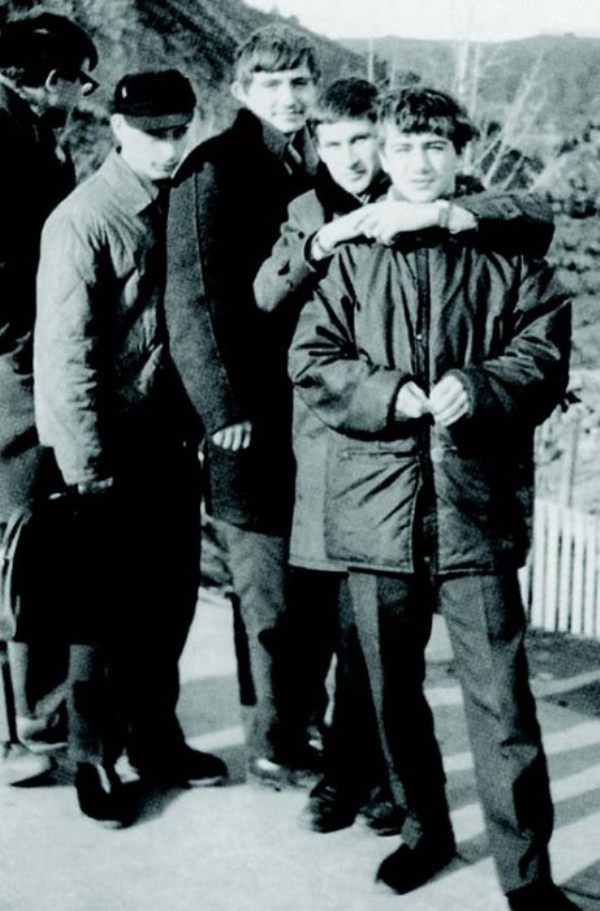
Vladimir Putin and his childhood friends in 1969. None of them have been seen since:


---------oOo---------

Future presidents Bill Clinton and George Bush with Governor George Wallace at a BBQ in 1983:


---------oOo---------

Children for sale in Chicago, 1948. Some parents sold their children due to poverty:


Hard to believe, right? Is it true? . . . .

From:

The Tragic Story Behind The Photo Of Four Children Who Had To Be Sold To Escape Poverty In The 1940s
Ananda Dillon
Updated September 24, 2021

America in the 1940s was a tumultuous place to live. World War II raged through the first half of the decade, finally ending in 1945 and leaving its mark on the country for decades. During the war, food and supplies were rationed, and, though the end of the war marked an economic boom in America, not everyone felt its effects. Recovery, in some instances, took years, and the Cold War turned international relations frosty when the Soviet Union asserted itself.

A photo of children for sale, taken in August of 1948, perfectly encapsulates the experience of those still down on their luck years after the war. The idea of any mother selling her children, let alone selling them with a sign posted in her front yard, feels preposterous by today's standards. But this 1948 image of children for sale is no joke, and the kids pictured did, in fact, find themselves sold off to strangers at the behest of their own parents.

Sadder still, the children for sale in the Chicago area went on to experience further hardship in their new homes. This 1948 image is truly one of those examples of film capturing an incredibly low moment that history won't let us forget.

In the tragic picture, the four children are seen on display on their front stoop as their mother hides her face from the photojournalist. The woman, Lucille Chalifoux, was only 24 years old, but pregnant with her fifth child at the time. Lucille and her husband Ray, age 40, were facing eviction from their apartment at the time. Ray had lost his job as a coal truck driver. Faced with the prospect of being homeless – and the daunting task of feeding so many mouths – they chose to auction off their own children.

Within two years, all four of the children pictured, as well as the child she was carrying, were sold off or given to other homes.

Seven-Year-Old RaeAnn Was Sold For $2

In the middle of the process of being purchased for $2, RuthAnn recalls that her younger brother Milton was crying so hard that the couple paying for her decided to take him as well. RuthAnn remembers the situation not so much as her mother trying to take care of the children but as her needing money for superficial pleasures. The couple who paid $2 for a 7-year-old girl was John And Ruth Zoeteman, farmers who ended up using their "adopted" kids as forced labor.

There is no evidence that they paid additional cash for Milton, or how much it would have been.

The Original Photo Ran In A Newspaper With A Heartbreaking Caption

The Valparaiso Vidette-Messenger ran the photo on August 5, 1948, with this caption, announcing the ages of the children and giving a bit of context yet very little background for such a tragic story.

“A big 'For Sale' sign in a Chicago yard mutely tells the tragic story of Mr. and Mrs. Ray Chalifoux, who face eviction from their apartment. With no place to turn, the jobless coal truck driver and his wife decide to sell their four children. Mrs. Lucille Chalifoux turns her head from camera above while her children stare wonderingly. On the top step are Lana, 6, and Rae, 5. Below are Milton, 4, and Sue Ellen, 2.”

According to a story in the NY Post, the photo grabbed public attention and soon made its way around newspapers in multiple states, even as far as Texas and New York.

Some Of The Children Were Allegedly Treated As Slaves In Their New Homes

Two of the children, RaeAnn and Milton, were sold to farmers John and Ruth Zoeteman for $2. The Zoetemans changed their names to Beverly and Kenneth and took them back to their farm. On the farm, the two children were reportedly regularly chained up in the barn. They were bought for the purpose of working on the farm and were forced to slave away for long hours. Milton even recalls his new "father" calling him a slave.

Media Buzz Helped Spur People To Donate To The Family, But No One Knows Where The Money Went

According to the NY Post, several days after the sad photo and its caption ran in a newspaper called the Chicago Heights Star, "A Chicago Heights woman offered to open her home to the children and that offers of jobs, homes and financial assistance poured in." However, it's unclear where the financial assistance was distributed, and whether it merely held the family together for another few years. Reportedly, it was another two years before the children were entirely sold off.

Family Members Accused The Mother Of Being Paid To Stage The Photo

Despite the legendary status of this photograph, to this day it is unknown how long the sign was posted, offering up the children for sale. As one writer noted, it might have been there just long enough for the photo to be taken, but it might have stood for years. Either way, some of the family members claimed the mother was just trying to drum up publicity by staging the photo.

In the days of reality TV when it seems many others are trying to do the same, it almost makes sense that perhaps Lucille Chalifoux was turning desperate times into desperate, inane actions.

Their Birth Mother Went On To Have Four More Children – And She Kept Them

The youngest child, David, whose birth name was Bedford Chalifoux, was given away at two years of age. When his adoptive family, the McDaniels, received him, he had bed bug bites all over his body. They raised him in a strictly religious fashion, but their proximity to his siblings RaeAnn and Milton allowed him to visit them at the farm on which they lived. He remembers untying them in the barn.

Years later, David reunited with his birth mother. Upon seeing him, she told him he looked just like his father but offered no apologies. He also met the four daughters she had during a later marriage: children which she kept.