Monday, October 14, 2024

MUSIC SPOT


-----------ooOoo-----------

Something a little bit different today, some musical recommendations. . .

-----------ooOoo-----------

I went to a christening last Sunday where the priest played this song after Holy Communion. I asked him afterwards who the artist was, the song and the album. He said the artist was Robert Plant, the song was Satan, Your Kingdome Must Come Down, but he didn’t know the album title, it was the one with the jester on the cover.


"Satan, Your Kingdom must Come Down" is a traditional spiritual song.

A recording of the song by Robert Plant (from the above 2010 album Band of Joy) was used as the theme song for the TV series Boss.

Here is a link to Robert Plant performing the song:


By the way:

Band of Joy (sometimes known as Robert Plant and the Band of Joy) were an English rock band formed in 1966. Various line-ups of the group performed from 1966 to 1968 and from 1977 to 1983. Frontman Robert Plant revived the band's name in 2010 for a concert tour of North America and Europe.

The band is notable for including two musicians, Robert Plant and John Bonham, who went on to join Led Zeppelin, as well as Dave Pegg, who would become a member of both Fairport Convention and Jethro Tull.

-----------ooOoo-----------

I came across the Gat Brothers on Youtube and they are not only great, but also an enigma: 2 rocking rabbis.

From the Algemeiner site:
What was initially perceived by many Israeli television viewers as a gimmick has turned into a phenomenon. A pair of devout, soft-spoken chasidic brothers in skullcaps and sidecurls are breaking down stereotypes and have emerged, according to a Times of Israel report, as the most unlikely of media darlings — reality rock stars.

Two days before their appearance in the championship round of the hit Israeli reality talent show ‘Rising Star’, Arie and Gil Gat have grown from a local obsession into international sensations. Increasingly known around the world as the ‘singing rabbis’, the brothers look, dress and act the part of the classic religious Jew – yet pound out an intoxicating rock & roll beat that can’t be denied.

The Gat brothers found their way to a more strictly religious lifestyle a decade ago yet never gave up their love of music, according to a profile piece published by Israel’s Channel 2 website. Before deciding to audition for ‘Rising Star’, Arie and Gil sought out and received Halachic (Jewish legal) approval to appear on a prime time television program whose target audience is largely secular Israelis.


Here are some video links to them busking on the streets of Jerusalem:

Sultans of Swing:

While My Guitar Gently Weeps:

The Boxer:

Heart of Gold:

Sound of Silence:


-----------ooOoo-----------

All worth clicking on and listening to.


Sunday, October 13, 2024

QUOTE FOR THE DAY


POETRY SPOT


-----------ooOoo-----------

Corny Bill

- Henry Lawson


-----------ooOoo-----------

Some preliminary comments:

This poem by Henry Lawson was published in In the Days When the World Was Wide and Other Verses, 1896.

From:

This nostalgic ballad celebrates a humble swagman named Corny Bill, recalling their shared experiences of hardship and camaraderie. Lawson's language is unadorned, capturing the earthy vernacular of the bush.

Compared to Lawson's other works, "Corny Bill" is a more lighthearted and affectionate portrayal of a stock character, replacing the often harsh and unforgiving depiction of life on the wallaby. However, the poem still reflects the era's social stratification, where itinerant workers like Bill are often marginalised.

The poem's informal tone and conversational style distinguish it from the more traditional and elevated poetic conventions of the time. It offers a glimpse into the lives of those often overlooked, providing a poignant and authentic tribute to the spirit of mateship and resilience.

Terminology:

Corny: coming from Cornwall, England

Clays: clay pipes

Wallaby: “on the wallaby” means to travel the outback as a swaggie or sundowner (tramp and casual workers). “on the wallaby track” and “hump the drum” mean the same thing. ‘On the wallaby track’ is often shortened to ‘on the wallaby’, meaning wandering about on foot, whether in search of work or otherwise.

Drum: The swag carried on one’s back with one’s belongings, the travelling with one being to hump one’s drum. Also known as a bluey and as Matilda.  hence waltzing Matilda meant to ttrvel by foot carring ones belongings in a rolled up blanket on one's back.

-----------ooOoo-----------

A sung version:


-----------ooOoo-----------


Corny Bill

- Henry Lawson

His old clay pipe stuck in his mouth,
His hat pushed from his brow,
His dress best fitted for the South --
I think I see him now;
And when the city streets are still,
And sleep upon me comes,
I often dream that me an' Bill
Are humpin' of our drums.

I mind the time when first I came
A stranger to the land;
And I was stumped, an' sick, an' lame
When Bill took me in hand.
Old Bill was what a chap would call
A friend in poverty,
And he was very kind to all,
And very good to me.

We'd camp beneath the lonely trees
And sit beside the blaze,
A-nursin' of our wearied knees,
A-smokin' of our clays.
Or when we'd journeyed damp an' far,
An' clouds were in the skies,
We'd camp in some old shanty bar,
And sit a-tellin' lies.

Though time had writ upon his brow
And rubbed away his curls,
He always was -- an' may be now --
A favourite with the girls;
I've heard bush-wimmin scream an' squall --
I've see'd 'em laugh until
They could not do their work at all,
Because of Corny Bill.

He was the jolliest old pup
As ever you did see,
And often at some bush kick-up
They'd make old Bill M.C.
He'd make them dance and sing all night,
He'd make the music hum,
But he'd be gone at mornin' light
A-humpin' of his drum.

Though joys of which the poet rhymes
Was not for Bill an' me,
I think we had some good old times
Out on the wallaby.
I took a wife and left off rum,
An' camped beneath a roof;
But Bill preferred to hump his drum
A-paddin' of the hoof.

The lazy, idle loafers what
In toney houses camp
Would call old Bill a drunken sot,
A loafer, or a tramp;
But if the dead should ever dance --
As poets say they will --
I think I'd rather take my chance
Along of Corny Bill.

His long life's-day is nearly o'er,
Its shades begin to fall;
He soon must mount his bluey for
The last long tramp of all;
I trust that when, in bush an' town,
He's lived and learnt his fill,
They'll let the golden slip-rails down
For poor old Corny Bill.


Friday, October 11, 2024

EXTRACT


5 x 5 CONTINUED: BOOKS


-----------ooOoo-----------

Continuing 5 Facts about 5 Boooks (being my favourites).

This is the last instalment you may be happy, or sadddened, to heare.

-----------ooOoo-----------

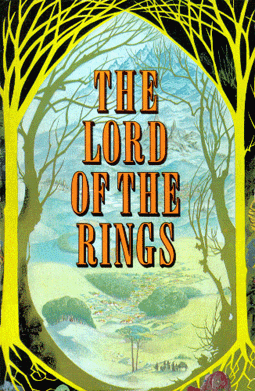
LORD OF THE RINGS


The Lord of the Rings is an epic high fantasy novel by the English author and scholar J. R. R. Tolkien (1892-1973). Set in Middle-earth, the story began as a sequel to Tolkien's 1937 children's book The Hobbit, but eventually developed into a much larger work. Written in stages between 1937 and 1949, The Lord of the Rings is one of the best-selling books ever written, with over 150 million copies sold.
__________

Facts:

1.

Tolkien was a devout Catholic. He served in the British Army during World War I and his experiences in the trenches, and his grief at his friends’ deaths, later influenced aspects of his fiction. He studied at Oxford University, where he later became a Professor of English Language and Literature. He also studied philology, a branch of linguistics that analyses the origins of languages.

Tolkien during WW1

2.

Some early critics of the books were harsh. In this excerpt from The Great British Dream Factory by Dominic Sandbrook, he quotes Edmund Wilson, who called the books “juvenile trash” in 1956. Philip Toynbee wrote that “today those books have passed into a merciful oblivion.” The Lord of the Rings is considered one of the greatest fantasy books ever written, and it has helped to create and shape the modern fantasy genre. Since release, it has been reprinted many times and translated into at least 38 languages. Its enduring popularity has led to numerous references in popular culture, the founding of many societies by fans of Tolkien's works, and the publication of many books about Tolkien and his works. It has inspired many derivative works, including paintings, music, films, television, video games, and board games.

3.

Sean Connery turned down the role of Gandalf because he didn't understand the script. Hey was considered for the role but he eventually turned it down and commented, "I never understood it. I read the book. I read the script. I saw the movie. I still don't understand it." Connery may have regretted this decision, his compensation for the job would have included a substantial percentage of the profits of the films. Actor Christopher Lee, who died in 2015, commented that, for decades, he had dreamt of playing Gandalf. By the time the films were made, he was well into his seventies and too old for the physical demands of the role. Instead he was cast as Saruman, the beginning of a major career revival that continued with George Lucas's Star Wars movies, Attack of the Clones and Revenge of the Sith, as well as Jackson's The Hobbit trilogy. Lee also had the distinction of being the only cast member to have ever met the esteemed author. Lee had read the LOTR books every year for 40 years before landing the role of Saruman.

4.

Aragorn and Arwen are cousins (63 times removed!). Basically Aragorn is a descendant of Elros, Elrond's brother. They were part of a race called "halfelves" who get to choose between elven and human existence. Elrond opted for an immortal life in Rivendell, while Elros chose to be human. This is probably why (many, many generations later) Elrond allowed his nephew to move into the elven enclave where Aragorn got very friendly with Elrond's daughter. It's also why Aragorn lives so much longer than other men.

5.

The Beatles tried to make their own LOTR movie. In his documentary, The Beatles: Get Back, Jackson revealed this tidbit. The fab four read (and loved!) LOTR in the late '60s and decided to make a feature film of their own, with Paul McCartney as Frodo, John Lennon as Gollum, George Harrison as Gandalf, and Ringo Starr as Sam. They hoped to get director Stanley Kubrick on board. But ultimately, they couldn't get the rights from Tolkien who wasn't keen on a pop group doing his story.

-----------ooOoo-----------

Thursday, October 10, 2024

QUOTE FOR THE DAY


FUNNY FRIDAY


---- 😊😊😊 -----


Given  that the pastweek has been about facts and books (with one more to go), there are no prizes for guessing the theme of today's Funny Friday: books.

Enjoy readers.


---- 😊😊😊 -----

SOME HUMOUR:
__________

If you take the first two letters of the title of each the 7 Harry Potter books, it spells out a secret message:

HAHAHAHAHAHAHA
__________

A KGB agent goes to a library and sees an old Jewish man reading a book.

“What are you reading, old man?” he asks.

“I’m learning Hebrew, comrade,” replies the old Jew.

The KGB agent asks, “What are you learning Hebrew for? You know it takes years to get a permission to travel to Israel? You will die before you get one.”

“I’m learning Hebrew for when I go to heaven so I can speak with Moses and Abraham,” replies the old man.

“How do you know you’re going to heaven? What if you go to hell?” asks the KGB agent.

“I already speak Russian."
__________

I launched a series of books aimed at teenagers last week.

Managed to hit three of the little shits.

(Similar but somewhat gross…
I released my own fragrance today….the people in the car didn’t like it)
__________

I went to the bookstore to buy a book about paranoia.

I asked the person behind the counter where they were, and she said "they're all around you" ...
__________

I bought a book on procrastination, I'll start reading it tomorrow.
__________

I told my teenage niece to go get me a phone book...

She laughed at me, and said

"Oh uncle, you're so old. Just use my phone."

So I slammed her phone against the wall to kill a spider.
__________

I asked a librarian if she had a book about Pavlov's Dog and Schrodinger's Cat

She said it rang a bell but wasn't sure if it was there or not.
__________

Years ago, my mother-in-law began reading, "The Exorcist". She said it was the most evil book she ever read. So evil in fact, she couldn't finish it, took it to the ocean and threw it off the pier.

I went out, but another copy, ran it under the faucet, and left it beside her bed.
__________

What do you call a book club that's been stuck on the same book for years?

Church

---- 😊😊😊 -----


So I was sitting on the bus just reading a book when somebody tapped me on the shoulder.

I turned around and saw an old lady. She said to me, "Sonny, would you like some nuts? I've got a couple hazelnuts and almonds if you'd like."

"Sure.", I replied. Then she gave me a handful of nuts and went back to sit with her friends.

"What a nice lady", I thought, while happily munching on the nuts.

A few minutes later, I felt another tap on my shoulder and there she was again, offering some nuts. I gladly accepted and she went back to her seat.

After about 10 minutes, she tapped me on the shoulder, once again offering some nuts.

I asked her, "Why don't you eat them yourself?"

"Because we've got no teeth", she replied.

"Then why do you buy them?", I asked.

"Oh, because we just love the chocolate around them."

---- 😊😊😊 -----


LIMERICK OF THE WEEK:

There was an old man
From Peru, whose lim'ricks all
Look'd like haiku. He

Said with a laugh "I
Cut them in half, the pay is
Much better for two."


---- 😊😊😊 -----

GALLERY:


---- 😊😊😊 -----


CORN CORNER:
__________

My girlfriend wants to break up with me because she says I am unAmerican.

I could see that coming a kilometre away.
__________

HELP! I’m a 39-year-old doctor (6'1, 315lbs) and random strangers keep asking me if it's going to rain – why??

Why would they turn to a meaty urologist for the weather?
__________

My best friend’s teacher told him he was ‘worthless and would never amount to anything.’

Which was particularly hurtful.

Especially since he is home schooled.
__________

We should have known communism was a bad idea

There were a lot of red flags

---- 😊😊😊 -----


Wednesday, October 9, 2024

EXTRACT


5 x 5 CONTINUED: BOOKS

 
-----------ooOoo-----------

Continuing 5 facts abut 5 of my favourite books.

Toay . . . 

-----------ooOoo-----------

ALICE’S ADVENTURES IN WONDERLAND

The cover of the 1865 edition of Alice's Adventures in Wonderland.

Alice's Adventures in Wonderland is an 1865 English children's novel by Lewis Carroll (Charles Dodgson, 1832-1898), a mathematics don at the University of Oxford. It details the story of a girl named Alice who falls through a rabbit hole into a fantasy world of anthropomorphic creatures. It is seen as an example of the literary nonsense genre. 
__________

Facts:

1.

Alice was a real girl, the daughter of Carroll's boss: Henry Liddell, the dean of Christ Church College at Oxford, where Carroll taught mathematics. Carroll formed a friendship with Henry Liddell, his wife Lorina, and their entire family.  The little sisters in the Doormouse's story — Elsie, Lacie, and Tillie — are references to their three daughters. Lorina Charlotte's initials became Elsie, Lacie is an anagram of Alice, and Tillie was short for Matilda, a nickname given to Edith. (A BBC documentary from 2015, The Secret World of Lewis Carroll, critically examined Dodgson's relationship with Alice Liddell and her sisters. It explored the possibility that Dodgson's rift with the Liddell family, and his temporary suspension from the college, might have been caused by improper relations with their children, including Alice.)

Lewis Carroll and the Lidell children

2.

On a boating trip up the Thames in the summer of 1862, Carroll spun a fantastic tale for Alice Liddell and her sisters. But after that, the kids pestered him to retell the story — Carroll even wrote in his diary about telling "the interminable Alice's adventures." So he eventually wrote the story down and gave it to Alice for Christmas 1864. (The original was half as long as the version later published and didn't include scenes like the Mad Hatter or Cheshire Cat.)

3.

In addition to partial deafness and other health complications, Carroll suffered from a rare neurological disorder that causes hallucinations and makes objects appear larger or smaller than they are. The disease wasn't discovered until 1955 by English psychiatrist John Todd. Eventually, it was named Alice in Wonderland Syndrome or Todd's Syndrome.

4.

After reading Alice's Adventures in Wonderland, Queen Victoria suggested that Carroll dedicate his next work to her. She probably should have been more specific: Carroll was a mathematician, so his next work was An Elementary Treatise on Determinants, With Their Application to Simultaneous Linear Equations and Algebraic Equations. He presented it to the Queen.

5.

Since it was published in 1865, it has been translated into 176 languages. At the time, the book was so popular that its sequel, Through the Looking-Glass, and What Alice Found There, sold out within seven weeks of its publication. By the way, Alice's Adventures in Wonderland and the sequel, Through the Looking Glass, and What Alice Found There, were both banned in China in 1931. Why? On the grounds that "animals should not use human language."

-----------ooOoo-----------

Tuesday, October 8, 2024

EXTRACT FOR THE DAY

Opening paragraphs, The Old Man and the Sea:
by Ernest Hemingway -

He was an old man who fished alone in a skiff in the Gulf Stream and he had gone eighty-four days now without taking a fish. In the first forty days a boy had been with him. But after forty days without a fish the boy’s parents had told him that the old man was now definitely and finally salao, which is the worst form of unlucky, and the boy had gone at their orders in another boat which caught three good fish the first week. It made the boy sad to see the old man come in each day with his skiff empty and he always went down to help him carry either the coiled lines or the gaff and harpoon and the sail that was furled around the mast. The sail was patched with flour sacks and, furled, it looked like the flag of permanent defeat.

The old man was thin and gaunt with deep wrinkles in the back of his neck. The brown blotches of the benevolent skin cancer the sun brings from its reflection on the tropic sea were on his cheeks. The blotches ran well down the sides of his face and his hands had the deep-creased scars from handling heavy fish on the cords. But none of these scars were fresh. They were as old as erosions in a fishless desert.


5 x 5 CONTINUED - BOOKS

-----------ooOoo-----------

Continuing 5 facts about 5 of my fabourite books . . . 

-----------ooOoo-----------

THE OLD MAN AND THE SEA

Original book cover

The Old Man and the Sea is a 1952 novella by the American author Ernest Hemingway (1899-1961). Written between December 1950 and February 1951, it was the last major fictional work Hemingway published during his lifetime. It tells the story of Santiago, an aging fisherman, and his long struggle to catch a giant marlin. The novella was highly anticipated and was released to record sales; the initial critical reception was equally positive, but attitudes have varied significantly since then.
__________

Facts:

1.

The Old Man and the Sea was the last major work Ernest Hemingway published in his lifetime. The simple story is about an old man who catches a giant fish in the waters off Cuba, only to have it devoured by sharks. Defeated, he returns home with the fish’s skeleton attached to the boat. Many consider this spare novel to be Hemingway’s best work. He wrote The Old Man and the Sea to prove he wasn’t finished as a writer - his last successful book, For Whom the Bell Tolls, came out in 1940 and his 1950 novel Across the River and Into the Trees was panned by critics. There was comment that Hemingway was "through" as a writer, The Old Man and the Sea was intended to prove that not only was he still in the writing game, he had yet to produce his best work.


2.

Ernest Hemingway claimed there was no symbolism in The Old Man and the Sea. The fable-like structure of the novel suggests that the story is symbolic, which is why many view The Old Man and the Sea as an allegory. But Hemingway thought all that was bunk—or at least, that’s what he said. "There isn’t any symbolism," he wrote to critic Bernard Berenson. "The sea is the sea. The old man is an old man … The sharks are all sharks no better and no worse. All the symbolism that people say is shit. What goes beyond is what you see beyond when you know."

3.

In the mid-1930s, the Cuban guide Carlos Gutiérrez had related a story involving an old man and a giant marlin to Hemingway, who retold it in Esquire magazine in an essay titled "On the Blue Water: A Gulf Stream Letter". This tale was likely first told in 1891 and was consistently retold by fishermen over the next forty years. Significant influence came from Hemingway's own experience with the Gulf Stream, where he sailed for thousands of hours in the decades before writing The Old Man and the Sea. He greatly enjoyed the sport of big-game fishing, participating in and winning several tournaments on his boat, the Pilar. Having put off a novelisation for sixteen years, but aided by his love and knowledge of fishing and the sea, Hemingway suddenly found himself writing a thousand words a day for The Old Man and the Sea, Twice as fast as usual.

4.

After early adulation faded, less positive reviews began to appear – overrated, more of the past bad writing, a "mock-serious fable" with "radical weaknesses". Despite the cooling critical outlook, The Old Man and the Sea won the Pulitzer Prize for Fiction on May 4, 1953, the first time Hemingway had received the award, having been overlooked previously for A Farewell to Arms and For Whom the Bell Tolls. The Old Man and the Sea's highest recognition came in 1954, as the only work of Hemingway's mentioned by the Swedish Academy when awarding him the Nobel Prize in Literature; they praised its "powerful, style-making mastery of the art of modern narration".

5.

In 1958 The Old Man and the Sea was made into a superb motion picture, starring Spencer Tracy. After seeing the film, Hemingway expressed his disappointment, remarking that Spencer Tracy looked less like a Cuban peasant fisherman than the rich actor he was. Nevertheless, Tracy earned an Oscar nomination for the role. Ernest Hemingway can be seen sitting in the cafe in the final scene wearing a tan baseball cap and conversing with other fishermen. This was his movie debut. Mary Hemingway, who was Ernest Hemingway's fourth wife and later became his widow, plays the blonde tourist at the end of the film. She crosses the street and takes a seat in the café, but speaks no lines.

Spencer Tracy as Santiago in The Old Man and the Sea

-----------ooOoo-----------

Monday, October 7, 2024

EXTRACT FOR THE DAY


From Catch-22, by Joseph Heller:
“'And don't tell me God works in mysterious ways,' Yossarian continued, hurtling on over her objection. 'There is nothing so mysterious about it. He's not working at all. He's playing. Or else He's forgotten all about us. That's the kind of God you people talk about - a country bumpkin, a clumsy, bungling, brainless, conceited, uncouth hayseed. Good God, how much reverence can you have for a Supreme Being who finds it necessary to include such phenomena as phlegm and tooth decay in His divine system of creation? What in the world was running through that warped, evil, scatalogical mind of His when He robbed old people of the power to control their bowel movements? Why in the world did He ever create pain?'

“'You'd better not talk that way about Him, honey,' she warned him reprovingly in a low and hostile voice. 'He might punish you.'

'Isn't He punishing me enough?' Yossarian snorted resentfully. 'You know, we mustn't let him get away with it. Oh no, we certainly mustn't let Him get away scot-free for all the sorrow He's caused us. Someday I'm going to make Him pay. I know when. On the Judgment Day. Yes, that's the day I'll be close enough to reach out and grab that little yokel by His neck and -'

'Stop it! Stop it!'

'What the hell are you getting so upset about?' he asked her bewilderedly in a tone of contrite amusement. 'I thought you didn't believe in God.'

'I don't,' she sobbed, bursting violently into tears. 'But the God I don't believe in is a good God, a just God, a merciful God. He's not the mean and stupid God you make him out to be.'
Yossarian laughed and turned her arms loose. 'Let's have a little more religious freedom between us,' he proposed obligingly. 'You don't believe in a God you want to, and I won't believe in a God I want to. Is that a deal?'”

B\5 x 5 CONTINUED: BOOKS -

-----------ooOoo-----------

Continuing 5 facts about 5 books, today . . . 

-----------ooOoo-----------

CATCH-22


Catch-22 is a satirical war novel by American author Joseph Heller (1923- 1999) first published in 1961. The novel is set during World War II, from 1942 to 1944. It mainly follows the life of antihero Captain John Yossarian, a U.S. Army Air Forces B-25 bombardier. The novel examines the absurdity of war and military life through the experiences of Yossarian and his cohorts, who attempt to maintain their sanity while fulfilling their service requirements so that they may return home.
__________

Facts:

1.

This was Heller’s debut book. While lying in bed in his apartment on the West Side of Manhattan in the early 1950s, over the course of an hour and a half, he developed the basic plot and collection of characters that he’d ultimately use in his novel. Heller, an advertising copywriter, spent the workday following writing out the entire first chapter of what would become Catch-22 by hand. A full year passed before he completed a second chapter.

Joseph Heller in 1986

2.

The title was changed to Catch-22 after numerous alternatives were rejected:
  • Heller’s agent felt that Catch-18 would be confused with a WW2 novel published at that time, Leon Uris’s Mila 18.
  • Catch-11 was suggested but it was thought that this might be confused with the 1960 movie Oceans Eleven.
  • Catch-17 was rejected as being too similar to the movie Stalag 17.
  • Catch-14 was rejected by the publisher as not being a funny number.
  • Catch-22 was selected as having the right syllables and because it sounded repetitive, reflecting repetition which occurs in the book.
3.

The novel's Catch-22 is as follows:
  • a combat pilot was crazy by definition (he would have to be crazy to fly combat missions);
  • since army regulations stipulated that insanity was justification for grounding, a pilot could avoid flight duty by simply asking;
  • but if he asked, he was demonstrating his sanity (anyone who wanted to get out of combat must be sane) and had to keep flying.
Catch-22 soon entered the language as the label for any irrational, circular, and impossible situation. For example, needing a key to enter a locked room but the key is in the locked room.

4.

Catch-22 is set in World War II, but its tone is shaped by the events of the 1950s. This was a decade of repression in America, exemplified by U.S. Senator Joseph McCarthy. The loyalty oaths and political paranoia in the novel reflect McCarthyism. Catch-22 grew in popularity during the years of the Vietnam War, when the general population became more attuned to Yossarian's point of view.

5.

Heller served in the US Army Air Corps during World War II and flew 60 combat missions as a B-25 bombardier. and he based a number of Catch-22’s characters on his army buddies. Yossarian’s name came from fellow WWII veteran Francis Yohannan. Additionally, the sociopathic Milo Minderbinder was designed with Heller’s childhood friend, Marvin “Beansy” Winkler of Coney Island, in mind.


-----------ooOoo-----------

Sunday, October 6, 2024

EXTRACT FOR THE DAY


5 x 5: BOOKS - WATERSHIP DOWN

-----------ooOoo-----------

WATERSHIP DOWN


Watership Down is an adventure novel by English author Richard Adams (1920-2016), published in 1972. Set in Hampshire in southern England, the story features a small group of rabbits. Although they live in their natural wild environment, with burrows, they possess their own culture, language, proverbs, poetry, and mythology. Evoking epic themes, the novel follows the rabbits as they escape the destruction of their warren and seek a place to establish a new home (the hill of Watership Down), encountering perils and temptations along the way.
__________

Facts:

1.
This debut novel by Adams (then aged 54 and a civil servant), was originally called Hazel and Fiver and was rejected by 7 publishers before being published by Rex Collings, a one-man publishing outfit in London. Collings wrote to a friend at the time, “I’ve just taken on a novel about rabbits, one of them with extra-sensory perception. Do you think I’m mad?” He also changed the title to Watership Down, the place where the rabbits resettle. ('Watership' derives from Old English, meaning 'a body of water, a piece of water’; 'down' has the meaning of a hill). The book was a smash hit and won numerous prizes.

Richard Adams

2.
Adams told the BBC in 2007 that the story started on a long car ride: He and his two daughters were going to Stratford-upon-Avon to see Judi Dench in a production of Twelfth Night. His elder daughter demanded a story to pass the time. "This called for spontaneity, it had to, and I just began off the top of my head: 'Once upon a time there were two rabbits, called eh, let me see, Hazel and Fiver, and I'm going to tell you about some of their adventures,'” he explained. “What followed was really the essence of Watership Down.” The story continued over the next few months during the morning school run; Adams told The Telegraph in 2014 that he’d go to bed forming the narrative in his mind, ready to tell the girls the next morning. In a way, the continually-forming story was Adams’ attempt to be a constant, steady presence in his daughters’ lives: “I’ve got a thing about that. Parents ought to spend a lot of time in their children’s company. A lot of them don’t, you know.”

3.
The rabbits were in fact modeled after WWII officers. Lieutenant Richard Adams commanded C Platoon in 250 Company’s Seaborn Echelon, and, as he wrote in his autobiography, he based Watership Down and the stories in it around the men of the 250 Airborne Light Company RASC—specifically, on their role in the battle of Arnhem. The battle, fought over nine days in September 1944 in and around the Dutch towns of Arnhem, Oosterbeek, Driel, and Wolfheze, resulted in devastating losses for the Allied forces, including in Adams’ company. Adams says that two characters were directly drawn from life. Hazel was inspired by Adams’ commanding officer, Major John Gifford, a man he described as “brave in the most self-effacing way” and an “excellent organiser” who rarely raised his voice, adding, “Everything about him was quiet, crisp and unassuming.” Gifford survived the war; Captain Desmond “Paddy” Kavanagh, on whom warrior Bigwig was modeled, did not. Daring, debonair Kavanagh was, Adams wrote, “afraid of nothing,” a “sensationalist,” and “by nature entirely the public’s image of a parachute officer.” He was killed in action outside Oosterbeek while providing covering fire for his platoon, at just 25 years old. As for Adams, he said in 2014 that he identifies more with Fiver: “Rather timid and not much of a fighter … but able to contribute something in the way of intuitive knowledge.”

4.
Before Watership Down, Adams hadn’t written a word. In an interview with The Guardian in 2015, he said, “I was 52 when I discovered I could write. I wish I’d known a bit earlier. I never thought of myself as a writer until I became one.” But Adams also acknowledges that nothing he’s done since has matched the power of his debut: “I try to look at it in a positive way, to say to myself, ‘Look at Watership Down – if you can do that, you can do any ruddy thing.’ Of course you can’t expect to have another success like that, but it does give you the confidence and the enjoyment to go on writing.”

5.
Watership Down has never been nationally banned in the United States. However, it has been banned by individual schools because of its violent content. Even though it is a novel about rabbits, it addresses dark topics like suicide, prejudice, and genocide. However, on the flip side, Watership Down symbolises the struggle to build a just society in a world where leaders all too often value their own power and egos over the safety and happiness of their followers.


-----------ooOoo-----------

Saturday, October 5, 2024

BOOK EXTRACT


From The Wind in the Willows, by Kenneth Grahame

'There's only one thing more to be done,' continued the gratified Badger. 'Toad, I want you solemnly to repeat, before your friends here, what you fully admitted to me in the smoking-room just now. First, you are sorry for what you've done, and you see the folly of it all?'

There was a long, long pause. Toad looked desperately this way and that, while the other animals waited in grave silence. At last he spoke.

'No!' he said, a little sullenly, but stoutly; 'I'm not sorry. And it wasn't folly at all! It was simply glorious!'

'What?' cried the Badger, greatly scandalised. 'You backsliding animal, didn't you tell me just now, in there - - '

'Oh, yes, yes, in there,' said Toad impatiently. 'I'd have said anything in there. You're so eloquent, dear Badger, and so moving, and so convincing, and put all your points so frightfully well— you can do what you like with me in there, and you know it. But I've been searching my mind since, and going over things in it, and I find that I'm not a bit sorry or repentant really, so it's no earthly good saying I am; now, is it?'

'Then you don't promise,' said the Badger, 'never to touch a motor-car again?'

'Certainly not!' replied Toad emphatically. 'On the contrary, I faithfully promise that the very first motor-car I see, poop- poop! off I go in it!'


5 x 5: BOOKS - THE WIND IN THE WILLOWS

-----------ooOoo-----------

5 facts about 5 books.

-----------ooOoo-----------

For the next 5 days I am posting single instalments of 5 x 5 regarding some of my favourite books. Plus an extract or quote from each book.

Books have, for younger people at least, given way, to e-books, social media and videos. They no longer know the joy and satisfaction that comes from being absorbed in a good book, of wanting to continue reading despite the early hours and having to go to work.


If you agree with my 5 x 5, disagree, wish to comment, drop me a line by email.

If you haven’t read the subject books, I recommend doing so.


-----------ooOoo-----------

Book 1:

THE WIND IN THE WILLOWS

The cover art for the first edition release of The Wind in the Willows

A classic children's novel by the British novelist Kenneth Grahame (1859-1932) first published in 1908. It details the story of Mole, Ratty, and Badger as they try to help Mr. Toad, after he becomes obsessed with motorcars and gets into trouble. It also details short stories about them that are disconnected from the main narrative.
__________

Facts:

1.
In 1899, at age 40, Kenneth Grahame married Elspeth Thomson and the next year they had their only child, a boy named Alastair (nicknamed "Mouse"). He was born premature, blind in one eye, and plagued by health problems until his death at age 20. When Alastair was about four years old, Grahame would tell him bedtime stories, some of which were about a toad, and on his frequent boating holidays without his family he would write further tales of Toad, Mole, Ratty, and Badger in letters to Alastair. The stories were further developed in letters Graham wrote while he was alone on boating vacations.

2.
In 1908, Grahame took early retirement from his position as secretary of the Bank of England. He moved with his wife and son to an old farmhouse in Blewbury, Berkshire. There, he used the bedtime stories he had told Alastair as a basis for the manuscript of The Wind in the Willows.

Kenneth Graham

Alistair Graham

3.
While he was in office, U.S. president Theodore Roosevelt wrote to Grahame to tell him that he saw the novel’s principal characters—Mole, Ratty, Toad, and Badger—as “old friends.”

4.
Kenneth Grahame died in 1932, a broken-hearted man of 73, who hadn’t written anything of note since The Wind In The Willows was published in 1908. His broken heart was from the death of Alistair, the two being buried in the same cemetery in Oxford.

5.
Mouse committed suicide 12 years before his father’s death, aged 20, prompted by his health problems, a fragile and nervous disposition, his finding it difficult to cope with his father’s immense fame and his father’s unrealistic expectations of him. His father was always a distant figure, incapable of demonstrating love to both his wife and his son. The evening of his death, Mouse made his way down to the Thames (ironically the home of Ratty, Toad and Mole). There he lay down on the railway track running across Port Meadow and awaited the train that ended his misery. His death did at least bring one consolation; in recognition of his suffering, Oxford University, for the first time, made special provision for disabled students.


Kenneth Graham

Alastair Graham

-----------ooOoo-----------