Sunday, February 24, 2013

Australian Firsts and Inventions, Part 2


__________


The first country to employ skiing as a sport. The first recreational ski club was formed in 1861 at Kiandra in the Snowy Mountains, NSW, Australia, where the first documented international downhill carnival was also held.
__________

The famous "black box" flight recorder for recording aeroplane movements was invented in Australia in 1958 by Dr David Warren at the Aeronautical Research Laboratories in Melbourne. 


Dr Warren with the Black Box Flight Recorder, which is actually orange. The origin of the term "Black Box" is uncertain. One explanation comes from the early film-based design of flight data recorders, which required the inside of the recorder to be perfectly dark to prevent light leaks from corrupting the record, as in a photographer's darkroom. 
__________


Also in 1958 the world’s first regular 'round the world' airline service was begun by Qantas 
__________

The inflatable aircraft escape slide, which becomes a raft if the aeroplane ditches in water was an Australian invention of 1965. 
__________

The Automatic Totalisator was invented by George Julius in 1913 for tote automated betting (TAB) at horse races. 
__________

The automatic letter sorting machine is an Australian invention from 1930 
__________

The two stroke lawn mower was invented by Aussie Mervyn Victor Richardson in 1952. The prototype was built using scrap metal, billy cart wheels, and a peach tin as a fuel tank. The prototype worked, and within three months had sold 30 units. Within four years he’d sold 60,000, created his own company, named Victa, and become a millionaire. 


Anyone interested in seeing that original mower can do so by visiting the City of Canada Bay Museum at 1 Bent St, Concord Sydney, NSW, the suburb in which Richardson resided. Opening hours are Wednesdays and Saturdays, 10:00 am to 4:00 pm and admission is free


__________

Differential gears – In 1897 David Shearer of South Australia built a steam car with differential inside left rear wheel hub. Does anyone know what that means? 
__________

In 1898 the teleprinter for recording messages onto a tape was invented by Donald Murray of Sydney. 
__________

Around 1912, inventor Gilbert Toyne in Geelong (who later established his business at 661 Parramatta Road, Five Dock), designed a rotary clothes hoist. By the early 1920s, Toyne's 'All-Metal Rotary Clothes Hoist' was being manufactured and advertised in Australia - about 25 years before the first 'Hills Hoist' which was the first to attach a handle to raise and lower the hoist. In 1945 Lance Hills began manufacturing the Hills Hoist, patenting the design after Toyne’s patent had expired. 

Toyne established the Aeroplane Clothes Hoist Company in 1911 to sell his rotary clothes hoist inventions 

Note the following photograph from 1873 which shows a rotary clothes line 73 years 'before' the Hills Hoist developed by Lance Hill and before Toyne's clothesline


Also a joy to kids.
__________


Lithium as a treatment for manic depression. 
__________

The Australian Crawl. Until the 1890's competitive freestyle was done with the head out of the water. Australian Dick Cavill popularised it and enabled it to be accepted in world class meetings. 
__________

First woman to sail solo around the world, Kay Cottee, 1988. 

__________

George Richard R. Nicholas made the first Australian acetylsalicylic acid (aspirin) in a tablet form, registered in 1917 as "Aspro". 

__________

Bruce Thompson invents the world’s first dual flush toilet in 1980, using alternative buttons for different strength flushing. 
__________

The first manufacture and marketing of the one piece bathing suit. 

In 1907 Australian swimmer Annette KIellerman visited the United States as an "underwater ballerina", a version of synchronised swimming involving diving into glass tanks. She was arrested for indecent exposure because her swimsuit showed arms, legs and the neck. 


Kellerman changed the suit to have long arms and legs and a collar, still keeping the close fit that revealed the shapes underneath. She later starred in several movies, including one about her life. She marketed a line of bathing suits and her style of one-piece suits came to be known as "the Annette Kellerman."


Saturday, February 23, 2013

Easter Island and its Statues, Part 3

The concluding part of the post on Easter Island statues:


Torsos and excavations: 
  • Although commonly thought of as being only heads, they have torsos down to the thighs. Some have a total body and there is one statue that is kneeling. The impression that they consist only of heads is that from the invention of photography until the 1950’s, only heads have been photographed as visible above the ground. 
  • In 1919 pictures of the first excavations by the Mana Expedition to Easter Island revealed that some statues were full sized. The discovery was confirmed in 1955 by the explorer Thor Heyerdahl when his Norwegian Archaeological Expedition excavated a statue. Over subsequent decades the discoveries were gradually forgotten, known by archaeologists but not by tourists, who began visiting the island when flights between Santiago and Tahiti, via Easter Island, began in the 1990s. 
  • Since 1990, the Easter Island Statue Project (EISP) has been undertaking an archaeological survey on Easter Island, aiming to create a full and complete, island-wide inventory for each statue. As part of the project, two seven metre tall, full-size statures, estimated to weigh about 20 tonnes, have been excavated in the Rano Raraku quarry. 


Ahu, Walls and carvings: 
  • The Rapa Nui also made stone platforms, referred to as ahu, on Easter Island. Of the 313 known ahu on the island, 125 were used as platforms for moai, The ahu also had a paved area in front. 


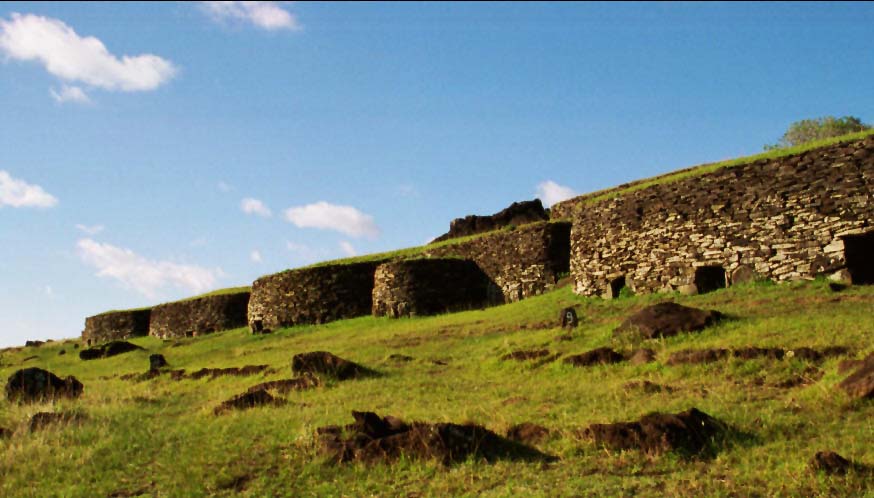
  • The Rapa Nui also made walls that are reminiscent of Inca walls and the walls at Machu Pichu: 


  • There are over 4,000 petroglyphs on Easter Island, pictures carved into rock, making Easter Island one of the richest sites for such carvings in Polynesia. Designs and images were carved out of rock for a variety of reasons: to create totems, to mark territory or to memorialize a person or event. 


Statues and History: 
  • The population of Easter Island was divided into clans, ruled by a single chief. The rival clans produced the moai as part of a cult of “mana” that included ancestor worship. The belief was that benefits – power, prosperity, prestige – were gifted to, and vested in, the clans from ancestors and that the transmission was through the moai, which represented the ancestors and forebears of the clans. According to mana, the ancestors provided the benefits for the living, the moai ensured a better deal for the ancestors in the spirit world. Any adverse circumstances such as crop failure necessitated more statues and bigger statues. Inter clan rivalry on respect of the production of moai was fierce. 
  • As has been already noted, the moai were produced between 1250 and 1500 AD, ceasing when the island became overpopulated and the resources diminished or were depleted and eventually exhausted. Such circumstances saw warriors, known as matatoa, gain increasing power and eventually control. The cult of mana was supplanted by the cult of the Bird Man, a mythical half man, half bird, the emblem of the matatoa. 
The Bird Man motif


As depicted in petroglyphs, even on the back of moai.
  • The Bird Man and mana cults both held that ancestors provided for the living but whereas mana held that this was achieved through ancestor worship and moai, the Bird Man cult believed the ancestors looked after the living through selected living humans. These humans were chosen through a competition. 
  • The Bird Man concept is not unique to Easter Island, it appears in other places and cultures in Polynesia, including Hawaii. What is unique to Easter Island is the selection of the persons by competition through whom the ancestors bestowed power. 
  • As depicted in the film Rapa Nui, the competition consisted of descent of sheer cliffs at a place called Orongo, a swim to an island known as Moto Nui where competitors awaited the birds that visited the island seasonally and then a swim back with an egg. 
Birdman petroglyphs at the site of Orongo, with Moyo Nui in the background 
  • The Bird Man competitions started around 1760, after the arrival of the first Europeans, and ended in 1878, with the construction of the first church by Roman Catholic missionaries who formally arrived in 1864. 
  • The accounts of the Europeans who visited Easter Island in 1722 and 1770 describe statues as standing erect. Cook described observing various statues lying face down during his visit in 1774. By 1868 there were no statues standing upright, apart from those buried. Various causes have been attributed to the statue toppling, notably earthquakes and internal war. It appears that at least some of the statues were deliberately toppled, leading to hypotheses that internal conflict generated by conflict between the ancestor worshippers and the Bird Man followers led to war and deliberate statue destruction, somewhat like the Taliban destroying statues. 
  • Ron Fisher in his work Easter Island Brooding Sentinels of Stone, advances one explanation for the statue toppling that is adopted by the movie Rapa Nui. Fisher suggests that there were two groups of people on the island, the-so-called Long Ears and the Short Ears. The Short Ears were slaves of the Long Ears, who forced the Short Ears to carve the moai. After many generations and during a rebellion, the Short Ears surprised the Long Ears and killed them all, which explains the abrupt end of the statue-carving. As against this, there have been few human remains found (although interestingly there has been evidence of cannibalism when loss of resources reduced the food supply in a drastic manner). 
Note that the statues are constructed with long ears. 
  • 55 moai have been re-erected and preservation and restoration work continues. Easter Island is now a protected, world heritage site. 

The Message: 

The Bradshaw Foundation is a private, non-profit organisation based in Geneva that focuses on archaeology, anthropology and genetic research. 

The Foundation’s website has a section on Easter Island and makes some overall observations, similar comments being made by Diamond in his fascinating book Collapse. 

From the Bradshaw Foundation website at: 

Stories concerning the collapse of past civilizations due to the overuse of natural resources and overpopulation are well-known. From the early civilizations in the 'fertile crescent' of the Near East to small island nations, history tells us how man has trashed his land and, in most cases, left for greener pastures when desert replaced cropland and orchards.  
But on Easter Island, once the trees were cut down, the islanders no longer could build a canoe and sail onward, looking for another island in the sea. They were trapped in a degraded environment, and then further impacted by European explorers who brought disease and, in many cases, outright death.  
Easter Island is so small that it can be seen in its entirety from its highest mountain; whomever cut down the last tree on the island had to know that it WAS the last tree. But he cut it down anyway.
 
The history of Rapa Nui was played out on a small island and it serves well as a metaphor for our earth today. It is hard to comprehend a mentality that ignores such things as bulldozing rainforests in the Amazon - for short-term gain, and seas that are being over-harvested. Mankind has learned very little from the past. The island called Easter has become a metaphor for our time. Only by understanding the past and altering present behavior can "earth island" avoid the dreadful fate of Rapa Nui. 


Friday, February 22, 2013

Funny Friday

Caution: some risque content and language...
_______________

_______________

This week, a random selection of short humorous items from Sickipedia:
_______________

At a job interview.

"What would you say was your greatest weakness?"

"Honesty."

"I don't think honesty is a weakness."

"I don't give a fuck what you think." 
_______________

Hot tip for getting an Oscar: 

Pretoria State Prison 
_______________

As I began to panic, I became increasingly warmer and very thirsty.

With no access to water, I knew that I had no choice but to do what Bear Grylls would do in this situation and drink my own urine.

It tasted better than I thought it would and to be honest, it really did refresh me.

Although I did get some funny looks from the others who had been stuck in the lift with me for the last 20 minutes. 
_______________

Last year my mate Dave found out that he couldn't have kids.

He was absolutely devastated, so being the kind of guy I am, I offered to have sex with his wife, which they both agreed to.

Dave called me today and said, "Look, you've been shagging my wife twice a day for the last six months and she still isn't pregnant."

"That's probably because I had a vasectomy back in 2009." I replied. 
_______________

Of all the utensils that were invented to eat rice with...

How the fuck did two sticks win? 
_______________

As my hamster laid stiff at the bottom of its cage with all 4 legs pointing upwards, I thought to myself, "This doesn't look good."

So I stood him upright. 
_______________

I made dinner for my new girlfriend last night.

After the meal I said, "Those chips that you've just eaten actually came from my garden this morning."

"Wow!" she smiled, "I didn't know that you grew potatoes?" 

I said, "I don't, some fucker must've thrown them over the fence." 
_______________

Limerick Spot:

First let me explain that I'm cursed.
I'm a poet whose time gets reversed.
Reversed gets time
Whose poet a I'm.
Cursed I'm that explain me let first
_______________

Thursday, February 21, 2013

You pays your money . . .


Whatever you want
Whatever you like
Whatever you say
You pay your money
You take your choice
Whatever you need
Whatever you use
Whatever you win
Whatever you lose
Whatever you want 

- Lyric from Whatever You Want, Status Quo 

Driving home the other day I was thinking about the Federal election coming up in September when the above song came on the radio. The lyrics “You pay your money, you take your choice” seemed particularly apt for the election - according to one internet comment: “The saying is of course taken to mean that it is entirely up to you which of the available choices you spend your money on, although there is also the unspoken implication that there isn't actually that much difference between the choices on offer.” 

Which had me wondering on the origin of the phrase. 

My recollection was that the wording was actually “You pays your money, you takes your choice”, which turned out to be correct.  There is also a variation “You pays your money, you takes your chance”. In the US it is commonly "You pays your nickel, you takes your choice."

The expression appears in Mark Twain’s Huckleberry Finn, dating from 1884: 

“Here’s your opposition line! Here’s your two sets o’ heirs to old Peter Wilks—and you pays your money and you takes your choice!” 

Although many believe that it dates from that reference, it first appeared in an 1846 Punch cartoon and is believed to have already been in use, probably as a Cockney expression yelled out by stall holders at the markets, well before that date. 

In 1845 the Ministry of John Peel faced a crisis over the repeal of the Corn Laws. These laws were trade laws designed to protect cereal producers of the United Kingdom against foreign imports. They also ensured that British landowners reaped the profits from farming in that the corn laws made it too expensive to import grain from elsewhere, even when Great Britain and Ireland were experiencing famine and food shortages. In 1845 Ireland was hit by a potato blight. Over the next 4 years over a million died in the Great Famine and a million more left Ireland. 

Many Tories were opposed to the repeal of the laws but Peel, Queen Victoria, the Whigs and some Tories were strongly supportive. When Peel’s cabinet failed to back him on repeal, he resigned as Prime Minister on 5 December, 1845. The leader of the Protectionists, Lord Stanley, refused to step into Peel’s shoes and form a government. Efforts by Lord Russell to form a Whig government also failed. Victoria invited Peel to form a government again, which he did. (Peel resigned again in 1846, after the repeal narrowly passed, and was replaced by Lord Russell). 

The 1846 Punch cartoon, headed The Ministerial Crisis, is from the period when there was no Prime Minister. It depicts a showman inviting John Bull to look into a display box. 

The following conversation is printed below the cartoon: 

Showman. "On your right you will perceive a Prime Minister a bolishing of hisself. And over your left is another Prime Minister a bolishing of the Corn-Laws." 

Master John Bull. "But which is the Prime Minister?" 

Showman. "Which ever you please, my little dear. You pays your money, and you takes your choice."


Wednesday, February 20, 2013

National Geographic Photograph Awards 2012, Part 2

Honourable Mention: 
‘Eerie Eiffel’, Indira Swari Wonowidjojo 
The winter gloomy day worked to my advantage to create this eerie feeling of the famous landmark Eiffel tower.

Honourable Mention: 
‘Predation up close and personal’, Francesca Harlijanto 
I was surrounded by thousands of fish that moved in synchrony because of the predation that was happening. It was an incredible experience.

Viewers’ choice for Places: 
‘Iceberg Hunters’, Adam Coish 
Chipping ice off an iceberg is a common way for the Inuit community to retrieve fresh drinking water while on the land. During a weekend long hunting trip, we came upon this majestic iceberg frozen in place. It was a perfect opportunity to grab enough ice and drinking water for the remainder of the trip. 

First Place for Places: 
‘The Matterhorn’, Nenad Salijic 
The Matterhorn 4478 m at full moon.

Viewers’ choice People: 
‘Expedition Admundsen’, Kai-Otto Melau 
A race that follows in the path of the famous explorer Roald Amundsen brings the contestants to the Hardangervidda Mountainplateu, Norway. 100km across the plateau, the exact same route Amundsen used to prepare for his South Pole expedition in 1911 is still used by explorers today. Amundsen did not manage to cross the plateau and had to turn back because of bad weather. He allegedly said that the attempt to cross Hardangervidda was just as dangerous and hard as the conquering of the South Pole. The group in the picture used the race as preparations for an attempt to cross Greenland.

First Place for People: 
'Amongst the Scavengers', Micah Albert 
At the end of the day women are allowed to pick through the dump site. 

Viewers’ choice for Nature: 
‘Tender Moment’, Sanjeev Bhor 
Everyday in mara starts with something new and different and day ends with memorable experiences with spectacular photographs . I was very lucky of sighting and photographing Malaika the name of female Cheetah and her cub . she is well known for its habit to jump on vehicles. She learned that from her mother Kike, and Kike from her mother Amber.Like her mother she is teaching lessons to her cub . Teaching lessons means addition of another moment for tourist . This is one of the tender moment between Malaika and her cub . I was very lucky to capture that moment 

First Place for Nature and Grand Prize: 
‘The Explosion’, Ashley Vincent 
The subject's name is Busaba, a well cared for Indochinese Tigress whose home is at Khao Kheow Open Zoo, Thailand. I had taken many portraits of Busaba previously and it was becoming more and more difficult to come up with an image that appeared any different to the others. Which is why I took to observing her more carefully during my visits in the hope of capturing something of a behavioural shot. The opportunity finally presented itself while watching Busaba enjoying her private pool then shaking herself dry. In all humility I have to say that Mother Nature smiled favourably on me that day!


Tuesday, February 19, 2013

National Geographic Photograph Awards 2012, Part 1


National Geographic holds an annual photographic competition open to allcomers. NG has some of the world’s best photographers, and best photographs, featured in its pages, sometimes films are even made about them – remember Clint Eastwood photographing bridges in Madison County? Anyway, the 2012 competition had 22,000 entries from over 150 countries (I didn’t even know there were that many countries in the world. I checked, there are 196). Photographs were submitted in 3 categories: people, places and nature, with judging being based on creativity and photographic quality. The guidelines for entries required that photographs not be manipulated, that they be real and that they capture special moments in time. 

The winning photographs and those receiving honourable mentions were announced last weekend and some are shown below, with the captions provided by the photographers. 

Some of the photographs inspired a variety of feelings, as well as being interesting and informative. Feel free to disagree with the results. I do. 

Part 2 tomorrow.
__________

Honourable Mention: 
‘Red Fox catching mouse under snow’, Michael Eastman 
With his exceptional hearing a red fox has targeted a mouse hidden under 2 feet of crusted snow. Springing high in the air he breaks through the crusted spring snow with his nose and his body is completely vertical as he grabs the mouse under the snow.

Honourable Mention: 
‘Chinese Traditional Dragon Boat Racing’ 
Dragon boating is a Chinese traditional entertainment. As an aquatic sport to commemorate Qu Yuan, a patriotic poet in ancient China, it is usually held in festivals, which can be traced back to two thousand years ago. 

Honourable Mention: 
‘Stilt Fishing’, Ulrich Lambert 
Stilt fishing is a typical fishing technique only seen in Sri Lanka. The fishermen sit on a cross bar called a petta tied to a vertical pole planted into the coral reef. This long exposure shot shows how unstable their position is. 

Honourable Mention: 
‘East of Iceland’, Eric Guth 
Glacial ice washes ashore after calving off the Breiðamerkurjökull glacier on Iceland's eastern coast. During the waning light of summer this image was created over the course of a 4 minute exposure while the photographer backlit the grounded glacial ice with a headlamp for 2 of those 4 minutes.

Honourable Mention: 
‘’Ursus arctos horribilis’, Jason Ching 
This photo of a wild, Alaskan, brown bear digging on a game trail was taken with a home made motion controlled triggering device hooked up to my DSLR.

Honourable Mention 
‘Captive’, Wendell Phillips 
Yayasan Galuh Rehabilitation Center is an impoverished mental health facility based in Bekasi, Indonesia that hosts over 250 patients. Most come from poor families no longer interested in managing their condition, or are unable. Some patients are homeless, deposited after being taken off streets by police The only medical treatment received is for skin conditions. No assessments, psychotherapy or psychiatric medications is available. Over one third of the patients are shackled in chains. These measures are implemented to those thought to be violent, uncontrollable and dangerous.


Monday, February 18, 2013

Monday quote


“I have more talent in my smallest fart than you have in your entire body.” 

- Walter Matthau to Barbara Streisand 


Both Matthau and Streisand starred in the lavish 1969 musical Hello, Dolly! 

Matthau had recently won an Oscar for The Fortune Cookie.  Streisand was a lot younger than Matthau and had not yet made a name for herself.  Funny Girl was yet to be released, although filmed.  Matthau objected to Streisand’s demands and her telling director Gene Kelly how the movie should be directed and refused to go near Streisand unless necessary for filming a scene.  They bickered constantly Matthau telling her what is quoted above and, on another occasion, that she had “no more talent than a butterfly’s fart”. Streisand presented Matthau with a bar of soap for his "sewer-mouth". Ultimately Matthau complained to the studio head, Richard Zanuck, who gave him a reality check, saying “I'd love to help you but this is not Hello, Walter! we're making.’” 

There have been contrary reports that the villain was Matthau’s bruised ego,  not Streisand’s inflated one. 

Whatever the truth, years later, he was an invitation-only guest at her One Voice concert to start up the charitable Streisand Foundation, paying $5,000 for the privilege.
__________

Walter Matthau (1920-2000) was born Walter John Matthow and served as a B-24 radioman-gunner in the same Group as James Stewart. His big break came when cast as Oscar in the film The Odd Couple in 1965. The next year he won his Oscar as Best Supporting Actor for The Fortune Cookie. Hello, Dolly! was made in 1969. He will also be especially remembered for his role in Grumpy Old Men and its sequel Grumpier Old Men. Matthau died of a heart attack at age 79.

Barbra Joan Streisand (1942 - ), was born Barbara but later changed it to Barbra. She is one of the most commercially and critically successful entertainers in modern entertainment history, being the best selling female artist on the RIAA list, the only female artist in the Top Ten and the only artist outside the rock and roll genre. Streisand won an Oscar for the 1968 film Funny Girl. Her career is too lengthy to detail but she has made the role of Roz Focker her own and her most recent film, the road movie The Guilt Trip, is currently showing. She was married to Elliot Gould 1963-1971 and is now married to actor James Brolin.