Sunday, October 12, 2014

Photographs from the Western Front in World War 1, Part 1


World War 1 began 100 years ago, on 28 July 1914, and concluded on 11 November 1918. In between more than 9 million combatants and 7 million civilians died. Stalin famously said that one death is a tragedy, a million deaths is a statistic. When the numbers become too high to comprehend, grieving gives way to dispassionate observation. That is why photographs of individual scenes will often bring home the tragedy and enormity that words cannot.

Here are some WW1 images that do that, photographs and captions from Like Pictures at:

A French pilot made an emergency landing in friendly territory after a failed attempt to attack a German Zeppelin hangar near Brussels, Belgium, in 1915. Soldiers are climbing up the tree where the biplane has landed. 

Looking out across a battlefield from an Anzac pill box near the Belgian city of Ypres in West Flanders in 1917. When German forces met stiff resistance in northern France in 1914, a "race to the sea" developed as France and Germany tried to outflank each other, establishing battle lines that stretched from Switzerland to the North Sea. Allies and Central Powers literally dug in, excavating thousands of miles of defensive trenches, and trying desperately to break through the other side for years, at unspeakably huge cost in blood and treasure. [Editor's note: Photographer James Francis Hurley was known to have produced a number of WWI images that were composites of pieces of several photos, and it is possible this image is a composite as well.]

French soldiers on horseback in street, with an airship "DUPUY DE LOME" flying in air behind them, between ca. 1914. 

German officers in a discussion on the Western Front. (The man 2nd from right, in fur collar is possibly Kaiser Willhelm, the caption does not indicate). The German war plan had been for a swift, decisive victory in France. Little planning had been done for a long-term, slow-moving slog of a battle. 

A downed German twin-engined bomber being towed through a street by Allied soldiers, likely from Australia, in France.

Bombardment of the Cathedral of Reims, France, in September of 1914, as German incendiary bombs fell on the towers and on the apse during the German invasion of northern France. 

Six German soldiers pose in a in trench with machine gun, a mere 40 meters from the British line, according to the caption provided. The machine gun appears to be a Maschinengewehr 08, or MG 08, capable of firing 450-500 rounds a minute. The large cylinder is a jacket around the barrel, filled with water to cool the metal during rapid fire. The soldier at right, with gas mask canister slung over his shoulder, is peering into a periscope to get a view of enemy activity. The soldier at rear, with steel helmet, holds a "potato masher" model 24 grenade. 

French soldiers in a bayonet charge, up a steep slope in the Argonne Forest in 1915. During the Second Battle of Champagne, 450,000 French soldiers advanced against a force of 220,000 Germans, momentarily gaining a small amount of territory, but losing it back to the Germans within weeks. Combined casualties came to more than 215,000 from this battle alone. 

Harnessed dogs pull a British Army machine gun and ammo, 1914. These weapons could weigh as much as 150 pounds. 

German captive balloon at Equancourt, France, on September 22, 1916. Observation balloons were used by both sides to gain an advantage of height across relatively flat terrain. Observers were lifted in a small gondola suspended below the hydrogen-filled balloons. Hundreds were shot down during the course of the war. 

Soldiers struggle to pull a huge piece of artillery through mud. The gun has been placed on a track created for a light railway. The soldiers are pushing a device, attached to the gun, that possibly slots into the tracks. Some of the men are in a ditch that runs alongside the track, the rest are on the track itself. A makeshift caterpillar tread has been fitted to the wheels of the gun, in an attempt to aid its movement through the mud. 

French Reserves from the USA, some of the two million fighters in the Battle of the Marne, fought in September of 1914. The First Battle of the Marne was a decisive week-long battle that halted the initial German advance into France, short of Paris, and led to the "race to the sea". 

Members of New Zealand's Maori Pioneer Battalion perform a haka for New Zealand's Prime Minister William Massey and Deputy Prime Minister Sir Joseph Ward in Bois-de Warnimont, France, during World War I, on June 30, 1918. 

In France, a British machine-gun team. The gun, which appears to be a Vickers, is mounted on the front of a motorcycle side car. 

A German prisoner, wounded and muddy, helped by a British soldier along a railway track. A man, possibly in French military uniform, is shown behind them, holding a camera and tripod, ca. 1916.

British soldiers standing in mud on the French front lines, ca. 1917. 

Ruins of Gommecourt Chateau, France. The small community of Gommecourt sat on the front lines for years, changing hands numerous times, and was bombed into near-oblivion by the end. 

Three dead German soldiers outside their pill box near Zonnebeke, Belgium. 

Dead horses are buried in a trench after the Battle of Haelen which was fought by the German and Belgian armies on August 12, 1914 near Haelen, Belgium. Horses were everywhere in World War I, used by armies, and caught up in farm fields turned into battlefields, millions of them were killed. 

German soldiers make observations from atop, beneath, and behind large haystacks in southwest Belgium, ca. 1915. 

Transport on the Cassel Ypres Hoad at Steenvorde. Belgium, September, 1917. This image was taken using the Paget process, an early experiment in color photography. 

Mountains of shell cases on the roadside near the front lines, the contents of which had been fired into the German lines. 

A French soldier smokes a cigarette, standing near the bodies of several soldiers, apparently Germans, near Souain, France, ca. 1915.

* * * * * * * * *

Saturday, October 11, 2014

Military Blunders: Isandlwana


(Hey Wayne, this one's for you, amigo).

Most people have seen the movie Zulu, the story of the 1879 gallant defence by British soldiers of the mission station at Rorke’s Drift in Natal. The mission station was defended by 150 men against 4,000 Zulus, who were armed not only with traditional spears (known as assegai) and shields, but also with the captured firearms from the earlier Battle of Isandlwana. Unlike Rorke’s Drift, that battle was a monumental fail, characterised by blunder after blunder.

* * * * * * * *
Back then, a time when Britain was seeking to increase its colonial holdings in Africa, one of the obstacles was the kingdom of Zululand headed by King Cetshwayo, pictured below.


Sir Henry Bartle Frere, pictured below, the British High Commissioner in South Africa, sought to deal with the obstacle. 


On his own initiative and without the approval of the British government, he presented demands and an ultimatum to Cetshwayo that were impossible to meet, the intent being to instigate a war with the Zulus. When the time expired, Frere ordered Lord Chelmsford to invade Zululand.

Chelmsford

Two weeks into the invasion, the British troops camped at Isandlwana. Cetshwayo had sent over 24,000 warriors to attack the Brits, who numbered 4,000 plus native auxiliaries and levies but who were armed with advanced firearms against the Zulu assegais, throwing spears, clubs and cowhide shields.

Chelmsford was dismissive of defence precautions, ignoring standing orders to entrench.  He failed to circle his wagons, stating "It would take a week to make." Like many other military commanders of the time, Chelmsford believed that a small force of trained British soldiers with superior weapons and artillery could withstand any native attack.

After a skirmish with a small Zulu force, Chelmsford came to the conclusion that it was part of the main Zulu force. Not only was he wrong, he then compounded the blunder by splitting his army, taking 2,500 men including half of his British soldiers, with the intention of wiping out the Zulu contingent. The reality was that the Zulus he had seen were a feint, intended to draw him away from his main force, a thought which did not occur to Chelmsford.

Lieutenant Colonel Henry Pulleine, an administrative officer with no combat experience, was left in charge of the men who remained, his orders being to defend the camp and to assist Chelmsford if called upon.

Pulleine

Colonal Anthony Durnford arrived not long afterwards from Rorke’s Drift with mounted troops and rocket battery. Although senior to Pulleine and although by tradition he should have assumed command, he elected to pursue a group of Zulu he thought were intending to attack Chelmsford’s rear.

Durnford

The Zulus were behind Chelmsford, that part is correct. Whilst Chelmsford was searching for them, the Zulus had manoeuvred themselves behind him, attacking the camp using the traditional horns and chest of the buffalo strategy that features in the film Zulu, the intent being to encircle the British. 

The failure to secure an effective defensive position, the poor intelligence on the location of the main Zulu army, Chelmsford's decision to split his force in half, and the Zulus' tactical exploitation of the terrain and the weaknesses in the British formation, all combined to prove catastrophic for the troops at Isandlwana.

Although the British lines held initially, the sheer weight of numbers forced the defenders to make smaller and smaller defensive squares. As ammunition ran out, hand to hand fighting – bayonets and rifles used as clubs against assegais and clubs – was fierce. The Zulus overran the camp and 1,300 of the 1,700 defenders died, comprising virtually all the British soldiers including Pulleine and Durnford, and native auxiliaries. Estimated losses on the Zulu side were the same.


The Zulus took or left on the field 1,000 Martini-Henry rifles, two field artillery guns, 400,000 rounds of ammunition, three colours, most of the 2,000 draft animals and 130 wagons, as well as tinned food, biscuits, beer, overcoats, tents and other supplies.. 


As King Cetshwayo feared, the embarrassment of the defeat forced the policy makers in London, who to this point had not supported the war, to rally to the support of the pro-war contingent. The Zulus ended up being crushed and the kingdom of Zululand taken over.

Chelmsford blamed Durnford for the debacle, claiming Durnford disobeyed his orders to fix a proper defensive camp, although there is no evidence such an order was issued Although much of the blame was sheeted home to Chelmsford, he finished his career with further multiple honours and promotions.

Isandlwana today


* * * * * * * * *

Friday, October 10, 2014

Funny Friday


* * * * * * * * *
A Barbie theme this week. Why? Why not.

* * * * * * * * * *
They're bringing out a new Barbie doll called "Internet Barbie", which is really a fat guy claiming to be a hot blonde.

* * * * * * * * * *

* * * * * * * * * *
A little girl is in line to see Santa. When it's her turn, she climbs up on Santa's lap. Santa asks, "What would you like Santa to bring you for Christmas?"

The little girl replies, "I want a Barbie and a G.I. Joe."

Santa looks at the little girl for a moment and says, "I thought Barbie comes with Ken."

"No," said the little girl. "She comes with G.I. Joe, she fakes it with Ken."

* * * * * * * * * *

* * * * * * * * * *

* * * * * * * * * *
A man walks into the toy store to get a Barbie doll for his daughter. So he asks the assistant, “How much is Barbie?”

“Well,” she says, “we have Barbie Goes to the Gym for $19.95, Barbie Goes to the Ball for $19.95, Barbie Goes Shopping for $19.95, Barbie Goes to the Beach for $19.95, Barbie Goes Nightclubbing for $19.95, and Divorced Barbie for $265.00.”

“Hey, hang on,” the guy asks, “why is Divorced Barbie $265.00 when all the others are only $19.95?”

“Yeah, well, it’s like this….Divorced Barbie comes with Ken’s house, Ken’s car, Ken’s boat, Ken’s furniture…”

* * * * * * * * * *

* * * * * * * * * *
Barbies gone bad . . .

Tattoo Barbie

Redneck Barbie

Goth Barbie

and good . . . 
Sister Barbie

* * * * * * * * * *
The following letter has been discounted by Snopes.com as factual:  

It was written by one Harvey Rowe in 1994 to amuse his friends and was disseminated person by person, growing in distribution until it was eventually touted as being authentic. Nonetheless, it is worth a reprint . . .

Dear Mr. Williams,

Thank you for your latest submission to the Institute, labelled '93211-D, layer seven, next to the clothesline post... Hominid skull.' 

We have given this specimen a careful and detailed examination, and regret to inform you that we disagree with your theory that it represents conclusive proof of the presence of Early Man in Charleston County two million years ago. Rather, it appears that what you have found is the head of a Barbie doll, of the variety that one of our staff, who has small children, believes to be 'Malibu Barbie.'

It is evident that you have given a great deal of thought to the analysis of this specimen, and you may be quite certain that those of us who are familiar with your prior work in the field were loathe to come to contradict your findings. However, we do feel that there are a number of physical attributes of the specimen which might have tipped you off to its modern origin:

1. The material is moulded plastic. Ancient hominid remains are typically fossilised bone.

2. The cranial capacity of the specimen is approximately 9 cubic centimetres, well below the threshold of even the earliest identified proto-hominids.

3. The dentition pattern evident on the skull is more consistent with the common domesticated dog than it is with the ravenous man-eating Pliocene clams you speculate roamed the wetlands during that time.

This latter finding is certainly one of the most intriguing hypotheses you have submitted in your history with this institution, but the evidence seems to weigh rather heavily against it. Without going into too much detail, let us say that:

1. The specimen looks like the head of a Barbie doll that a dog has chewed on.

2. Clams don't have teeth.

It is with feelings tinged with melancholy that we must deny your request to have the specimen carbon-dated. This is partially due to the heavy load our lab must bear in its normal operation, and partly due to carbon-datings notorious inaccuracy in fossils of recent geologic record.

To the best of our knowledge, no Barbie dolls were produced prior to 1956 AD, and carbon-dating is likely to produce wildly inaccurate results.

Sadly, we must also deny your request that we approach the National Science Foundation Phylogeny Department with the concept of assigning your specimen the scientific name Australopithecus spiff-arino. Speaking personally, I, for one, fought tenaciously for the acceptance of your proposed taxonomy, but was ultimately voted down because the species name you selected was hyphenated, and didn't really sound like it might be Latin.

However, we gladly accept your generous donation of this fascinating specimen to the museum. While it is undoubtedly not a Hominid fossil, it is, nonetheless, yet another riveting example of the great body of work you seem to accumulate here so effortlessly. You should know that our Director has reserved a special shelf in his own office for the display of the specimens you have previously submitted to the Institution, and the entire staff speculates daily on what you will happen upon next in your digs at the site you have discovered in your Newport back yard.

We eagerly anticipate your trip to our nation's capital that you proposed in your last letter, and several of us are pressing the Director to pay for it. We are particularly interested in hearing you expand on your theories surrounding the trans-positating fillifitation of ferrous ions in a structural matrix that makes the excellent juvenile Tyrannosaurus Rex femur you recently discovered take on the deceptive appearance of a rusty 9-mm Sears Craftsman automotive crescent wrench.

Yours in Science, Harvey Rowe Chief Curator-Antiquities

* * * * * * * * * *
Corn Corner:

The other day I found an Action Man doll on my doorstep. That was followed the next day by a model car.

This morning there was a Barbie.

I think someone’s toying with me.

* * * * * * * * * *
When Princess Di was a youngster, she took Ken and Barbie out of their dreamhouse and set them on fire.

After 20 minutes, the only thing still alight was Barbie's foot.

It seems her Ken doll burned out long before her leg end ever did.

* * * * * * * * *

Thursday, October 9, 2014

Manneken Pis


Wednesday night is always trivia night and, as usual, last night’s questions included a geography question. In this case the question was:

Name the item, name the city and country in which it is located.

I knew this one because my mother had a similar brass statue about 8cm (3 inches) tall that stood on the sill of one of the lounge room windows. It was always referred to in my mother’s native Dutch as "Manneken Pis" (pronounced “mon-ner-ker-peace”, the mon being sounded as in “money”), meaning Little Man Piss”. She had brought it with her from the old country along with other brass and copper objects, long before it became fashionable to collect such things.

* * * * * * * 
Some facts and trivia about Manneken Pis:

* * * * * * * 
The statue dates from 1618, which replaced a similar fountain that dated back to 1388, and is located in Brussels. It is 61cm (24 inches) in height and shows a small, naked boy urinating into the basin of the fountain upon which he stands. It is a cultural icon of Belgium, as much as the Liberty Bell for Americans, Ned Kelly’s helmet for Australians and red phone boxes for the British. It is also the spiritual emblem of Brussels.


* * * * * * * 
As to why a statue in Belgium is known by a Dutch name, the Dutch language is one of the three official languages of Belgium, the other 2 being French and German. Dutch and Flemish are the same language.e

* * * * * * * 
The statue has been repeatedly stolen and replaced, the current statue dating from 1965. the current statue dates from 1965. The original restored version is kept safely in storage.

* * * * * * * 
There are various legends explaining the origin of the statue, including that the boy’s father was a tourist who lost his son in the city. After receiving help from villagers to find the boy, he gifted this statue to them. Another tale is one where the boy was a spy during a siege of the city and put out a bomb by urinating on the explosives.

* * * * * * * 
Several times each week the statue is dressed in costume, according to a published schedule which is posted on the railings around the fountain. His wardrobe consists of several hundred different costumes, many of which may be viewed in a permanent exhibition. The changing of the costume on the figure is a colourful ceremony, often accompanied by brass band music. Many costumes represent the national dress of nations whose citizens come to Brussels as tourists; others are the uniforms of assorted trades, professions, associations, and branches of the civil and military services.


* * * * * * * 
On occasion, the statue is hooked up to a keg of beer. Cups will be filled up with the beer flowing from the statue and given out to people passing by. 


* * * * * * * 
In the 80s another statue, Jeanneke Piswas built called Jeanneke Pis to give Manneken Pis a playmate. This other statue is a little girl fountain, but she is lesser known and hides in an alleyway a short distance away from Mannekin Pis.


* * * * * * * 
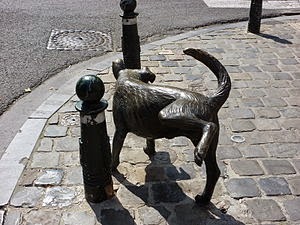
In 1998 the burghers of Brussels erected a further urinating statue, Zinneke Pis, this time of a dog. Ulike Manneken Pis and Jeanneke Pis, this one does not discharge water, or beer.


* * * * * * * * *