Thursday, September 15, 2011

Robert Benchley


“Hebrews 13:8.”

-  Theatre review by Robert Benchley

Robert Benchley (1889-1945) was a writer, columnist, essayist and the theatre critic for The New Yorker magazine.  For a time Benchley shared an office with Dorothy Parker.  Their daily lunches at the Algonquin Hotel attracted other writers and wits, eventually becoming known as the Algonquin Round Table. 

Benchley’s  1920's review of the long running Broadway show Abie’s Irish Rose, which he hated, consisted solely of the above Bible verse.  Those readers who consulted a Bible to look up the verse discovered that it read:

“Jesus Christ, the same yesterday, and today, and forever.”


Wednesday, September 14, 2011

Quote: A A Milne


"Sometimes,' said Pooh, 'the smallest things take up the most room in your heart."   

- A A Milne (1882-1956), Winnie the Pooh


A Two Minute Story


Sent to me by Byter Arthur:

Curtain Rods

She spent the first day packing her personal belongings into boxes, crates and suitcases. On the second day, she had the movers come and collect her things. On the third day, she sat down for the last time at their beautiful dining room table by candlelight, put on some soft background music and feasted on a pound of prawns, a jar of caviar, and a bottle of Chardonnay.

When she had finished, she went into each and every room and deposited a few half-eaten prawns dipped in caviar into the hollow of the curtain rods. She then cleaned up the kitchen and left.

When the husband returned with his new girlfriend, all was bliss for the first few days. Then slowly, the house began to smell. They tried everything, cleaning, mopping and airing the place out. Vents were checked for dead rodents and carpets were steam cleaned. Air fresheners were hung everywhere. Exterminators were brought in to set off gas cannisters, during which they had to move out for a few days. In the end they even paid to replace the expensive wool carpeting.

Nothing worked.

People stopped coming over to visit. Repairmen refused to work in the house. The maid quit.

Finally, they could not take the stench any longer and decided to move. A month later, even though they had cut their price in half, they could not find a buyer for their stinky house. Word got out and, eventually, even the local real estate agents refused to return their calls.

Finally, they had to borrow a huge sum of money from the bank to purchase a new place.

The ex-wife called the man and asked how things were going. She told him she missed her old home terribly and would be willing to reduce her divorce settlement in exchange for getting the house back. Knowing his ex-wife had no idea how bad the smell was, he agreed on a price that was about 1/10th of what the house had been worth, but only if she were to sign the papers that very day. She agreed and within the hour, his lawyers delivered the paperwork.

A week later, the man and his new girlfriend stood smirking as they watched the moving company pack everything to take to their new home. Including the curtain rods.

I love a happy ending, don’t you?


Tuesday, September 13, 2011

Anecdotes

Peter Bogdanovich


John Ford


John Wayne

From Peter Bogdanovich's 2004 book Who the Hell's In It?:


Peter Bogdanovich:  I'm giving John Wayne a book as a birthday present.

John Ford:  He's got a book.


Ned Kelly: Part 8


Jerilderie:

The Kellys had their own system of informants, spies and safe houses.  The arrest of Kelly sympathisers only strengthened Kelly support.  It also meant that those families, having lost their breadwinners, were lacking income and therefore doing it tough.  Kelly and his gang resolved to obtain funds to help those sympathisers.

The New South Wales police had been smug about the Victorian attempts to catch Kelly, believing that they could do a more efficient job.

Through information deliberately filtered to the police, Ned let it be known that he intended to hold up the bank in Goulburn. 

Instead, on 8 February 1879, they rode to Jerilderie.  In pairs they had drinks at the local hotel, gathering local knowledge, including the names of the local police.  Kelly then went to the police station and yelled out “Devine, there’s a drunken man at Davidson’s Hotel who has committed murder.  Get up at once, all of you.”  Devine and his deputy, Richards, immediately got up and ran out, straight into revolvers aimed at them.


Monday, September 12, 2011

Live, Laugh, Love

 
The following items are all variations on a theme, that to get the most out of life, follow three little words:  Live, Laugh, Love.  I have been unable to find the original author but that is, in any event, unimportant.  It seems to me that there is some good advice there, that even just trying to follow it would probably make some difference for the better.


Ned Kelly: Part 7


Euroa:

Although the government had brought in harsh laws to seek out the Kelly Gang and although the gang had been declared to be outlaws, able to be shot on sight with no fear of prosecution, the Kelly Gang remained at large.

Two hundred police were put into the area and black trackers were brought down from Queensland. It didn’t help.  Neither did the tough police approach.  Sympathy and support for the police began to give way to resentment as suspected sympathisers were held for weeks without charge.

To raise funds to assist sympathisers with ail money and pay debts, Ned and the gang decided to rob the bank at Euroa, a town of about 300 people.

Saturday, September 10, 2011

Movie Moments


Conviction (2010)

Comment:
Sometimes truth is stranger than fiction, even Hollywood fiction.  Imagine if your brother or sister was convicted of murder and you believed him to be innocent.  How far would you go to try to overturn his conviction, how long would you try and what would you be willing to give up to do it?  A woman in the US, Betty Anne Waters, went further than most.  Convinced of her brother’s innocence and with all appeal avenues exhausted, whilst working and raising 2 children as a single mother, she obtained her High School qualifications and then a law degree to be able to represent her brother. In the face of stubborn authorities who refused assistance and cooperation for their own reasons, witnesses who had lied, police manipulation of witnesses, police corruption and the apparent official destruction of exhibits after the passage of time, she managed to obtain her brother’s release as not being guilty.  This was done when she located blood evidence and had it DNA tested to show that the offender’s blood at the scene was not her brother’s and when witnesses swore affidavits as to police pressure to lie at the trial.  This was done with the assistance of The Innocence Project, a nonprofit organisation dedicated to overturning wrongful convictions.

Synopsis:
The film tells the above story.

Stars:
Hilary Swank, Minnie Driver

Quote:
Abra Rice:  We’re gonna be friends ‘cos we’re the oinly ones in class who went through puberty.

Link:
Trailer:

Trivia:
·       Kenneth Waters died in 2001. 6 months after his release from 18 years in prison, when he slipped and fell off a wall while taking a shortcut to his brother’s house after dinner with his mother.  He died from head trauma injuries.  Be4tty Anne Waters has said of her brother’s death “It’s sad, but the greatest part is Kenny died free and innocent.”
·       In 2009 the town of Ayers and its insurers settled his estate’s civil rights suit for $3.4m.
·       Betty Anne Waters has gone on to obtain a Master’s in Education and a Doctorate in Jurisprudence.  She now works with the Innocence Project.


The real Betty Anne Waters and her brother Kenneth, leaving court as a free man.


Ned Kelly: Part 6


The Stringybark Creek killings:

Ellen Kelly, Bill Skillion and Bricky Williamson were sentenced by Redmond Barry on 9 October 1878.

At first the police did nothing in looking for the Kelly Gang, waiting for the worst of the winter to be over.  In late October the local police chief, Superintendent Sadleir, sent out two parties to look for the Kellys, one from Greta in the North and one from Mansfield in the South, the intention being to trap the Kellys in the middle.

The Mansfield party, under the charge of Sergeant Kennedy, consisted of 4 members disguised as prospectors. The party comprised:

Sergeant Michael Kennedy
Age 36, from Westmeath, Ireland,
Father of five


Constable Thomas McIntyre
Age 32, from Belfast, Ireland
A schoolteacher before becoming a police officer, he was the only survivor of the Stringybark Creek killings.

Quote: Alfred A Montapert


"Do not confuse motion and progress. A rocking horse keeps moving but does not make any progress."
 
 
-  Alfred A. Montapert


Friday, September 9, 2011

Ned Kelly: Part 5


The Fitzpatrick Incident and Outlawed

The events which resulted in Ned being declared an outlaw started on 15 April, 1878.

According to Constable Fitzpatrick, then aged 21, he went to the Kelly house to arrest Ned’s brother, Dan, aged 17, for horse stealing. 


There are two versions as to what happened next.

Fitzpatrick’s version:

Funny Friday


  Today, some Irish humour . . .

Three Irishmen, drunk as can be, come staggering down the street singing Danny Boy at the top of their lungs. They stopped in front of Flaherty’s house, still singing. After a few minutes the window flies open and Mrs Flaherty yells out "Why don't you drunken sots go somewhere else.

"Would you be Mrs. Flaherty?" asks one of the drunks.

"You know damn well I am," she says.

"Well, Missus, would you kindly tell us which one of us is your husband so the other two can be going home."


When Saddam Hussein set the Kuwaiti oil wells on fire when facing defeat in the Iraq war, the Kuwaiti oil sheiks sought to recruit legendary Texas firefighter Red Adair to put out the fires.  Red Adair was the world’s best known extinguisher of oil well fires, even having had a movie made about him (John Wayne played him, of course).  Red received local recognition when he extinguished a fire and capped the well in Bass Strait.

When Red was first approached by a representative for the sheiks he replied that he was too busy, that he had more work than he could handle as it was but that his Irish cousin, Green Adair, might be able to deal with it. 

The sheik telephoned Green and asked  “Hello, is that Green Adair ….. ?”

“Yess, sorr, dat’s roight, tis me Green Adair at yer service …” said the voice at the end of the line.

“Mr Adair, that terrible man Saddam Hussein has set fire to our oil wells. Can you come and help us?”

The Irishman thought for a second and replied “Oh, I don’t know sorr, we’re awful busy at de moment . . .”

“We will pay you ten million pounds per oil well, Mr Adair” responded the sheik.

“Me an’ de lads‘ll be over in de mornin’ sorr …..” replied Green.

The next day at first light, a military jumbo circled the raging fires and then proceeded to land a short distance from the largest blaze.  The cargo doors opened and a battered dark blue truck came hurtling down the ramp and sped right into the middle of the flaming inferno. As it came to a halt all of the doors opened and twenty Irish navvies in jackets and boots jumped out and started to furiously stamp up and down on the flames and beat them flames with their jackets.

Eventually the fire was extinguished.  With  BBC cameras filming and people patting Green on the back, Green was approached by the sheik who said to him “That was magnificent, remarkable.  Tell me what you want and it is yours,  ask anything.”

“Well.” replied Green, “for a start, we’ll get the brakes on dat fockin’ trock fixed.”

Thursday, September 8, 2011

Wednesday, September 7, 2011

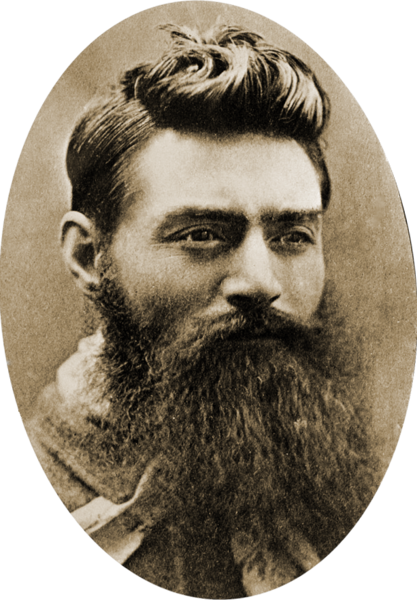
Ned Kelly


Because there is so much of the Ned Kelly story still to come, I am going to leave it for a few days so that readers will not go into information overload.

As you may have gathered, I find the Kelly history fascinating, and not just because of the events.  (For those overseas readers who do not know of Ned Kelly and the Kelly Gang, keep reading the future parts because there is a powerful climax and ending to the story).  The Kelly saga is also of interest from a historical perspective in its association with other events at the the time and in its depictions of society at the time.

More to come.


Origin: Maverick


Samuel Augustus Maverick (1802-1870) was a Texas lawyer, politician, land baron and signer of the 1836  Texas Declaration of Independence. He was sent as a delegate from the Alamo to the Texas independence convention in San Antonio, the battle of the Alamo taking place whilst he was at the convention.  He was also the contributor of a new word to the English language – “maverick” – first cited in 1867.


In later years he practised as a lawyer and as a rancher.  Those who like watching western movies will be familiar with the original style of ranching:  open range.  The movies often depict the hostilities which develop when someone tries to fence their land, especially with barbed wire.

Because of open range ranching , it was necessary for ranchers to brand their cattle for identification of ownership.  Samuel steadfastly refused to do so, thereby resulting in the word maverick entering the English language, meaning both an unbranded range animal as well as a slang term for someone who exhibits a streak of stubborn independence.

Maverick stated that he refused to brand because he did not wish to inflict pain on any animal; others said it was just laziness.  The real explanation is probably more mercenary.  Elsewhere ranchers who came across unbranded cattle simply put their own brands on them and claimed them as their own.

Not so with Sam Maverick, who was no ordinary citizen.  Sam was a well known lawyer, the influential Mayor of San Antonio, a member of the Texas legislature, and the holder of 385,000 acres.

Sam claimed that if all other ranchers branded their cattle and didn’t, all the unbranded cattle were his.  He therefore claimed ownership of all unbranded cattle.  This led to any unbranded cattle becoming known as Maverick’s.

Tuesday, September 6, 2011

Origin: 5 o'clock shadow


Everyone knows that a 5 o’clock shadow refers to visible beard growth that appears by late afternoon, after having shaved in the morning. 

But what’s the origin of the term?  Patience, we’ll get to that.

Ever heard of the 5 o’clock shadow that cost an election and thereby the Presidency?  I have written about it previously:

In 1960 John Kennedy was running against former Vice President Richard Nixon.  Kennedy was thought of as lacking experience, as being too youthful, plus he was a Catholic.  Some queried whether his allegiance would be to Rome first and the US second. 

TV was just coming in and the candidates agreed to a series of question and answer sessions – The Great Debates – that would be televised nationally as well as being broadcast on the radio.

Kennedy had been campaining in the West and was looking fit, tanned and refreshed.  Nixon had just recovered from a severe knee infection which had caused him to lose significant weight and made him look gaunt.  Kennedy declined makeup, causing Nixon to do likewise.  Big mistake.  Nixon had a heavy beard so that his 5 o’clock shadow looked pronounced.  With his gauntness and pale skin, it made him look devious, consistent with the Kennedy advertising campaign that had asked the public:


Ned Kelly: Part 4


The Early Years,  continued

On 11 November 1870 Ned commenced a 3 month term of imprisonment on charges of assault and obscenity.

Three weeks after getting out, Ned lent his horse to his friend, Isaiah “Wild” Wright, who said that he had lost his horse.


Wild Wright

Wright was married to Bridget Lloyd, a member of the local Lloyd family, and therefore had close links with the Kellys.  He was also to become one of the Kelly Gang’s staunchest supporters.

Wright told Ned that if Ned happened to find the lost horse, they could exchange the horses when he was next nearby.  Ned did find the lost horse and rode it to Greta.  What Wild Wright had not told Ned was that the lost horse was stolen.

Sunday, September 4, 2011

Quote: Helen Keller


"When one door closes another opens. But often we look so long so regretfully upon the closed door that we fail to see the one that has opened for us."

-       Helen Keller

Helen Keller (1880-1968) contracted what is believed to have been scarlet fever or meningitis at the age of 19 months, which left her deaf and blind. With the assistance of a tutor, Anne Sullivan, appointed when Helen was aged 6, she was able to comprehend the spelling of words, thereby identifying objects, by touches on her hand.  Helen Keller went on to become a world famous speaker, author, a spokesperson for people with disabilities, a suffragist, pacifist, radical socialist, birth control supporter and advocate for workers’ rights. In 1964 she was awarded the Presidential Medal of Freedom by President Johnson, one of the two highest US civilian honours.


Ned Kelly: Part 3


The Early Years, continued:

At the age of 12, Ned stepped into his father’s shoes when Red died.

Ellen moved herself and her family to Eleven Mile Creek, not far from Benalla and halfway between Greta and Glenrowan, where she lived in a slab hut.  Superintendent Nicholson recorded that they lived in poverty and squalor, the slab hut with bark roof being divided into 5 compartments by partitions of blankets and rags.


The Kelly house at Eleven Mile Creek.


What remains of the Kelly homestead at Eleven Mile Creek