Thursday, December 16, 2021

WORD & PHRASE ORIGINS, CONTINUED

-------oOo-------

Continuing a look at a list circulating on the internet with claimed origins of listed words and phrases, most of them incorrect . . .

-------oOo-------

‘IRON-CLAD CONTRACT’

This came about from the iron-clad ships of the Civil War.

It meant something so strong it could not be broken.

Comment:

ironclad (adj.)
1852 of knights, 1861, of warships, American English, from iron (n.) + clad. Figuratively, of contracts, etc., "very rigid or strict, allowing no evasion or escape," from 1884. As a noun meaning "iron-clad ship," it is attested from 1862.

Source:
Etyonline

ironclad agreement
A mythical contract that can't be broken—like the Loch Ness Monster, often reported but never confirmed. As a practical matter, there is no agreement that can't be broken if the parties have sufficient resources, well-qualified legal talent, and plenty of time.

Source:
The Free Dictionary

-------oOo-------

‘PASSING THE BUCK / THE BUCK STOPS HERE’

Most men in the early west carried a jackknife made by the Buck Knife company. When playing poker it was common to place one of these Buck knives in front of the dealer so that everyone knew who he was. When it was time for a new dealer the deck of cards and the knife were given to the new dealer. If this person didn't want to deal he would "pass the buck" to the next player. If that player accepted then "the buck stopped there".

Comment:

Poker became very popular in America during the second half of the 19th century. Players were highly suspicious of cheating or any form of bias and there's considerable folklore depicting gunslingers in shoot-outs based on accusations of dirty dealing. In order to avoid unfairness the deal changed hands during sessions. The person who was next in line to deal would be given a marker. This was often a knife, and knives often had handles made of buck's horn - hence the marker becoming known as a buck. When the dealer's turn was done he 'passed the buck'.


Source:
The Phrase Finder

"The buck stops here" is a phrase that was popularized by U.S. President Harry S. Truman, who kept a sign with that phrase on his desk in the Oval Office. The phrase refers to the notion that the President has to make the decisions and accept the ultimate responsibility for those decisions. Truman received the sign as a gift from a prison warden who was also an avid poker player. It is also the motto of the U.S. Naval Aircraft Carrier USS Harry S. Truman.

At the recreation of the Truman Oval Office at the Truman Library in 1959, 
former President Truman poses by his old desk which has the famous "The Buck Stops Here" sign.

Source:
Wikipedia

-------oOo-------

‘RIFF RAFF’

The Mississippi River was the main way of traveling from north to south. Riverboats carried passengers and freight but they were expensive so most people used rafts. Everything had the right of way over rafts which were considered cheap. The steering oar on the rafts was called a "riff" and this transposed into riff-raft – or riff-raff, meaning low class.

Comment:

As early as 1326, the Annales Paulini (the chronicles of the reigns of Edward I and Edward II) record the French term 'rifler' with the meaning of 'robber; plunderer'. The Anglo-Norman word 'raf' was used in the French moral text The Debate between the Body and the Soul, circa 1330, with an undefined but generally depreciative meaning. The seems to derive from the French verb 'raffler', 'to ravage' or 'snatch away'. It may be that the two words 'rif' and 'raf' were simply semi-rhyming variants of each other.

At that stage 'rif and raf' meant 'everything; every little bit', which no doubt reflects the 'rifling; stripping' meaning and indicates that plunderers left little of value behind them.

The 'riff-raff' version that has come down to us appears in Gregory's Chronicle, circa 1470:

Many a man was mortheryde and kylde in that conflycte, I wot not what name hyt for the multytude of ryffe raffe. [Many men were murdered and killed in that fight. I don't know what to describe it due to the large number of riff-raff'.]

It is clear that, by that date, the meaning of 'ryffe raffe' related to people and was derogatory. It seems likely that the name 'riff-raff' had transferred from the plunder to the plunderer.

The meaning continued to change , more toward the current 'scum; dregs of society' meaning. In 1545, Roger Ascham's Toxophilus, the Schole of Shooting included it with that meaning:

The common wealthe can be contente to take at a fonde father's hand the rifraffe of the worlde.

Source:
The Phrase Finder


Riff Raff from The Rocky Horror Show

-------oOo-------

Wednesday, December 15, 2021

THOUGHT FOR THE DAY


FROM THE VAULT

The following Christmas item was posted in February of this year because I originally came across it well after Christmas had been and gone.

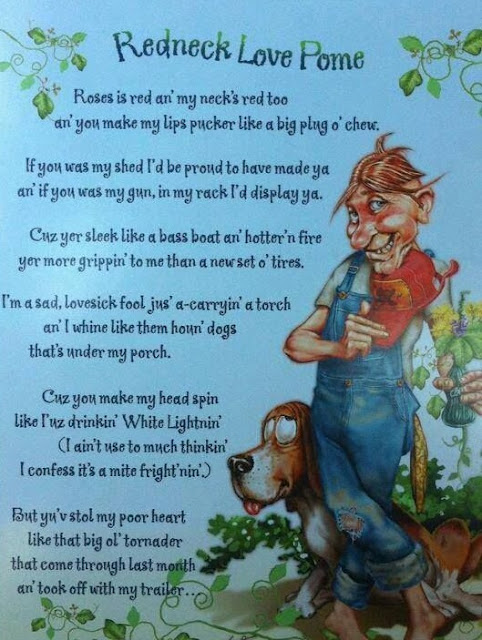
I was reminded of it yesterday when I posted some redneck humour.

Being about Christmas, it is worth another airing . . .


Thursday, February 4, 2021

The following poem is about Christmas but I have only just come across it. Think of it as 6 weeks late or 46 weeks early . . .

Redneck Christmas

Roy Jerden


T'were the night after Christmas, 'n' the house was all dark.
Not much money for 'lectric in the ol' trailer park.
Ma waitin' tables at the club on the base,
jist me and my sisters alone in the place.

A big ol' blue norther, t'were a hard winter storm.
We's all snuggled up close, jist tryin' ta stay warm.
The trailer's as cold as a well digger's ***,
cause they come out that mornin' and turnt off the gas.

I shore kinda hated to git out of that bed,
but ol' Mother Nature made me git up, instead.
I'd gotta go out if I wanted a leak,
'cause the toilet had bin all plugged up fer a week.

Outside it 'peered warmer, which was a suprise.
As I peed on the tree, sumpin lit up the skies.
Them lights shined down on the yard, and I froze.
Shore prayed it warn't one of them weird UFO's.

As I stood thar turnin' round and around
there was white stuff fallin' and coatin' the ground.
I grabbed a big buncha it up in my mitts.
I thought it was snow, but turnt out it were grits.

I heared a big motor runnin' up overhead
and down come a monster truck painted all red.
It bounced on the front 'n' bounced on the back,
then the driver clumb down 'n' grabbed a tow sack.

He was white-haired 'n' husky, with red overalls,
long ZZ Top whiskers 'n' blood-shot eyeballs.
A red John Deere work cap was perched on his nut
and a WalMart white T-shirt half-covered his gut.

He look like he just come off'n the farm,
'cept fer them tattoos of elves on his arm.
As I stood around there jist like a complete dick,
he says, “Boy ain't you gonna say crap to St. Nick?”

“Yes siree Bob”, says I, “I got sumpin to say.
I'd shore like ta know where you was yesterday.
The toilet's stopped up and we's all out of heat,
ain't got no money and they's nuthin' to eat.”

“I was fixin' ta make it on time”, he then said.
He look kinda sheepish, and hung down his head.
“But I stopped at a bar when I finished my rounds.
And run inna St. Paddy at the Hare 'n' the Hounds."

"Ya know that he's the very best pal of St. Nick.
But there's none who can put 'em away like that Mick.
And the next thing ya know, we's over at Chances
Where that Tooth Fairy is doin' ten-dollar lap dances.”

“The Tooth Fairy a stripper? That done give me the chills!”
“Yessir”, says he, “Where ya think she gits all them bills?”
“Jist a minute”, I goes. “Where's the reindeer and sleigh?”
He turnt even redder, and then looked away.

“Well, we had a poker game goin', I thought I would win.
I was holdin' four aces and bet everthang in.”
There was a palpable silence, a terrible hush.
“Then that damn Easter Bunny laid down a straight flush.”

“Well, I cut cards with a redneck and won me that truck
But as for the reindeer, they was squat outta luck
They throwed a big barbeque, and cooked 'em up slow
But I must say them reindeer's good eatin', ya know?”

No Dasher, no Dancer, no Prancer and Vixen!
No Comet, no Cupid, no Donner and Blitzen!
For hung on that red-painted monster truck's nose
was eight pairs of antlers, lined up in two rows.

“Anyway, I brung vittles for you and the girls.”
And out of the sack he pulled seven skint squirrels.
“I jist bagged 'em thar in yer neighbor's back yard
Fry 'em up well, boy, with plenty of lard.”

I goes, “Them squirrels is rilly fine eatin' fer shore,
But ta git past tomorrow, we's gonna need more.”
says he,“Well, I's a bit short on cash fer today.”
And he give me six lottery numbers to play.

Then up drives my ma with bad blood in her eye
Draws out her six-shooter, jist primed to let fly.
Then lowers her arm down and commences to bawl
says, “I love you, you bastard, you tol' me you'd call!”

He says, “Boy, looks like it's not healthy to linger
Sticks his mitt out 'n' goes “Just pull on my finger.
The truck is fer you, son. I bid ya goodnight.”
And on a column of wind, he plumb riz out of sight.

I feels fevered and flushed as I stands there in awe
And I reckons this redneck St. Nick was my paw.
A voice far-off hollers, “Merry Christmas, now, y'all!
Then adds, “Don't fret none baby, jist wait fer my call!”

P.S.
Them lottery numbers worked out good. We bought a double-wide on our own lot 'n' a giant TV and had still had lots of money left over fer me to go to big rig truck driving school and Ma to that there beauty college. And on top of that a Nigerian guy is going to deposit over a million dollars in my bank account.

Tuesday, December 14, 2021

QUOTE FOR THE DAY


SOME REDNECK HUMOUR . . .

According to Wikipedia:

The term originally characterised farmers that had a red neck, caused by sunburn from long hours working in the fields. A citation from 1893 provides a definition as "poorer inhabitants of the rural districts ... men who work in the field, as a matter of course, generally have their skin stained red and burnt by the sun, and especially is this true of the back of their necks". Hats were usually worn and they protected that wearer's head from the sun, but also provided psychological protection by shading the face from close scrutiny. The back of the neck however was more exposed to the sun and allowed closer scrutiny about the person's background in the same way callused working hands could not be easily covered.

The item states that “Redneck” is a derogatory term chiefly, but not exclusively, applied to white Americans perceived to be crass and unsophisticated, closely associated with rural whites of the Southern United States. The word is usually considered offensive but people from the white South sometimes jocularly call themselves "rednecks" as insider humour.


In Australia the equivalent term is “bogan”, a slang term for a person whose speech, clothing, attitude and behaviour are considered unrefined or unsophisticated. The prevalence of the term bogan has also been associated with changing social attitudes towards social class in Australia. Since the 1980s, the bogan has become a very well-recognised subculture, often as an example of bad taste. It has antecedents in the Australian larrikin and ocker, and various localised names exist that describe the same or very similar people to the bogan.

The origin of the term bogan is unclear; both the Macquarie Dictionary and the Australian Oxford Dictionary cite the origin as unknown. Some Sydney residents' recollection is that the term is based on the concept that residents of the western suburbs (stereotyped as "Westies") displayed what are now termed "bogan" characteristics and that an individual who displayed these characteristics to a strong extent was as "west" as the Bogan River in western New South Wales. According to another anecdote, the term emerged in Melbourne's outer-western and outer-eastern suburbs in the late 1970s and early 1980s.


The word "bogan" is derogatory and carries with it a variety of stereotypes. Bogans typically wear ugg boots, or thongs in summer. Bogans come in different varieties. Once upon a time their hair favoured the mullet and mohawks. The younger ones are more prone to standardisation: torn jeans and sloppy sweaters, or flanny shirts, or a wife-beater singlet, and long hair au naturel - or, of late, rat-tails. Unusually, bogans can be of any age…


Bonus item . . .


Monday, December 13, 2021

QUOTE FOR THE DAY


PAST VISIONS OF THE FUTURE . . .


I recently posted an item about future predictions. It inspired a contribution by Graham E, today’s G Spot, and comes from the following site:

Thanks, Mr E.

Graham’s email:
Hi Mr O,

Not sure if you have seen these visions of the future, they were part of a collector’s album issued in 1930 by Echte Wagner, a German margarine company which issued several albums of cards between the wars. Each image came with an explainer on the back.


Wonderful Futuristic Visions of Germany By Artists In 1930
______________


Wireless Private Phone and Television.

Everyone now has their own transmitter and receiver and can communicate with friends and relatives. But the television technology has also improved so much that people can speak to each other in real time. Transmitters and receivers are no longer bound to their location, but are always placed in a box of the size of a camera.
_______________


Artificial Island

Since there is no island airport on the shortest route to America, there could be an artificial landing place in the middle of the ocean. Of course, there are hotels, baths, restaurants and a cinema on the island.
_______________


Monorails

In order to increase the speed of traffic, we will build single-lane expressways on which carriages run on two wheels, one behind the other. The cars are streamlined to minimize the air resistance. A heavy gyro is installed in the traction unit, the axle of which is resistant to all tilting. To ensure that the train does not jump the rail, which would be a disaster at 500 km, it features stabilization surfaces just like a rocket car.
_______________


Rocket Ships

The future of aircraft is rockets. Rockets are installed at the stern. Escaping gases propel the aircraft forward. Nankou is a city on the north coast of China. Because the rocket ship can attain speed of 1000 km, it takes less than 8 hours for the Berlin-Tokyo route. A steamboat takes about 50 days today!
_______________


Flying Wings

The Rocket Wing is shaped like a parabola. The lavishly furnished cabins are installed in the wings and hold 400 passengers. Because there is no longer a fuselage, the control fins are located at the ends of the wings. The driver’s cab, from which the rockets are controlled, is in the middle of the crossroads.
_______________


Nuclear-Powered Cars

Tomorrow’s car is powered by a tiny engine, driven by the nuclear power. The speed of the cars has grown accordingly. They travel at 200kph-300kph an hour on city roads. On faster roads, speeds of 1000kmh are achievable.
_______________


An Ocean Giant

The shape of the steamer has changed significantly. All the bulky constructions have disappeared, not even a chimney can be seen. So the size of the steamers has grown: the ship shown here carries 20,000 passengers in two days from Hamburg to New York.
_______________


Motorways

The horses are extinct and electricity has replaced steam. The pedestrian is no longer afraid of the dangers of traffic, because the road and footpath are strictly separated. All men and women wear uniform clothing: zipped up skirts and trousers.
_______________


Landing An Airship

The airship shown here is just about to sink into its giant cradle. It is no longer lifted by gas and driven by motors, but by a transformer which is capable of changing gravity into repulsive force. This has made it possible to raise, lower and move even the biggest loads.

(Note that the sign shows the flight is from Sydney, Australia).
_______________


Moon Landings

Is this not a bad drawing? Do not the missiles have to ignite at the stern of the ship and spit their fire backwards? No, it’s all right! The ship is landing. The brake booms have been blown up and the craft has decelerated rapidly. Now you can comfortably land on the Moon.
_______________


Planes For All

Here we have the opportunity to each own our own plane. Where are the propellers? No need for them. These plane rises and fall vertically. The engine is a small capsule, in which the atomic breakdown takes place. On the right you can see an airplane garage and an air-conditioned car park.
_______________


Spaceship Port

Because there are rare minerals on the moon, America has constructed the Moma-AG (Moon-Minerals-yield-AG). Costing 20 billion dollars, space ships can dock and renew their rocket fuel. The port floats freely in space.
_______________

Sunday, December 12, 2021

QUOTE FOR THE DAY


ORIGINS OF PHRASES, PART 1

-------oOo-------

Byter Charlie Z sent me an email that he thought may be of interest for Bytes. Thanks, Charlie.

I have seen it before and I am aware that it contains inaccuracies.

Nonetheless it is of interest, so here it is with commentary from me.

-------oOo-------



'A SHOT OF WHISKEY'

In the old west a .45 cartridge for a six-gun cost 12 cents and so did a glass of whiskey.

If a cowhand was low on cash he would often give the bartender a cartridge in exchange for a drink. This became known as a "shot" of whiskey.

Comment:

Firstly, note that the Americans spell whisky as “whiskey”.

As regards the bullet price origin . . . not so.

Factually the price of a bullet was not equivalent to the price of a drink of whiskey. It actually equalled about 10 cartridges.

The use of the term “shot” in this context well predates the use in the Old West (1850-1900). It is recorded as used c 1700 in respect of “drinking shots”. According to the Oxford English Dictionary, the meaning as a charge to be paid” (and, in a more specific usage, “a bill or one’s share of it, especially in a pub or bar”), goes back to 15th-century England.

Finally, the phrase “shot of whiskey” didn’t actually become common until the mid-20th century.

Source:
Snopes.com

According to University of Melbourne language expert John Hajek, the alleged origin is not true:
“It’s just made up. A ‘shot’ is probably the result of when you’re pouring the drink. That sudden jerking movement is where it almost certainly came from. It was also a word for payment in a pub or bar, which goes back to the 15th century.”
Source:
AAP Fact Check

-------oOo-------

‘THE WHOLE NINE YARDS’

American fighter planes in WW2 had machine guns that were fed by a belt of cartridges.

The average plane held belts that were 27 feet (9 yards) long. If the pilot used up all his ammo he was said to have given it the whole nine yards.

Comment:
Again, not so.

I have posted about this phrase previously (back in 2012, has it been that long?), so I will simply repost that item:

Wednesday, May 16, 2012

The Whole Nine Yards and Kilts

It’s funny where looking up things takes you, in the present case, kilts. Not that I was looking up kilts but that I was led there.

Let me explain.

I recently heard the expression “the whole nine yards” again. Most will be aware that it means completely, the whole thing. Some years ago I had heard that the expression originated from the length of machine gun ammunition belts in World War 2 fighter planes. It was suggested that the length of the belts was nine yards (about 3 metres) and that to empty one’s ammunition belt at a target was to “go the whole nine yards”.

Looking into it further today, I found the following:
  • There are numerous explanations for how the phrase developed, some explanations referring to tests (walking 9 yards over coals), to clothing (using 9 yards of material in suits and kilts) and to construction (the amount of concrete carried by concrete trucks).
  • Nonetheless, experts are unable to explain how the phrase originated.
  • The earliest recorded use of the phrase is from 1962, suggesting that most of the explanations are incorrect.
  • It is likely that the phrase developed in the US in the 1960’s.

There is a more detailed examination at:

Which raises kilts.

Snopes.com, the authoritative site on urban myths, origins and electronic spam, suggests that “the best candidate for the origin of the expression might lie with a risque story of uncertain age” concerning a young Scot and his kilt. The item appears at:

Rather than quote the story, I will set out the lyrics of a song which tell the same tale. It is called Angus and his Kilt:

Well, Angus was a happy lad, for soon he would be wed.
He'd found a brisk and bonnie lass to take him to his bed.
And happier still his mother was that he had found a wife,
For, truth be told, she'd often feared she'd be stuck with him for life.

Chorus:
It's a fine thing, a bonnie thing, the grandest ever seen.
(Repeat last line of verse)

In honour of the grand affair that wedding day would be,
She set about to weave a kilt, the finest ever seen.
The night before the wedding, when the kilt was finally done,
She called young Angus over and she tried it on her son.

She wound the kilt about him and she wound, and wound, and wound,
And when she finished winding, it was still eight yards too long.
"Never fear, my bonnie boy. We'll simply cut it off,
And to your blushin' bride we'll give the extra length of cloth."

Now Angus was so pleased, y'know, his heart had swelled with pride.
He felt that he must rush right out and show it to his bride.
'Twas raining, so he grabbed a cloak to shield him on the moor,
But in his haste to be away his kilt slammed in the door.

Well, Angus was in such a rush to show off for his bride,
He never really noticed that he had left his kilt behind.
He knocked upon her door and cried, "Oh, let me in, I pray!
I've something that you've got to see before our wedding day."

Now, Bridget let him in, y'know, but said, "Ye cannot stay.
For I've got to have my beauty sleep before our wedding day."
"I'll only be a moment, love, but it's so grand, my dear,
Ye've really got to see what I'm a-hiding under here."

Now, when the cloak was thrown aside and Angus stood quite bare,
We must admit she was impressed and tried hard not to stare.
"Oh, love, I'll ne'er see finer, though far and far I roam!"
"Well, lass," he cried, "that's nothing! I've got eight more yards at home!"

-------oOo-------
‘BUYING THE FARM’

This is synonymous with dying. During WW1 soldiers were given life insurance policies worth $5,000.

This was about the price of an average farm so if you died you "bought the farm" for your survivors.

Comment:

Snopes.com gives the origin as undetermined.

One explanation sometimes given for the origin is that the death benefits paid to the beneficiaries of soldiers who died in battle were often enough to pay off the mortgage on the family home or farm, rather than purchase one, hence the deceased was said to have “bought the farm.” Snopes rates this explanation as tenuous.

Another similar suggestion is that it came from wistful statements by aviators to the effect that after the war was over, they’d like to settle down and buy a farm. Many were killed in dogfights, with the result that “He bought the farm” became a way of saying “His war is now over.”

Another theory leaves out soldiers entirely — according to it, farmers whose buildings were hit by crashing fighter planes would sue the government for damages, and those damages were often enough to pay off all outstanding mortgages on the property. Since very few pilots would survive such a crash, the pilot was said to have “bought the farm” with his life.

According to snopes, “to buy it” (meaning “to die”) existed in the language long before “to buy the farm” did. It’s more reasonable to suppose the one is an extension of the other, with “the farm” substituting for (the often unstated) “it.”

Source:
Snopes.com

From The Phrase Finder:
Bought the farm' is a 20th century expression and all the early references to it relate to the US military. The New York Times Magazine, March 1954, had a related phrase, in a glossary of jet pilots' slang:

"Bought a plot, had a fatal crash."

That clearly refers to a burial plot. The 'bought' in that case probably doesn't suggest any actual or potential purchase, but to an earlier use of 'bought it', that is, being killed. This dates back to at least the early 20th century. This example from 1943 isn't the earliest, but it does make the meaning explicit. It's from Cyril Ward-Jackson's It's a piece of cake; or, R.A.F. slang made easy:

"He's bought it, he is dead - that is, he has paid with his life."

Specific references to 'the farm' come a little later. There are reports of the phrase being in use in the US military from 1955 onward. Here's a citation from 1963, in Ed Miller's Exile to the Stars:

"The police dispatcher says a plane just bought the farm."

 . . . . 

(Another explanation) is the idea that, if a serviceman was killed in action, his family would receive a payout from the insurance that service personnel were issued with. This would be sufficient to pay off the family mortgage.

My two-penneth is on the last explanation but, given that we don't have the full evidence, that's just speculation.

Source:
The Phrase Finder

-------oOo-------
More to come.

Saturday, December 11, 2021

QUOTE FOR THE DAY


CONTINUING: TOP 10 + 2 CHRISTMAS MOVIES:

-------oOo-------
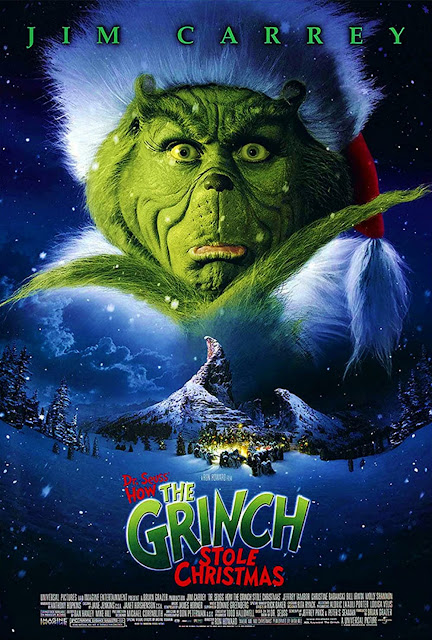
How The Grinch Stole Christmas


I’m not a great Jim Carrey fan but I do like this film. It’s not everyone’s favourite, in fact it gets a lot of negative reviews online, but there are things about the film I like:
  • the witty Carrey comments, much of it ad lib;
  • the children's movie also having adult humour on another level, like a Christmas pantomime (watch for the Who women putting their keys in the glass bowl at the get together, as for a swingers’ party)
  • it’s fun

Some facts and trivia:

Released in 2000.

It is based on Dr. Seuss's 1957 book of the same name and is the first Dr. Seuss book to be adapted into a full-length feature film.

The film is narrated by Anthony Hopkins and stars Jim Carrey as The Grinch.

The film earned mixed reviews from critics, who praised Jim Carrey's performance, but criticized its dark theme and somewhat scary moments.

It spent four weeks as the #1 film in the United States, grossed $345 million worldwide and was the sixth-highest grossing film of 2000.

Before his death in 1991, Dr. Seuss had refused offers to sell the film rights to his books. After his death, however, his widow Audrey Geisel agreed to several merchandising deals, including clothing lines, accessories and CDs. In July 1998, Geisel's agents announced via letter she would auction the film rights of How the Grinch Stole Christmas. In order to pitch their ideas to Geisel, the suitors ultimately had to be willing to pay $5 million for the material and hand over 4 percent of the box-office gross, 50 percent of the merchandising revenue and music-related material, and 70 percent of the income from book tie-ins. The letter also stated that "any actor submitted for the Grinch must be of comparable stature to Jack Nicholson, Jim Carrey, Robin Williams and Dustin Hoffman." Additionally, it was stipulated that the estate would not consider a director or writer who had not earned at least $1 million on a previous picture.

The scene where the Grinch is directing his dog, Max (Kelley), before stealing Christmas, is Jim Carrey making fun of producer and director Ron Howard, imitating his style of directing. Howard found the scene hilarious, and decided to include it in this movie.

The original Grinch was not green. Like everything else in the book, he was black and white with some red and pink splotches, but producer and director Ron Howard wanted this movie to also be an adaptation of the 1966 TV special.

The Grinch (Jim Carrey) is the only character who breaks the fourth wall in this movie. He actively tries to avoid speaking in rhyme and even interacts with the narrator (Sir Anthony Hopkins).

-------oOo-------

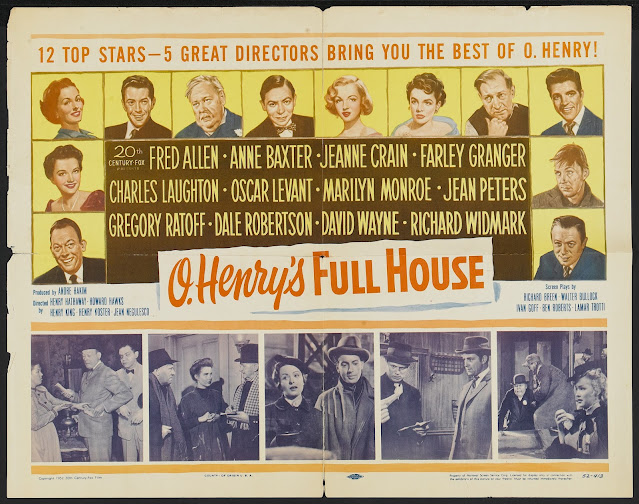
O. Henry's Full House


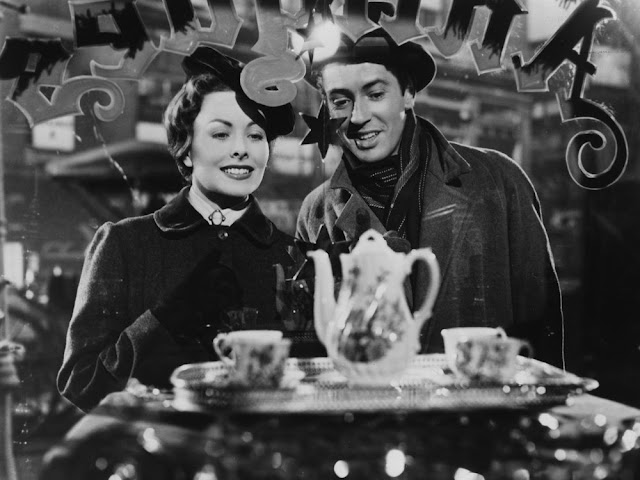
O. Henry's Full House is a 1952 American anthology film made by 20th Century Fox, consisting of five films, each based on a story by O. Henry. The film was directed by five directors from five screenplays with different authors and is narrated by author John Steinbeck, who made his only on-camera appearance to introduce each story.

It is included in my Top Ten + 2 for one reason only: it includes the film version of O’Henry’s story of "The Gift of the Magi", starring Jeanne Crain and Farley Granger.

I’m am not going to tell you of that story, I have posted the whole O’Henry’s story previously and it is well worth a read or re-read. Go to:

Those who wish to watch The Gift of the Magi segment of O’Henry’s Full House, can do so by clicking on:

Other reasons to watch O’Henry’s Full House:
5 good stories, I also really like The Last Leaf
A stellar cast
An appearance by Marilyn Monroe early in her career

You will not be disappointed.


-------oOo-------

Friday, December 10, 2021

QUOTE FOR THE DAY


FUNNY FRIDAY

 -------☹😊☹-------


Two more Fridays and it’s Christmas Eve, readers, it’s that close.

Here is some Friday humour to mark the way . . .

 -------☹😊☹-------

 SOME HUMOUR:

Adam was walking around the Garden of Eden, feeling very lonely, so God asked Adam, "What is wrong with you?" Adam said he didn't have anyone to talk to.

God said he was going to give him a companion and it would be a woman. He said this person will cook for you and wash your clothes. She will always agree with every decision you make. She will bear your children and never ask you to get up in the middle of the night to take care of them. She will not nag you, and will always be the first to admit she was wrong when you've had a disagreement. She will never have a headache, and will freely give you love and compassion whenever needed.

Adam asked what a woman like this would cost him. God said, "An arm and a leg."

Adam replied, "What can I get for just a rib?" 

-------oOo------- 
What's the difference between a fairy tale and a redneck tale? 

Fairy tales begin with "Once upon a time...", while redneck tales begin with "Y'all ain't gonna believe this shit..." 

-------oOo------- 

A man was taken to court for calling an Honourable Minister a pig. 

It was his first offence and the Judge was in a good mood and decided to show mercy. 

So he discharged him after warning him to desist from unguarded utterances in future. 

The man removed his cap and thanked the benevolent Judge profusely. ''Thank you, your lordship." 

He continued. "Honestly sir, I didn't know it was wrong to call an Honourable Minister a pig. I won't do it again. I am sorry.'' 

''It's okay.'' Said the Judge. ''You may go.'' 

''My lord, may I ask a question, sir?'' 

''Feel free,'' answered the Judge. 

''Now I know it's wrong to call an Honourable Minister a pig, but is it also wrong to call a pig Honourable Minister?'' 

Amused, the Judge replied. ''I don't know why you would want to address a pig as Minister. But I don't think the pig would mind. Anyway, it's not unlawful by the way. Yes, you may call any pig Honourable Minister.'' 

The man smiled and nodded, then he turned to look pointedly at the Minister and said. ''Goodbye, Honourable Minister.

(This reminds me of a story I heard may years ago that someone in Parliament once declared that one of the Members had the brain of a sheep.  Ordered to retract on a point of order, he then declared "Very well, the Honourable Member for [whatever electorate it was] doesn't have the brain of a sheep.")

 -------oOo------- 
In Jerusalem, a female journalist heard about a very old Jewish man who had been going to the Wailing Wall to pray, twice a day, every day, for a long, long time. So she went to check it out.

She went to the Wailing Wall and there he was! 

She watched him pray and after about 45 minutes, when he turned to leave, she approached him for an interview. 

“Sir, how long have you been coming to the Wall and praying?”

“For about 60 years.” 

“60 years! That’s amazing! What do you pray for?” 

“I pray for peace. I pray for all the hatred to stop and I pray for all our children to grow up in safety and friendship.” 

“How do you feel after doing this for 60 years?”

 “Like I’m talking to a wall!”

 -------☹😊☹------- 
Someone from Melbourne sent me an email yesterday stating that she would go to my friend’s restaurant in Sydney when the boarders were open again.  She obviously meant “borders” but it reminded me of the following:

A teacher addresses her primary school class:  “Class, the lesson now is spelling.  I would like each of you to stand up, tell me what you had for breakfast and then spell it.  Billy?” 

Billy stands and says “ I had bacon and eggs Miss, B-A-C-O-N, E-G-G-S.” “Good,” says the teacher, “Sally?” 

Sally stands and says “I had toast, Miss, T-O-A-S-T.”  “Also good,” says the teacher, “Johnny?” 

Johnny gets to his feet and says “I didn’t have any fuckin’ breakfast, F-U-….”  Before he can finish the teacher cuts him short and soundly tells him off, then sends the children out to recess. 

Over the break she thinks to herself that she may have been a little hard on Johnny, that maybe she should make it up to him when class resumes. She decides that she will ask him the first question when they return from recess. 

After they are all seated she says “Class, this lesson is geography.  Johnny, can you tell me where the Queensland border is?” 

Says Johnny “Well, when I left home this morning he was in bed with me Mum, that’s why I didn’t have any fuckin’ breakfast.” 

-------☹😊☹-------
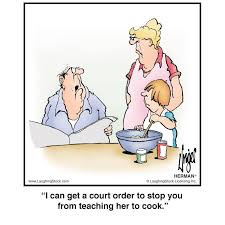
 

LIMERICK OF THE WEEK:

One of the first limericks I learned, when I was a youngster in school . . .

In the garden of Eden sat Adam,
Massaging the bust of his madam,
He chuckled with mirth,
For he knew that on earth,
There were only two boobs and he had 'em !

I know that there is an alternative version that refers to Adam having two balls but I believe that the above one is a better one.  This is the one from my primary school days . . . 

In the Garden of Eden lay Adam,
Gently caressing his madam,
And loud was his mirth
For on all of the earth,
There were only two balls -- and he had 'em.

Obviously human balls since the animals had been created:

25 And God made the beast of the earth after his kind, and cattle after their kind, and every thing that creepeth upon the earth after his kind: and God saw that it was good.

26 And God said, Let us make man in our image, after our likeness: and let them have dominion over the fish of the sea, and over the fowl of the air, and over the cattle, and over all the earth, and over every creeping thing that creepeth upon the earth.

-------☹😊☹-------
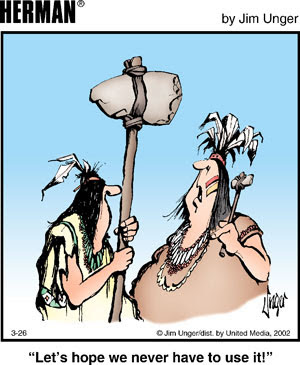
GALLERY:

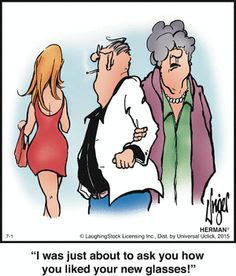
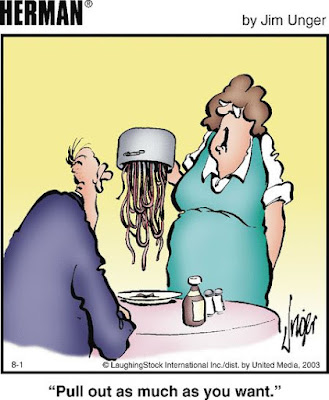
Some more Jim Unger Herman cartoons, I love these, love the faces, the captions, the humour . . .


-------☹😊☹-------
RELIGION SPOT:

A Protestant archaeologist uncovered Jesus Christ’s tomb.

And he discovered inside it remains, which beyond any reasonable doubt belong to Jesus Christ himself. The archaeologist understands that this could be catastrophic for Christian faith, since this means that there wasn’t any Resurrection of Christ. He’s in desperate need of advice, and so he decides to call the Pope despite being Protestant, because the Pope is the single most important person in the Christian world. He calls the Pope and tells him his story and asks him what to do, whether he should go public with his discovery or bury it forever to save the Christian faith worldwide. The Pope answers him: “Wait, holy crap, you mean Christ was real?!” 

-------☹😊☹-------


CORN CORNER:

Bruce Lee was fast

But his brother, Sudden, was faster. 

-------oOo------- 

They've finally found a cure for dyslexia

The news is music to my arse.

 -------oOo-------

 Did you hear that the guy that makes rings and necklaces out of steel is closing his shop for today?

Yes, it's ferrous jeweller's day off.

-------☹😊☹-------