Sunday, May 16, 2010

Reader Comment

From Byter Steve:
Diane and I visited Robert Louis Stevenson's grave and home when we went to Samoa last year. It’s a wonderful place, full of presence. I spent ages in his writing room and could feel him – there was an atmosphere which said “Here is a place where a great man lived and worked”. RLS was a great benefactor for the Island, and was loved dearly by the natives at all levels. His was a grand life, but he knew what it was like to be a common man and indeed he had a great respect for working people.

His body of work of course, is his legacy, and he should be remembered for its quality and his wonderfully furtive imagination. He doesn’t receive as much credit in the literary world as some of the great modern writers (Stephen King for instance), but he stands hands and shoulders above them all, and I believe he is there at the front of the line alongside the greatest story teller of them all – Charles Dickens. Apart from Dickens, who else has a legacy that touches so many people at so many levels?  For instance, find me an adult who hasn’t read Treasure Island and then find me a child who hasn’t read it or who doesn’t know the story? You can’t. He has spanned  generations and touched the lives of those millions upon millions of people and there is not a foul word amongst it.

A truly wonderful man.

Origin: $ and £


There are a number of explanations as to how the $ sign developed.

The most common is that the sign comes from the sign originally used for the peso, also known as the Spanish dollar. The sign used in Spain and Mexico for peso  –  a P followed by an S  –  gradually came to be written with the S overlaying the P, thereby giving rise to the $ sign. Support for this explanation comes from business correspondence in Britis North America from the 1770’s between British, Americans, Canadians and Mexicans using the $ sign. The term dollar and the dollar sign were adopted as US currency in 1785.

 An alternative explanation is that the sign comes from the figure 8 with a stroke through it, denoting pieces of eight, another name for the Spanish dollar. (The Spanish dollar, a silver coin, was also known as the real de a ocho, or eight-real coin, a dollar being worth 8 reales, hence the term pieces of eight, Robert Louis Stevenson’s tale Treasure Island and its depiction of Long John Silver’s parrot constant calling out “Pieces of Eight” led to the association of pieces of eight with pirates).

The name 'dollar', however, derives from the Dutch or Low German word daler (in German taler or thaler) - originally Joachimstaler, referring to a coin from the silver mines of Joachimstal, in Bohemia (now Jáchymov in the Czech Republic), which opened in 1516.

The pound sign - £ - being the symbol for the basic currency unit of the United Kingdom, derives from a capital "L", standing for libra, the basic Roman unit of weight, which is in turn derived from the Latin word for scales or a balance. The pound became a British unit of weight, and the pound currency unit was so named because it was originally the value of 1 pound Tower Weight (326 g)] of fine (pure) silver.

Saturday, May 15, 2010

Poem: Robert Louis Stevenson


Watching Jessica Watson on TV arrive home on Saturday afternoon, I was struck by some of the first words spoken to her by her mother after she stepped ashore:  “Home is the sailor home from the sea.”  The irony of that comment upon Jessica Watson’s homecoming is that the words come from a poem that is a requiem, a death poem.

The work is actually called Requiem and was written in 1879 by Robert Louis Stevenson (1850-1894). Stevenson was a sickly man for the whole of his life and suffered from tuberculosis, dying of a cerebral haemorrhage. Stevenson spent his last five years on the island of Samoa as a planter and chief of the natives. Requiem was penned at a time when he was ill, distraught and close to death.  The poem is engraved on his tombstone in Samoa:
Under the wide and starry sky,
Dig the grave and let me lie.
Glad did I live and gladly die,
And I laid me down with a will.

This be the verse you grave for me:
Here he lies where he longed to be;
Home is the sailor, home from the sea,
And the hunter home from the hill.
 Stevenson with his wife and household in Samoa - click on picture to enlarge.

Marilyn Monroe


Brit born Aussie Naomi Watts, 41, is to play Marilyn Monroe in a biopic of Marilyn’s life. That's Naomi Watts above as Marilyn, the real Marilyn below.

The movie starts filming in January and will be called Blonde. It will be based on the controversial biography of Marilyn Monroe, also called Blonde, by US author Joyce Carol Oates. Released in 2000, it is an “imagined memoir” which features detailed sex scenes, including one with President John F Kennedy whilst he is on the phone to Fidel Castro. Two other Marilyn Monroe movies are also in the works. Marilyn is based on accounts by former deputy LA Coroner Lionel Grandison that he was forced to falsify the death certificate from murder to suicide. My Week with Marilyn is based on Marilyn’s filming of The Prince and the Showgirl with Sir Laurence Olivier.

Friday, May 14, 2010

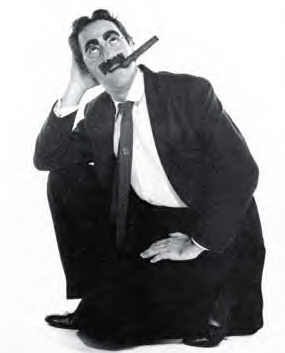
Quote: Groucho Marx


When Groucho Marx enquired in the 1930's as to membership of an American country club, he was advised that the club had a restricted membership policy, that is, it did not allow Jews to become members.  The club offered to waive its no-Jews rule for Groucho provided he abstained from using the swimming pool.  Groucho, married to someone who was not Jewish, remarked “My daughter’s only half Jewish, can she wade in up to her knees?”

Movies: The Medusa Touch

Comment:

This movie is, imho, vastly underrated. The brooding presence and wonderfully evocative voice of Richard Burton make this movie. It is a hard one to find but worth tracking down, otherwise try getting a copy on Amazon. I believe that it is available on DVD.

Not only are the matters raised in this movie thought provoking (no pun intended), there are scenes which are ironically and horribly topical in the present day, notwithstanding that the movie was made in 1978, more than 30 years ago.  The scene of the airliner striking the office block is horrific in the light og 9/11, but that hasn't stopped more recent posters higlighting that fact:

Quote: Edward VIII / Duke of Windsor


"A few hours ago I discharged my last duty as King and Emperor, and now that I have been succeeded by my brother, the Duke of York, my first words must be to declare my allegiance to him. This I do with all my heart.

You all know the reasons which have impelled me to renounce the throne. But I want you to understand that in making up my mind I did not forget the country or the empire, which, as Prince of Wales and lately as King, I have for twenty-five years tried to serve.

But you must believe me when I tell you that I have found it impossible to carry the heavy burden of responsibility and to discharge my duties as King as I would wish to do without the help and support of the woman I love.   ....

During these hard days I have been comforted by her majesty my mother and by my family. "
 
-  Edward VIII (1894-1972) became King of England after the death of his father, George V, on January 20, 1936. On December 10, 1936, King Edward VIII submitted his abdication  and it was endorsed by Parliament the next day. He thus became the only British monarch ever to resign voluntarily. Edward was made Duke of Windsor by his brother, George VI, following his resignation and he and Wallis Simpson were married on 5 June 1937.
 
The above text is from his resignation speech on December 11, 1936.
 
Hear the speech at:
http://www.youtube.com/watch?v=UouwlU4YE-w

Quote: Wallis Simpson


"I am so anxious for you not to abdicate and I think the fact that you do is going to put me in the wrong light to the entire world because they will say that I could have prevented it.”

-  Wallis Simpson, Duchess of Windsor  (1896-1986)

Quote: Queen Mary


"I do not think you have ever realised the shock, which the attitude you took up caused your family and the whole nation. It seemed inconceivable to those who had made such sacrifices during the war that you, as their King, refused a lesser sacrifice."

Mary (1867-1953) (formerly Queen Mary when her husband George V was king),  in a letter to her son, the Duke of Windsor, formerly Edward VIII, July 1938.

Thursday, May 13, 2010

Humour: Prince Charles


I don't usually post jokes but I came across the following classic oldie again recently and it never fails to make me smile.  Another justification is that the punchline has become part of everyday language. 
On the last occasion that Prince Charles visited Australia, he attended a function at Wagga Wagga, where he was met by various dignitaries, including the Mayor of Wagga Wagga. Whilst having a cocktail, the Mayor said to the Prince “Your Highness, it’s quite a hot day and yet you have chosen an unusual style of headwear, a fur cap. Isn’t that quite hot and uncomfortable?” The Prince replied “Well, yes, it is actually, but it was Mummy’s idea.” “I’m sorry, Her Majesty told you to wear it?" said the Mayor.  “Oh, yes,” replied Charles. “I spoke to her by telephone this morning.  She asked me what I was doing today and I told her I was attending a reception at Wagga Wagga.  She then said ‘Wear the fox hat.’ “

Quote: Ralph Waldo Emerson


“The purpose of life is not to be happy. It is to be useful, to be honourable, to be compassionate, to have it make some difference that you have lived and lived well.”

- Ralph Waldo Emerson (1803-1882)

Wednesday, May 12, 2010

Quote: Lyndon Baines Johnson


“I don’t want loyalty. I want loyalty! I want him to kiss my ass in Macy’s window at high noon and tell me it smells like roses. I want his pecker in my pocket.”

President Lyndon Baines Johnson (1908-1973) outlines the degree of loyalty he  expects from those around him, in the context of discussing a prospective assistant. 
Quoted by D Halberstam in The Best and the Brightest (1972)

Quote: Carl Gauss


"Ask her to wait a moment - I am almost done.”

- Carl Friedrich Gauss (1777-1855),
German mathematician and scientist, upon being informed in the middle of working on a difficult mathematical problem that his wife was dying.

Monday, May 10, 2010

RIP: Lena Horne (1917-2010)


(I know that my father in law, Noel, 84, who had his own jazz radio program at age 17, will be mourning the loss of one of jazz's greats.  This one's for you, Noel).

Jazz legend Lena Horne died in hospital yesterday aged 92.

Miss Horne was renowned as much for her striking beauty and magnetic sex appeal as for her sultry voice and talent. Her African-American background inspired a lifetime of civil rights activism.

Some moments:

- Born in 1917, from age 16 she sang in the chorus of the Cotton Club (a famous night club in Harlem that featured the greatest black singers and performers but generally denied admission to black customers). Having become a nightclub performer, she then moved to Hollywood where bit parts in small films led to roles in Cabin in the Sky and Stormy Weather. However, the Red Scare in Hollywood and her activist views caused her to be blacklisted.

Quote: Ronald Reagan


"If not us, who? If not now, when?"


Ronald Reagan (1911-2004), Second Inaugural Address 1985, referring to a balancing of the budget. Since then the phrase has been used in a variety of contexts and extended situations. A clip of Reagan speaking the words appears in the sci fic pic Alien Nation, in the context of Earth accepting alien refugees.

Sunday, May 9, 2010

Origin: Dutch courage


Byter Carla has asked for a Bytes on the origin of Dutch courage. Here it is.

Meaning:

Courage obtained as a result of being intoxicated or from using alcohol. The implication is therefore that the courage so obtained would not otherwise be present, that is, that the person would be cowardly without the alcohol.

Origin:

References in numerous phrases to things being “Dutch” reflect the low regard the English, and later the colonial Americans, had for the people of Holland. In the 17th and 18th centuries the English and the Dutch were major rivals for control of the seas, trade and colonisation. Four wars, not unsurprisingly termed the Anglo-Dutch Wars, were fought between those countries in those centuries.

Soft drinks linked to pancreatic cancer - Studies


From:
Daily Mail/Mail Online 09.05.2010 at
The damage to your teeth by consuming sugar and soft drinks may seem trivial now that research has shown they may also increase the risk of pancreatic cancer, writes Roger Dobson. A new study at Georgetown University in the US looked at sugar-sweetened carbonated beverages or soft drinks and the risk of pancreatic cancer in 60,000 men and women in Singapore over a 14-year period. It found that those who drink more than two soft drinks a week almost double the risk of developing the disease. And a second study over 16 years by the University of East Anglia, monitoring 25,000 adults in the UK, shows that those who had the most sucrose (table or white sugar) in their diet were twice as likely to get the disease as those who had the least.

Some 7,500 people are diagnosed with pancreatic cancer each year in the UK. It is difficult to detect and treat, and there are few early symptoms. Little is known about the exact causes, and it can develop for no obvious reason. But new research is shedding light on possible risk factors.

Another extensive study of 160,000 people at the University of Hawaii looked at diet and pancreatic-cancer risk, and showed that higher intakes of fructose (a sugar that occurs naturally in fruits, vegetables and honey) and sucrose led to a 35 per cent higher risk of disease. During the research at the University of East Anglia, participants kept daily food diaries and sucrose intake was calculated for each person. The researchers have been looking for any dietary differences between those who went on to develop pancreatic cancer and those who did not. Results show that those who consumed the most sucrose were twice as likely to develop the cancer, although why is not clear. A key role of the pancreas is to produce insulin, which helps keep sugar levels in the blood at a stable level. One theory is that excess sucrose intake could trigger pancreatic cancer through increased insulin production. Excess insulin may result in an increase in growth factors and other compounds that may stimulate growth of cancer cells.

Saturday, May 8, 2010

Quote: Joan Rivers


"Don't tell your kids you had an easy birth or they won't respect you. For years I used to wake up my daughter and say, 'Melissa you ripped me to shreds. Now go back to sleep.'."

Joan Rivers (1933- )

Fences

(Click on images to enlarge)
I love this fence.

Some more interesting (and weird) fences below...

Friday, May 7, 2010

Humour: MasterChef Bingo


Click on image to enlarge

Quote: Lillian Carter


"Sometimes when I look at all my children, I say to myself, 'Lillian, you should have stayed a virgin.'" 

 Lillian Carter (1896-1983),
at the 1980 Democratic Convention, where her son was nominated for a second term as US President

Wednesday, May 5, 2010

Quote:Aldous Huxley


"It is a little embarrassing that, after forty-five years of research and study, the best advice I can give to people is to be a little kinder to each other."

- Aldous Huxley (1894-1963)

Quote: Kevin Welch


"There'll be two dates on your tombstone. And all your friends will read 'em. But all that's gonna matter is that little dash between 'em."

- Kevin Welch (1955 - )

Tuesday, May 4, 2010

The Hungry Mile


Sydney suffered in the Great Depression as much, if not more, than the other capital cities in Australia and more than much of the world. High numbers of unemployed meant that many families were destitute. Men who wanted to work were unable to obtain employment, resulting in hungry stomachs for themselves, wives and children; evictions, marital breakups and suicides.
They tramp there in their legions on the mornings dark and cold
To beg the right to slave for bread from Sydney's lords of gold;
They toil and sweat in slavery, 'twould make the devil smile,
To see the Sydney wharfies tramping down the hungry mile.

(The Hungry Mile by Ernest Antony)
The Hungry Mile was the name that the wharfies and maritime workers gave during the Great Depression to the mile long area of wharves between Darling Harbour and Miller’s Point, near the Sydney Harbour Bridge.

Monday, May 3, 2010

Quote: Josef Stalin


"One death is a tragedy.  A million deaths is a statistic."

-  Josef Stalin (1878 - 1953)

Creepy Ads..


(Click on pictures to enlarge).

I was undecided as to whether to post the above pic under Vintage Ads or Coincidences.  In the end I did neither, I created a new category: Creepy Ads.

This ad is from 1979 and is for Pakistan Airways. It is a genuine ad and was published in the March 19, 1979 issue of French magazine, Le Point:
See:
and

As if that pic isn't creepy enough, how about this 1984 ad for the World Trade Centre:


Sunday, May 2, 2010

Quote: Rita Rudner


"Marriages don't last. When I meet a guy, the first question I ask myself is: is this the man I want my children to spend their weekends with?"

Rita Rudner (1953 - )

Coincidences: Wilmer McLean


At the outbreak of the American Civil War, Wilmer McLean (1814-1822) was a retired major in the Virginia militia. Too old to return to active duty, he made his living selling sugar to the Confederate Army. McLean’s misfortune was that his farm at Manassas, Virginia was located on the road between Richmond and Washington. McLean lived in the middle between the Confederate and Union capitals.


Needing a headquarters for himself and his staff, Confederate General P G T Beauregard decided to base himself in McLean’s cottage. In the first engagement of the war, Union artillery fired on the house, initiating what was to become the First Battle of Bull Run. One cannonball fell down the cottage chimney and exploded in the stewpot, requiring a revision of the General’s lunch plans The General weote after the battle:
"A comical effect of this artillery fight was the destruction of the dinner of myself and staff by a Federal shell that fell into the fire-place of my headquarters at the McLean House.”

Saturday, May 1, 2010

Leonard Cohen: Everybody Knows


Everybody knows the anti-smoking advertisement that features Leonard Cohen singing and which uses the theme "everybody knows smoking causes these diseases ... yet you still do it". Everybody knows that the Leonard Cohen song so used is called…Everybody Knows. Or do they?

It’s a great song with powerful mixed images, ordinary things expressed and looked at in different ways (“Everybody knows that you've been faithful / Ah give or take a night or two”).

I have previously noted that the lyrics of Bob Dylan and Leonard Cohen can be read and recited as poetry. The same holds true of the lyrics of Billy Joel and Tom Wait.

Everybody Kows is no exception, here is some info on the song:

Fretkillr has left the building...


Some time ago I posted an item about an anonymous singer/guitarist who travelled by the name FretKillr, sometimes FretKiller. I said how much I liked the videos he posted on YouTube, about 100 in number, and that if he ever released any albums I would be buying them so quick that I would leave air trails behind me like Road Runner. Alas and aleck, Mr Fretkillr is no more, YouTube has taken down all his videos. The music has died. The consensus is that this was initiated by the copyright holders of the songs he was singing.

There are some videos left on YouTube where they are being posted by diehard fans of FretKillr but it is only a matter of time before they go where FretKillr has gone.

Catch my favourite Fretkillr song, Wayfaring Stranger, the best rendition of this old folk song I have ever heard, at:

Some other postings by Fretkillr fans (see these videos before Fretkillr and the video clips are extinct):

Mr Bojangles:

Don’t Think Twice, It’s Alright:

Ain’t Misbehavin’:

Wonderful World:

In the words of one of the fans at the Wayfaring Stranger post:
Music lives on for ever! I will seek it, I will find it, for it feeds my soul! Thanks to all the music makers out there whomever they may be.