Saturday, April 9, 2011

Tech Support


My kids think of me as a dinosaur because of my lack of computer skills. They have grown up with computers and technology; they are neither awed by the wonder, nor intimidated  by the ever increasing complexity, of today's machines, computers and devices.  I, on the other hand, admit that I don't know how to use the video recorder, or whatever it is called these days, that I choose not to have a face book identity and that I do not tweet. 

I therefore relate to the following, which are supposed to be genuine...

=================================

Tech support: What kind of computer do you have?

Female customer: A white one...

=================================

Customer: Hi, this is Celine. I can't get my diskette out.

Tech support: Have you tried pushing the Button?

Customer: Yes, sure, it's really stuck.

Tech support: That doesn't sound good; I'll make a note.

Customer: No, wait a minute... I hadn't inserted it yet... it's still on my desk... sorry....

=================================

Friday, April 8, 2011

The Twilight Zone, Part 2


The Twilight Zone, a television series (1959-1965) created by U.S. writer Rod Serling. These dramatised fictional tales were the first adult television programs to present paranormal events in a serious and believable way. Staple topics included time travel, accidental journeys, premonitions, and encounters with the dead and with aliens. The series inspired a movie, Twilight Zone - The Movie (1983), and was revived sporadically from 1985-1987, and run in syndication 1987-1988. The expression twilight zone has long had the meaning "the lowest layer of the sea that natural light can reach." The show, however, popularised another pre-existing meaning, "an ambiguous or unsettled state between two opposing conditions such as life and death or reality and fantasy.".
- Encarta


Last week I posted Numbers 12 and 11 of my Top Ten Twilight Zone episodes, there being 12 because I couldn’t work out which 2 to drop.

Here are the next 5:

More about Acacia and Cosmo...


(Click on the pics to enlarge)

Last week I posted a Byte about Cosmopolitan Middle East starting up and my daughter, Acacia, being the art director.

Above and below are some pics of the launch party of Cosmo ME in Dubai, where she is now living. Acacia is second from the left in the pic above, standing in front of her Cosmo cover.


Thursday, April 7, 2011

Remember me?


Remember me?

I'm the person who goes into a restaurant, sits down patiently and waits while the waitresses do everything but take my order.

I'm the person who goes into a department store and stands quietly while the sales clerks finish their little chit-chat.

I'm the person who drives into a petrol station and never blows the horn, but waits patiently while the attendant finishes reading a comic book.

Yes, you might say I'm a good guy, but do you know who else I am?

I'm the person who never comes back, and it amuses me to see you spending thousands of dollars every year to get me back when I was there in the first place … and all you had to do was to show me a little courtesy.

Wednesday, April 6, 2011

Puns


Pun:
1. the humorous use of a word or phrase so as to emphasize or suggest its different meanings or applications, or the use of words that are alike or nearly alike in sound but different in meaning; a play on words.
2. the word or phrase used in this way.

"A pun is a short quip followed by a long groan."
~Author Unknown


1. Two vultures board an airplane, each, carrying two dead raccoons. The stewardess looks at them and says, "I'm sorry, gentlemen, only one carrion allowed per passenger."

2. Did you hear that NASA recently put a bunch of Holsteins into low earth orbit? They called it the herd shot 'round the world

3. Two boll weevils grew up in South Carolina. One went to Hollywood and became a famous actor. The other stayed behind in the cotton fields and never amounted to much. The second one, naturally, became known as the lesser of two weevils

4. Two Eskimos sitting in a kayak were chilly, but when they lit a fire in the craft, it sank proving once again that you can't have your kayak and heat it, too.

5. A three legged dog walks into a saloon in the Old West. He slides up to the bar and announces: I'm looking for the man who shot my paw."

6. Did you hear about the Buddhist who refused Novocain during a root canal? He wanted to transcend dental medication.

7. A group of chess enthusiasts checked into a hotel and were standing in the lobby discussing their recent tournament victories. After about an hour, the manager came out of the office and asked them to disperse. "But why?" they asked, as they moved off. "Because," he said, "I can't stand chess nuts boasting in an open foyer."

8. A woman has twins, and gives them up for adoption. One of them goes to a family in Egypt and is named "Ahmal." The other goes to a family in Spain; they name him "Juan." Years later Juan sends a picture of himself to his birth mother. Upon receiving the picture, she tells her husband that she wishes she also had a picture of Ahmal. Her husband responds, "They're twins! If you've seen Juan, you've seen Ahmal."

9. Mahatma Gandhi, as you know, walked barefoot most of the time, which produced an impressive set of calluses on his feet. He also ate very little, which made him rather frail and with his odd diet, he suffered from bad breath. This made him ....what? (Oh, man, this is so bad, it's good) A super-callused fragile mystic hexed by halitosis.

10. And finally... there was a man who sent ten different puns to friends, in the hope that at least one of the puns would make them laugh

Unfortunately, no pun in ten did.
Quote: John Lennon


How can I go forward when don’t know which way I’m facing?
How can I go forward when I don’t know which way to turn?

- John Lennon (1940-1980),
 lyrics  from How? from the album Imagine

John Lennon’s second post-Beatles album, Imagine, was released in 1971 and is considered the most popular of his works. The album contains many well known tracks – Imagine, Power to the People, Crippled Inside, Jealous Guy, Gimme Some Truth, Oh My Love, Oh Yoko, How Do You Sleep?

Oh My Love and How? were influenced by his experience with primal therapy, a psychotherapy written about previously in Bytes in a post about John Lennon’s song Mother. It can be read at:

Oh My Love was written to communicate the joy and growth Lennon was experiencing as a result of the therapy. How? describes the questions he was facing as a result of the changes produced in him by reason of the primal therapy.  The questions above and those in the rest of the lyrics also have a wider applicability: not only to proposed actions and journeys, but also to our own lives, that to know and understand where we are going we should know where we are and how we got there.

Monday, April 4, 2011

King of Kings


 Last Sunday I was discussing with a friend some of the movies that had been made about the life of Jesus. This was touched off by a remark about Mel Gibson’s The Passion.


We remembered Jeffrey Hunter in King of Kings, made in 1961. Some years earlier, in 1956, Hunter had played the role of Martin Pawley in the classic The Searchers. When he made King of Kings he still had youthful good looks, a fact not lost on the producers who included a lot of close-ups featuring Hunter’s blue eyes. This led some Hollywood wags to refer to the movie as I Was a Teenage Jesus.


Then there was Max Von Sydow, who played Jesus as an intense, morose man who only displays warmth and happiness when he is with children. That movie, The Greatest Story Ever Told, has remained in my mind from first viewing for two reasons: firstly, the number of big name stars in it, and secondly, that one of those stars was John Wayne. "How does John Wayne feature in a movie about the Christ?" I hear you ask. Suffice to say that he did not meet Jesus on the road to Jerusalem and say to him “Where are ya headed, pilgrim?” But more of that later.

Last Words: Thomas J Grasso


“I did not get my Spaghetti-O’s, I got spaghetti. I want the press to know this.”

- Thomas J Grasso,
executed by injection on 20 March 1995 in Oklahoma.

Grasso strangled an 87-year-old woman in Tulsa with her own Christmas tree lights on Christmas Eve 1990 while stealing a cheap television set and $12.

For his last meal, Grasso ordered two dozen steamed mussels; two dozen steamed clams; a Burger King double cheeseburger with lettuce, tomato, onion, mustard and mayonnaise; a 16-ounce can of Franco-American spaghetti with meatballs in tomato sauce, to be served at room temperature; half a dozen barbecued spare ribs, two large strawberry milkshakes, and a half a pumpkin pie, with whipped cream and diced strawberries.

Asked if he had anything to say, his last words were as above.


Saturday, April 2, 2011

Career Symbols: The sailors' bell-bottoms


Bell-bottom trousers date back to the early 1800’s when they were a standard part of American naval outfits. Although the exact origins remain unknown due to a lack of records, the earliest recorded reference to bell-bottoms dates from 1813 when Commodore Stephen Decatur wrote that the men on the frigates United States and Macedonia were wearing "glazed canvas hats hats with stiff brims, decked with streamers of ribbons, blue jackets buttoned loosely over waistcoats and blue trousers with bell bottoms." Bell-bottoms did not become regulation wear for the Royal Navy until the mid-19th century.

Sailors in uniform, 1854

Friday, April 1, 2011

The Twilight Zone, Part 1


Imagine yourself as a child in a world without computers, home invasions, carbon emissions or home delivery food. A world with quality TV programs, where nudity and swearing are banned from TV shows and where people stand up for the playing of “God Save the Queen” at the beginning of each movie session at the local theatre. Imagine yourself in… The Twilight Zone.

Actually, you’re not in the Twilight Zone, you’re in Australia between 1959 and 1964 when the original series of The Twilight Zone was broadcast.

(Creator of the show and scriptwriter Rod Serling thought he had come up with the term "Twilight Zone" on his own and liked the sound of it, but after the show aired he found out that it is an actual term used by Air Force pilots when crossing the day / night sides above the world).

During its life, The Twilight Zone used several introductions, all spoken by Rod Serling:

Season 1 (1959-1960):

There is a fifth dimension beyond that which is known to man. It is a dimension as vast as space and as timeless as infinity. It is the middle ground between light and shadow, between science and superstition, and it lies between the pit of man's fears and the summit of his knowledge. This is the dimension of imagination. It is an area which we call "The Twilight Zone".


The 1957 Swiss spaghetti harvest


It has been popular for newspapers to insert an untrue, often far fetched item for April Fool’s Day.

That has not always been the case. Indeed, back in 1957 when TV was quite new and people believed pretty much everything that was broadcast, when TV shows didn’t play jokes on their viewers and when awareness of foreign cuisine was limited to the local Chinese eatery, an April Fool’s joke would have had the perfect surroundings.

So it was that on 1 April 1957, the highly acclaimed program Panorama announced to its viewers that thanks to a very mild winter and the virtual elimination of the dreaded spaghetti weevil, Swiss farmers were enjoying a bumper spaghetti crop.

This announcement was accompanied footage of Swiss swomen pulling strands of spaghetti from trees. It was made even more believable by a voice over by respected broadcaster Richard Dimbleby.

See it at:

It remains one of the most acclaimed April Fool hoaxes of all times and I never fail to raise a chuckle when viewing it.

More About the First Car Advertisement...


I have previously posted items about music, poetry, movies, bad jokes (and good jokes), racism, sexism and all sorts of other isms; items about love, friendship, sorrow and loss; items about Christians, Muslims, Buddhists, about Nazis, communists, fascists…. so what item gets the most feedback and discussion? Whether Winton or Daimler had the world’s first car ad.

Byter AV left a message on the blog:
If you like the Baker Electric visit Jay Leno's garage and take a ride in his 1909 model:
That was not about the ad, although it did refer to the item at the end of the post.

Following on from Byter Richard’s comment yesterday, and my response, I received an email from Byter Tobye from Atlanta, Georgia, who commented:
Isn't there a distinction to be made between a catalogue and an advertisement? I'm just sayin'.....it's not exactly apples to apples here.
Then Byter Richard returned to the fray, having brought his big mate with him, one Stephen Meyn, who has his own website at:

Thursday, March 31, 2011

Cosmo Middle East


Last night I received an email from my daughter, Acacia (below), who is living in Dubai as art director for the launch of Cosmopolitan Middle East. More of that in a moment.

Don’t ask her whether Cosmo ME  is going to have someone on the front cover in a burqa, she has heard that comment, and variations on it, ad nauseum.

Acacia was previously art director of Cosmopolitan, and later Cleo, in Sydney. What she does as a graphic designer is to turn a page or screen of text into the result that you see in the magazine, with pics, fonts, graphics, pullouts and all those other type of magazine graphic design things.

The reason for my daughter’s excited email was that the first issue of Cosmo ME is now ready to launch on 1 April with her cover of Khloe Kardashian. The cover was leaked by Khloe Kardashian on her website and has now gone global, including stories in The Huffington Post, RadarOnline, X17online and the Examiner. According to Acacia, it’s like having a painting hung in the Louvre.

For those not in the know, the Kardashian Klan are celebrities in the US. The females of the species are the ones who get the attention: Kim, Kourtney, Khloe and their mother Kris. Brother Robert missed out on being a KK, having been named after his father who is also a Robert.

ME Cosmo will not be sold in every ME country but nonetheless it is a bold move for women by women.

Reader Comment

Byter Richard has taken issue with my post yesterday in which I claimed that the 1898 Winton Motor Carriage advertisement was the world’s first car ad.

Richard sent me a pic of the Daimler catalogue of 1896, which advertises motor vehicles for sale, amongst other Daimler equipment, engines and machines:

(Click on the pics to enlarge)

 Not content with disputing my assertion, Richard gives the knife a final twist by pointing out that by 1896, Daimler had already been selling automobiles for 10 years.

There is an  interesting aspect to Richard’s email to me. He is a mad cyclist, one of those bike riders you see on the road in bicycle shorts and brightly coloured cycling shirt. His email to me opened with the words “My cycling social group disagee!”

Prior to my posting items, I usually seek confirmation from various sources, as I did that with the Winton ad prior to posting. I have looked into the aspect of the world’s first car ad again and although there are numerous references to the Winton ad, there are none for the Daimler catalogue. Nonetheless I accept the date on the Daimler ad, although not necessarily the assertion that Daimler had been selling cars 10 years before that. Daimler-Motoren-Gesellschaft (DMG) (Daimler Motors Corporation) commenced activities in 1890, selling engines and later automobiles.

Whilst looking into the above issues I came across an ad for the Baker Electric car, dating from about 1906:


I love it. I want one.

Wednesday, March 30, 2011

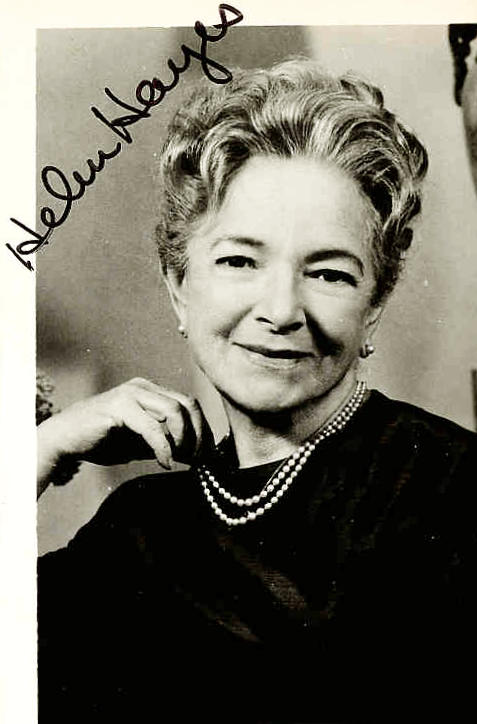
Quote: Helen Hayes


"If you rest, you rust."

- Helen Hayes

Helen Hayes Brown (1900 – 1993) was an American actress whose career spanned almost 70 years. Dubbed the "First Lady of the American Theatre", she was one of twelve people who have won an Emmy, a Grammy, an Oscar and a Tony award. The Oscar was received for Best Supporting Acress for playing an elderly stowaway in the 1970 pic Airport. Hayes has also received the Presidential Medal of Freedom, America's highest civilian honor, from President Ronald Regan in 1986.

From President Regan’s presentation speech: 
I can't resist pointing out that Helen was married to a happy rebel named Charlie MacArthur, a wonderful playwright and a man of natural style. When she first set eyes on Charlie, it was at a party. And he was eating from a bag of peanuts. He looked at her and asked if she'd like some peanuts. And as he poured them into her hand he said, "I wish they were emeralds." And years later, as a famous and celebrated playwright, he bought Helen what she'd asked for as an anniversary gift—a handful of jewels. And as he poured the emeralds into her hand, you know what he said? "I wish they were peanuts."

Tuesday, March 29, 2011

Vintage Ads: Winton Motor Carriages


(Click on pics to enlarge)

When was the first car ad, above,  placed? If you said 30 July, 1898, take a point.

Now, for a bonus point, where was the ad placed?

Sorry, time’s up and no, it wasn’t in the the New York Times or Washington Post. It was placed in Scientific American.

The ad was placed by the Winton Motor Carriage Company.  Alexander Winton was a Scottish-immigrant bicycle maker who switched to building cars in 1896. By 1900 he had the world’s largest auto factory. Winton stopped producing cars in 1924 and started making stationary engines. The firm was bought by General Motors in 1930.

The 1898 ad shown above is the first known automobile advertisement and encouraged readers to dispense with the expense, care and anxiety of keeping a horse. In another first, Winton made the first American car sale, to Robert Allison of Pennsylvania, a sale initiated by the Scientific American ad. Winton sold another 21 vehicles in 1898, including one to James Packard who went on to later form his own car company.

By 1902, Winton advertising no longer emphasised the benefits of a car over a horse. Perhaps to show ease of operation, the ads showed that even a woman could operate an automobile:


Quote: Neil Postman


"The Benedictine monks who invented the mechanical clock in the 12th and 13th centuries believed that such a clock would provide a precise regularity to the seven periods of devotion… here is a great paradox: the clock was invented by men who wanted to devote themselves more rigorously to God; and it ended as the technology of greatest use to men who wished to devote themselves to the accumulation of money. Technology always has unforeseen consequences, and it is not always clear, at the beginning, who or what will win, and who or what will lose. …Gutenberg thought his invention would advance the cause of the Holy Roman See, whereas in fact, it turned out to bring a revolution which destroyed the monopoly of the Church."

- Neil Postman
Amusing Ourselves to Death (1985)

Neil Postman (1931 - 2003) was an American author, media theorist and cultural critic, who is best known by the general public for his 1985 book about television, Amusing Ourselves to Death. For more than forty years, he was associated with New York University. Postman was a humanist who believed that "new technology can never substitute for human values."

Humour: The Bacon Tree


Two Mexicans are stuck in the desert, wandering aimlessly and close to death. They are close to just lying down and waiting for the inevitable, when all of a sudden...

“Hey Pepe, do you smell what I smell? Ees bacon, I is sure of eet.”

“Si, Luis, eet smells like bacon to meee.”

So with renewed strength, they struggle off up the next sand dune, and there, in the distance, is a tree, just loaded with bacon. There’s raw bacon, dripping with moisture… fried bacon, back bacon, double smoked bacon - every imaginable kind of cured pig meat you can imagine!

“Pepe, Pepe - we ees saved - eees a bacon tree!”

“Luis, are sure ees not a meerage? We ees in the desert, don’ forget.”

“Pepe, when deed you ever hear of a meerage that smell of bacon? Ees no meerage - ees a bacon tree.”

And with that, Luis races towards the tree. He gets to within 5 metres - Pepe following closely behind - when all of a sudden, a machine gun opens up, and Luis is cut down in his tracks. It is clear he is mortally wounded but, true friend that he is, he manages to warn Pepe with his dying breath.

“Pepe, go back man - you was right, ees not a bacon tree.”

“Luis, Luis, mi amigo… what ees eet?”

“Pepe, ees not a bacon tree… ees...

ees...

ees...

(wait for it)

... a Ham Bush.”


Sunday, March 27, 2011

Quote: Buddha


The secret of health for both mind and body is not to mourn for the past, worry about the future, or anticipate troubles, but to live in the present moment wisely and earnestly.

- Buddha

Siddhārtha Gautama was a spiritual teacher who founded Buddhism. In most Buddhist traditions, he is regarded as the Supreme Buddha, "Buddha" meaning "awakened one" or "the enlightened one." The time of his birth and death are uncertain, opinion as to the date of his birth being around 563 BC. By tradition, Gautama is said to have been born in a small state of what is now Nepal and later to have taught primarily throughout regions of eastern India. Gautama is the primary figure in Buddhism, and accounts of his life, discourses, and monastic rules are believed by Buddhists to have been summarised after his death and memorized by his followers. Various collections of teachings attributed to him were passed down by oral tradition, and first committed to writing about 400 years later. He is also regarded as a god or prophet in other world religions or denominations, including Hinduism, Islam and the Bahai faith.

Graphics gone wrong...

"OMG! The exclamatory online abbreviation has won the approval of the Oxford English Dictionary.
The term - short for ''Oh my God'' or ''Oh my gosh'' - is one of dozens of new entries in the authoritative reference book's latest online update."

-  News Report, Sydney Morning Herald, 26 March 2011

OMG is also the exclamation offered by graphic designers when it is pointed out to them that logos designed by them for use by their clients have an unintended risque aspect.  The exclamation is not so much "Oh my God" as "OH MY GOD!!!!"  It is an exclamation also repeated by the client who has used the logo.

A mild example is the following:


What do you see?  An abstract male figure on the left and a female fisgure in a long skirt on the right?  Or a pair of female breasts and a torso?
 
There are more examples of inappropriate logos and trade names at the sites listed below.  Click on those links to access the sites but be warned that many of the logos are unintendedly risque.
 
http://listsgalore.blogspot.com/2008/06/18-logos-gone-wrong.html
 
http://www.artistmike.com/Bad-Logos/BadLogos.html

Saturday, March 26, 2011

Benny Hill, elections and Lego blocks...


Does anyone remember the Benny Hill Show? Benny’s show came to its demise when the tastes of his audiences, or at least of the suits at the BBC, became more sophisticated and PC.

Benny Hill came to mind when I was thinking about today’s NSW State election. More particularly, as I was wondering about the origin of the word “election” I recalled the non PC skit where Benny Hill portrays Mr Chow Mein, an Asian gentleman with dark, combed back hair, black rimmed glasses and a speech impediment that results in “l’s” being pronounced as “r’s” and "r's" as "l's".  It's stereotyping at its worst but the clips still had me chuckling.


The relevant conversation between Chow Mein and Henry McGee is as follows:
Henry McGee: This is not your first visit to Britain?
Chow Mein: I come to Britain 11 years ago.
Henry McGee: What were you looking for?
Chow Mein: Knowredge.
Henry McGee: You were looking for knowledge. Did you find it?
Chow Mein: Yes.
Henry Mcgee: Where?
Chow Mein: In Norfolk.
Henry McGee: Why were you looking for knowledge in Norfolk?
Chow Mein: Because that is where it is
Henry McGee: Oh, the city of Norwich.
…
Henry McGee: Is life in China more bearable than, well, take you and me. Are you, as a Chinaman, happier or healthier than me?
Chow Mein. Let me ask you a question. When was the last time that you had an erection?
Henry McGee: (long pause).. had…?
Chow Mein:  )more carefully and slower) When was the last time you had an election?
Henry McGee: Oh, you mean a parliamentary election?
Chow Mein: Of course. Wait a minute… you didn’t think I meant…a council election?
See some of the Chow Mein skits at:

Thursday, March 24, 2011

Another quote about politics


If a politician murders his mother, the first response of the press or of his opponents will likely be not that it was a terrible thing to do, but rather that in a statement made six years before he had gone on record as being opposed to matricide.

- Meg Greenfield

Mary Ellen (Meg) Greenfield (1930 – 1999) was a Washington Post and Newsweek editorial writer and a Washington, D.C. insider known for her wit and for being reclusive.  She managed to overcome male domination of the journalism industry to be awarded journalism’s highest honour, a Pulitzer Prize for Editorial Writing, in 1978.  Greenfield spent 20 years as the editorial page editor for the Washington Post and 25 years as a columnist for Newsweek.  She died in 1999 of cancer, aged 68.


Elizabeth Taylor

 
“I've been through it all, baby, I'm mother courage.”

During one of her 8 weddings Elizabeth Taylor was asked by a presiding official to enumerate her previous husbands. "What is this," Taylor replied, "a memory test?"

“I've only slept with men I've been married to. How many women can make that claim?”