Saturday, June 25, 2011

Movie Moments: #66


Marathon Man (1976)

Comment:
I have a dentist appointment next week, having broken a tooth on a Tic Tac.  Yes, I know that you are supposed to suck them, not crunch them, but I tend to get impatient with food that lasts a long time.  Tic Tacs, like Minties that rip out fillings, probably generate a lot of dentists’ fees.  I mention this because I have sometimes said to dentists, as they are about to start with their probe, “Yes, it’s safe”, or in a German accent “Is it safe?”  None have ever known what I was talking about.  It comes from this movie (see the clip below).  Sir Laurence Olivier portrays an ex-Nazi, a former dentist, who tortures Dustin Hoffman to find out whether it is safe for him to collect illicit diamonds.  What a superb idea for a torturer, a dentist working on teeth.  Even thinking of it makes me shudder.

Synopsis:
SS dentist Christian Szell, "the White Angel" of Auschwitz, seeks to smuggle priceless diamonds from the United States.  Other people want the diamonds as well.

Quote:
Janeway: In 1945, Szell let it be known around Auschwitz he could provide escape for anybody who could pay the price. He started out with gold naturally, but very quickly worked his way up to diamonds.
Babe: Why did you say "naturally" when you said he started with gold?
Janeway: Szell knocked it out of the Jews' teeth before he burned them. Szell was a dentist.

Link:
The torture scene (not graphic):

Trivia:
Producer Robert Evans was set upon getting Laurence Olivier to play the part of Szell. However, because Olivier at the time was riddled with cancer, he was uninsurable so Paramount refused to use him. In desperation, Evans called his friends Merle Oberon and David Niven to arrange a meeting with the House of Lords (the upper body of the UK's parliament). There, he urged them to put pressure on Lloyds of London to insure Britain's greatest living actor. The ploy succeeded and a frail Olivier started working on the film. In the end, not only did he net an Oscar nomination for Best Supporting Actor, but his cancer also went into remission. Olivier lived on for another 13 years.


Friday, June 24, 2011

Funny Friday


An email by Byter Arthur:

A young Chinese couple get married.

She's a virgin & they are both waiters.

Truth be told, he is a virgin too, but she doesn't know that.

On their wedding night, she cowers naked under the sheets, as her husband undresses in the darkness.

He climbs into bed next to her and tries to be reassuring.

"My darring," he whispers, "I know dis you firss time and you berry flighten. I pomise you, I give you anyting you want, I do anyting juss anyting you want. You juss ask.”

“Whatchu want?" he says, trying to sound experienced and worldly, which he hopes will impress her.

A thoughtful silence follows, and he waits patiently and eagerly for her request.

Se eventually shyly whispers back, "I want to try someting I have heard about from other girls ... Nummaa 69".

More thoughtful silence, but this time from him Eventually, in a puzzled tone he asks her...

"You want ... Garric chicken with corrifrowa?"


Movie Moments: #65


M*A*S*H  (1970)

Comment:
Not many of today’s youngsters watching MASH on TV reruns will be aware that it was originally a movie, or that the them has lyrics.  The film is set in Korea but was intended as an anti-war film about Vietnam.  Director Robert Altman removed any references to Korea, wanting audiences to mistake the setting as Vietnam, but nervous studio suits made him not only restore them but also add an opening title that identifies the place as Korea.  Still a great film with many classic moments, too numerous to mention.

Synopsis:
Doctors and nurses at a front line Mobile Army Surgical Hospital try to sane amidst the brutality and horror of war.

Quote:
Painless: [lining up during football game] All right, Bub, your fuckin' head is coming right off.
[the first use of the word "fuck" in a major motion picture and in a studio movie]

Link:
The Last Supper scene:

Trivia:
Mobile Army Surgical Hospitals remained in US Army service until 2006 when the last one was donated to Pakistan.

When studio execs first saw the dailies, they complained to Robert Altman that the soldiers looked dirty compared to the soldiers in Tora! Tora! Tora! (1970) and Patton (1970), the much bigger budget war movies being made by 20th Century Fox. Altman, a veteran of WWII, replied that soldiers in war are dirty. The next day the execs told the producers of those two films to make their soldiers look dirtier.

The 14-year-old son of Robert Altman, Mike Altman, wrote the lyrics to the theme song "Suicide is Painless". Because of its inclusion in the subsequent TV series, he continued to get residuals throughout its run and syndication. His father was paid $75,000 for directing but his son eventually made about $2,000,000 in song royalties.

Thursday, June 23, 2011

Quote: Mahatma Gandhi


"Men often become what they believe themselves to be. If I believe I cannot do something, it makes me incapable of doing it. But when I believe I can, then I acquire the ability to do it even if I didn't have it in the beginning."


Mahatma Gandhi (1869-1948)


Wednesday, June 22, 2011

The Art Gallery of New South Wales - Early Images


(Click on images to enlarge)

Mowing the lawn at the Art Gallery


The Art Gallery of New South Wales is a distinctive landmark in Sydney.

The date of the above photograph is unknown to me but I can advise the following:

The facade and old wing of the Art Gallery were built between 1896 and 1909.

The statue shown in the above photograph is by Gilbert Bayes and is called The Offerings of Peace.  It was made in 1923 and purchased  by the Art Gallery in 1924.

Mervyn Victor did not invent his motorised Victa lawn mower until 1952.


Under construction


Movie Moments: #64


Captains Courageous (1937)

Comment:
Taken from Robert Louis Stevenson’s 1897 book, this 1937 pic won Spencer Tracy a Best Actor Oscar for his portrayal of the Portuguese fisherman Manuel.  Filmed long before CGI and blue screens, the special effects remain amazing and the action sequences memorable and exciting.  Well worth getting.

Synopsis:
Coming of age flick: spoiled rich kid Harvey Cheyne falls overboard from a liner in the Grand Banks area off Newfoundland.  Picked up by a fishing boat, he soon learns that being spoiled and arrogant has no place on a working fishing schooner captained by Captain Disko.

Quotes:
Harvey:  I bet I know a lot of things you don't know. I know that's not French you're singing.
Manuel Fidello:  That's right. About ten million people know it's Portuguese.
Harvey: I bet you can't speak French.
Manuel Fidello: Right now, I sorry I speak English.

Link:

Trivia:
Because John Travolta has his own jumbo and a pilot’s licence to fly it (he is a goodwill ambassador for Qantas), and because of his starring in Saturday Night Fever, Grease etc, he is often called Captain Disco.


Monday, June 20, 2011

I've Learned


I’ve Learned

-  Omer B Washington

I've learned that you cannot make someone love you.
All you can do is be someone who can be loved.
The rest is up to them.
I’ve learned that no matter how much I care,
some people just don’t care back.
And it’s not the end of the world.
I’ve learned that it takes years to build up trust,
and only seconds to destroy it.
I’ve learned that it’s not what you have in your life,
but who you have in your life that counts.
I’ve learned that you can get by on charm for about fifteen minutes.
After that, you’d better know something.


I’ve learned that you shouldn’t compare yourself to the best others can do,
but to the best you can do.
I’ve learned that it’s not what happens to people,
It’s what they do about it.
I’ve learned that no matter how thin you slice it,
there are always two sides.
I’ve learned that you should always leave loved ones with loving words.
It may be the last time you see them.
I’ve learned that you can keep going
long after you think you can’t.


I’ve learned that heroes are the people who do what has to be done
When it needs to be done
regardless of the consequences.
I’ve learned that there are people who love you dearly,
but just don’t know how to show it.
I’ve learned that sometimes when I’m angry I have the right to be angry,
but that doesn’t give me the right to be cruel.
I’ve learned that true friendship continues to grow even over the longest distance.
Same goes for true love.
I’ve learned that just because someone doesn’t love you the way you want them to
doesn’t mean they don’t love you with all they have.


I’ve learned that no matter how good a friend is,
they’re going to hurt you every once in a while
and you must forgive them for that.
I’ve learned that it isn’t always enough to be forgiven by others.
Sometimes you have to learn to forgive yourself.
I’ve learned that no matter how bad your heart is broken,
the world doesn’t stop for your grief.
I’ve learned that our background and circumstances may have influenced who we are,
but we are responsible for who we become.
I’ve learned that just because two people argue, it doesn’t mean that they don’t love each other.
And just because they don’t argue, it doesn’t mean they do.


I’ve learned that sometimes you have to put the individual
ahead of their actions.
I’ve learned that two people can look at the exact same thing
and see something totally different.
I’ve learned that no matter the consequences,
those who are honest with themselves get farther in life.
I’ve learned that your life can be changed in a matter of hours
by people who don’t even know you.
I’ve learned that even when you think you have no more to give,
when a friend cries out to you,
you will find the strength to help.


I’ve learned that writing, as well as talking,
can ease emotional pains.
I’ve learned that the people you care most about in life
are taken from you too soon.
I’ve learned that it’s hard to determine where to draw the line between being nice
and not hurting people’s feelings and standing up for what you believe.
I’ve learned to love and be loved.
I’ve learned…


Movie Moments: #63


My House in Umbria (2003).

Comment:
Anyone who has been watching the superbly filmed Downton Abbey at one million pounds per episode will have seen Dame Maggie Smith’s portrayal of the Dowager Countess of Grantham, Violet Crawley.  She has played roles as diverse as Minerva McGonogall in Harry Potter, Reverend Mother in Sister Act, Miss Jean Brodie in The Prime of and Desdemona in Othello.  In the pic mentioned not long ago, Murder By Death, she was young and a stunner.  My House in Umbria is one of my wife’s faves and is an enjoyable Maggie Smith vehicle, even if it is a made for TV flick.  The part could have been written for her, it is the type of role she plays so well.  She also received an Emmy for Best TV miniseries/movie for her portrayal.

Synopsis.
Emily Delahunty, an eccentric British author living in Umbria, Italy, takes an assortment of 3 people into her house after they survive a terrorist attack on a train in which they are all passengers. 

Quote:
Emily Delahunty: “Sometimes I feel as if we are all in a story that’s being made up as each day passes.”

Links:
The trailer for the film:
Dame Maggie Smith commenting on the film:


Sunday, June 19, 2011

RIP: Rex Mossop


Rex Mossop (1928-2011)

Manly rugby league legend and former commentator Rex Mossop died today, aged 83.   Mossop, who played rugby league and rugby union for Australia, suffered from Alzheimer's disease.  He was admitted to Royal North Shore Hospital this year and his condition is understood to have deteriorated in the past week.

Mossop played rugby union for the Manly club and played Tests for the Wallabies between 1948 and 1951.He switched codes in 1951, joining English club Leigh before returning to Australia.  Mossop  played for Manly-Warringah from 1956 as the cornerstone of their forward pack before retiring in 1963 at the age of 35.  He was rugby league's premier television commentator on Channels Seven and Ten from the 1970s until 1990.

-           News Report, Sydney Morning Herald
 
 
 Rex “Moose” Mossop, aka The Moose That Roared, Rex Messup and Tyrannosaurus Rex (ie a dinosaur), played football hard and uncompromising.  He lived life the same way.  Decried by feminists, vilified by gays and opposed by civil libertarians, Mossop had no time for political correctness and typified the Frank Sinatra song “I Did It My Way.”  He was also known for his mangling of the English language, regularly winning sports commentator tautology awards.
 
 
 Some memorable moments:

The famous appearance on Steve Vizard’s Tonight Live, when he was seated next to Julian Clary:
The blue screen falls on Rex:

Movie Moments: #62


Chicago  (2002)

Comment:
The first musical to win the Best Pic Oscar since Oliver! in 1969, this superb film is based on the 1975 Broadway musical, which in turn is based on 1 1926 play, all sharing the same name.  The play, in turn, was based on the on the stories of two real-life Jazz-era killers, Beulah Annan and Belva Gaertner.  It is today’s Movie Moment because like yesterday’s Pulp Fiction item about the Louise Brooks bob hairstyle, there is an even closer copy by Catherine Zeta Jones in Chicago.

Synopsis:
Two 1920’s women, singer/dancer Velma Kelly and would-be singer/dancer Roxy hart await trial for murder.  Represented by lawyer Billy, who thinks that not only courtrooms but also life in general is a circus, the movie looks at issues of celebrity, scandal, corruption and the legal system.

Quote:
Velma Kelly: [Rising from the stage alone] 'C'mon Babe, why don't we paint the town... And all that Jazz. I'm gonna rouge my knees and roll my stockings down... And all Jazz. Start the car I know a whoopie spot... where the gin is cold and the piano's hot. It's just a noisy hall, where there's a nightly brawl... And all that Jazz.
(Part of the lyrics of the musical number “All That Jazz”).

Saturday, June 18, 2011

History: George Johnston


George Johnston (1764 – 1823)

Born at Annandale in Scotland, Johnston became an officer in the marines and served in America and the East Indies before travelling to New South Wales as a lieutenant with the First Fleet in 1778.  After serving as adjutant to Governor Phillip, he became a captain in the NSW Corps in 1792.

Johnston received extensive land grants in the areas of modern Petersham, Bankstown and Cabramatta, Both the Georges River and the suburb of Georges Hall are named after him, the latter from the farmhouse of the same name built on land grants received by him.  The building still exists.

Johnston also received grants of land which now comprise the suburb of Annandale, named after his property of that name which, in turn, was named after the place of his birth.  He and former convict Ester Abrahams (transported at age 15 for stealing fabric) farmed and lived on this land with their children until the 1870s when it was sold and sub-divided for residential development. The main street of Annandale, Johnston Street, is named for him and the gates of their property now stand in the grounds of Annandale Public School.

Movie Moments: #61


Pulp Fiction (1994)

Comment:
Quentin Tarentino’s Pulp Fiction was nominated for 7 Oscars, including best film, but lost that award to Forrest Gump.  It kick started John Travolta’s career back into life and is today a deserved film classic.

Synopsis:
Four stories - the lives of two mob hit men, a boxer, a gangster's wife, and a pair of diner bandits – intertwine.  In typical Quentin Tarantino fashion, there is mega violence, dark humour and homage to other films.

Quote:
Jules: There's a passage I got memorized. Ezekiel 25:17. "The path of the righteous man is beset on all sides by the inequities of the selfish and the tyranny of evil men. Blessed is he who, in the name of charity and good will, shepherds the weak through the valley of the darkness, for he is truly his brother's keeper and the finder of lost children. And I will strike down upon thee with great vengeance and furious anger those who attempt to poison and destroy My brothers. And you will know I am the Lord when I lay My vengeance upon you."

Friday, June 17, 2011

Funny Friday


A man attends at his doctor’s surgery after test results come back.  The doctor says “I have some good news and some bad news.”  “What is the bad news, doctor?” asks the man.  The doctor says “The tests show that you have terminal cancer and only a short time to live.”  “Oh my God,” says the man, “What is the good news?”  “Well, says the doctor, “did you see the cute little receptionist when you came in?  I’m taking her out tonight.”

A man takes his young son to the London Zoo.  The young lad is especially keen to see the monkeys but when they arrive at the monkey enclosure, there is not a single monkey to be seen.  He says to the nearby keeper in a broad Northern accent, “ ‘Ere, where’s all the moonkeys then?”  The keeper replies “They’re all in the ‘uts.  It’s the matin’ season.”  The man says “Do you think they’d coom out if I threw a peanut?”   Replies the keeper “Would you?”


Thursday, June 16, 2011

Movie Moments: #60


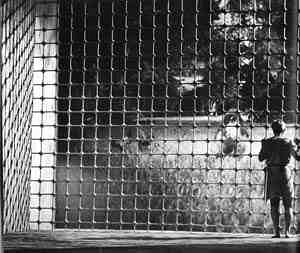
The Incredible Shrinking Man (1957

Comment:
You may need to get this from Amazon but, beyond the crap title and the crap science, this is a good film.  If it feels like an episode from The Twilight Zone, that may be because the story was written by Richard Matheson, who wrote 14 of the TZ episodes, including Nightmare at 20,000 Feet.  He is also the author of I Am Legend, What Dreams May Come and Duel.  Remember also that the movie predates computer-generated imagery.

Synopsis:
The 1950’s saw numerous sci-fi films where genetic mutations, size changes, abnormal characteristics etc were blamed on radioactivity and the effects of nuclear exposure.  This film is no exception.  Robert Carey is exposed to a radioactive cloud at sea and begins shrinking, as you have probably guessed from the title.  As he shrinks further and further, he has to do battle with a cat and then a spider, eventually becoming so small that he can escape what has become a prison by walking through a window mesh.  The implication being that he will shrink to atomic size, there is a final monologue win which he declares that he still matters. 

Speech:
[closing soliloquy narration, added by the film’s director Jack Arnold]
Scott Carey: I was continuing to shrink, to become... what? The infinitesimal? What was I? Still a human being? Or was I the man of the future? If there were other bursts of radiation, other clouds drifting across seas and continents, would other beings follow me into this vast new world? So close - the infinitesimal and the infinite. But suddenly, I knew they were really the two ends of the same concept. The unbelievably small and the unbelievably vast eventually meet - like the closing of a gigantic circle. I looked up, as if somehow I would grasp the heavens. The universe, worlds beyond number, God's silver tapestry spread across the night. And in that moment, I knew the answer to the riddle of the infinite. I had thought in terms of man's own limited dimension. I had presumed upon nature. That existence begins and ends in man's conception, not nature's. And I felt my body dwindling, melting, becoming nothing. My fears melted away. And in their place came acceptance. All this vast majesty of creation, it had to mean something. And then I meant something, too. Yes, smaller than the smallest, I meant something, too. To God, there is no zero. I still exist!

Link:

Trivia:
Those who like their sci-fi straight will be disappointed to know that there is a remake in the works for 2012 to star Eddie Murphy, so expect screwball comedy and fart jokes.


Origins: Gobbledygook


The Free Online Dictionary defines gobbledegook as pretentious or unintelligible jargon, such as that used by officials.

According to the UK based Plain English Campaign, which has since 1979 been advocating the use of understandable plain language:

"What's wrong with gobbledygook? We can't put it any better than a nurse who wrote about a baffling memo. She said that 'receiving information in this form makes us feel hoodwinked, inferior, definitely frustrated and angry, and it causes a divide between us and the writer.'"

The word was coined by Maury Maverick, a member of the US House of Representatives in 1944.  Working for the Smaller War Plants Corporation, he was fed up with the “convoluted language of bureaucrats” and with "that terrible, involved, polysyllabic language those government people use in Washington."

He issued a memo banning the use of incomprehensible language, stating “(Those turkeys in Texas were) ... always gobbledygobbling and strutting with ludicrous pomposity. At the end of this gobble there was a sort of gook.”

Although speakers such as George W Bush and Dan Quayle have frequently been quoted for unintelligible comments, their utterances are frequently more foot in mouth than gobbldegook:

"I know what I believe. I will continue to articulate what I believe and what I believe – I believe what I believe is right." – George W Bush

"Reports that say that something hasn't happened are always interesting to me, because as we know, there are known knowns; there are things we know we know. We also know there are known unknowns; that is to say we know there are some things we do not know. But there are also unknown unknowns — the ones we don't know we don't know."  - Donald Rumsfeld

True gobbledegook requires a public servant to do it right:

A NEW TAX SYSTEM (GOODS AND SERVICES TAX) ACT 1999 - SECT 165.55


Commissioner may disregard scheme in making declarations

 For the purposes of making a declaration under this Subdivision, the Commissioner may:
(a)  treat a particular event that actually happened as not having happened; and 
(b)  treat a particular event that did not actually happen as having happened and, if appropriate, treat the event as:       
 (i)  having happened at a particular time; and        
(ii)  having involved particular action by a particular entity; and  
(c)  treat a particular event that actually happened as: 
              (i)  having happened at a time different from the time it actually happened; or        
(ii)  having involved particular action by a particular entity (whether or not the event actually involved any action by that entity).


Movie Moments: #59


In and Out (1997)


Comment:
Another movie that stands repeated viewings over time, usually a sign that it is more than just a time-filler.  A large well known cast; a well written, funny script and numerous memorable moments make this a film to put on the list to rent from your local video store.  (Am I the only one who still calls them video stores, when they o longer have videos, only Blu-ray and DVD’s?).

Synopsis:
Howard Brackett, the English teacher in a small Indiana high school, is looking forward to his coming wedding to fellow teacher Emily.  When one of his former students wins an Oscar for portraying a gay soldier and thanks Howard for being  his inspirational gay motivator, the media descend.

Quote:
[at the Academy Awards]
Glenn Close (as herself): This is Cameron's first nomination and he's in extremely good company. Tonight he joins fellow best actor nominee Paul Newman for "Coot", Clint Eastwood for "Codger", Michael Douglas for "Primary Urges"
[blows him a kiss]
Glenn Close: and Steven Seagal for "Snowball in Hell".

Trivia:
The film was inspired by Tom Hanks’ outing f tow persons in his tearful speech when he accepted his 1994 Oscar for his role in Philadelphia.  In his speech Hanks mentioned his high-school drama coach Rawley Farnsworth, and his former classmate John Gilkerson, "two of the finest gay Americans, two wonderful men that I had the good fortune to be associated with".


Wednesday, June 15, 2011

Quote: Napoleon Hill


The strongest oak of the forest is not the one that is protected from the storm and hidden from the sun. It's the one that stands in the open where it is compelled to struggle for its existence against the winds and rains and the scorching sun.
 -       Napoleon Hill
  
Napoleon Hill (1883 – 1970) was an American author and one of the first of the self-help, motivational writers.  Hill’s most famous work, “Think and Grow Rich”, looks at the role that personal belief plays in personal success.  Hill studied and interviewed many of the world’s most successful and powerful men to develop what he called his Philosophy of Achievement   Modern philosophy-of-success teachers still use Hill’s principles.


Movie Moments: #58


Analyze This (1999)

Comment:
Robert De Niro is, imho, an actor who has not had sufficient recognition.  His performances in drama and comedy are some of the best in moviedom.  In Analyse This he wants again plays a mafia boss, but this time for laughs. A good film, but the follow up sucked.  Eatch the first one.

Synopsis:
Billy Crystal [lays Dr Sobel, a shrink whose life is turned upside down by  mafia boss Paul Vitti (Robert De Niro), who is having psychological issues.  Not only is he unable to get it on with his mistress, he can’t even kill people any more, instead breaking out in tears.  Needless to say, this is a no no in mafialand.

Quote:
[Ben rushes up to Paul's room after Jelly throws a hit man off the balcony onto the wedding party]
Boss Paul Vitti: Hey, people get depressed, they jump. But that ain't my fault.
Dr Ben Sobel: Oh, so you're telling me it was suicide?
Boss Paul Vitti: I don't know, he probably left a note. Jelly, did they find that note?
Jelly: [taking out a pen] Uh no, but they will in a minute.
Dr Ben Sobel: Oh, and let me guess what it says? "Life is bullshit, I can't fucking take it no more! Signed, the Dead Guy."
Jelly: Hey, that's good, Doc.

Trivia:
The prison scenes at the end were actually filmed at the Sing Sing prison. The prisoners seen walking down the corridor at the beginning of the scene are real prisoners who belonged to the prison's drama club. The shooting at Sing Sing took only one day.